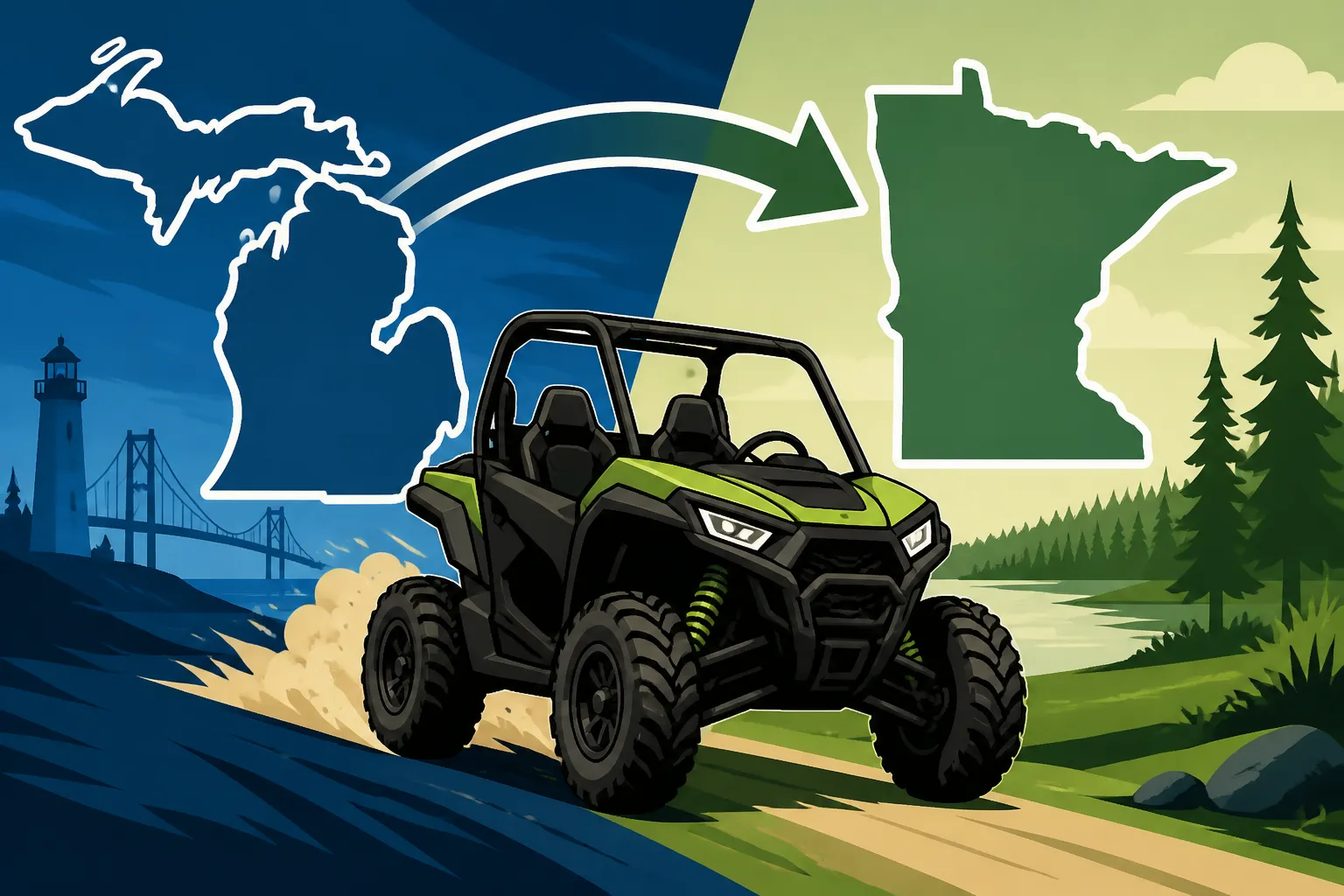
Taking a Michigan ATV to Minnesota
Taking a Michigan ATV to Minnesota means planning for more than the ride: a Michigan license does not cover Minnesota trails. The key step is getting a Minnesota non-resident ATV trail pass when required, then keeping it available for inspection. Here’s how to prepare your machine and paperwork, and what to confirm before you cross the state line.
Check the Minnesota pass requirement before leaving
If you’re bringing an ATV registered in Michigan to ride on Minnesota state or grant-in-aid trails, you must purchase and possess a Minnesota non-resident ATV trail pass, according to the Minnesota Department of Natural Resources. The pass requirement applies provided the vehicle has not been in Minnesota for more than 30 consecutive days. If your machine will be in Minnesota longer, check with the Minnesota Department of Natural Resources about the rules that apply to your situation rather than assuming the non-resident pass covers an extended stay.
The pass is valid for the calendar year, from January 1 through December 31, according to the Minnesota Department of Natural Resources. That means the relevant dates are tied to the calendar year, not to when you buy the pass. If you’re planning a late-year trip that continues into the next calendar year, confirm what you need for each part of the trip with the Minnesota Department of Natural Resources.
You do not have to physically display the pass on your ATV. However, the Minnesota Department of Natural Resources requires you to keep it in your immediate possession and make it available for inspection by officers. Keep it somewhere you can reach quickly while riding, not buried in a bag on a trailer or left at your lodging. If the pass is electronic, confirm how it must be shown and make sure you can access it during the ride.
| What to check | What it means for your trip |
|---|---|
| Where you plan to ride | The Minnesota non-resident ATV trail pass is required for riding on Minnesota state or grant-in-aid trails, according to the Minnesota Department of Natural Resources. |
| How long the ATV will be in Minnesota | The pass applies to a Michigan-registered ATV that has not been in Minnesota for more than 30 consecutive days, according to the Minnesota Department of Natural Resources. |
| Pass dates | It is valid from January 1 through December 31, according to the Minnesota Department of Natural Resources. |
| Where to keep the pass | It does not need to be displayed on the ATV, but it must be in your immediate possession and available for inspection, according to the Minnesota Department of Natural Resources. |
| Your Michigan paperwork | A Michigan ORV license or trail permit does not replace Minnesota’s non-resident pass for the covered Minnesota trails. |
Think of the Michigan and Minnesota requirements as separate systems. Michigan’s annual ORV license and trail permit authorize use under Michigan rules; they do not serve as a Minnesota trail pass. For a closer look at the Michigan side, see Non-Resident ORV Permits in Michigan and Michigan ORV Reciprocity With Neighboring States. Those topics help with understanding Michigan requirements for riders from elsewhere, but they do not change Minnesota’s rules for a Michigan ATV.
Before traveling, identify the trails or trail system you intend to use and confirm that your pass covers your planned riding. A map or ride plan can help you avoid setting out with an unclear idea of which roads, trails, or facilities you will use. For Michigan maps and trail markers, Michigan ORV Trail Maps and What the Signs Mean can help with route planning at home; for your Minnesota route, confirm current trail access and conditions with the Minnesota Department of Natural Resources.
Prepare your Michigan paperwork and machine
Before you leave, gather the documents connected with the ATV and the trip. Keep the Michigan registration or ownership paperwork available, along with the Minnesota pass and any rider documents that may apply. The Minnesota pass rule does not mean you can set aside your Michigan documents: having clear records can help you answer questions about the machine and show what you purchased.
Keep required paperwork somewhere protected but easy to reach. A waterproof document sleeve or small organizer, including one sold through Amazon, can help keep paper documents together in wet or dusty conditions. If you rely on digital records, make sure you can access them without depending on a weak signal, and keep a backup where practical. The pass must be available for inspection, so plan for access rather than just storage.
For Michigan riders, an annual ORV license and trail permit have different purposes. The Michigan Department of Natural Resources says the combined Michigan license and trail permit expire on March 31 of the following year, regardless of when they were purchased. That Michigan expiration date is separate from Minnesota’s calendar-year pass dates. If your trip falls near either boundary, check both requirements before heading out. Michigan ORV Permit Year: April 1 to March 31 explains the Michigan permit cycle, while Do You Need Both a License and a Trail Permit in Michigan? covers how the Michigan permits work together.
Also inspect the ATV before loading it. Confirm that the machine is in sound operating condition, that the tires and controls are ready for the intended terrain, and that you have the equipment and clothing needed for your planned ride. These are practical trip checks, not a substitute for the operating and equipment rules in the state where you ride. Check Minnesota’s current requirements before departing, especially if the vehicle has been modified or the trip includes riders with different experience levels.
If a young rider is coming along, do not assume Michigan’s youth rules automatically answer what Minnesota allows. The Michigan Department of Natural Resources requires anyone under 16 operating an ORV on public lands to have an approved ORV safety certificate and be under direct visual supervision of an adult; children under 10 are prohibited from operating four-wheel ATVs on Michigan public lands. These are Michigan rules. Confirm Minnesota’s age, supervision, and safety-certificate requirements separately before the trip. For Michigan details, see Michigan ORV Safety Certificate for Riders Under 16 and Michigan ORV Age Rules at 10, 12 and 16.
Confirm local rules and ride within them
A trail pass addresses the pass requirement for the covered Minnesota trails; it should not be treated as a blanket approval for every place, road, or facility. Confirm where ATVs are allowed, what local restrictions apply, and whether there are closures before you ride. Weather and trail conditions can change, and a route that appears open on an older map may not be available when you arrive.
It is also worth checking the rules for the specific vehicle and riders in your group. Requirements can cover equipment, passengers, helmets, and operation by younger riders. Michigan rules do not automatically apply across the state line. If you are unsure about a Minnesota requirement, ask the Minnesota Department of Natural Resources or the relevant local authority before using the route.
For comparison, Michigan has rules on several of these subjects. The Michigan Legislature requires a United States Forest Service-approved spark arrester and muffler in good working order for ORVs on public lands. It also requires operators and passengers generally to wear a Department of Transportation-approved crash helmet and protective eyewear, with exceptions under certain conditions. In Michigan, a passenger may be carried only when the vehicle’s design or manufacturing standards provide for passengers. These are Michigan requirements, not a checklist for Minnesota; confirm Minnesota’s current rules for your machine and route.
Michigan also requires headlights and taillights to be illuminated during specified nighttime hours, according to the Michigan Legislature. That rule is relevant if you ride in Michigan, but you should verify Minnesota’s lighting requirements for your planned use. Similarly, rules about road access, speed, noise, alcohol, and safety equipment can differ by state and location. Avoid relying on memory of the Michigan rules as proof that an ATV is legal on a particular Minnesota trail or road.
A practical approach is to check the rules in this order:
- Confirm that the Minnesota trail or area you want to use is open to your ATV.
- Check whether your route uses a Minnesota state or grant-in-aid trail covered by the non-resident pass requirement.
- Buy the pass if required, and keep it within immediate reach while riding.
- Confirm the rules for the vehicle, riders, and equipment with the Minnesota Department of Natural Resources or relevant local authority.
- Check for trail closures and changing conditions shortly before you ride.
This approach also helps avoid confusion between a machine’s registration, a trail pass, and permission to use a particular route. Those are different questions. A valid pass does not establish that every trail is open to your ATV, and a Michigan license does not replace the Minnesota pass.
Plan for the return trip to Michigan
Before heading home, make sure the ATV and its paperwork are in order for the next part of your trip. If you plan to ride again in Michigan, check that the Michigan license and, where needed, the trail permit are still valid. The Michigan Department of Natural Resources sets the expiration at March 31 of the following year regardless of purchase date, while the Minnesota Department of Natural Resources sets the non-resident pass year from January 1 through December 31. Keep those timelines separate in your trip planning.
If you rode on Minnesota trails, keep the pass available for the duration of the trip and do not discard the purchase information until you are finished riding. If an officer asks to inspect it, the Minnesota Department of Natural Resources says it must be in your immediate possession and available. That requirement is easier to meet if you decide in advance where it will be stored and make sure every rider knows where to find it.
For future trips, keep a simple record of the dates the ATV is in Minnesota and the trails you plan to ride. That can be especially useful if you make repeated visits or expect the machine to remain in the state for an extended period. The Minnesota Department of Natural Resources’ stated non-resident pass condition refers to the ATV not having been in Minnesota for more than 30 consecutive days; if your schedule may exceed that period, ask the agency what applies before you ride.
The main takeaway is straightforward: for a Michigan-registered ATV used on Minnesota state or grant-in-aid trails, plan on a Minnesota non-resident ATV trail pass when the stated condition applies. Keep it with you, confirm local trail access and operating rules, and treat Michigan permits as separate paperwork for riding in Michigan. If you are unsure about a stay longer than 30 consecutive days, or about a particular trail or vehicle requirement, check with the Minnesota Department of Natural Resources before setting out.
Sources
- Michigan Department of Natural Resources — Purchase permit, learn requirements – State of Michigan (checked October 28, 2026)
Disclaimer
This article is for general informational purposes only and does not constitute professional advice. Laws, prices and regulations vary by location and change over time. Consult a qualified professional for guidance on your specific situation.