Michigan ORV Permit for Frozen Lakes
Planning to ride an ATV or UTV on a frozen Michigan lake raises a common paperwork question: do you need the regular ORV trail permit, or just the annual license? For riding on the frozen surface of public waters, Michigan requires an ORV license but not a trail permit. That distinction can save you from buying a permit you do not need for that ride, while still leaving important questions about access and ice safety.
What permit you need for a frozen lake
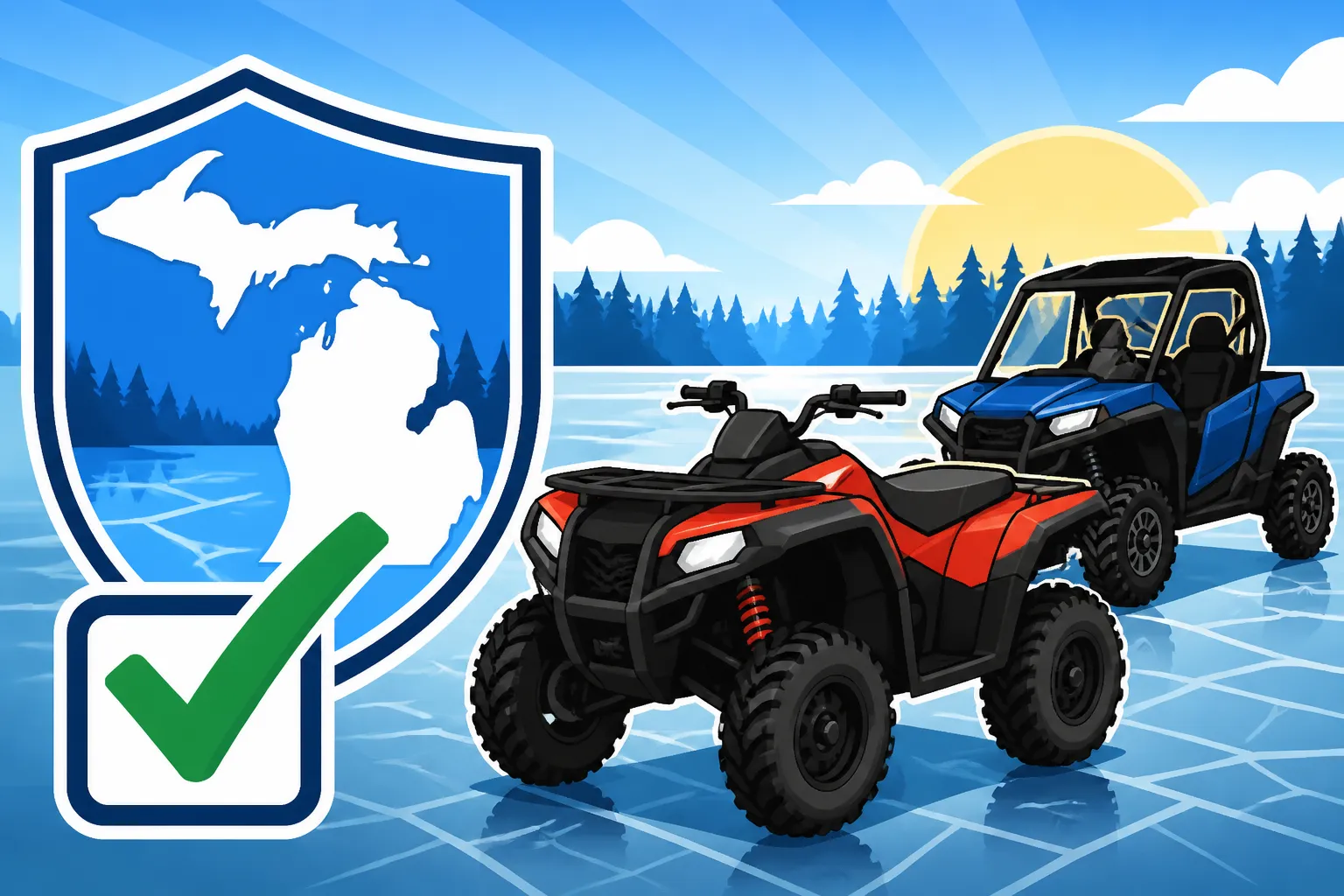
According to the Michigan Department of Natural Resources, ORVs may be operated on the frozen surface of public waters with an ORV license, but a trail permit is not required for that specific use. In other words, riding across a public lake’s frozen surface is treated differently from riding on a designated ORV trail.
That difference matters because the ORV license and trail permit cover separate requirements. The license is required for the frozen-water use described by the DNR. The additional trail permit applies when you ride on state-designated ORV trails. A trail permit is not a general substitute for a license, and not needing a trail permit on the lake does not mean you can ride there without the license.
If you are riding during the same outing on both a frozen public water surface and a state-designated trail, check what applies to each part of your route. The lake exception does not automatically carry over to the trail. For an overview of how the two credentials differ, see Michigan ORV License and Trail Permit Explained. If you plan to use designated trails as well, Do You Need Both a License and a Trail Permit in Michigan? can help clarify when the additional permit applies.
| Where you ride | ORV license | Trail permit |
|---|---|---|
| Frozen surface of public waters | Required | Not required for this specific use |
| State-designated ORV trail | Required | Required |
| A route that includes both | Required | Required for the designated-trail portion |
The Michigan DNR lists the annual ORV license at $26.25 and the additional trail permit at $10.00, for a combined total of $36.25; those figures are as of October 2026. For a frozen public-water ride alone, the applicable requirement is the license, not the combined license-and-trail-permit package. Check the DNR for current amounts before buying, since permit costs can change.
The practical takeaway is simple: do not purchase the trail permit solely because you intend to ride on a frozen public lake. But do not mistake that exception for a blanket permission to ride anywhere. The requirement described here applies to the frozen surface of public waters. It does not establish access to private property, authorize riding on a closed area, or replace any other rules that apply to your machine or route.
Check access and conditions before heading out
A permit answers a paperwork question; it does not guarantee that a particular lake or access point is open to riding. Before leaving, confirm that you are allowed to reach and use the area, and check for closures or restrictions that affect the route.
Confirm that the water and access are public
The DNR rule concerns the frozen surface of public waters. If you are unsure whether a lake, shoreline, launch, or route is public, do not assume that the frozen surface makes it available to everyone. Access across private land can require permission, and a public-water ride does not automatically permit you to cross private property to reach it.
Be especially careful where a route approaches a home, dock, resort, or other developed shoreline. A lake may be public while a particular access road or nearby property is not. Confirm the status of the access point and respect posted restrictions. For private-land questions, Michigan ORV Permit Exemption on Private Land explains why riding on private property is a separate issue from public-land requirements.
Look for closures and local restrictions
The Michigan DNR has authority to close state trails and facilities because of weather-related events and wet conditions. That fact is most directly relevant to managed trails and facilities, but it is also a reminder to check current notices rather than relying on an old map or a previous trip. A permit does not override a closure.
Local access arrangements can also differ. A lake entrance may be restricted, a parking area may be unavailable, or the route you planned may include a trail with its own permit requirements. If your trip includes routes beyond the lake, check each part separately. Michigan ORV Permits and Trail Closures is useful when a planned ride may cross a managed trail or facility.
Do not treat another rider’s tracks as proof that an area is open or legal. Tracks can lead across private property, a closed route, or unsafe ice. Verify the route with the relevant land manager or access authority before you ride.
Treat ice safety as a separate decision
The ORV license rule does not certify ice strength or make a frozen lake safe. Ice conditions can vary across a single waterbody and change with weather, currents, springs, inlets, outlets, snow cover, and other conditions. A surface that supported a previous ride may not be safe later.
Check current local information and use conservative judgment. Avoid riding when conditions are uncertain, and do not assume that a permit or a marked route is evidence of safe ice. If you cannot confirm that the surface and access are suitable, the safest decision is to stay off.
Make sure the machine and rider are ready
Having the correct license is only one part of preparing for a winter ride. The operator must also follow the rules for age, equipment, passengers, and safe operation. Some of those rules apply across public lands, not just to trails.
Check age and safety-certificate requirements
According to the Michigan Department of Natural Resources, anyone under 16 operating an ORV on public lands must have a valid ORV safety certificate and be under an adult’s direct visual supervision. The DNR also says children under 10 are prohibited from operating four-wheel ATVs on public lands. These requirements matter on a frozen public water surface because the licensing exception does not remove public-land safety rules.
For a young rider, confirm that the machine is appropriate and that the required supervision can be maintained in the conditions. Distance, low visibility, snow, and the layout of a lake can make it harder to keep a child in direct view. The safety certificate must be carried while operating on public lands, so make sure it is available rather than left at home. See Michigan ORV Safety Certificate for Riders Under 16 for more on the certificate requirement.
Use required protective equipment
Michigan law generally requires ORV operators and passengers to wear a Department of Transportation-approved crash helmet and protective eyewear. The Michigan Legislature identifies exceptions under certain conditions, including operation on private property with permission or riding in a UTV with an approved roof and properly fastened safety belts. Do not assume a standard roof or an unfastened belt qualifies for an exception.
Cold-weather layers should not interfere with a helmet, eye protection, or safe control of the machine. Before setting off, check that helmets fit securely and that eyewear stays in place. If you need replacement equipment, compare the specifications and fit carefully; an online listing, including one on Amazon, is not a substitute for checking that the item meets the applicable standard. For more detail, see Michigan Helmet Law for ATV Riders.
Passengers are allowed only when the vehicle’s manufacturing standards or design provide for carrying them, according to the Michigan Legislature. A rider should not add a passenger to an ATV that was designed for a single operator. For a UTV, follow the seating and restraint arrangements intended for that machine.
Check lighting, mechanical condition, and route
If the ride could continue into darkness, the Michigan Legislature requires an ORV’s headlight and taillight to be illuminated from a half-hour after sunset to a half-hour before sunrise. Check that both lights work before leaving, and plan the trip so you are not relying on a failed light to get back safely.
A properly working muffler and spark arrester also matter. The Michigan Legislature requires ORVs operated on public lands to have a United States Forest Service-approved spark arrester and a muffler in good working order and constant operation. A damaged exhaust system or missing spark arrester is not just a maintenance concern.
Cold weather can affect starting, battery performance, traction, and the ability to recover a stuck machine. Inspect the vehicle before departure, carry gear suited to the route, and avoid setting out with a mechanical problem that could leave you stranded. A frozen lake may look open and straightforward, but it can be far from help.
A practical permit and ride checklist
Use this checklist before a frozen-lake outing:
- Confirm the type of riding. If you will ride only on the frozen surface of public waters, the DNR requires an ORV license but not a trail permit for that specific use. If your route also uses a state-designated ORV trail, check the trail-permit requirement for that portion.
- Verify the license is current. According to the Michigan DNR, annual ORV licenses and trail permits expire on March 31 of the following year, regardless of when they were purchased. If you are unsure whether yours remains valid, check before the trip.
- Confirm access. Make sure the lake and the route to it are accessible to you. A public-water permit rule does not give permission to cross private land or use a restricted access point.
- Check closures and conditions. Look for current notices affecting the route or facility, and make a separate, cautious decision about ice conditions. A valid license does not make ice safe.
- Prepare the rider and machine. Confirm the required safety certificate and supervision for a young operator, check protective equipment and lights, and make sure the vehicle is in good condition.
- Recheck costs before purchase. The DNR’s published license and trail-permit amounts can change. For current details, use Michigan ORV License Cost and What It Covers and confirm the figures with the DNR before buying.
A common mistake is buying both credentials automatically, even when the planned ride is only on a frozen public-water surface. Another is focusing so much on the permit that access, conditions, and equipment get overlooked. Keep those questions separate: identify where you will ride, confirm the correct permit, then verify that the route is open and suitable.
If a trip’s route is unclear, describe it precisely when checking the rules: lake surface only, access road, state-designated trail, or a combination. That makes it easier to determine whether the trail permit applies. The lake exception is specific, so avoid extending it to other roads or trails without confirming the rules for those places.
Sources
- Michigan Department of Natural Resources — ORV FAQs – State of Michigan (checked October 28, 2026)
- Michigan Department of Natural Resources — Purchase permit, learn requirements – State of Michigan (checked October 28, 2026)
Disclaimer
This article is for general informational purposes only and does not constitute professional advice. Laws, prices and regulations vary by location and change over time. Consult a qualified professional for guidance on your specific situation.