Indiana Riders Coming to Michigan Trails
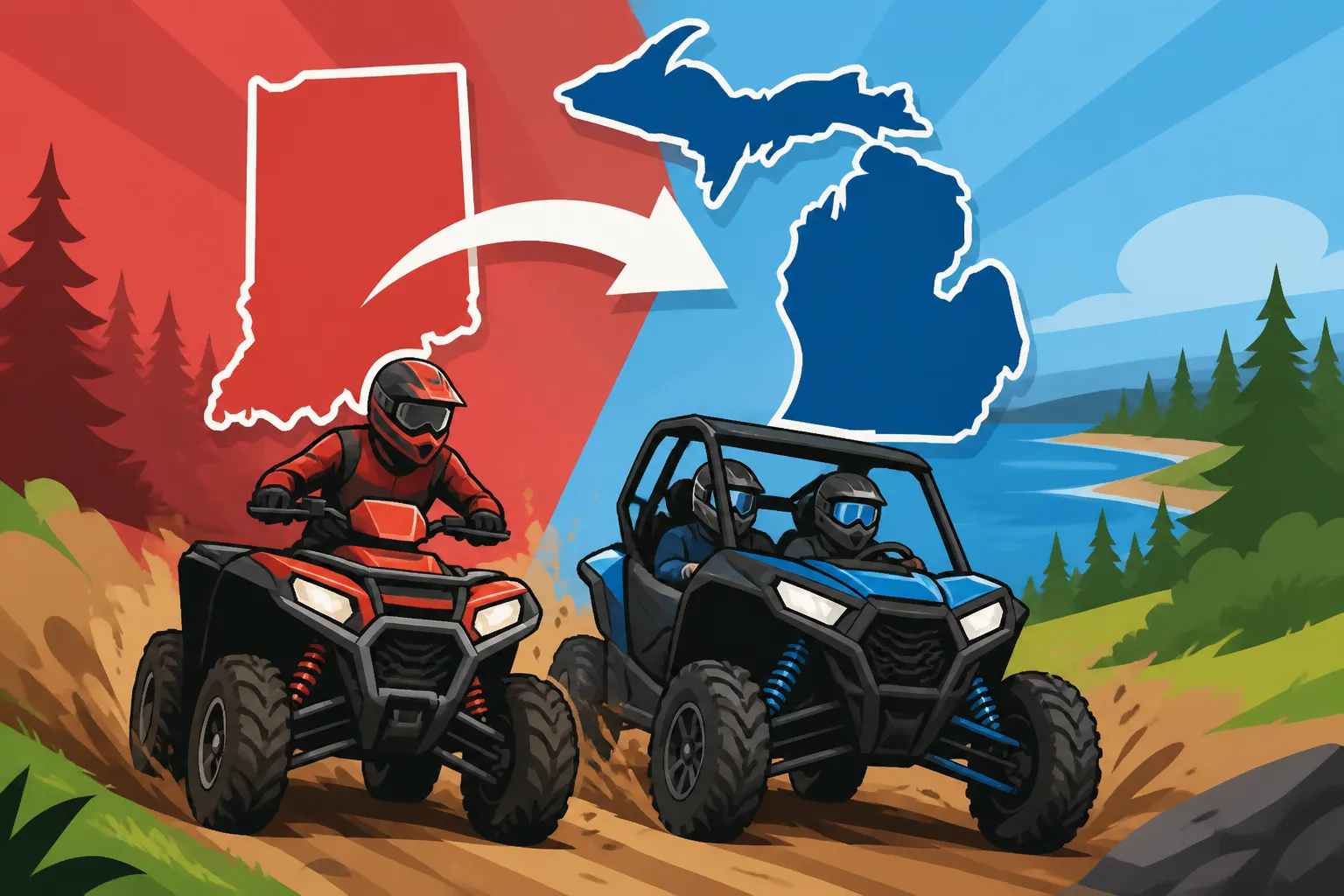
Indiana riders can bring their ATVs and UTVs to Michigan, but an Indiana registration or permit does not replace Michigan’s requirements for riding public land. The main task is sorting out which Michigan permits you need, whether your machine fits the route, and which safety rules apply to your riders.
What Indiana riders need before hitting Michigan trails
Michigan permits are required for state-designated trails
Indiana residents must buy a Michigan ORV license and an ORV trail permit to ride on state-designated ORV trails, according to the Michigan Department of Natural Resources. The trail permit is in addition to the base license. An out-of-state registration or permit should not be treated as a substitute for Michigan’s requirements.
As of October 2026, the Michigan Department of Natural Resources lists the annual ORV license at $26.25 and the additional trail permit at $10.00, for a combined total of $36.25. Check the DNR’s current information before purchasing, since permit costs can change.
The base license and trail permit cover different requirements. The license is required for public-land use, while the additional trail permit is needed for state-designated ORV trails. For example, Michigan allows licensed ORVs on the frozen surface of public waters without requiring a trail permit for that specific use, according to the Department of Natural Resources. That exception does not mean trail riding is permit-free.
| Where you plan to ride | Michigan requirement to keep in mind |
|---|---|
| State-designated ORV trail | ORV license and additional trail permit |
| Frozen surface of public waters | ORV license; no trail permit for this specific use |
| State forest road | Check that the road is open to ORVs and follow its posted rules |
| Private property | Public-land permit rules may not apply, but get the owner’s permission and confirm which other rules still apply |
Michigan’s annual ORV licenses and trail permits expire on March 31 of the following year, regardless of when you buy them, according to the Michigan Department of Natural Resources. A permit purchased late in the season does not extend into a full year from its purchase date. Before planning a return trip, check whether your permits will still be valid.
For a broader explanation of the two permits and where they apply, see Michigan ORV License and Trail Permit Explained. Out-of-state riders can also review ORV Permits for Out-of-State Riders in Michigan and Michigan ORV Reciprocity With Neighboring States. Reciprocity can matter for some requirements, but it does not remove the Michigan permit requirement for an Indiana rider using state-designated trails.
Nonresidents generally do not need a Michigan title
The Michigan Department of Natural Resources says nonresidents are exempt from needing a Michigan vehicle title for their ORV. That is separate from the permit requirement: an Indiana resident still needs the required Michigan license for public-land use and both permits for state-designated trails.
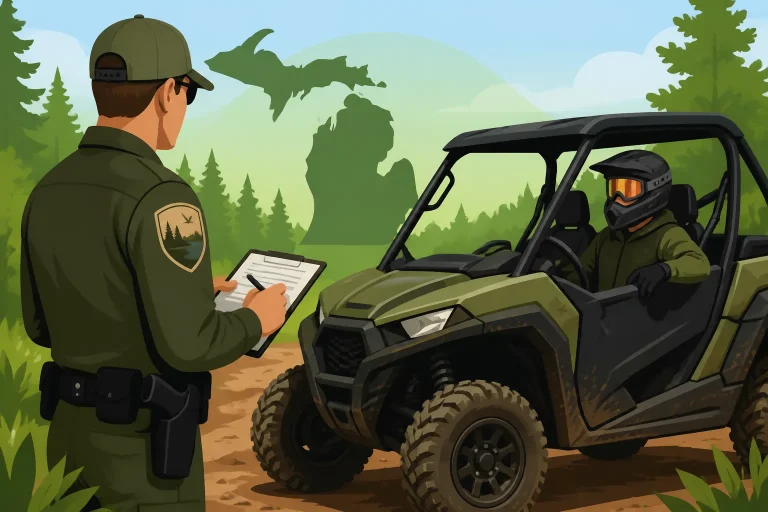
Bring the ownership and registration documents you normally use for your machine, but do not assume that proving Indiana ownership is all you need for Michigan trail access. Keep your Michigan permit information available while riding, and check the DNR’s guidance if your machine has unusual paperwork or ownership status. Michigan ORV Paperwork During a DNR Stop covers what to have ready if an officer asks about your documents.
Check the route, machine, and season before you go
Match the machine to the trail width
Michigan designates three ORV trail types by width: motorcycle-only trails maintained at 24 inches, trails maintained at 50 inches, and ORV routes maintained at a minimum 72 inches, according to the Michigan Department of Natural Resources. These categories are not interchangeable. A route that accommodates a wider machine does not mean every narrower trail does.
Before setting out, identify your machine’s width and check the designation for each part of your intended route. A side-by-side that is too wide for a narrower trail can leave you with no legal way to continue as planned. Conversely, a wider route designation does not tell you whether the surface, conditions, or local postings make the route suitable for your machine.
Trail maps and signs are useful for understanding those distinctions. Use Michigan ORV Trail Maps and What the Signs Mean to get familiar with the markings, and check for closures before leaving. The Michigan Department of Natural Resources can close state trails and facilities because of weather events and wet conditions. A route that appears on a map may not be open on the day you arrive; Michigan ORV Trail Closure Notices can help you check for changes.
State forest roads are not a blanket open-road pass
Michigan state forest roads are generally open year-round to ORV use unless they are posted otherwise or seasonally closed, according to the Michigan Department of Natural Resources. “Generally” matters: check the signs and any closure notices for the road you intend to use rather than assuming every forest road is open.
A forest road, an ORV trail, and a public road designated for ORV use are not the same thing. If your route includes public roads, use only roads where ORVs are allowed and follow the rules for road riding. Those rules can differ from trail rules, including requirements that apply to younger operators. See Michigan ORV Road Rules for Riders Under 16 if a young person in your group may be riding on a road.
Plan around access, not just mileage. Confirm that the route connects to an open trail or road, that the machine fits the designated width, and that you can legally ride each connecting segment. If weather has made conditions wet, closures may affect access even when the route was previously open.
Youth, safety gear, and machine rules
Rules for riders under 16
Michigan’s youth requirements are important for Indiana families because an out-of-state certificate may be accepted only if it meets Michigan’s comparable-certificate standard. Anyone under 16 must complete an approved ORV safety course and carry a valid safety certificate to operate an ORV on public lands, according to the Department of Natural Resources.
For nonresident operators aged 12 to 15, the Michigan Legislature says the rider must present a safety certificate issued under Michigan’s ORV law or a comparable certificate issued under another state’s or a Canadian province’s authority. An Indiana certificate may qualify if it is comparable; do not assume that any training card or informal course record will meet the requirement. Carry the certificate with the rider. Michigan ORV Safety Certificate for Riders Under 16 explains the certificate requirement in more detail.
The certificate is not a substitute for supervision. According to the Department of Natural Resources, a rider under 16 must be under an adult’s direct visual supervision while operating an ATV on public lands. Children under 10 are prohibited from operating four-wheel ATVs on public lands. These rules apply even when a child has experience riding at home or on private property.
Road operation has a separate age-related rule. The Michigan Legislature says an adult does not need a driver’s license to operate an ATV on a public road designated for ORV use. A person under 18 must either have a valid driver’s license or be under the direct supervision of a parent or guardian while holding an ORV safety certificate. Do not confuse this road rule with the requirements for unsupervised operation on public land.
Helmets, eyewear, belts, and passengers
In Michigan, ORV operators and passengers generally must wear a Department of Transportation-approved crash helmet and protective eyewear, according to the Michigan Legislature. Exceptions can apply in specific circumstances. For example, a UTV occupant may qualify for a helmet-law exception when the UTV has an approved roof and each occupant’s safety belt is properly adjusted and fastened.
A seat belt is therefore not just a comfort feature if you are relying on that UTV exception. The Department of Natural Resources also says that certain state-managed areas, including the Silver Lake ORV Area, require a seat belt for each occupant regardless. Check the rules for the particular area before riding.
If you are replacing a helmet or eyewear, confirm that the product meets the required standard rather than relying on a product name or a vague listing description. Whether you shop locally or through Amazon, look for clear manufacturer information about DOT approval and fit. The same care applies to UTV belts and roof equipment if you plan to rely on the helmet exception.
Passenger capacity also depends on the machine’s design. Under Michigan law, carrying a passenger on an ORV is prohibited unless the vehicle’s manufacturing standards or design explicitly provide for transporting passengers, according to the Michigan Legislature. A second seat added informally does not necessarily make the machine suitable for a passenger. Check the manufacturer’s specifications and keep each rider in a designated seat.
Equipment and responsible operation
Michigan requires a United States Forest Service-approved spark arrester and a muffler in good working order and constant operation on ORVs used on public lands, according to the Michigan Legislature. Check that the equipment is present and functioning before the trip; a machine that is loud or missing required equipment can create problems even if it is otherwise trail-ready.
Noise limits also apply. According to the Michigan Legislature, an ORV manufactured after January 1, 1986, must not exceed 94 dB(A), while an older model must not exceed 99 dB(A), when tested using the SAE J1287 stationary test procedure. A loud exhaust is not a reliable indicator of performance, and modifying it can leave the machine out of compliance.
Lighting matters if your ride runs after dark. The Michigan Legislature prohibits operating an ORV without a lighted headlight and taillight from a half-hour after sunset to a half-hour before sunrise. Plan your route and return time so you are not caught without working lights.
Alcohol rules are another reason to plan ahead. Under Michigan law, the blood alcohol concentration limit for operating an ORV is 0.08 grams or more per 100 milliliters of blood, per 210 liters of breath, or per 67 milliliters of urine, according to the Michigan Legislature. The statutory fine range for a first-offense OUI on an ORV is $100 to $500, as of October 2026, according to the Michigan Legislature. The safest plan is to keep the operator completely separate from alcohol.
A practical pre-trip check for Indiana riders
Use this checklist before leaving Indiana:
- Buy a Michigan ORV license for public-land use and add the trail permit if you will ride state-designated trails.
- Check the expiration date. Michigan permits expire on March 31 of the following year, even if they were purchased later in the season.
- Confirm your route’s trail or road designation and make sure your machine fits its width category.
- Look for current closure information, especially after wet weather.
- For riders under 16, carry the required safety certificate and arrange direct visual supervision. Confirm that an out-of-state certificate is comparable if the rider is between 12 and 15.
- Check helmet, eyewear, seat-belt, and passenger requirements for each machine and riding area.
- Inspect the spark arrester, muffler, headlights, and taillights, and keep the machine within Michigan’s noise limit.
- Keep the operator sober and make a plan for getting back before darkness if the machine’s lights are not suitable.
If you are unsure whether your Indiana paperwork, safety certificate, or machine setup satisfies Michigan’s rules, check with the Michigan Department of Natural Resources before riding. Sorting out the details in advance is simpler than discovering a problem at a trailhead or during a stop.
Sources
- Michigan Department of Natural Resources — ORV FAQs – State of Michigan (checked October 28, 2026)
- Michigan Department of Natural Resources — Purchase permit, learn requirements – State of Michigan (checked October 28, 2026)
- Michigan Legislature — MCL – Section 324.81131 (checked October 28, 2026)
- Michigan Legislature — MCL Section 324.81133 (checked October 28, 2026)
- Michigan Legislature — MCL Section 324.81134 (checked October 28, 2026)
- Michigan Legislature — Michigan Compiled Laws, Section 324.81147 (checked October 28, 2026)
Disclaimer
This article is for general informational purposes only and does not constitute professional advice. Laws, prices and regulations vary by location and change over time. Consult a qualified professional for guidance on your specific situation.