Michigan ORV Reciprocity With Neighboring States
Michigan ORV Reciprocity With Neighboring States
A Michigan trail trip can involve more than one kind of permission: a state ORV license, a trail permit, and sometimes a youth safety certificate. The confusing part is that “reciprocity” can mean different things, and recognition of a safety certificate does not necessarily settle permit requirements. Here’s what Michigan’s stated rules establish, and what riders should verify before crossing a state line.
What reciprocity means for an ORV trip
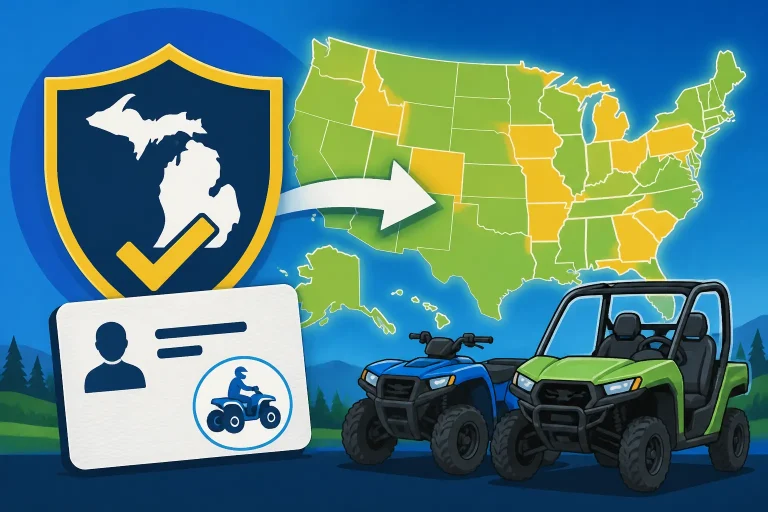
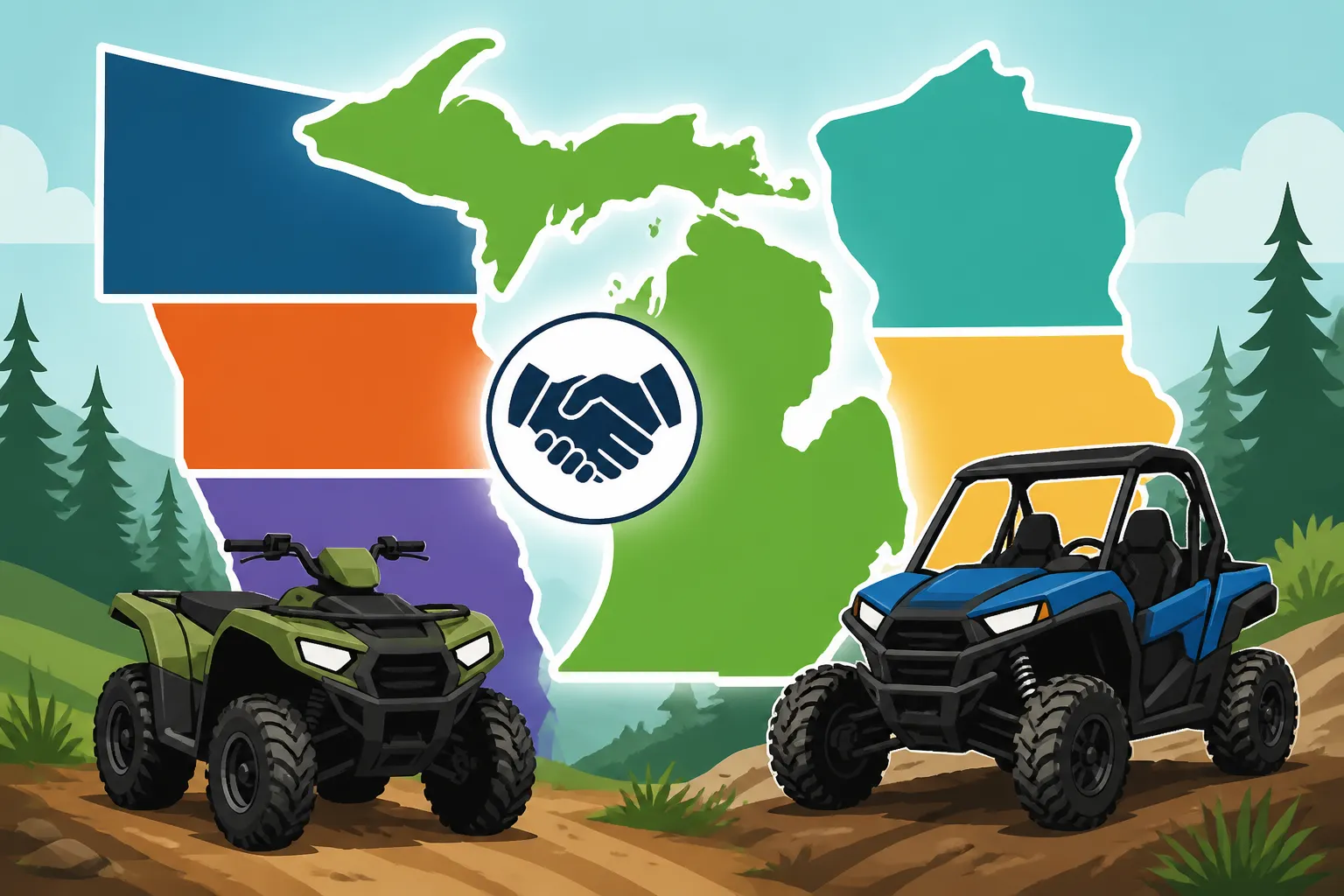
Reciprocity is not one blanket agreement that automatically lets an ATV or UTV ride anywhere in neighboring states. It can refer to whether a state recognizes another state’s safety certificate, whether a home-state permit satisfies a destination state’s permit rules, or whether a machine’s registration is accepted. Those are separate questions.
For a rider coming into Michigan, the clearest reciprocal rule in the available Michigan requirements concerns youth safety certificates. The Michigan Legislature says nonresident operators aged 12 to 15 may present a Michigan Part 811 ORV safety certificate or a comparable certificate issued under another state or a Canadian province. That establishes certificate recognition for this age group; it does not establish that a visitor’s home-state permit replaces Michigan’s ORV license or trail permit.
For a Michigan rider heading to another state, do not assume Michigan paperwork will be accepted there just because Michigan recognizes some out-of-state certificates. The other state sets its own rules for permits, machine registration, rider age, equipment, and where an ORV may operate. Check the destination state’s official ORV authority before the trip, and ask specifically about your machine and the places you plan to ride.
It also helps to separate three terms that people often use interchangeably:
- ORV license: Michigan’s base license for ORV use.
- Trail permit: An additional permit needed for state-designated ORV trails.
- Safety certificate: A training document required for certain young riders; it is not a license or trail permit.
| What you are checking | What Michigan’s stated rule establishes | What still needs checking |
|---|---|---|
| Nonresident youth safety certificate | A comparable certificate from another state or a Canadian province may be presented by nonresident operators aged 12 to 15, according to the Michigan Legislature | Whether the destination accepts a Michigan certificate, especially for a particular age group |
| Michigan ORV license | Michigan has an annual ORV license, according to the Michigan Department of Natural Resources | Whether a home-state permit is accepted in place of it; do not assume it is |
| Michigan state-designated ORV trails | A separate trail permit is needed in addition to the base license, according to the Michigan Department of Natural Resources | Whether a particular trail or facility is open and what additional rules apply |
| Out-of-state machine or registration | Michigan’s youth certificate rule does not itself settle registration or permit questions | Which documents the state requires for the machine and the intended route |
For a broader look at visitor requirements, see Non-Resident ORV Permits in Michigan and [Out-of-State Riders and the Michigan ORV License]. If you are coming from Wisconsin or Ohio, the related articles Do Wisconsin Riders Need a Michigan Permit? and Do Ohio Riders Need a Michigan ORV License? can help you frame the questions to confirm.
What out-of-state riders should check before riding in Michigan
The safest planning approach is to treat a Michigan ride as subject to Michigan’s rules unless the Michigan authority specifically confirms an exemption or alternative. A home-state license, registration, or trail sticker may be useful documentation, but it is not proof by itself that Michigan accepts it for every purpose.
The Michigan Department of Natural Resources lists an annual ORV license at $26.25, with an additional $10.00 trail permit required for state-designated ORV trails, for a combined cost of $36.25 as of October 2026. Check the Michigan Department of Natural Resources for current figures before purchasing, since the costs and requirements can change. The trail permit is not a substitute for the base license.
Michigan annual ORV licenses and trail permits expire on March 31 of the following year, regardless of when they were purchased, according to the Michigan Department of Natural Resources. That matters for visitors planning a trip near the end of the permit period: a sticker that was valid earlier in the season may not cover a later ride.
Before traveling, establish what kind of riding you will actually do. A state-designated ORV trail has a different permit requirement from riding on a state forest road, a frozen public water surface, or private property. According to the Michigan Department of Natural Resources, state forest roads are generally open year-round unless posted otherwise or seasonally closed. Michigan also allows ORVs on the frozen surfaces of public waters with an ORV license, but a trail permit is not required for that specific use, according to the Department of Natural Resources. Do not treat either rule as permission to ride anywhere: closures and local restrictions can still matter.
Use this checklist when planning:
- Confirm that your Michigan ORV license is current for the intended ride.
- Determine whether your route includes state-designated ORV trails and therefore requires the additional trail permit.
- Check whether the trail, road, or facility is open. The Michigan Department of Natural Resources can close state trails and facilities due to weather-related events or wet conditions.
- Confirm that your machine is allowed on the trail or route. Width can affect which routes are suitable.
- Check rider-age and safety-certificate requirements, especially when a young person will operate the machine.
- Review helmet, eyewear, passenger, lighting, and equipment requirements for the type of machine and location.
- Keep proof of your permit and safety certificate accessible, and make sure the information matches the machine and rider.
If your question is specifically whether a certificate from another state counts, see Wisconsin Safety Certificate Accepted in Michigan or Safety Certificate Reciprocity for Michigan Riders. Certificate recognition is a narrow part of reciprocity, not a general waiver of Michigan’s other rules.
Safety certificates and age rules for visiting riders
For families, youth-certificate recognition is the most directly stated reciprocity rule. The Michigan Legislature says a nonresident operator aged 12 to 15 may present an ORV safety certificate issued under Michigan Part 811 or a comparable certificate issued under the authority of another state or a Canadian province.
That does not mean a young rider can operate without supervision. According to the Michigan Department of Natural Resources, operators under 16 must have a valid ORV safety certificate and be under the direct visual supervision of an adult while operating on public lands. Children under 10 are prohibited from operating four-wheel ATVs on public lands altogether, according to the Department of Natural Resources. A safety certificate does not override that restriction.
The certificate rule also should not be confused with an adult’s riding permit. The certificate relates to a rider’s training and eligibility; the ORV license and trail permit relate to the machine’s use in Michigan. A visiting family should confirm each item separately rather than relying on one document to answer every question.
Before leaving home, check the certificate itself:
- Confirm that it is an ORV safety certificate, not merely a general safety course completion record.
- Make sure it identifies the rider and issuing authority.
- If it is from outside the United States, confirm that it was issued under a Canadian provincial authority, as described in the Michigan Legislature’s rule.
- Carry the certificate while riding, in a form that can be shown if requested.
- Confirm that the young rider will be directly visible to the supervising adult on public lands.
For Michigan riders traveling out of state, make the reverse inquiry with the destination’s official authority. Michigan’s acceptance of a comparable certificate for certain nonresident youth does not require another state to accept a Michigan certificate on the same terms. Ask about the rider’s age, the type of ORV safety credential, supervision requirements, and whether the rule changes between public trails and private land.
There can also be separate rules for riding on public roads designated for ORV use. The Michigan Legislature says a driver’s license is not required for adults operating an ATV on those designated roads, but a person under 18 must either have a valid driver’s license or be under the direct supervision of a parent or guardian while holding an ORV safety certificate. That road rule is distinct from the public-land supervision requirement, so parents should not assume one supervision arrangement automatically satisfies every setting.
Machine type and Michigan rules that still apply
A permit or recognized certificate does not exempt a visitor from Michigan’s operating and equipment rules. Before riding, check that the machine fits the route and that required safety equipment is in place. Rules can differ by vehicle type, location, and the circumstances of the ride.
The Michigan Department of Natural Resources designates three ORV trail types by width: motorcycle-only trails maintained at a 24-inch width, trails maintained at a 50-inch width, and ORV routes maintained at a minimum 72-inch width. This makes measuring or confirming the manufacturer’s width useful before choosing a route. A wide side-by-side should not be assumed to fit an ATV trail simply because it is allowed on some ORV routes.
Helmet and passenger rules deserve attention, especially for visitors accustomed to different requirements at home. The Michigan Legislature generally requires ORV operators and passengers to wear a Department of Transportation-approved crash helmet and protective eyewear. The Legislature also describes exceptions under certain conditions, including operating on private property with permission or riding in a UTV equipped with an approved roof and properly fastened safety belts. Those exceptions have specific conditions; do not assume that an ordinary roof or a loosely worn belt is enough.
Michigan law also prohibits carrying a passenger on an ORV unless the machine’s manufacturing standards or design provide for transporting passengers, according to the Michigan Legislature. A passenger should not ride on a machine designed for a single rider simply because that is customary in another state.
Other equipment and operating rules may matter across a border:
- Michigan law requires a United States Forest Service-approved spark arrester and a muffler in good working order and constant operation on ORVs operated on public lands, according to the Michigan Legislature.
- For ORVs manufactured after January 1, 1986, Michigan law sets an exhaust-noise ceiling of 94 dB(A); for older models, the ceiling is 99 dB(A), when tested using the SAE J1287 stationary procedure, according to the Michigan Legislature.
- Michigan requires a lighted headlight and taillight from a half-hour after sunset to a half-hour before sunrise, according to the Michigan Legislature.
- The Michigan Legislature sets the blood-alcohol threshold for ORV operation at 0.08 grams or more per 100 milliliters of blood, per 210 liters of breath, or per 67 milliliters of urine.
- The statutory fine range for a first-offense operating under the influence on an ORV is $100.00 to $500.00, according to the Michigan Legislature.
The point is not that every visitor needs to memorize every equipment provision before loading a trailer. It is that an out-of-state sticker or certificate does not guarantee that the machine meets Michigan’s rules. Review requirements for the machine and the ride location, and address any questionable equipment before reaching the trail.
For related Michigan-specific details, see Michigan ORV Permit Reciprocity With Other States only if you are comparing permit rules; for youth requirements, Michigan ORV Safety Certificate for Riders Under 16 and Michigan ORV Age Rules at 10, 12 and 16 provide focused explanations. If you are also planning road use, confirm those requirements separately rather than treating trail access as road authorization.
A practical cross-border verification process
Reciprocity questions are easiest to resolve when you describe the exact trip instead of asking only whether “Michigan has reciprocity.” A useful inquiry identifies the rider, machine, documents, and route. The answer may differ for a young rider on a trail, an adult on a forest road, or a UTV on a designated route.
Use this process before the trip:
- Identify the destination and route. Note the state, trail system, road, public land, or facility you intend to use. A state rule may not cover local closures or route-specific limits.
- Describe the machine. Provide the vehicle type and width, and explain whether it is an ATV or UTV. Michigan’s width definitions affect which routes may be appropriate.
- List the documents you have. Separate the home-state permit, registration, insurance documents, and safety certificate. They serve different purposes.
- Ask whether each document is recognized. Specifically ask whether the destination accepts the home-state ORV permit, machine registration, and safety certificate. Do not infer one answer from another.
- Check age and supervision conditions. Give the rider’s age and ask about training, supervision, road use, and passenger rules.
- Confirm machine and safety requirements. Ask about helmet, eye protection, seat belts, spark arresters, mufflers, lighting, and passenger capacity where relevant.
- Check current access and closures. Confirm that the intended trail or facility is open and suitable for the machine on the planned day.
- Save the response and carry the required documents. Keep a record of what the responsible authority says and bring the original or accepted form of each required document.
When calling or writing to an official authority, a specific question is more effective than “Is my permit good there?” For example: “I am visiting from another state with a UTV and a youth rider who holds a state-issued ORV safety certificate. Does this certificate meet your requirement, and what permit does the machine need for this designated trail?” That makes clear that you are asking about both the rider and the vehicle.
A short pre-trip file can prevent a frustrating turn-around. Include the machine’s identifying information, proof of any required permit, the youth certificate if applicable, and notes on where the authority confirmed access. If a permit is bought for a season that ends on March 31, remember the expiration rule when setting travel dates, as stated by the Michigan Department of Natural Resources. Recheck conditions close to departure, since a permit does not keep a trail open during a closure.
Finally, treat border crossings as a change of jurisdiction, not a continuation of the same ride rules. A Michigan license may be only one part of what another state asks for; a Michigan-recognized certificate may not guarantee recognition elsewhere; and a trail open in one jurisdiction may have different requirements just across the line. Confirm the destination rules directly and plan around the machine and riding location you will actually use.
Frequently Asked Questions
Does Michigan accept another state’s ORV safety certificate?
For nonresident operators aged 12 to 15, the Michigan Legislature says Michigan accepts a comparable ORV safety certificate issued under another state’s authority or by a Canadian province. That recognition does not by itself replace Michigan permit requirements.
Does a Michigan ORV permit automatically work in a neighboring state?
Do not assume it does. The destination state decides whether it recognizes a Michigan permit, and the requirements may depend on the machine and where you plan to ride. Confirm with that state’s official authority.
Does a nonresident need a Michigan trail permit?
The Michigan Department of Natural Resources requires an additional trail permit for use of state-designated ORV trails, along with the base ORV license. Visitors should confirm current requirements and any applicable exceptions before riding.
Can a young visitor ride in Michigan with a certificate from home?
A comparable out-of-state or Canadian provincial certificate may be presented by nonresident operators aged 12 to 15, according to the Michigan Legislature. The Michigan Department of Natural Resources also requires riders under 16 on public lands to have a valid certificate and direct visual supervision by an adult. Children under 10 may not operate four-wheel ATVs on public lands.
Sources
- Michigan Department of Natural Resources — ORV FAQs – State of Michigan (checked October 28, 2026)
- Michigan Department of Natural Resources — Purchase permit, learn requirements – State of Michigan (checked October 28, 2026)
- Michigan Legislature — MCL – Section 324.81131 (checked October 28, 2026)
- Michigan Legislature — MCL Section 324.81133 (checked October 28, 2026)
- Michigan Legislature — MCL Section 324.81134 (checked October 28, 2026)
- Michigan Legislature — Michigan Compiled Laws, Section 324.81147 (checked October 28, 2026)
Disclaimer
This article is for general informational purposes only and does not constitute professional advice. Laws, prices and regulations vary by location and change over time. Consult a qualified professional for guidance on your specific situation.