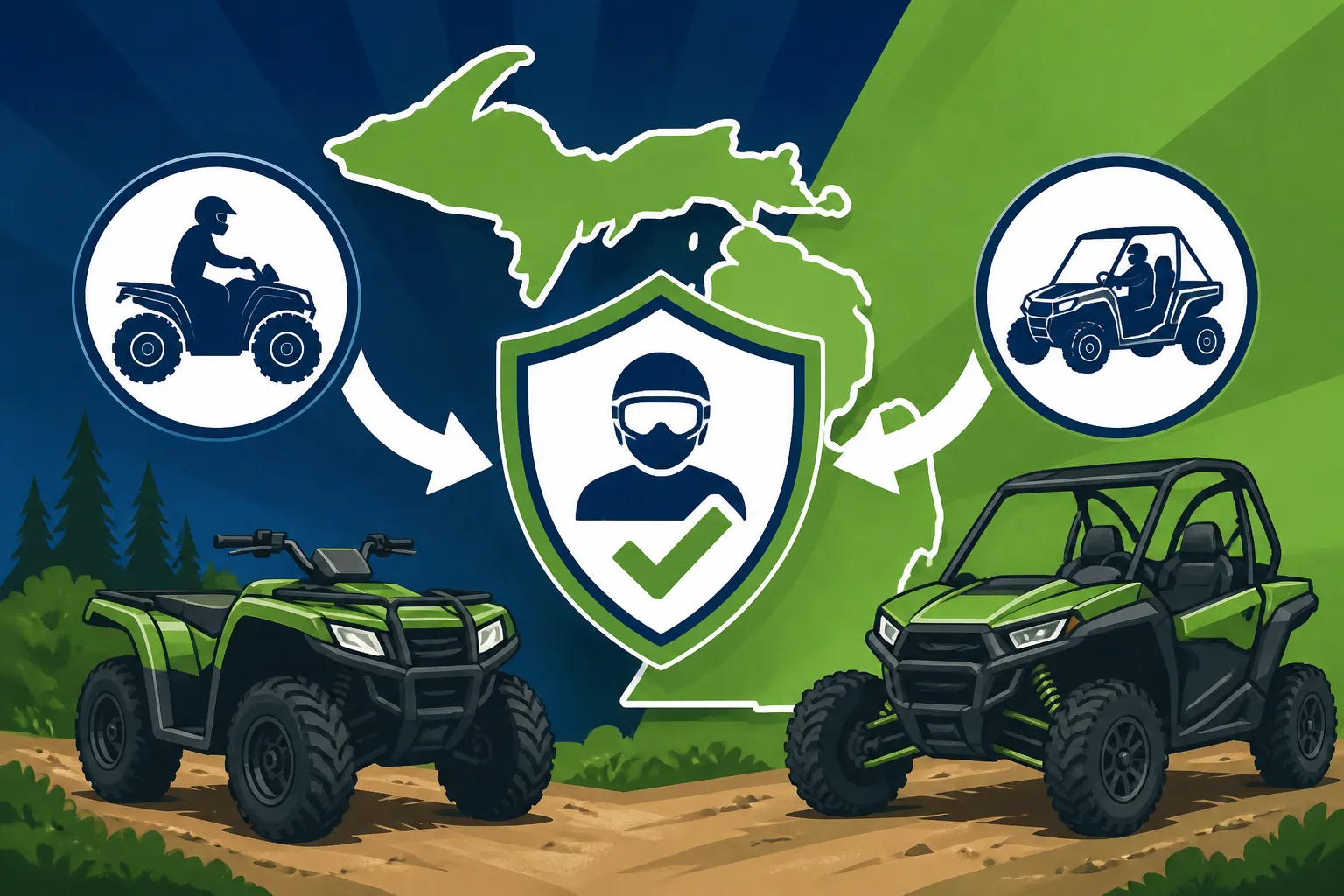
Safety Certificate Reciprocity for Michigan Riders
Safety Certificate Reciprocity for Michigan Riders
If you’re bringing an ATV or UTV into Michigan, or a young rider is visiting from another state or Canada, it can be hard to tell whether an out-of-area safety certificate will count. The key is to separate the certificate rule from trail permits and supervision requirements. Here’s what Michigan recognizes, what a rider should carry, and when to confirm the details before heading out.
What Michigan’s reciprocity rule covers
Michigan has a specific rule for nonresident youth operators. Under the Michigan Legislature, nonresident operators aged 12 to 15 must present either an ORV safety certificate issued pursuant to Michigan Part 811 or a comparable certificate issued under the authority of another state or a province of Canada.
That is the clearest reciprocity rule in the facts available: a qualifying out-of-state or Canadian certificate can serve as the comparable certificate for nonresident riders in that age group. The rule is about a safety certificate. It does not, by itself, establish that every state’s course or card is accepted in every situation, or that a certificate replaces other Michigan riding requirements.
Michigan’s general youth rule also matters. According to the Department of Natural Resources, anyone under 16 operating an ORV on public lands must have a valid ORV safety certificate and be under an adult’s direct visual supervision. The department also says youth under 16 must complete an approved ORV safety course and carry their certificate when operating on public lands.
These requirements work together, but they answer different questions:
- Is the rider required to have a certificate? Michigan requires a valid certificate for youth under 16 on public lands, according to the Department of Natural Resources.
- Can a visitor’s certificate count? The Michigan Legislature recognizes a comparable certificate from another state or a Canadian province for nonresident operators aged 12 to 15.
- Does a certificate let a youth ride without supervision? No. The Department of Natural Resources requires direct visual supervision by an adult for operators under 16 on public lands.
- Does the certificate replace a license or permit? No. A safety certificate concerns rider training and qualification; ORV licenses and trail permits are separate requirements.
If you’re checking the course and document requirements for a young Michigan rider, see Michigan ORV Safety Certificate for Riders Under 16 and Michigan ORV Age Rules at 10, 12 and 16. For a closer look at the supervision requirement, What Direct Visual Supervision Actually Means explains why having an adult somewhere nearby may not be enough.
The rule is narrower than “all certificates are interchangeable”
It is tempting to read “comparable certificate” as a blanket promise that any ATV safety card from anywhere will work. The specific reciprocity provision supplied by the Michigan Legislature concerns nonresident operators aged 12 to 15 and a comparable certificate issued under another state’s or a Canadian province’s authority.
That wording is useful, but it still leaves practical questions. A card might be a completion record from a private provider rather than a certificate issued under a state or provincial authority. It may be an online course record, a digital record in an account, or a document with a name that differs from the Michigan certificate. Those distinctions could matter when an officer or riding facility asks the operator to show proof.
For that reason, do not rely only on the fact that the rider took a safety course. Confirm that the document is the certificate issued or recognized under the relevant jurisdiction’s authority, and that it is accepted as comparable for the rider’s particular circumstances. A course completion email or receipt may not be the same thing as the certificate itself.
The safest approach is to check both ends of the trip: the authority that issued the certificate and the Michigan agency responsible for the riding location or activity. If the documentation is unclear, get confirmation before the ride rather than expecting a trail-side conversation to settle whether a card qualifies.
Who needs a certificate, and where the age rules apply
Michigan’s safety certificate rule is tied to age and location. According to the Department of Natural Resources, anyone under 16 operating an ORV on public lands must have a valid ORV safety certificate and be under direct visual supervision of an adult. The department also says youth under 16 must complete an approved ORV safety course and carry the certificate while operating on public lands.
This is not just a question for Michigan residents. A visiting family should consider the rider’s age, the kind of machine, and where the machine will be used. The specific out-of-state reciprocity rule addresses nonresident operators aged 12 to 15, while the general public-lands rule covers youth under 16.
The Department of Natural Resources also says children under 10 are prohibited from operating four-wheel ATVs on public lands. That restriction is separate from the certificate and supervision requirements. A safety certificate should not be treated as permission to ride a machine or in a place where the age rule prohibits operation.
| Rider or situation | What the supplied Michigan rule says | Practical takeaway |
|---|---|---|
| Michigan rider under 16 on public lands | The Department of Natural Resources requires a valid ORV safety certificate and direct visual supervision by an adult. | Carry the certificate and plan for an adult to supervise the ride directly. |
| Nonresident operator aged 12 to 15 | The Michigan Legislature allows a Michigan Part 811 certificate or a comparable certificate issued under another state’s or a Canadian province’s authority. | Bring the actual certificate and verify that it meets the comparable-certificate standard. |
| Child under 10 operating a four-wheel ATV on public lands | The Department of Natural Resources prohibits this. | A certificate does not override the age restriction. |
| Rider on private property | The supplied public-lands certificate rules do not describe every private-land situation. | Check the applicable rules for the property and activity rather than assuming public-land rules apply unchanged. |
| Adult operator | The supplied youth certificate rules do not establish a general certificate requirement for adults. | Do not mistake a youth certificate rule for a universal adult course requirement. |
The table is a way to sort the questions, not a substitute for checking the precise riding location. “Public lands” can include different kinds of places and facilities, and the relevant rules can depend on where the machine will be operated. If a planned ride includes public trails, state forest roads, a designated ORV area, or a private property section, confirm requirements for each part of the route.
The vehicle category still matters
People often use “ATV,” “UTV,” and “ORV” as if they mean exactly the same thing. The Michigan Department of Natural Resources designates three ORV trail types by width: motorcycle-only trails maintained at a 24-inch width, trails maintained at a 50-inch width, and ORV routes maintained at a minimum 72-inch width. General ORV routes can accommodate larger vehicles, subject to the relevant route rules.
That classification is not a reason to skip the safety certificate check. The youth certificate requirements are stated for ORVs, while the under-10 prohibition specifically refers to four-wheel ATVs on public lands. If you are unsure how a particular machine is classified, use the manufacturer’s information and confirm the applicable definition before riding.
The distinction is especially important for families transporting a youth on a UTV. A certificate does not decide whether a passenger is permitted, whether the machine is designed for that passenger, or whether the vehicle’s safety equipment meets a separate rule. Those are different questions from training reciprocity.
For age-related details beyond certificate recognition, Michigan Rules for 12- to 15-Year-Old Riders and Three-Wheel ATVs and Riders Under 16 can help you identify which rules need a separate check. Do not assume an age rule for one machine type automatically applies to a different one.
What a visitor should carry and verify
A practical document check can prevent confusion at the trailhead. Before traveling, make sure the young operator’s certificate is legible, belongs to that rider, and can be shown without depending on a login or a weak mobile signal. If the issuing jurisdiction provides a physical card, carry it. If it provides an official digital certificate, save an accessible copy and confirm that it remains valid and readable offline.
The Michigan Legislature’s reciprocity language calls for a comparable certificate issued under the authority of another state or a Canadian province. So, when checking a card, look for information that establishes what it is: the rider’s name, the issuing authority, and a clear indication that it is an ORV or ATV safety certificate. If the document only shows that a course was started or paid for, ask the issuer whether a separate certificate is issued after successful completion.
Before setting out, work through these questions:
- Is the rider within the age group covered by the reciprocity provision? The Michigan Legislature’s stated nonresident rule covers operators aged 12 to 15.
- Is the rider a nonresident? The reciprocity wording specifically concerns nonresident operators; do not automatically extend it to every rider or circumstance.
- Who issued the certificate? Check whether it was issued under the authority of a state or Canadian province, as the Michigan Legislature’s rule specifies.
- Does the rider have the certificate, rather than only course paperwork? Michigan requires youth under 16 on public lands to carry a valid certificate, according to the Department of Natural Resources.
- Will an adult provide direct visual supervision? The Department of Natural Resources requires this for operators under 16 on public lands.
- Is the machine and riding area allowed for that age? The Department of Natural Resources prohibits children under 10 from operating four-wheel ATVs on public lands.
- Are there separate license or trail-permit requirements? A safety certificate does not replace them.
This check is especially useful when the certificate uses a different name from Michigan’s terminology. A course may be called ATV safety, off-highway vehicle safety, or ORV safety in the issuing jurisdiction. A difference in the course name does not automatically prove the document is invalid, but the operator should verify whether the certificate qualifies as comparable rather than guess.
For visitors arriving from a nearby state, Michigan ORV Reciprocity With Neighboring States and [Out-of-State Riders and the Michigan ORV License] address related but separate questions. For Canadian visitors, Ontario Riders Bringing an ATV to Michigan can help identify other cross-border issues. Keep the distinction clear: a safety certificate is not an ORV license, and a license question is not resolved by certificate reciprocity.
Keep supervision and proof in the riding plan
Certificate reciprocity can answer whether a youth’s document is recognized, but it does not remove the supervision requirement. According to the Department of Natural Resources, an operator under 16 on public lands must be under an adult’s direct visual supervision. Make that arrangement before the ride, particularly if the group plans to split up, use separate routes, or let the youth ride ahead.
Keep the adult responsible for supervision close enough to maintain direct visual oversight as required. A parent or guardian should not assume that another adult in the group automatically satisfies the rule; decide who is supervising and make sure that person understands the route and the youth’s role.
Carry the certificate in a way that protects it from water, dirt, and damage. If the group relies on a digital copy, make sure the device can display it where there may be limited service. A paper copy can serve as a backup, but it should be a copy of the actual certificate, not just a note saying the rider completed a class.
For families who still need to arrange training, ORV Safety Course Online vs In Person outlines the course-format decision. The certificate’s acceptance is a separate matter from the course delivery method, so confirm both the course’s approval and the status of the document it issues.
What certificate reciprocity does not replace
The most common mistake is treating a safety certificate as an all-purpose pass. It is not. It documents safety training or qualification; it does not independently authorize every machine, route, or riding situation.
A certificate does not replace direct visual supervision for a youth under 16 on public lands. The Department of Natural Resources requires both a valid certificate and adult supervision for those operators. A certificate also does not override the Department of Natural Resources’ prohibition on children under 10 operating four-wheel ATVs on public lands.
It does not replace ORV licenses or trail permits. Michigan’s license and trail-permit requirements are separate from rider training. If a visitor is unsure what permits apply to the machine and route, consult ORV Permits for Out-of-State Riders in Michigan and Do You Need Both a License and a Trail Permit in Michigan?. Avoid assuming that a certificate from another jurisdiction provides any kind of permit reciprocity.
The certificate also does not settle whether an operator may use a road. The Michigan Legislature states that a driver’s license is not required for adults operating an ATV on public roads designated for ORV use, but individuals under 18 must either have a valid driver’s license or be under direct supervision of a parent or guardian while holding an ORV safety certificate. That is a separate road-use rule, with a separate age condition. If the ride includes a road route, confirm that route access is allowed and that the rider meets the road-specific requirements.
Nor does a certificate determine whether a passenger may ride. The Michigan Legislature prohibits carrying a passenger on an ORV unless the vehicle’s manufacturing standards or design provide for transporting passengers. A youth’s safety card does not make an otherwise unsuitable passenger arrangement legal.
Helmet and protective-eyewear requirements are also separate. The Michigan Legislature generally requires ORV operators and passengers to wear a Department of Transportation-approved crash helmet and protective eyewear, with exceptions under specific conditions. A qualifying certificate does not create an exemption. Check the applicable vehicle and riding circumstances rather than assuming that training, supervision, or a UTV’s presence changes the equipment rule.
Handle uncertain cases before departure
If a certificate’s status is uncertain, do not wait until the group reaches a trail or is stopped during a ride to investigate. Contact the issuing state or provincial authority and ask whether the document is an official ORV safety certificate issued under its authority. Then confirm with the appropriate Michigan authority whether that certificate is comparable for the nonresident youth rule.
Be ready to describe the rider’s age, residency, certificate issuer, type of machine, and planned riding area. Those details help avoid a vague answer to a broad question like “Is my ATV card accepted in Michigan?” If the group will ride both public and private land, ask about each setting. The rule described by the Department of Natural Resources is specifically about public lands, and a private-land situation may raise different questions.
If the rider has no certificate, is waiting for one, or has only an unverified course record, make a different plan. Do not assume a screenshot of enrollment or a course receipt will satisfy a requirement to carry a valid certificate. For Michigan residents, the approved-course and certificate process is covered in Michigan ORV Safety Certificate for Riders Under 16. If the rider is a visitor, also check the state or provincial issuing process and Michigan’s reciprocity rule.
A little preparation is worthwhile because the consequences of misunderstanding the rule can include a ride that has to be changed or stopped. More importantly, the certificate requirement is part of a broader youth-safety system: training, supervision, appropriate equipment, and choosing a permitted route all matter. Treat each as its own check rather than expecting one card to answer every question.
Frequently Asked Questions
Does Michigan accept an out-of-state ATV safety certificate?
The Michigan Legislature says a nonresident operator aged 12 to 15 may present a Michigan Part 811 ORV safety certificate or a comparable certificate issued under the authority of another state or a Canadian province. That wording does not establish blanket acceptance for every age or certificate type, so confirm uncertain documents before riding.
Does an accepted certificate let a youth ride alone?
No. According to the Department of Natural Resources, anyone under 16 operating an ORV on public lands must be under an adult’s direct visual supervision as well as have a valid safety certificate.
Can a child under 10 ride a four-wheel ATV on Michigan public lands with a certificate?
No. The Department of Natural Resources prohibits children under 10 from operating four-wheel ATVs on public lands. A certificate does not override that restriction.
Does a safety certificate replace Michigan ORV permits?
No. Safety certificates and ORV licenses or trail permits are separate requirements. Check the permit rules for the machine and planned route before riding.
Sources
- Michigan Department of Natural Resources — Purchase permit, learn requirements – State of Michigan (checked October 28, 2026)
- Michigan Legislature — MCL – Section 324.81131 (checked October 28, 2026)
- Michigan Department of Natural Resources — ORV FAQs (checked November 2, 2026)
Disclaimer
This article is for general informational purposes only and does not constitute professional advice. Laws, prices and regulations vary by location and change over time. Consult a qualified professional for guidance on your specific situation.