Three-Wheel ATVs and Riders Under 16
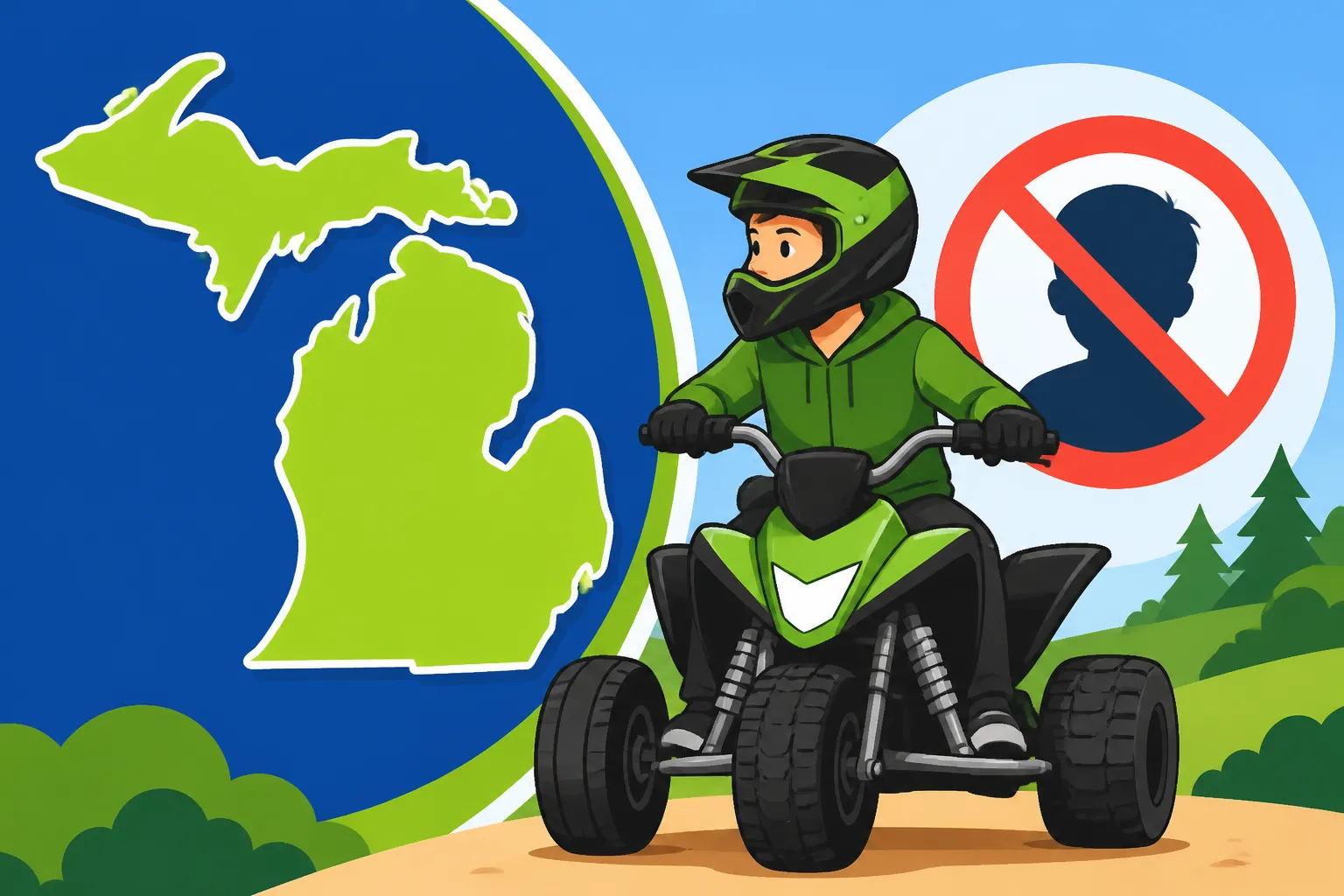
A three-wheel ATV can look like a loophole in Michigan’s youth riding rules, especially because one age restriction specifically names four-wheel ATVs. But three wheels do not automatically mean a young rider is exempt. Here’s how the under-16 supervision and safety-certificate rules apply, what the four-wheel restriction does and doesn’t establish, and what to check before riding on public land.
Michigan’s under-16 rule applies to three-wheel ATVs
Michigan’s youth rules are about operating an off-road vehicle on public lands, not simply about whether the machine has three or four wheels. According to the Department of Natural Resources, anyone under 16 must have a valid ORV safety certificate and be under the direct visual supervision of an adult to operate an ATV on public lands. The rule does not provide a general three-wheel exception.
That means a three-wheeler is not a way for a youth to ride unsupervised. Even if a machine is old, unusual, or marketed as a youth model, its wheel count does not replace the certificate and supervision requirements. An adult riding elsewhere on the property, or keeping in touch by phone, should not be treated as direct visual supervision; the supervisor needs to be able to see the young operator.
The general age rule and the separate restriction for younger children are easy to confuse. According to the Department of Natural Resources, children under 10 are prohibited from operating four-wheel ATVs on public lands. That statement specifically names four-wheel machines. It does not, by itself, establish that a child under 10 may operate a three-wheeler. Don’t read a narrowly worded restriction as permission for a different machine unless the applicable rule clearly says so.
For families deciding whether a child may ride a specific three-wheeler, the safe approach is to confirm the machine’s classification and the youth’s eligibility with the Michigan Department of Natural Resources before riding on public land. This is especially important with older machines, where the manufacturer’s description, current condition, and actual configuration may not match what a parent assumes from its appearance.
| Situation on public land | What the rule establishes |
|---|---|
| Rider under 16 on an ATV | A valid ORV safety certificate and direct visual supervision by an adult are required, according to the Department of Natural Resources. |
| Rider under 10 on a four-wheel ATV | The Department of Natural Resources prohibits operation on public lands. |
| Rider under 10 on a three-wheel ATV | The four-wheel restriction alone does not confirm eligibility. Check the specific machine and rule with the Department of Natural Resources. |
| Rider who is 16 or older | The Department of Natural Resources says operators must be at least 16 to operate an ATV unsupervised on public lands. Other riding and permit rules still apply. |
The word “unsupervised” matters. The general threshold for riding without supervision is not the same as permission to ride without training or to ignore other requirements. A rider who is under 16 still needs the certificate and adult supervision, and riders of any age need to follow the rules for the land and machine.
For a fuller overview of the age bands, see Michigan ORV Age Rules at 10, 12 and 16. If you’re focused on a three-wheeler’s age-specific treatment, Three-Wheelers and the Michigan Age Limit is also relevant. Those distinctions are worth checking before making a purchase or bringing a machine to a trailhead.
The under-10 four-wheel restriction is not a three-wheeler permission
The most tempting interpretation is that because Michigan’s stated under-10 prohibition refers to four-wheel ATVs, a child under 10 may ride a three-wheeler. That conclusion does not follow from the wording alone. A restriction on one type of machine does not establish the rules for another, and the broader under-16 requirements still matter.
According to the Department of Natural Resources, any youth under 16 operating an ORV on public lands must complete an approved safety course, carry a valid certificate, and ride under direct visual supervision of an adult. The facts also state that children under 10 are prohibited from operating four-wheel ATVs on public lands. They do not provide a separate affirmative eligibility rule for under-10 riders on three-wheel ATVs.
That leaves a practical question for parents: does the particular three-wheeler fall under the relevant ATV or ORV rule, and is the child eligible to operate it at that location? The machine’s three-wheel layout does not answer that question on its own. Confirm it with the Department of Natural Resources before treating the machine as an option for a young child.
Check the actual machine, not just the label
A family may use “three-wheeler” to describe any ATV with three wheels, but the exact machine details can matter when identifying what rules apply. Record the make, model, and configuration, and check any owner’s manual or manufacturer information that is available. If the machine has been modified, repaired, or converted, disclose that when asking for guidance.
It also helps to be precise about where the ride will take place. Michigan’s age requirements in the facts above concern public lands. A private property setting may involve different rules, but permission from a landowner does not automatically settle every safety, liability, or local requirement. Don’t assume that a rule for public trails applies identically to private property, or that permission removes all other obligations.
For general age guidance, Michigan Rules for 12- to 15-Year-Old Riders explains the youth range that most often raises questions. The page Michigan Age Rules on Private Property may also help separate public-land requirements from private-property considerations. When a child is near an age threshold, verify the exact rule rather than relying on a family member’s recollection or a seller’s assurance.
Don’t substitute experience for eligibility
A child who has ridden on private land for years may still need the required certificate and supervision on public lands. Skill can reduce some risks, but it does not replace a legal requirement. Likewise, a parent’s confidence in a child’s balance or judgment does not create an age exemption.
The same applies to a slow, small, or vintage three-wheeler. A modest engine or low speed may affect how the machine handles, but it does not by itself establish that a youth may ride unsupervised or bypass a safety course. Confirm the applicable age and supervision rules for the exact use.
Certificate and direct supervision are separate requirements
Under-16 riders need both the safety certificate and direct visual supervision on public lands. One does not replace the other. Having completed the course does not authorize a youth to ride alone, and adult supervision does not make the certificate optional.
According to the Department of Natural Resources, a youth under 16 must complete an approved ORV safety course and carry the safety certificate while operating an ORV on public lands. Keep the certificate accessible during the ride, rather than assuming it can be produced later from home. If the youth is a nonresident aged 12 to 15, Michigan law recognizes a comparable ORV safety certificate issued under another state’s or a Canadian province’s authority, according to the Michigan Legislature.
“Direct visual supervision” also deserves attention in planning. It means the adult needs to be in a position to observe the young rider, not merely available somewhere nearby. A riding group can spread out quickly on a trail, around turns, or through wooded terrain. If the adult cannot see the youth, the arrangement may not meet the ordinary meaning of direct visual supervision.
Before heading out, discuss how the adult will maintain sight of the youth and what the group will do if riders become separated. Choose a route and pace that make supervision realistic. If the group includes different ages or machines, keep the under-16 rider with the supervising adult rather than assuming another adult in the wider group is enough.
For details about the supervision standard, see What Direct Visual Supervision Actually Means. To review the course requirement and certificate basics, see Michigan ORV Safety Certificate for Riders Under 16. The course itself is not a substitute for checking that the certificate is valid and available for the ride.
Keep the course and machine choice connected
The safety course is part of the legal requirement, but training is most useful when it matches the riding situation. A three-wheeler can handle differently from a four-wheel ATV, and a young rider who has practiced on one configuration should not be assumed ready for another. Parents should consider the child’s size, experience, ability to reach controls, and capacity to follow instructions under changing conditions.
A rider’s ability to turn, stop, and manage uneven ground matters more than whether a machine looks manageable while parked. Before a public-land ride, make sure the youth understands how to stop, how to respond if the machine tips or stalls, and how to stay with the supervising adult. If the child cannot reliably follow those instructions, postponing the ride is the safer choice.
The certificate requirement is a minimum condition for riding, not a guarantee that a particular rider is ready for every terrain or machine. Parents still need to make a conservative judgment about fit and ability, and to follow any additional rules that apply at the location.
Public-land riding also involves permits and location rules
Meeting the youth age and supervision requirements does not automatically authorize a ride. Michigan requires an ORV license for public-land riding, and riding on state-designated ORV trails requires an additional trail permit. According to the Michigan Department of Natural Resources, the annual ORV license costs $26.25; the additional trail permit costs $10.00, making the combined cost $36.25. Those figures are stated as of October 2026.
The annual license and trail permit expire on March 31 of the following year, regardless of when they were purchased, according to the Michigan Department of Natural Resources. Check the current permit status before a ride, particularly if the family bought the machine or permit partway through the riding season.
A trail permit is not required for every type of ORV use. For example, the Department of Natural Resources says a trail permit is not required for riding on the frozen surface of public waters, although an ORV license is required. That is a specific exception; it should not be generalized to state-designated trails or other public-land riding.
For a broader breakdown of where each permit applies, see Do You Need Both a License and a Trail Permit in Michigan? and Michigan ORV License Without a Trail Permit: Where You Can Ride. If you are riding outside Michigan, Non-Resident ORV Permits in Michigan can help identify the separate questions nonresident families should check.
Permit rules are only one part of planning. The Department of Natural Resources can close state trails and facilities because of weather or wet conditions. Check current closures before traveling, and don’t assume a trail is open just because it was accessible on a previous visit. State forest roads are generally open year-round to ORV use unless posted otherwise or seasonally closed, according to the Department of Natural Resources.
A permit does not change the youth rule
A valid ORV license and trail permit do not let a rider under 16 ride unsupervised. Similarly, a youth safety certificate does not replace the required permit. Treat these as separate checks: confirm the rider is eligible and supervised, confirm the machine has the required permits, and confirm the route is open to that machine.
The same separation applies to local access. A route or road may have its own restrictions, even if the vehicle has a valid permit. If the ride includes roads designated for ORV use, review the rules for that specific route and the rider’s age. Michigan law says a person under 18 must either have a valid driver’s license or be under the direct supervision of a parent or guardian while holding an ORV safety certificate when operating on public roads designated for ORV use. The Michigan Legislature also says adults do not need a driver’s license for that use.
That road-specific rule is not a replacement for the under-16 rules on public lands. A parent planning a route that connects trails with designated roads should check both sets of requirements and keep the youth under the required supervision.
Safety checks matter on a three-wheeler
Legal eligibility is only the starting point. Before a ride, confirm the machine is in good working order and suited to the rider. A three-wheeler’s stability, controls, and turning behavior can differ from a four-wheel ATV. Do not assume that a child who fits a four-wheeler will be comfortable or safe on a three-wheeler.
Michigan’s general ORV safety rules also apply. According to the Michigan Legislature, operators and passengers generally must wear a Department of Transportation-approved crash helmet and protective eyewear. There are exceptions in certain circumstances, including some UTV configurations with an approved roof and properly fastened safety belts; those exceptions should not be assumed to apply to a three-wheel ATV.
If you’re buying protective equipment, confirm that the helmet meets the required standard rather than relying on a product title or general description. When comparing options on Amazon, check the product’s certification details and fit information; a listing alone should not be treated as proof of compliance. Eye protection should also fit securely and remain usable in dust, wind, and changing light.
Other operating rules can affect a family ride. The Michigan Legislature requires a United States Forest Service-approved spark arrester and a muffler in good working order and constant operation on ORVs operated on public lands. A passenger may not be carried unless the vehicle’s manufacturing standards or design explicitly provide for transporting passengers. That restriction is important on a three-wheeler: do not add a passenger simply because there appears to be room.
Headlights and taillights must be lighted from a half-hour after sunset to a half-hour before sunrise, according to the Michigan Legislature. A young rider should not be taken into darkness unless the machine and route are properly equipped and the ride is allowed. Michigan’s legal blood alcohol concentration limit for operating an ORV is 0.08 grams or more per 100 milliliters of blood, per 210 liters of breath, or per 67 milliliters of urine, according to the Michigan Legislature. Alcohol and youth riding do not mix, and responsible adults should remain capable of supervising and responding to an emergency.
These details are not reasons to overload a child with legal language at the trailhead. They are planning checks for the adults. Before departure, inspect the machine, verify the equipment, confirm the route and permits, and make sure the adult can maintain visual contact with the youth.
A practical pre-ride check for parents
Use a consistent check before each public-land ride. It helps avoid the common mistake of settling one question, such as the certificate, and assuming the rest is covered.
- Confirm the machine and rider. Identify the three-wheeler and verify that the youth is eligible to operate that specific type of machine at the intended location. Do not infer under-10 eligibility from the four-wheel restriction.
- Check the age requirements. If the rider is under 16, confirm the valid ORV safety certificate and arrange direct visual supervision by an adult. For the under-10 question on a three-wheeler, obtain a clear answer from the Department of Natural Resources before riding.
- Carry the certificate. Make sure the youth has the required certificate available during the ride, not merely completed the course at some point.
- Verify permits and access. Confirm the ORV license, any required trail permit, and whether the route is open to the machine. Check for closures and posted restrictions.
- Inspect protective gear. Confirm that required helmet and eye protection fit properly, and check the machine’s spark arrester, muffler, lights, and passenger design.
- Set supervision expectations. Choose a pace and route that allow the adult to keep the youth in view. Make a plan for stops and separation before the ride begins.
If any of those checks is uncertain, delay the public-land ride until it is resolved. That is a better outcome than arriving at a trail and relying on an assumption about the machine’s age category or the child’s eligibility.
Frequently Asked Questions
Can a child under 16 ride a three-wheel ATV alone on Michigan public lands?
No. According to the Department of Natural Resources, anyone under 16 operating an ATV on public lands must have a valid ORV safety certificate and be under an adult’s direct visual supervision. The three-wheel configuration does not create a general exception.
Does Michigan’s under-10 ban on four-wheel ATVs mean a child under 10 can ride a three-wheeler?
Not based on that rule alone. The Department of Natural Resources’ restriction specifically prohibits children under 10 from operating four-wheel ATVs on public lands. It does not, by itself, confirm eligibility for under-10 riders on three-wheelers. Verify the specific machine and rule with the Department of Natural Resources.
Does an ORV safety certificate let a rider under 16 ride without an adult?
No. The certificate and direct visual supervision are separate requirements. A youth under 16 needs both on public lands, according to the Department of Natural Resources.
Does a valid trail permit override age restrictions?
No. Permits and youth eligibility are separate requirements. A permit does not remove the under-16 certificate and supervision rules, and the youth requirements do not replace any permit needed for the route.
Sources
- Michigan Department of Natural Resources — ORV FAQs – State of Michigan (checked October 28, 2026)
- Michigan Department of Natural Resources — Purchase permit, learn requirements – State of Michigan (checked October 28, 2026)
- Michigan Legislature — MCL – Section 324.81131 (checked October 28, 2026)
- Michigan Legislature — MCL Section 324.81134 (checked October 28, 2026)
Disclaimer
This article is for general informational purposes only and does not constitute professional advice. Laws, prices and regulations vary by location and change over time. Consult a qualified professional for guidance on your specific situation.