ORV Safety Course Online vs In Person
ORV Safety Course Online vs In Person
Choosing an ORV safety course is not just a question of convenience. Michigan youth need an approved course and a valid certificate to ride on public lands, but an online option is useful only if it meets the state’s requirements. Here’s how to compare online and in-person training, check that a certificate will count, and choose a format that fits the rider.
What Michigan requires before a young rider uses public lands
Michigan’s course requirement applies to youth riding off-road vehicles on public lands. According to the Department of Natural Resources, anyone under 16 must complete an approved ORV safety course and carry a valid safety certificate to operate an ORV on public lands. A course completion record that is not accepted as an official certificate may not meet that requirement, so confirm what the provider issues before enrolling.
The course is one part of the rules, not a substitute for supervision or age limits. According to the Department of Natural Resources, an operator under 16 must be under the direct visual supervision of an adult on public lands. The same agency says children under 10 are prohibited from operating four-wheel ATVs on public lands altogether. Completing training does not override that restriction.
For riders who can legally operate, direct visual supervision means the adult must be able to see the youth rider. The details matter in practice: a supervising adult should be positioned to observe the rider, rather than relying on a phone call, a general plan to meet later, or someone else’s account of what happened. For more on this requirement, see What Direct Visual Supervision Actually Means.
Requirements can differ depending on where the machine is being used. A rule for public lands should not automatically be treated as a rule for private property, a county road, or a trail system in another state. According to the Department of Natural Resources, Michigan’s under-16 certificate requirement applies to operating an ORV on public lands. Check the rules that apply to the actual riding location, and get permission before using private land.
It also helps to know what Michigan means by an ATV and a UTV. According to the Michigan Department of Natural Resources, there are three ORV trail types by width: motorcycle-only trails maintained at a 24-inch width, trails maintained at a 50-inch width, and ORV routes maintained at a minimum 72-inch width. A course may help a rider understand general operating risks, but a parent should still make sure its instruction and examples fit the machine the youth will use.
For an overview of the certificate requirement, read Michigan ORV Safety Certificate for Riders Under 16. To review age rules in more detail, see Michigan ORV Age Rules at 10, 12 and 16. These distinctions are worth settling before picking a course: a certificate is important, but it does not make an otherwise prohibited ride legal.
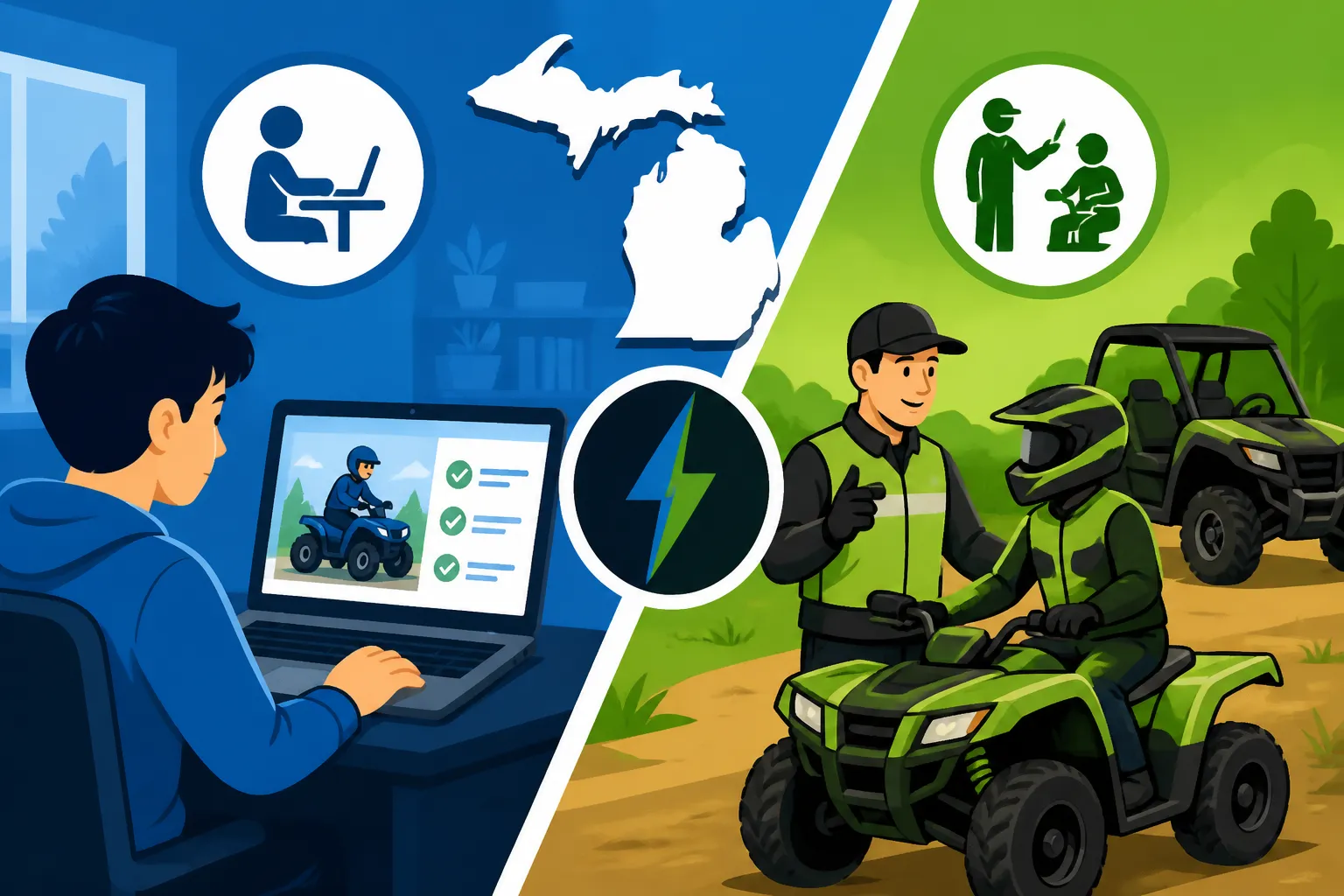
Online vs in-person training: what each format is good for
An online course can make it easier to study at home and work through material at a comfortable pace. Depending on the provider, a learner may be able to pause and revisit lessons, which can help when a concept needs more explanation. It can also be a convenient fit when attending a scheduled class would be difficult.
The trade-off is that online learning may not provide the same chance to ask an instructor questions in the moment or practice a skill with direct feedback. A young rider can finish the lessons without having demonstrated how they apply safety ideas to the particular ATV or UTV they will operate. Parents can fill some of this gap by discussing the material and practicing safe habits together, but that is not a replacement for whatever the approved course requires.
In-person instruction offers a scheduled learning environment and a chance to interact directly with an instructor. A rider may find it easier to ask questions, hear how a concept applies to a real situation, and stay focused in a class setting. Where the course includes practical instruction, that format may also make it easier for the learner to connect the material with how a machine behaves.
The trade-off is scheduling and travel. An in-person class may require the family to plan around a set time and location. It may also be a less comfortable fit for a learner who needs extra time to process information or who learns better by reviewing material independently.
Neither format is automatically better for every rider. The important first question is whether the specific course is approved and whether it results in a certificate Michigan accepts. After that, compare the teaching format with the rider’s needs and experience.
| Consideration | Online course | In-person course |
|---|---|---|
| Schedule | May offer more flexibility; confirm how the provider schedules access and completion | Usually requires attendance at a scheduled session |
| Questions | Check how the provider handles questions and support | Direct conversation with an instructor may be available |
| Practice | Ask whether any practical component is required or offered | Ask whether instruction includes practical activities |
| Learning style | Can suit learners who prefer self-paced review | Can suit learners who benefit from live instruction |
| Certificate | Confirm that the course is approved and that completion produces an accepted certificate | Confirm approval and what certificate or record is issued |
| Best next step | Verify recognition before paying or beginning | Verify recognition and attendance requirements before registering |
This comparison describes common format trade-offs, not a guarantee about any specific provider. Course content, instructor access, testing, practical components, and certificate delivery can differ. Do not assume that every class advertised as “online” or “hands-on” meets Michigan’s requirement.
For a closer look at the two training approaches, see Hands-On ORV Safety Training in Michigan. If considering a remote option, Online ORV Safety Course Providers can help you focus on the questions to ask before choosing.
How to check whether an online course and certificate count
The word “online” describes a delivery format. It does not, by itself, prove that a course is approved for Michigan or that its certificate meets Michigan’s requirement. Before enrolling, verify the specific provider and course rather than relying on a search result, a general statement that the course is state-approved, or an old certificate image posted by another rider.
Use this checklist when evaluating a course:
- Confirm Michigan approval. Ask whether the exact course is approved for Michigan ORV safety certification. If approval is unclear, check with the Michigan Department of Natural Resources before proceeding.
- Ask what document the rider receives. Find out whether successful completion results in a valid ORV safety certificate, rather than only a receipt, course completion screen, or attendance record.
- Check how the certificate is delivered. Ask how the rider or parent can access the certificate after completion and what to do if it is misplaced.
- Clarify completion requirements. Find out what the learner must do to finish the course, including any required assessment, participation, or in-person component. Do not assume the rules from one provider apply to another.
- Verify the course is appropriate for the rider. Ask the provider whether the course is designed for a youth rider and whether any eligibility conditions apply.
- Check what proof to keep. Ask whether the rider needs to carry the certificate, and whether a digital version is acceptable. The Department of Natural Resources says an eligible youth must carry a valid safety certificate while operating on public lands.
- Save confirmation. Keep the provider’s course details and completion information with the certificate. If anything about the record is ambiguous, resolve it before heading out.
A parent or guardian should be involved in this check, especially when the rider is young. The learner may understand the course material but not know how to judge whether the provider’s description addresses Michigan’s rules. A quick confirmation before enrollment is easier than discovering that a certificate does not meet the requirement at the riding location.
When comparing courses, be cautious of broad claims. “National,” “recognized,” or “accepted” can mean different things depending on who is using the term. Ask a direct question: is this specific course approved for Michigan, and will its certificate satisfy Michigan’s requirement for an under-16 rider on public lands? If the answer is vague, verify with the state agency before relying on it.
The certificate is not the only proof or document a family may need for a ride. Permit requirements depend on where and how the ORV is being used. For example, according to the Michigan Department of Natural Resources, using state-designated ORV trails requires a trail permit in addition to the base ORV license. Course certification and riding permits address different requirements; one does not replace the other. For permit details, see Michigan ORV Safety Certificate for Riders Under 16 and the relevant permit information for the planned riding area.
Nonresident families should check certificate acceptance separately. According to the Michigan Legislature, nonresident operators aged 12 to 15 must present a Michigan Part 811 ORV safety certificate or a comparable certificate issued under another state’s or a Canadian province’s authority. This does not mean that any course from outside Michigan will qualify; confirm that the certificate is comparable and accepted. Safety Certificate Reciprocity for Michigan Riders covers the recognition question in more detail.
Choosing the format that fits the rider and the ride
Start with the learner, not the platform. A rider who can stay focused on a screen, read instructions carefully, and ask for help when confused may find an online course manageable. A rider who benefits from live discussion, reminders to stay on task, or immediate feedback may do better in person. Some learners prefer one format for studying and another for practical instruction, if the approved provider offers that combination.
Consider what the rider has already done. A youth who has spent time around machines may recognize controls and terminology, but familiarity is not the same as safe judgment. A new rider may need more discussion of what can go wrong and how to respond. In either case, the family should treat the course as a foundation rather than a guarantee that the rider is ready to go out alone.
The planned machine also matters. An ATV and a UTV differ in size, seating, and how the operator interacts with passengers. According to the Michigan Legislature, a passenger may be carried only when the vehicle’s design or manufacturing standards provide for transporting passengers. A young operator should understand that a UTV’s extra seats do not make it safe or lawful to carry someone in a machine not designed for passengers.
Parents can make the training more useful by connecting it to the ride they are planning. Before the first outing, review the machine’s controls and operating instructions, check that the rider understands where the route goes, and agree on what to do if visibility is lost or the group becomes separated. Practice should happen in an appropriate, permitted setting with close adult supervision. It should not be treated as permission to enter public land before the certificate and age requirements are met.
The rules that apply during the ride are broader than course completion. According to the Michigan Legislature, ORV operators and passengers generally must wear a Department of Transportation-approved crash helmet and protective eyewear, with exceptions under certain conditions. A UTV’s safety equipment and properly fastened seat belts may affect whether a helmet exemption applies, but families should verify the conditions rather than assume a roof alone is enough. Training cannot replace the equipment rules.
Families should also check machine condition and riding conditions before leaving. Michigan law requires a spark arrester and muffler in good working order and constant operation on ORVs operated on public lands, according to the Michigan Legislature. The Michigan Department of Natural Resources can close state trails and facilities because of weather or wet conditions. A course certificate does not provide access to a closed trail, so check the destination before setting out.
A sensible decision process is:
- Confirm the rider is legally eligible for the planned activity and location.
- Check Michigan approval and certificate details for the exact course.
- Choose online or in-person instruction based on how the rider learns and what support is available.
- Make sure the rider receives and knows how to carry the valid certificate.
- Review local riding, equipment, supervision, and permit rules before the trip.
If the learner struggles with self-paced study, has questions that are not being answered, or cannot explain the safety ideas in their own words, pause and ask the provider for help. If an online course does not offer enough support, an in-person option may be a better fit. Conversely, if travel or scheduling makes a live class impractical, a verified online course may be a useful route, provided it is approved and produces the certificate Michigan requires.
Common mistakes to avoid
Assuming any online certificate is accepted. A course can look relevant without satisfying Michigan’s approval requirement. Verify the exact course and certificate with the provider and, if necessary, the Department of Natural Resources.
Treating a certificate as permission to ride without supervision. According to the Department of Natural Resources, a rider under 16 must be under direct visual supervision of an adult on public lands. Passing a course does not remove that condition.
Confusing course completion with eligibility. According to the Department of Natural Resources, children under 10 may not operate four-wheel ATVs on public lands. A completed course does not change that rule.
Leaving certificate proof at home. The Department of Natural Resources requires eligible youth to carry a valid safety certificate while operating on public lands. Know where the certificate is and how to access it before riding.
Assuming the same rules apply everywhere. Public lands, private property, designated routes, and roads can have different requirements. Identify the exact place and type of riding before relying on general advice.
Skipping the adult’s role. A course is not a substitute for an adult checking the machine, choosing a suitable route, monitoring conditions, and maintaining the required visual supervision. If the adult cannot keep the youth in view, the ride does not meet the direct-supervision standard described by the Department of Natural Resources.
Waiting until the day of the ride to check a course. Approval, access, certificate delivery, and course completion requirements can take time to confirm. Resolve those questions before making plans around a particular outing.
For certificate questions and age rules, Michigan ORV Safety Certificate for Riders Under 16 is a useful next read. If the rider is coming from outside the state, check Non-Resident ORV Permits in Michigan and Safety Certificate Reciprocity for Michigan Riders rather than assuming that another state’s paperwork automatically carries over.
Frequently Asked Questions
Does Michigan accept every online ORV safety course?
No. Michigan requires an approved course for youth who need an ORV safety certificate. Confirm that the exact online course is approved and that it issues a certificate Michigan accepts.
Can a youth ride alone after completing the course?
No. According to the Department of Natural Resources, an operator under 16 must be under direct visual supervision of an adult while operating on public lands. The certificate does not remove that requirement.
Does completing the course let a child under 10 ride a four-wheel ATV on public lands?
No. According to the Department of Natural Resources, children under 10 are prohibited from operating four-wheel ATVs on public lands. Course completion does not override the restriction.
Should a family choose online or in-person training?
Choose the approved format that best supports the rider’s learning and questions. Verify approval and certificate acceptance first; then weigh flexibility, instructor access, and whether the rider needs more direct support.
Sources
- Michigan Department of Natural Resources — Purchase permit, learn requirements – State of Michigan (checked October 28, 2026)
- Michigan Department of Natural Resources — ORV FAQs (checked November 2, 2026)
Disclaimer
This article is for general informational purposes only and does not constitute professional advice. Laws, prices and regulations vary by location and change over time. Consult a qualified professional for guidance on your specific situation.