Recreation Passport vs ORV Trail Permit in Michigan
Michigan riders can easily confuse a Recreation Passport with an ORV license or trail permit, especially when one trip includes roads, trails, and recreation areas. They serve different purposes, and having one does not automatically cover the others. Here’s how to tell what your ATV or UTV needs, when the extra trail permit applies, and what to check before setting out.
The key difference: site access versus ORV riding permission
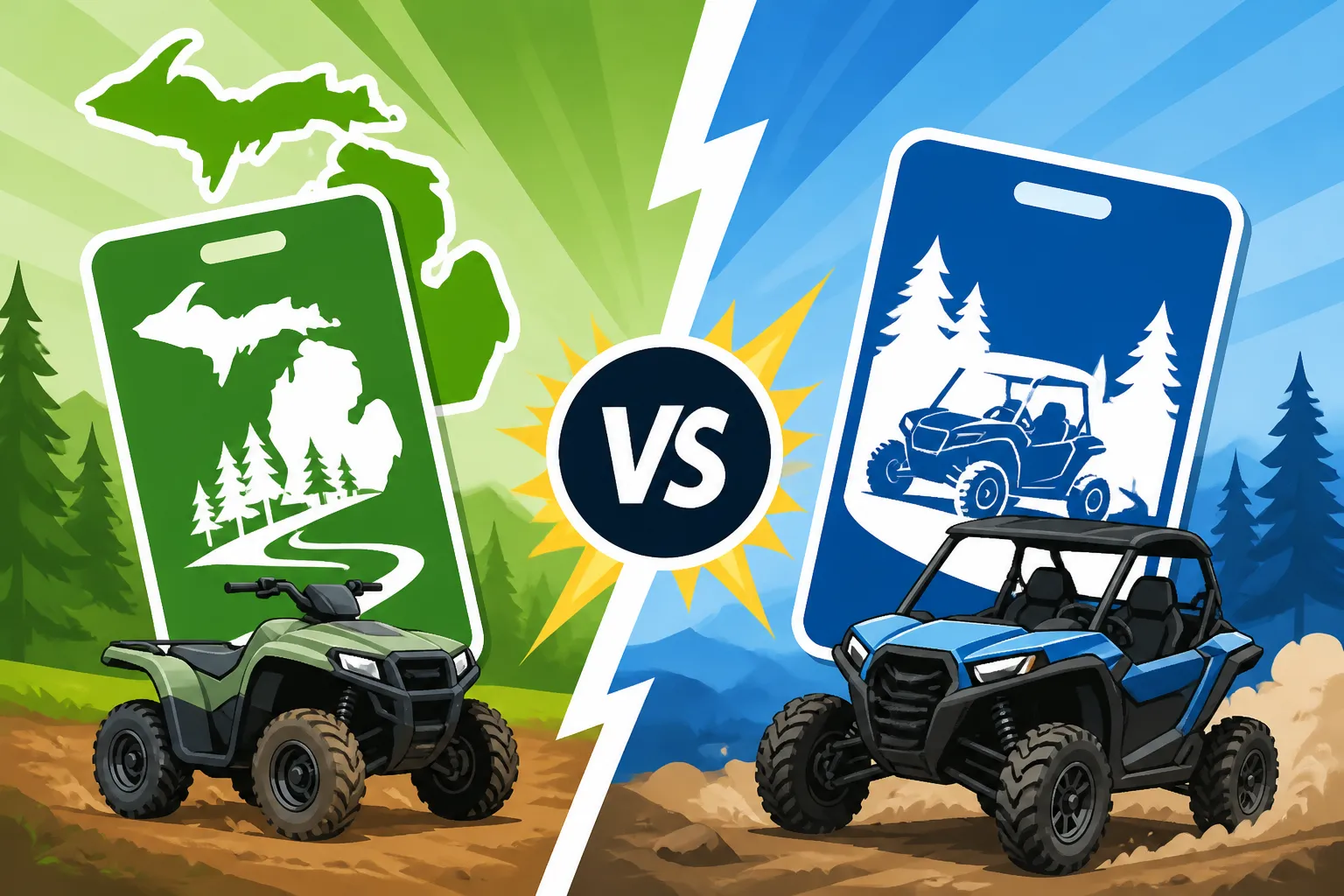
A Recreation Passport and an ORV trail permit are not interchangeable. The ORV license and trail permit relate to operating an off-road vehicle under Michigan’s ORV rules. A Recreation Passport is a separate access credential associated with recreation sites; check Michigan Department of Natural Resources guidance to confirm whether and how it applies to the particular place you plan to visit.
That distinction matters because a vehicle can be properly permitted for a ride but still need to meet a site’s separate entry requirements. The reverse is true, too: having a Recreation Passport does not serve as an ORV license or as the required trail permit for a state-designated ORV trail.
| Item | What it relates to | What it does not replace |
|---|---|---|
| ORV license | Operating an ORV where the license is required | A trail permit required for state-designated ORV trails |
| ORV trail permit | Riding on state-designated ORV trails | The base ORV license or a site-access credential |
| Recreation Passport | Access rules for applicable recreation sites | The ORV license or trail permit required for riding |
| Site-specific rules | Entry, vehicle use, closures, or other conditions at a particular location | The permits required by Michigan’s ORV rules |
The practical approach is to treat these as separate questions. First, identify where the machine will be ridden and determine which ORV credentials apply. Then check whether the trailhead, park, or other recreation site has a separate entry requirement. Finally, look for local restrictions or closures before you travel.
Why the names cause confusion
“Passport,” “license,” and “permit” sound like versions of the same document, but the names refer to different requirements. In this context, the ORV license is the base riding credential. The trail permit is an additional credential for a particular kind of route. The Recreation Passport concerns site access rather than permission to ride a state-designated ORV trail.
If you’re comparing the ORV credentials themselves, Michigan ORV License and Trail Permit Explained and Do You Need Both a License and a Trail Permit in Michigan? provide useful related information. For the Recreation Passport side of the question, Michigan Recreation Passport Cost and Renewal and Recreation Passport at Michigan Trailhead Lots can help you investigate site-access details. Confirm current requirements with the Michigan DNR before relying on an assumption about a particular location.
A simple way to think about it
Imagine a trip that starts at a recreation site, continues along a road, and then enters a state-designated ORV trail. The Recreation Passport question concerns access to the applicable site. The ORV license question concerns the machine’s authority to operate where that license is required. The trail-permit question arises when the route includes a state-designated ORV trail.
Do not assume that buying one item covers the entire outing. Make a short list of every place and route on your itinerary, then check both entry requirements and ORV requirements for each. This is especially useful when your starting point is a trailhead or recreation area with its own access rules.
Which credential applies to your route
The route, not just the type of machine, determines what to check. A trail permit is specifically required for state-designated ORV trails. Other situations may have different requirements, so avoid treating “I’m riding on public land” as a complete answer.
According to the Michigan Department of Natural Resources, the annual ORV license costs $26.25, and operating on state-designated ORV trails requires an additional $10.00 trail permit. As of October 2026, the combined cost is $36.25. The Recreation Passport is separate from those ORV credentials.
| Planned use | What to check |
|---|---|
| State-designated ORV trail | ORV license and the additional trail permit |
| Frozen surface of public waters | ORV license; the Michigan DNR says a trail permit is not required for this specific use |
| State forest road | Whether the road is open to ORVs and whether it is posted or seasonally closed; confirm the applicable ORV credential for that route |
| Recreation site or trailhead | Whether a Recreation Passport or another site-access requirement applies |
| Route combining several types of access | Each segment’s ORV requirements, site-entry conditions, and any closures |
State-designated trails
If your ride includes a state-designated ORV trail, plan on the base ORV license plus the additional trail permit. That requirement is the clearest point of difference between the ORV credentials: a base license by itself does not satisfy the extra permit requirement for those trails.
If you are specifically trying to ride without a trail permit, do not rely on a map label or a casual description of a route. Confirm whether the route is a state-designated ORV trail and what rules apply to it. Michigan ORV License Without a Trail Permit: Where You Can Ride can help you think through the distinction, but verify the route with official Michigan DNR information before riding.
State forest roads and changing conditions
State forest roads are a separate route type from state-designated ORV trails. According to the Michigan Department of Natural Resources, state forest roads are generally open year-round to ORV use unless they are otherwise posted or seasonally closed. That does not mean every road is open, or that a trail permit is required or unnecessary for every possible connection on a planned ride. Check the specific road and the rules for any adjoining trail.
Conditions can also change after you plan your trip. The Michigan Department of Natural Resources has authority to close state trails and facilities because of weather-related events and wet conditions. A map or a previous visit may not reflect a current closure. Check for notices before leaving, especially after heavy rain or other weather that could affect access.
Frozen public waters and private land
Riding on a frozen lake or other public water has a distinct permit rule. According to the Michigan Department of Natural Resources, an ORV license is required to operate on the frozen surface of public waters, but a trail permit is not required for that specific use. For details focused on that setting, see Michigan ORV Permit Rules for Frozen Lakes.
Private property is another case where riders should avoid broad assumptions. Exemptions can depend on the land and circumstances, and permission to ride on private land is not the same thing as permission to use public trails or facilities. Check the details in Michigan ORV Permit Exemptions on Private Land and confirm what applies to the property you will use.
Cost, purchase timing, and expiration
For budgeting, separate the base ORV license from the trail permit. According to the Michigan Department of Natural Resources, as of October 2026, the annual ORV license costs $26.25. The additional trail permit costs $10.00, bringing the combined cost to $36.25 for a rider who needs both.
Those amounts do not include a Recreation Passport. Because it is separate, do not add it to an ORV permit total without first checking whether your trip requires one for the specific recreation site. Likewise, do not assume that a site-access credential makes up for a missing ORV license or trail permit.
The amount you need depends on what you plan to ride. Someone whose route includes a state-designated ORV trail needs to account for both ORV items. Someone riding only in a situation with a different stated rule should verify that situation directly rather than purchasing or skipping a credential based on a general impression. The Michigan DNR is the place to confirm current rules and purchase details.
Check the expiration date, not just the purchase date
An annual ORV license and trail permit do not necessarily cover a full year from the day you buy them. According to the Michigan Department of Natural Resources, annual Michigan ORV licenses and trail permits expire on March 31 of the following year, regardless of their purchase date.
That makes purchase timing important if you buy late in the season. Before paying, check the permit year and expiration date so you understand how much of the riding season the credentials cover. The rule also matters when planning a trip that crosses the end of a permit year: credentials that worked on an earlier ride may no longer be valid after their expiration date.
For a fuller explanation of the annual cycle, see Michigan ORV Permit Year: April 1 to March 31. If you are comparing the Recreation Passport’s terms or renewal process, check its current details separately rather than assuming the ORV permit calendar also applies to it.
Keep the records and machine details straight
A useful pre-trip check is to confirm that the credential applies to the machine and the route you actually intend to use. If you ride more than one ATV or UTV, do not assume a permit associated with one machine automatically covers another. Confirm the Michigan DNR’s current rules for the credential you are purchasing.
Keep your permit information accessible and make sure any required display or documentation instructions have been followed. The ORV permit and Recreation Passport may be checked in different contexts, so knowing which item applies to which part of the trip can save time if someone asks about your access or riding permission. For practical storage ideas, Keeping Your ORV Paperwork With the Machine may help.
Check rider eligibility and basic ORV rules too
Sorting out permits is only one part of a legal ride. Rider age, supervision, equipment, and the kind of vehicle all matter. These rules do not turn a Recreation Passport into an ORV credential; they are additional conditions to consider when deciding whether a rider and machine are ready for the planned route.
According to the Michigan Department of Natural Resources, operators must be at least 16 years old to operate an ATV unsupervised on public lands. Anyone under 16 must have a valid ORV safety certificate and be under an adult’s direct visual supervision. Children under 10 are prohibited from operating four-wheel ATVs on public lands.
The Michigan Department of Natural Resources also says youth under 16 must complete an approved ORV safety course and carry their safety certificate to operate an ORV on public lands. If a youth rider is coming from outside Michigan, the Michigan Legislature requires non-resident operators aged 12 to 15 to present a Michigan Part 811 safety certificate or a comparable certificate issued under another state’s or a Canadian province’s authority. Confirm the details for the rider’s age and situation before the trip.
Road access can introduce another set of conditions. According to the Michigan Legislature, adults do not need a driver’s license to operate an ATV on public roads designated for ORV use. Individuals under 18 must either have a valid driver’s license or be under the direct supervision of a parent or guardian while holding an ORV safety certificate. A road designated for ORV use is not automatically a state-designated ORV trail, so check which permit requirement applies to each part of the route.
Know which kind of vehicle you are riding
The categories used in Michigan’s ORV rules are not simply interchangeable everyday labels. According to the Michigan Department of Natural Resources, there are three ORV trail types designated by width: motorcycle-only trails maintained at a 24-inch width, trails maintained at a 50-inch width, and ORV routes maintained at a minimum 72-inch width.
Those definitions can affect where a vehicle may travel, so check route restrictions for your machine rather than assuming that a trail open to one kind of ORV is suitable for every ATV or UTV. A Recreation Passport does not resolve vehicle-width restrictions, and a trail permit does not by itself establish that a particular machine is allowed on every route.
Safety and equipment requirements still apply
Permits do not excuse riders from equipment rules. According to the Michigan Legislature, ORV operators and passengers generally must wear a Department of Transportation-approved crash helmet and protective eyewear. Exceptions can apply in particular circumstances, including certain UTV configurations; verify the details for the machine and ride rather than assuming that all UTV occupants are exempt.
The Michigan Department of Natural Resources says a UTV occupant seeking to ride without a crash helmet must have a roof that meets the applicable standard and properly adjusted and fastened safety belts. The Michigan DNR also says each occupant must wear a seat belt in the Silver Lake ORV Area. Check area-specific rules as well as the general requirement.
Other equipment rules may be relevant to a particular ride. The Michigan Legislature requires a United States Forest Service-approved spark arrester and a muffler in good working order and constant operation on ORVs operated on public lands. It also requires a lighted headlight and taillight during the period from a half-hour after sunset to a half-hour before sunrise. These are riding obligations, not substitutes for permits.
Avoid common mistakes before you head out
The simplest way to prevent a permit mix-up is to make the route specific. “Going riding in Michigan” is too broad to answer whether you need a trail permit or a Recreation Passport. Identify the site where you will park, the road or route you will travel, and whether the outing includes a state-designated ORV trail.
Before departing, use this checklist:
- Identify each trail, road, water surface, and recreation site on the itinerary.
- Confirm whether any part of the route is a state-designated ORV trail.
- Check whether the ORV license and, where required, the trail permit are valid for the trip.
- Check separately whether the recreation site has a Recreation Passport or other entry requirement.
- Verify current closures, posted restrictions, seasonal conditions, and vehicle-width limits.
- Confirm that each rider meets the age, supervision, and safety-certificate rules that apply.
- Check required safety equipment and any site-specific rules for helmets and seat belts.
The most common error is treating a credential as an all-purpose pass. A Recreation Passport should not be used as proof that an ORV has the required license or trail permit. An ORV trail permit should not be treated as proof that a recreation site’s separate entry requirement has been met. And a machine that is permitted for one route is not necessarily permitted on every connecting route.
Another frequent problem is planning around a route that has changed. The Michigan Department of Natural Resources can close state trails and facilities because of weather or wet conditions, and state forest roads may be posted or seasonally closed. Check current notices rather than relying solely on a saved map, an old trip plan, or what another rider remembers.
If an ORV is operated without a required trail permit, there may also be a penalty. According to the Michigan Legislature, operating an ORV without the required trail permit is a state civil infraction carrying a civil fine of not more than $500, as of October 2026. The better solution is to confirm the route and credential requirements before riding.
For a trip that includes a trailhead or recreation site, write down the two separate answers: what the ORV needs to ride the route, and what the site requires for access. That small distinction makes it easier to buy the right credentials, avoid paying for an assumption, and spot gaps in the plan before you arrive.
Frequently Asked Questions
Does a Recreation Passport replace a Michigan ORV trail permit?
No. The Recreation Passport and ORV trail permit serve different purposes. The ORV trail permit is required for state-designated ORV trails, in addition to the base ORV license. Check the Michigan DNR for any separate site-access requirement.
Do I need both an ORV license and a trail permit?
For operating on state-designated ORV trails, yes. According to the Michigan Department of Natural Resources, the annual ORV license is $26.25 and the additional trail permit is $10.00, for a combined total of $36.25 as of October 2026. Other uses may have different requirements.
Is a trail permit required on frozen public water?
According to the Michigan Department of Natural Resources, an ORV license is required to operate on the frozen surface of public waters, but a trail permit is not required for that specific use.
When do annual ORV credentials expire?
According to the Michigan Department of Natural Resources, annual ORV licenses and trail permits expire on March 31 of the following year, regardless of when they were purchased.
Sources
- Michigan Department of Natural Resources — Operator age restrictions (checked October 28, 2026)
- Michigan Department of Natural Resources — Purchase permit, learn requirements – State of Michigan (checked October 28, 2026)
- Michigan Department of Natural Resources — Age restrictions and safety certificate (checked October 28, 2026)
- Michigan Legislature — MCL – Section 324.81131 (checked October 28, 2026)
- Michigan Legislature — Michigan Compiled Laws, Section 324.81147 (checked October 28, 2026)
Disclaimer
This article is for general informational purposes only and does not constitute professional advice. Laws, prices and regulations vary by location and change over time. Consult a qualified professional for guidance on your specific situation.