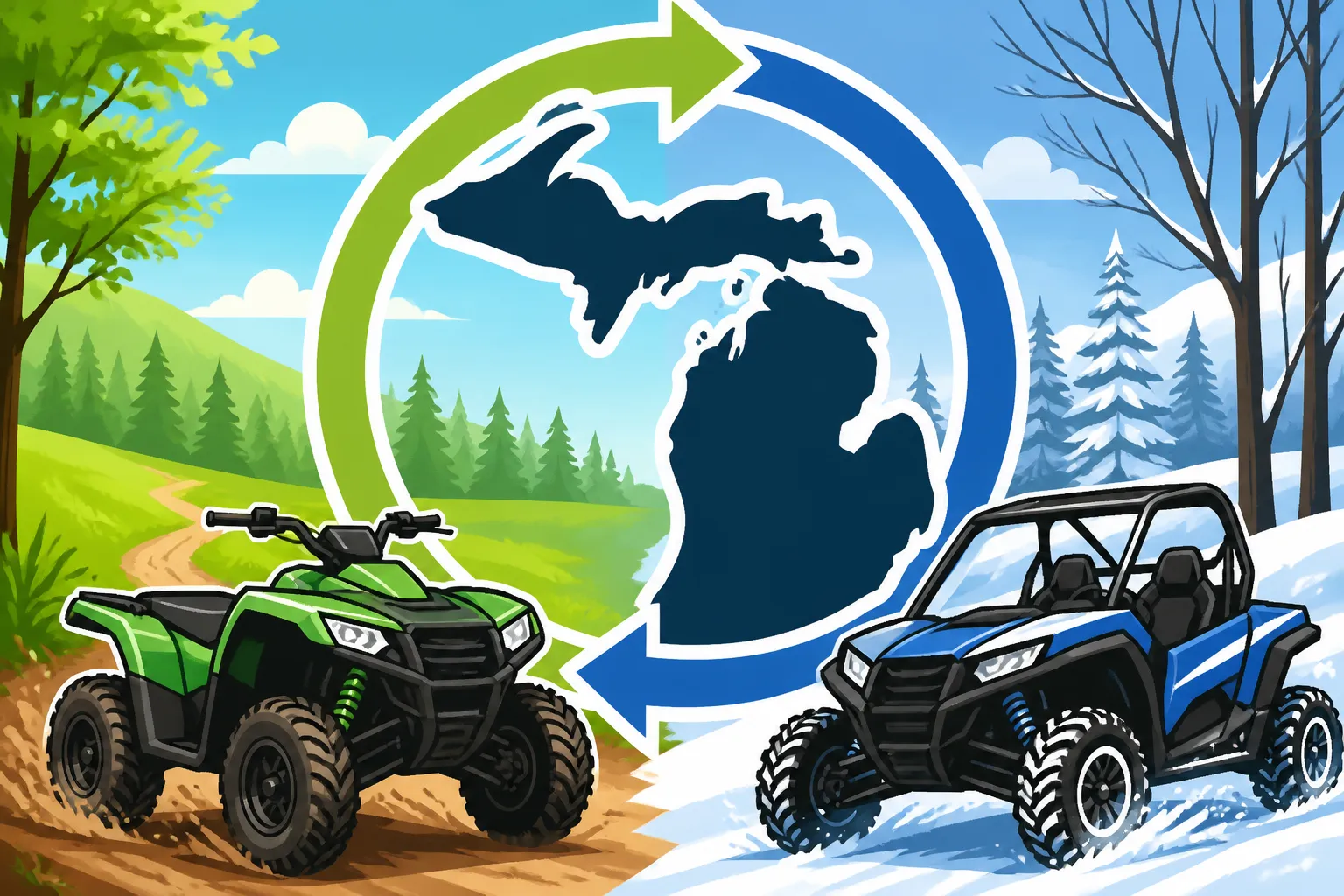
Michigan ORV Permit Year: April 1 to March 31
Michigan’s ORV permit dates can be confusing because the riding season doesn’t necessarily match the permit year. If you ride across spring, buy a machine mid-season, or travel to Michigan from another state, the key is knowing when your permit expires and which permits your ride requires. Here’s how the April 1 to March 31 cycle works and how to avoid a gap.
How Michigan’s ORV permit year works
Michigan’s ORV permit year runs from April 1 through March 31. A permit is tied to that annual cycle, not to the date you bought your machine or the date you first went riding. When the cycle ends, a permit from that year no longer covers riding in the next one.
That calendar matters most when you ride in early spring. A permit purchased during one permit year does not automatically carry over just because you bought it near the end of the year. Check the dates shown for the permit before you buy, especially if you’re purchasing in March or planning to ride on April 1.
Michigan has two permits riders commonly need to consider:
- ORV license: Required for many ORVs operated on public lands and roads open to ORVs, subject to exemptions.
- ORV trail permit: An additional permit required for designated ORV trails and certain riding areas.
They serve different purposes. An ORV license doesn’t automatically mean you can ride everywhere that requires a trail permit. The rules for your particular route or riding area determine which permits you need. For a closer comparison, see Michigan ORV License and Trail Permit Explained and Do You Need Both a License and a Trail Permit in Michigan?.
| Permit or issue | What to check | Why the April 1 to March 31 cycle matters |
|---|---|---|
| ORV license | Whether your machine and planned riding location require one | A license from the previous permit year won’t cover the new cycle |
| ORV trail permit | Whether your planned trail or riding area requires it | It may be required in addition to the ORV license |
| Private-land riding | Whether an exemption applies to your specific situation | An exemption for private property does not necessarily apply to nearby public land |
| Out-of-state machine | Whether registration or an exemption is recognized in Michigan | Do not assume another state’s paperwork replaces Michigan permits |
| March purchase | The permit’s effective dates and end date | A late-season purchase may have limited time before the cycle changes |
The permit year is separate from the state’s riding rules, local road ordinances, and trail opening or closing dates. A valid permit doesn’t make a closed trail open, and it doesn’t give you permission to ride on a road where ORVs aren’t allowed. Check the route rules as well as the permit dates.
Which permits you need for a ride
Start with where you plan to ride, not simply with whether your machine has a sticker. Michigan’s ORV rules can apply differently on public land, designated trails, local roads, private property, and certain riding areas.
For many riders using public ORV routes, the ORV license is the basic permit to check. If the ride includes a designated ORV trail or a riding area that requires the additional trail permit, you may need both. Some roads are open to ORVs only under local rules, and those rules can impose requirements beyond the state permit.
A quick way to plan is to break a ride into its parts:
- Identify every place you’ll ride. List trails, routes, state land, local roads, private property, and any managed riding area.
- Check the permit requirement for each part. A route that is legal to ride may still require a specific permit.
- Look for local rules. County and township ordinances can determine whether ORVs may use particular roads and what restrictions apply.
- Confirm the permit year. Make sure the permit is valid on the actual ride date, not just the date you bought it.
- Keep proof available. Follow current instructions for displaying the permit and keep any purchase confirmation or other required documents accessible.
For example, a rider might have a current ORV license but still need a trail permit for a designated trail. Another rider may be using a local road that is open to ORVs under an ordinance; the permit requirements for that road may differ from those for a designated trail. The name of a place or route alone doesn’t tell you which permits apply. Check the rules for the specific segment.
If you plan to ride only in a location where a permit exemption may apply, read the exemption carefully. Private-land rules are not a general pass to ride public roads, state land, or neighboring property. Michigan ORV Permit Exemptions on Private Land explains the distinction.
Also keep a permit separate from other documents that may be relevant. A title establishes ownership; it is not an ORV permit. A vehicle registration from another state may be relevant to an exemption or reciprocity question, but it should not be treated as a substitute without confirming Michigan’s current rule. For title and ownership questions, see How to Title an ATV in Michigan.
What changes when the permit year turns over
The transition between March 31 and April 1 is a useful point to review your paperwork. A permit valid during one cycle does not remain valid indefinitely. If you ride after the cycle ends, confirm that you have the permits required for the new cycle before heading out.
This catches riders who store a machine for winter and assume last season’s sticker is still good when they bring it out in spring. It also affects people who buy a used ATV or UTV near the end of the season. The machine may have a sticker on it, but that does not prove it is valid for your ride date or that it covers the location you intend to use.
A permit is not something to rely on based on appearance alone. Check the printed or electronic purchase record and the current instructions for the permit. If the machine came with an old sticker, ask the seller what it represents and verify the status yourself. A sticker can be out of date, damaged, or associated with a previous permit year.
When you buy a machine mid-season, consider these questions before riding:
- Is the existing permit valid for the date of your planned ride?
- Does it belong to the correct permit year?
- Does your planned route require an ORV license, a trail permit, or both?
- Are you required to obtain your own permit, or does any recognized exemption apply?
- Are you relying on a seller’s statement rather than verifiable permit information?
Don’t assume the permit transfers with the machine. The relevant rules may depend on the type of permit, the machine, the rider, and the riding location. Check before the sale or before your first trip. Michigan ORV License for a Machine Bought Mid-Season covers that situation in more detail.
March deserves special attention. A purchase made near the end of the permit year might not provide a full year of riding, and the next permit year may have separate dates or availability. Before completing a purchase, read the effective period shown in the sales process. If the system offers a choice of dates or permit periods, choose based on when you plan to ride and verify what the confirmation says.
The same practical check applies if you buy in April. Don’t rely on a previous owner’s paperwork to cover your new-season riding. Confirm the new permit requirements, then save the confirmation. For more on late-season purchases, see Buying a Michigan ORV License in March and When Michigan ORV Permits Expire Each Year.
A simple reminder can prevent a wasted trip: set a calendar alert before the next April 1 cycle and check the permit status before the first spring ride. If you ride with family or friends, check each machine. A valid permit on one vehicle does not establish that another vehicle is covered.
Out-of-state riders and reciprocity
Visitors often arrive with a plate, registration, or off-road permit from another state and wonder whether it is enough for Michigan. The safe approach is to check Michigan’s current rules for nonresident machines and riders rather than assume that paperwork recognized at home is automatically accepted here.
Reciprocity is not the same as a general promise that every out-of-state registration replaces Michigan’s permit. Rules can depend on the state that issued the document, the vehicle, the type of use, and the Michigan location where you plan to ride. A registration intended for use on roads may also be different from an off-road permit.
Before traveling, confirm:
- Whether Michigan recognizes your home state’s document for your kind of machine.
- Whether the recognition applies to your planned riding locations.
- Whether a Michigan ORV license is still required.
- Whether a trail permit is required for your route or riding area.
- Whether the rule changes if you ride a machine owned by someone else or rent one in Michigan.
If you cannot confirm that an exemption or reciprocal arrangement applies, don’t treat it as automatic. Check the current information from the Michigan DNR or the relevant official permit channel before the trip. [Michigan ORV Reciprocity With Neighboring States] and ORV Permits for Out-of-State Riders in Michigan focus on those questions.
A rider visiting for a weekend may be tempted to skip the research because the trip is short. But permit rules don’t generally depend on how many days you plan to ride. A single ride on a route that requires a permit can create a problem if you’re relying on the wrong document.
Renters should ask the rental shop which permits are included and which remain the rider’s responsibility. Don’t assume that a rental machine is automatically ready for every trail or route. The shop may explain what it provides, but you should still match that information to your itinerary. For more, see Michigan ORV Rental Permit and Passport Rules.
Buying, displaying, and keeping permit records
Michigan ORV permits are available through official sales channels, including the state’s licensing system and authorized agents. Check Where to Buy a Michigan ORV License for the available options and current purchasing process. Avoid relying on an old receipt, a seller’s description, or an online listing that does not clearly identify the permit and permit year.
After you buy, read the instructions for displaying the permit on your machine. Placement requirements matter: an otherwise valid permit can be hard to verify if it is obscured, damaged, or placed incorrectly. Follow the current directions rather than improvising with a holder or relocating the sticker to a spot that seems convenient. Michigan ORV Sticker Placement on an ATV and Michigan ORV Sticker Placement on a Side-by-Side cover placement questions.
Keep a record of the purchase as well. A digital confirmation can be useful if you need to check what you bought, while a paper copy may be handy when your phone is out of battery or service. If you print a record, a small waterproof document sleeve can help keep it dry in a gear bag. Amazon is one place people look for simple sleeves, but the sleeve is only for storing paperwork; it does not replace the required permit display.
You can also keep a short permit checklist with your trail maps. A basic folder or weather-resistant map case bought through Amazon may help keep route notes and printed records together, especially on a multi-day trip. Keep the paperwork separate from anything that could damage the permit sticker, and follow official display instructions rather than trying to protect the sticker with an unapproved cover.
If you manage paperwork for several machines, label the records by vehicle or VIN so you don’t confuse one machine’s documents with another’s. A small organizer from Amazon can be useful for storing receipts and maintenance records at home, but it does not establish that a permit is valid. Always verify the actual permit dates and requirements.
A practical pre-ride check can be brief:
- Confirm the permit year and the date it expires.
- Confirm that the permits match the places on your route.
- Check that the permit is displayed as instructed.
- Keep purchase records available, without treating them as a substitute for the sticker or other required proof.
- Recheck the requirements if your route changes.
A simple way to avoid a permit-year mistake
The April 1 to March 31 cycle is straightforward once you separate the calendar from the riding location. Your permit date tells you whether the permit is current; the rules for the place you’re riding tell you which permits are required. You need to check both.
Before each season, and especially before a March or early-April trip, verify the permit’s effective period and review the rules for your route. Don’t assume last year’s sticker is still valid, that a permit transfers with a used machine, or that an out-of-state document automatically counts in Michigan. When a detail is unclear, confirm it through the Michigan DNR or the official sales channel before riding.
Disclaimer
This article is for general informational purposes only and does not constitute professional advice. Laws, prices and regulations vary by location and change over time. Consult a qualified professional for guidance on your specific situation.