Michigan’s Extra $10 ORV Trail Permit
Michigan’s ORV trail permit is the extra permit many riders discover only after they have bought an ORV license. The two serve different purposes, and a license alone may not cover a ride on a designated trail or scramble area. Here’s what the additional permit generally covers, when you may need it, how to buy it, and what to check before heading out.
What the extra ORV trail permit is for
Michigan separates its ORV license from its ORV trail permit. The trail permit is the additional authorization associated with riding designated ORV trails and scramble areas; it is not a replacement for the ORV license. Riders who need both should make sure they have both before riding.
The name can be confusing because both permits relate to ORV use, and both may be represented by decals on the machine. A useful way to think about them is:
| Item | What it generally covers | What to check |
|---|---|---|
| ORV license | Required for many kinds of ORV operation on public lands | Whether the land or riding area requires it, and whether an exemption applies |
| ORV trail permit | Additional permit for designated ORV trails and scramble areas | Whether your planned route or riding area requires it |
| Both | The combination needed for riding where both are required | Current rules, permit year, and sticker placement |
The extra permit is commonly described as costing $10, which is why riders often call it Michigan’s “extra $10” trail permit. Fees can change, though, so confirm the current amount through the Michigan DNR or its authorized sales channel before you purchase. The important practical point is not the precise fee: it is that buying an ORV license does not automatically mean you have also bought the trail permit.
For a broader overview of how the two fit together, see Michigan ORV License and Trail Permit Explained. If you are unsure whether your particular ride needs both, Do You Need Both a License and a Trail Permit in Michigan? is a useful companion.
What the additional permit supports
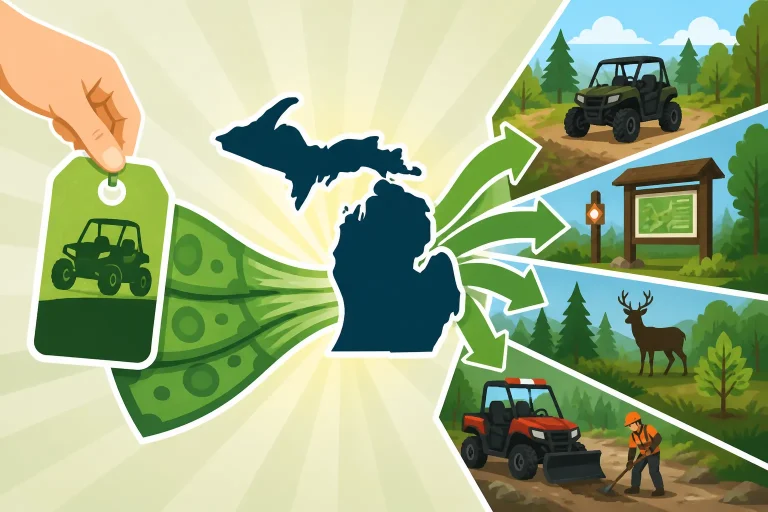
The trail permit is connected to Michigan’s designated trail system and scramble areas. Permit revenue supports trail-related work, such as maintenance and improvements. That connection can make the separate charge feel less arbitrary: it is tied to the use and upkeep of the trail system rather than simply duplicating the general ORV license.
It is still your responsibility to confirm that the place you plan to ride is one where the trail permit is required. A trail name, an open road, and a DNR-designated ORV trail are not necessarily interchangeable categories. A route may connect different types of land or riding area, each with different rules. Check a current map and the rules for the specific area rather than relying only on a pin in a navigation app.
Do not confuse the permit with a general riding pass
The trail permit is not a universal pass to ride anywhere in Michigan. It does not grant permission to ride on private property, override a closure, authorize use of a trail that does not allow your machine, or replace other required licenses. It also does not make an otherwise prohibited road legal for ORV travel.
That distinction matters when planning a loop. You might need the ORV license on public land, the additional trail permit for a designated trail, and permission from a landowner for a private connection. Each requirement addresses something different. A permit on the machine cannot make up for missing landowner permission or a route that is closed.
When you may need it
The extra trail permit is generally required when you ride a designated ORV trail or scramble area where Michigan requires it. The ORV license has broader application to ORV use on public lands, but it does not stand in for the trail permit where that additional permit is required.
Do not assume that every place called a “trail” on a social media post or commercial map is a designated ORV trail. Nor should you assume that a forest road and a trail have identical permit rules. Use official information to identify the land type and designation, then confirm the permit requirements for that riding area.
Designated trails and scramble areas
If your ride includes a designated ORV trail or scramble area, plan on checking whether both the ORV license and trail permit are required. This is especially important if you are heading to a riding destination with several kinds of terrain or access points. A staging area, an ORV route, a forest road, and a designated trail can have different rules even when they are close together.
Permit rules may also depend on the machine. Check that your machine is allowed on the specific trail. Width restrictions, trail closures, and other operating rules can apply independently of the permit requirement. Having both decals does not entitle a wide side-by-side to enter a narrow trail, for example.
Roads, routes, and private land
A county road, forest road, ORV route, and designated ORV trail should not be treated as synonyms. Their classifications affect where you may ride and which requirements apply. If your trip includes road riding, check the local ordinance and road rules too; the trail permit does not authorize road use by itself.
Private land is a separate case. A state permit does not give you access to someone else’s property. If you are riding on land you own or have permission to use, check the rules for that land and activity rather than assuming the public-land permit rules apply in the same way. The details can depend on the setting and how the machine is being operated. See Michigan ORV Permit Exemptions on Private Land for a closer look at that distinction.
If you plan to ride only on public roads or forest roads, do not assume that the trail permit is either always needed or never needed. Identify each part of your route and verify its designation. For a related explanation of where riders may use an ORV license without the extra trail permit, see Michigan ORV License Without a Trail Permit: Where You Can Ride.
Out-of-state riders and reciprocity
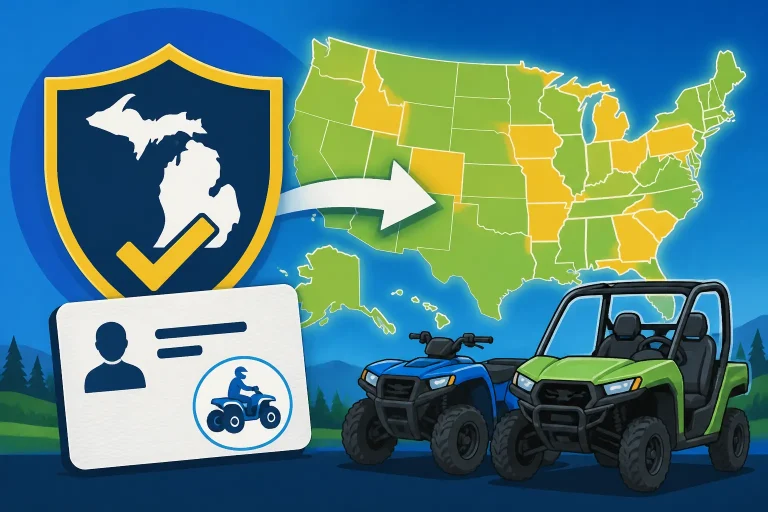
Coming from another state does not automatically waive Michigan’s permit requirements. A home-state registration, trail sticker, or membership may be valid at home but may not satisfy Michigan’s rules. Before crossing the border with your ATV or UTV, check Michigan’s current requirements for nonresidents and for the specific riding area.
Reciprocity is easy to misunderstand. It may refer to recognition of a safety certificate, a registration arrangement, or some other part of ORV regulation. Recognition of one credential does not necessarily mean Michigan will accept another state’s trail permit in place of Michigan’s. Check each requirement separately: machine licensing, trail permits, safety certification, and any local access conditions.
For more on cross-border questions, see [Michigan ORV Reciprocity With Neighboring States] and Non-Resident ORV Permits in Michigan. If you are bringing a Wisconsin machine, Do Wisconsin Riders Need a Michigan Permit? addresses that situation specifically.
Buying the permit and attaching it correctly
Buy permits through an authorized Michigan channel and follow the instructions provided with the permit. Availability and purchasing procedures can change, so check the current Michigan DNR information before relying on an old receipt, saved web page, or previous season’s process. If you buy online, make sure you understand what proof you need to carry and whether you must print anything.
The permit year and the riding season are not always what a rider expects. A permit bought near the end of one season may not remain valid for the next permit year. Check the printed dates or current instructions, especially if you are buying in advance, transferring machines, or purchasing close to a season boundary. Michigan’s April 1 ORV Permit Year explains why the permit-year dates matter.
A simple pre-ride purchase checklist
Before you complete a purchase, confirm:
- Which permits you need. Check the ORV license and trail permit separately.
- Which machine the permit is for. Permit rules and display instructions may be machine-specific.
- Where you intend to ride. Verify that the trail or scramble area is open and allows your machine.
- The permit year. Make sure it will be valid for the date of your ride.
- How proof must be displayed or carried. Follow the current instructions rather than improvising.
- Whether other riders need their own permits. Do not assume that one machine’s permit covers a group.
When in doubt, contact the relevant state office or authorized seller before traveling. Resolving a question at home is easier than discovering at the trailhead that you bought the wrong item or cannot show the required proof.
Sticker placement and condition
Follow the placement instructions for each decal. Keep the required information visible and make sure the sticker is attached to the machine it belongs to. Avoid placing it where mud, a rack, a cover, or a removable accessory will hide it. A sticker that has peeled, faded, or been damaged may be difficult to verify, so inspect it before the trip.
Do not assume you can move a decal from one machine to another just because you own both machines. Transfer and replacement rules may apply. If a sticker is lost or damaged, check the official replacement process instead of relying on a photocopy or a decal from a different machine. Related guidance is available in Where the Michigan ORV Sticker Goes on Your Machine and Replacing a Lost ORV License Sticker.
If you keep permits or purchase records in a phone, plan for limited cell service. Save or print any documentation you are instructed to retain before leaving home. A compact waterproof pouch can help protect paper records; riders shopping for one on Amazon should check that it seals securely and can be stored without interfering with the decals or controls.
What the extra permit does not cover
The additional trail permit addresses a particular permit requirement. It does not replace every other rule a rider might encounter. It is not a substitute for the ORV license, landowner permission, a required safety certificate, machine-specific trail access, or any applicable road-use rule.
A permit also does not guarantee that a trail is open on the day you arrive. Closures can be temporary or seasonal, and conditions such as heavy rain can lead to restrictions. Check closure notices and current trail information before setting out. If you use an app or downloaded map, compare it with current official information; an offline map can be useful for navigation, but it may not reflect a recent closure.
Permits do not replace route planning
A well-planned ride needs more than the right decals. Check:
- Trail width and machine restrictions
- Seasonal closures and temporary restrictions
- Staging-area and parking rules
- Road connections and local ordinances
- Fuel availability and expected range
- Whether the route crosses private land
- Cell coverage and offline navigation options
A paper or offline backup map can be valuable where reception is unreliable. If you use an app, download the map before leaving service. Riders looking for a phone mount or a backup charging setup on Amazon should make sure the equipment is secure and does not block the rider’s view or interfere with safe operation.
Keep proof organized
Keep the machine’s permit decals intact and retain any purchase confirmation or other documentation the official instructions say to keep. You generally do not need to carry a paper title on every ride simply because you have a trail permit, but you should know what proof is required for the particular permits and activity involved. Do not treat a title, bill of sale, ORV license, and trail permit as interchangeable documents.
A small document pouch or a dedicated folder at home can help keep purchase records together. Amazon may be one place to look for a weather-resistant organizer, but choose something that protects the paperwork without covering required decals or encouraging you to carry documents that should be stored securely elsewhere.
If a conservation officer checks your machine, stay calm, follow instructions, and show the permits or proof requested. If you discover that a decal is missing or unreadable before a ride, resolve it before entering the trail system. The permit process is simpler when the machine and paperwork are prepared in advance.
Common mistakes and a practical pre-ride check
The most common mistake is buying the ORV license and assuming the trail permit is included. Another is relying on a previous year’s sticker or a friend’s recollection of the fee and requirements. Rules and fees can change, and a permit that was right for an earlier trip may not be valid for a new permit year or a different riding area.
Other avoidable mistakes include buying a permit for the wrong machine, placing a decal where it cannot be seen, assuming an out-of-state permit is accepted, or riding a closed trail because a third-party map still shows it as open. The solution is not complicated: check the official rules, identify the route, and verify the permits before leaving.
Use this quick check before a Michigan ride:
- Confirm whether the ORV license is required.
- Confirm whether the additional trail permit is required for your route.
- Verify the current fee and purchase process with an official source.
- Check permit-year validity and machine-specific instructions.
- Make sure the decals are attached correctly and readable.
- Confirm that your machine is allowed on each trail or route.
- Check for closures, local road rules, and landowner permissions.
- Save any required documentation for offline access.
For current costs, consult Michigan ORV License Cost and What It Covers and Michigan ORV Trail Permit Price. These details can change, so use the official information at the time you purchase rather than relying on an old receipt or a figure repeated online.
The short version: Michigan’s extra trail permit is separate from the ORV license and is generally required for designated ORV trails and scramble areas. The commonly referenced $10 amount is worth verifying before purchase. Check both permit requirements, confirm your route and machine are eligible, and make sure the decals are in place before riding.
Disclaimer
This article is for general informational purposes only and does not constitute professional advice. Laws, prices and regulations vary by location and change over time. Consult a qualified professional for guidance on your specific situation.