Keeping Your ORV Paperwork With the Machine
There's nothing quite like hitting Michigan's trails or cruising down a two-track in your ATV or UTV, but that freedom can quickly turn into a headache if you're ever stopped by a conservation officer or local law enforcement and don't have your paperwork in order. Many riders forget that just like driving a car, operating an ORV comes with a responsibility to carry certain documents. This guide is all about helping you understand exactly what paperwork you need, why it matters, and the best ways to keep it safe and accessible while you're out enjoying your ride.
Why Your ORV Paperwork Needs to Stay Put
It's easy to think, "Who cares? I'm just out in the woods!" But neglecting to carry your essential ORV documents can lead to real hassles, from inconvenient delays to hefty fines, or even having your beloved machine impounded. It’s not about being a killjoy; it’s about being a responsible, prepared rider.
The Law and What It Demands
Michigan law is pretty clear when it comes to what you need to have on hand while operating an ORV. This isn't just a suggestion; it's a requirement. Conservation officers and local deputies are trained to verify these documents during routine stops or after an incident. They're looking for proof that you're authorized to be on the trail or road, and that your machine meets all the legal criteria.
Imagine this scenario: You're enjoying a fantastic ride on the [Tin Cup Spring OHV Loop Length] near Cadillac, the sun is out, and the trails are perfect. Suddenly, you round a bend and there's a DNR officer checking riders. They wave you over, and politely ask for your ORV license, trail permit, and proof of ownership. If you've left them back at the cabin, or worse, have no idea where they are, that smooth ride can quickly become a frustrating interrogation. You might receive a ticket right on the spot for not being able to produce the documents. This is not only embarrassing but can lead to a fine. It can also cause delays while the officer attempts to verify your information, holding you up and potentially ruining your day of riding. Understanding [Michigan ORV Paperwork During a DNR Stop] is crucial for any rider.
Practical Reasons Beyond the Law
Beyond the legal mandate, there are many practical reasons why keeping your paperwork with your machine is just plain smart. Think of it as your riding emergency kit, but for administrative peace of mind.
Consider a situation where you're deep in the [Upper Peninsula ATV Trail Mileage Total], miles from cell service, and your UTV breaks down in a way that requires a professional tow or repair. If you need to arrange for a specialized recovery service, they’ll often want proof of ownership before they’ll touch your machine. Having a copy of your title or a bill of sale can quickly establish that the machine is yours, preventing potential delays or questions about its legitimacy. Or, if you unfortunately have an accident and need to provide information to emergency services or another party, having your insurance details and personal identification readily available streamlines the process significantly. It ensures that critical information is accessible when you might be stressed or injured, helping everyone involved act quickly and appropriately.
Essential Documents to Keep With Your Machine
So, what exactly are these crucial pieces of paper (or digital files) that you should never leave home without? It's more than just one item, and each serves a distinct purpose in proving your right to operate your ORV in Michigan.
Proof of Ownership: Title and Bill of Sale
While the actual, original title for your ORV is arguably the most important document you possess, it's almost universally recommended not to carry the original with you on the trail. Why? Because if you lose it, or if your machine is stolen with the title inside, you've just made it significantly easier for someone else to claim ownership. It's best practice to keep your original [Storing Your ATV Title Somewhere Safe] at home in a secure, fireproof location.
Instead, what you should carry is a clear, legible photocopy of your ORV title. This copy serves as proof of ownership if questioned by law enforcement, while the original remains protected. For machines purchased through a private sale, a comprehensive bill of sale is equally, if not more, important, especially immediately after the purchase when the title might still be in the process of being transferred. A well-drafted bill of sale, like those you can customize using platforms such as LawDepot, provides clear evidence of the transaction and temporary ownership. It should include the VIN, purchase price, date, and signatures of both buyer and seller. Familiarize yourself with [Michigan ATV Bill of Sale: What to Put in It] to ensure your document is complete. When buying a used machine, remember that [Michigan ATV Bill of Sale Template Requirements] are pretty specific about what needs to be included. This document acts as your temporary proof of ownership until the title transfer is fully processed at the Secretary of State.
ORV License and Trail Permit
In Michigan, virtually all ORVs operating on public lands or trails require both an ORV license and, if you're on a designated ORV trail, a separate ORV trail permit. These are often combined into a single sticker that you affix to your machine, but it’s still critical to understand what each covers. The ORV license allows you to operate the machine in general, while the trail permit grants you access to Michigan’s extensive network of designated ORV trails.
The state's ORV permit year typically runs from April 1st to March 31st of the following year, so it's a good idea to check that your stickers are current before you head out. These stickers must be prominently displayed on your machine, usually on the front fender or another visible location. If your machine is older or has a unique design that makes sticker placement difficult, you should still carry the physical proof of purchase (the receipt) for both the license and permit. Imagine being on the [Holly Oaks ORV Park Day Pass Cost] trails, having a blast, and then a park ranger stops you. They'll be looking for those stickers. If they're missing or expired, you could face a fine for [Michigan Fine for No ORV Trail Permit]. Keeping the receipt proves you did your part even if the sticker somehow fell off. To learn more about these requirements, check out [Michigan ORV License and Trail Permit Explained].
Safety Certificate (for Young Riders)
Michigan takes youth ORV safety very seriously, and for good reason. Riders under a certain age have specific requirements to meet before they can legally operate an ORV on public lands and trails. One of the most critical is the ORV safety certificate. This certificate demonstrates that the young rider has successfully completed a state-approved safety course, understanding the rules of the trail, safe operation practices, and emergency procedures.
For parents, ensuring your child has their safety certificate accessible is non-negotiable. If your child is riding, and they fall within the age bracket requiring this certificate, law enforcement will certainly ask for it. A common scenario might be riding with your family on the [Family-Friendly ORV Trails in Michigan]. A conservation officer spots a younger rider and pulls your group over. If your 14-year-old can't produce their safety certificate, they could be cited, and the ride could be cut short. While some states accept digital copies, having a physical laminated card is often the safest bet, especially in areas with spotty cell service. For all the details on who needs this and how to get it, read [Michigan ORV Safety Certificate Requirements].
Proof of Insurance (if applicable)
While not all ORVs in Michigan are legally required to carry insurance, there are very specific circumstances where it becomes mandatory. The most common scenario is when you modify your ORV to be street legal and operate it on county roads or other approved public roadways. In these cases, your ORV is treated more like a conventional vehicle, and no-fault insurance is typically required.
If you've gone through the process of making your UTV street legal and are enjoying the ability to ride from the trail to town for gas or lunch, you absolutely must carry proof of insurance. This could be your insurance card, a copy of your policy, or even a digital ID card on your phone (though a physical backup is always wise, as mentioned before). Failure to produce proof of insurance when operating a street-legal ORV on public roads can lead to significant fines and penalties, mirroring those for regular vehicles. For a deeper dive into when insurance is a must-have, consult [Michigan ORV Insurance and When You Actually Need It].
Smart Ways to Store Your Paperwork on the Trail
Having the right documents is only half the battle; keeping them safe, dry, and accessible while bouncing around on the trails is the other. You wouldn't just throw your valuable papers into a muddy puddle, would you? Thoughtful storage can make all the difference.
Waterproof and Secure Solutions
The Michigan weather can be notoriously unpredictable, and even on a sunny day, creek crossings, mud puddles, or a sudden downpour can drench everything you're carrying. That's why waterproofing your essential documents is paramount.
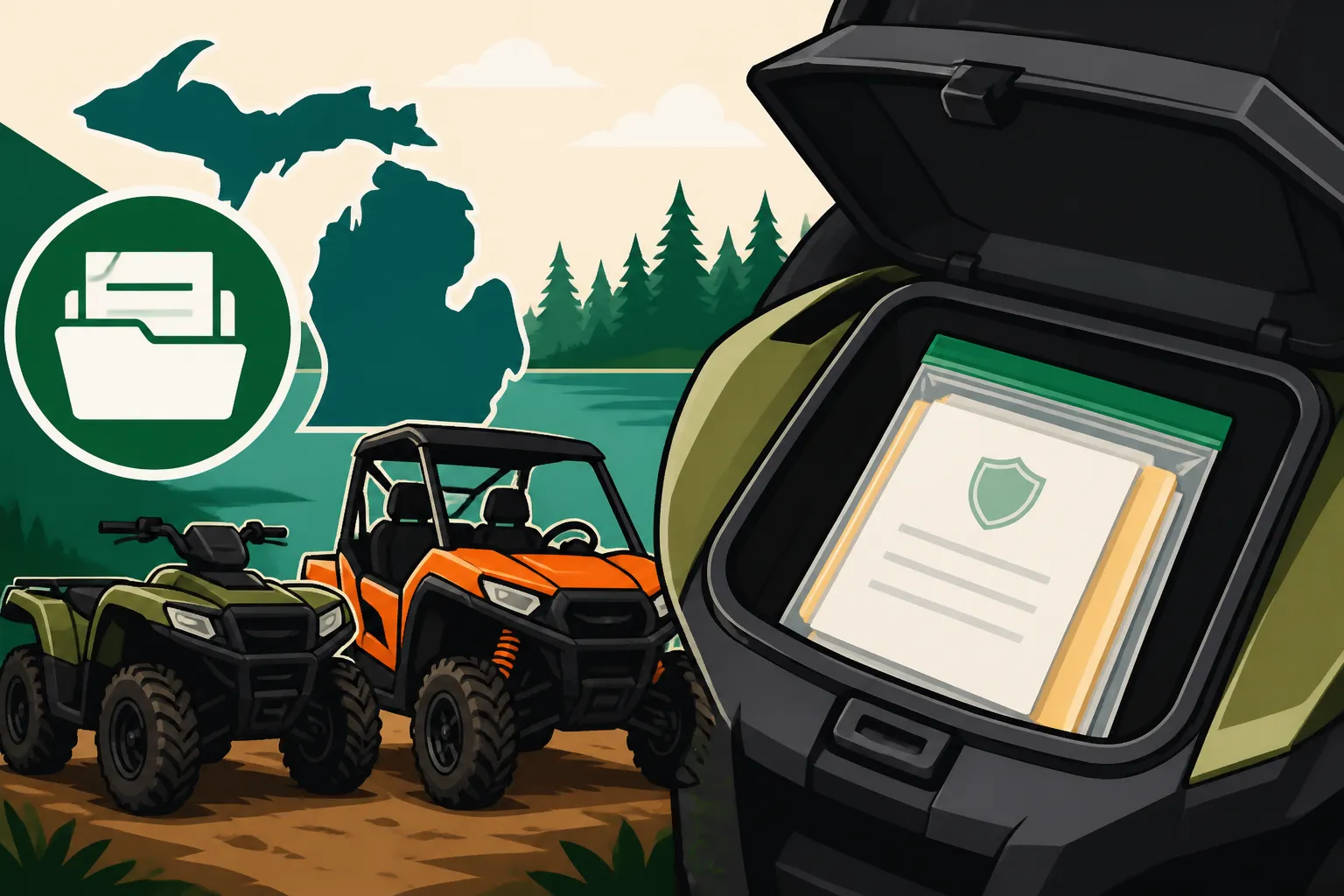
One of the best solutions is a heavy-duty, submersible dry bag. These bags are designed for kayaking and boating, so they're more than capable of handling the rigors of ORV riding. You can find small ones perfect for just documents, or larger ones if you need to carry other essentials. Look for those with roll-top closures and durable buckles. Another excellent option is a small, sealed hard case, often made by companies that specialize in protective gear for electronics. These cases are crushproof, dustproof, and waterproof, offering superior protection. Many ATVs and UTVs also come equipped with small, integrated glove boxes or storage compartments. While these are convenient, they are rarely fully waterproof on their own. Always put your documents into a secondary waterproof container before placing them in one of these compartments. For instance, a small, sealable plastic bag inside a hard case, which then goes into your glove box, offers multiple layers of protection. When choosing a solution, consider how securely it can be attached to your machine or carried on your person. A bag that's simply tossed into a cargo net could fly out on a bumpy section of the [Little O Trail Mileage and Terrain].
Digital vs. Physical Copies
In our increasingly digital world, it's tempting to think that having everything on your smartphone is sufficient. While digital copies can be convenient, they come with their own set of potential pitfalls on the trail.
Many law enforcement agencies in Michigan will accept a clear digital image of your driver's license, insurance card, or ORV permits, especially if they can verify the information electronically. The convenience is clear: one less thing to lose or get wet. However, what happens if your phone battery dies? Or if you're in a remote area without cell service, making it impossible to pull up a cloud-stored document or verify an e-permit? These are very real concerns on Michigan's extensive trail system. A savvy rider knows to always have a physical backup. This means even if you prefer digital copies, keep a laminated or waterproofed physical copy of your important documents as a contingency. You can create these physical copies for important records like bills of sale or even a copy of your title on a platform like LawDepot, print them out, and then waterproof them. This dual approach ensures you're prepared for any situation, from a dead phone to a skeptical officer who prefers a tangible document.
| Document Type | Original Location (Home) | Carry With Machine (Copy) | Notes |
|---|---|---|---|
| ORV Title | Yes | Yes (Copy Recommended) | Original is too valuable/risky to carry; photocopy is best. |
| Bill of Sale | Yes | Yes (Copy Recommended) | Crucial for recent private sales, especially during title transfer. |
| ORV License Sticker | N/A | Yes (Affixed) | Must be affixed to machine; keep purchase receipt as backup. |
| ORV Trail Permit Sticker | N/A | Yes (Affixed) | Must be affixed to machine; keep purchase receipt as backup. |
| Safety Certificate | Yes | Yes (Physical or Digital) | Required for youth riders; physical copy is safer than relying on phone. |
| Proof of Insurance | Yes | Yes (Physical or Digital) | Only if required (e.g., street-legal ORV); physical card recommended. |
| Driver's License | N/A | Yes (Physical) | Required for operating any motor vehicle, including street-legal ORVs. |
| Emergency Contacts | N/A | Yes (Physical) | Not legally required, but highly recommended for emergencies. |
What NOT to Do
Just as important as knowing what to do is understanding what common mistakes to avoid when it comes to ORV paperwork. These missteps can quickly lead to bigger problems.
First and foremost, never carry your original ORV title with you on the machine. As mentioned, the risk of loss or theft far outweighs the convenience. Losing an original title can be a bureaucratic nightmare, requiring you to apply for a replacement [Replacing a Lost Michigan ORV Title] which can take time and effort. Second, don't rely on simply stuffing your documents into a non-waterproof pocket, backpack, or an unsealed compartment on your ORV. Mud, rain, dust, and even sweat can quickly render your papers illegible, or they could simply fall out unnoticed. Third, avoid the "it won't happen to me" mentality regarding law enforcement stops or accidents. Even if you only ride on private land, crossing a road to access another section of private property, or briefly using a public easement, could put you in a position where an officer asks for your credentials. Always assume you might be asked to produce your documents and prepare accordingly.
What to Do If You're Caught Without Proper Paperwork
Even the most prepared riders can sometimes make a mistake or encounter an unforeseen issue. If you find yourself in a situation where you're stopped and don't have all your required paperwork, knowing how to react can significantly influence the outcome.
Understanding the Consequences
Let's not sugarcoat it: operating an ORV in Michigan without the legally required documents can lead to various penalties. The specific consequences will depend on what's missing, where you're riding, and the discretion of the officer involved. For instance, riding without a current ORV license or trail permit can result in a fine. The exact cost can vary, but it's typically more than the cost of the permit itself, essentially a penalty for non-compliance. You might receive a ticket similar to a traffic citation. If your ORV isn't titled, or if there are serious questions about ownership, the machine could potentially be impounded until proper documentation can be produced. This is a huge hassle, involving impound fees, storage costs, and the stress of proving ownership. [Penalty for Operating an Untitled ORV in Michigan] explains the potential legal ramifications in detail. For young riders, a missing safety certificate can also lead to fines for both the rider and potentially the supervising adult.
How to Handle a Stop Graciously
If a conservation officer or law enforcement official pulls you over, the absolute best thing you can do is remain calm, cooperative, and respectful. Even if you know your paperwork isn't in order, getting defensive or argumentative will only make the situation worse.
Pull over safely and completely. Turn off your engine and remove your helmet so you can communicate clearly. When the officer approaches, be polite. Explain honestly what documents you have and which ones you might be missing. For example, "Officer, I apologize, I have my ORV license sticker affixed, but I seem to have left my physical trail permit receipt at home." If they ask for a document you don't have, simply state that you don't have it on you. Avoid making excuses or fabricating stories. An officer is much more likely to be understanding, or at least less severe, if you are cooperative and honest. They might issue a warning, give you a fix-it ticket where you can prove compliance later, or issue a citation. Your demeanor during the stop is a significant factor in how the situation plays out.
Resolving the Issue Post-Stop
If you do receive a citation for missing paperwork, the next steps are crucial. Don't just ignore it, hoping it will go away; it won't, and penalties will only escalate.
The first thing to do is carefully read the citation and understand what you've been ticketed for and the deadline for response. Your priority should be to obtain the missing documents. If you were cited for not having your ORV license, go purchase one immediately. If it was for a missing safety certificate, work with your child to get it. If you have the documents but simply didn't have them on you, gather them as proof. In some cases, especially if it's a first offense and you quickly remedy the situation, you might be able to present the newly acquired or located documents to the court or an administrative office to have the fine reduced or even dismissed. This often requires an appearance in court or submitting proof by mail, depending on the specifics of the citation. Always follow the instructions on your ticket for addressing the issue. Understanding [Michigan ORV Title Problems and How to Clear Them] can be a helpful resource if your issue is related to ownership documentation.
Preparing for Different Riding Scenarios
The type of riding you do in Michigan can also influence your paperwork needs. A casual ride around your private property is different from exploring state trails, and a street-legal UTV has even more specific requirements. Tailoring your paperwork preparedness to your activity is smart.
Trail Riding and Backcountry Adventures
When you're heading out for serious trail riding, especially deep into Michigan's vast state forests or the wild expanses of the Upper Peninsula, preparedness goes beyond just legal documents. While your ORV license, trail permit, and ownership copies are still essential, you should also think about emergency information.
Consider carrying a laminated card with emergency contact information (names and phone numbers of people who aren't on the ride with you), any critical medical conditions or allergies for each rider in your group, and perhaps even your insurance policy number. In remote areas, cell service can be non-existent, making it difficult for first responders to get vital information quickly. Having this physical card attached to your machine or readily accessible in a waterproof pouch could literally save a life. It's also a good idea to have a simple map of the area (downloaded to a GPS device or printed) in case you get disoriented and need to guide help to your location. Even if you're exploring [Pere Marquette State Forest ORV Trails], being self-sufficient in terms of information is key.
Road-Legal ORVs and Public Road Use
If you've taken the steps to make your side-by-side or ATV street legal in Michigan, your paperwork requirements expand considerably. You're no longer just an ORV operator; you're operating a registered motor vehicle on public roads, and with that comes additional responsibilities and documents.
Beyond your ORV license and trail permit (which you'll still need for off-road segments), you must carry your valid driver's license, proof of Michigan no-fault insurance, and your vehicle registration. Your machine will also need a license plate, and that plate must be displayed properly. An officer stopping a street-legal UTV on a county road will treat it much like a car stop, meaning they'll expect to see all the standard vehicle documents. If you're riding with younger passengers, remember to review [Michigan ORV Road Rules for Riders Under 16], as age restrictions and supervision requirements apply even on county roads. Platforms like LawDepot can also be helpful for general vehicle record-keeping and ensuring all your documents are organized for both on and off-road use. For example, some riders use these tools to create affidavits for lost documents or to keep track of maintenance records that might become relevant in a road stop.
Special Events or Out-of-State Riding
Michigan is a popular destination for ORV riders, and many visitors come from surrounding states or even Canada to enjoy our trails. Conversely, many Michigan riders venture to neighboring states for new riding experiences. In both scenarios, you need to be mindful of specific paperwork requirements that might differ from your usual routine.
If you're an out-of-state rider coming to Michigan, you'll need a Michigan ORV license and trail permit, regardless of whether your home state has similar permits. Michigan does not have widespread reciprocity agreements with other states for these permits, so it's best to assume you need Michigan's own. For non-residents, these can typically be purchased online through the Michigan DNR eLicense system or at authorized license retailers. Check out [Non-Resident ORV Permits in Michigan] for more detailed information. If you're a Michigan resident heading out of state, research the ORV laws and permit requirements for your destination state well in advance. Some states might require a specific non-resident permit, different safety certifications, or have unique insurance mandates. Participating in organized events or races often comes with its own set of waivers, registration forms, and perhaps even additional insurance proof. Always double-check event requirements before you leave.
Disclaimer
This article is for general informational purposes only and does not constitute professional advice. Laws, prices and regulations vary by location and change over time. Consult a qualified professional for guidance on your specific situation.