Engine Size Limits for Michigan Riders Under 16
It can be incredibly confusing for parents trying to do the right thing when it comes to getting their kids out on the trails. You want them to have fun and experience the joy of Michigan's incredible outdoors, but the rules around what kind of off-road vehicle (ORV) they can legally ride can feel like a tangled mess. This guide is here to untangle that, focusing specifically on the engine size limits and other vital regulations for young Michigan riders under the age of 16.
The Core Rules: Engine Size and Age Brackets in Michigan
Michigan takes the safety of its youngest ORV riders seriously, and for good reason. These machines can be powerful, and matching the right size and power to a child's age, skill, and physical maturity is absolutely critical. It's not just about what they can ride, but what they should ride safely.
What the Law Says About Engine Displacement for Young Riders
Michigan law has specific engine displacement (size) limitations tied directly to a rider's age. This isn't a suggestion; it's a hard and fast rule designed to prevent serious accidents.
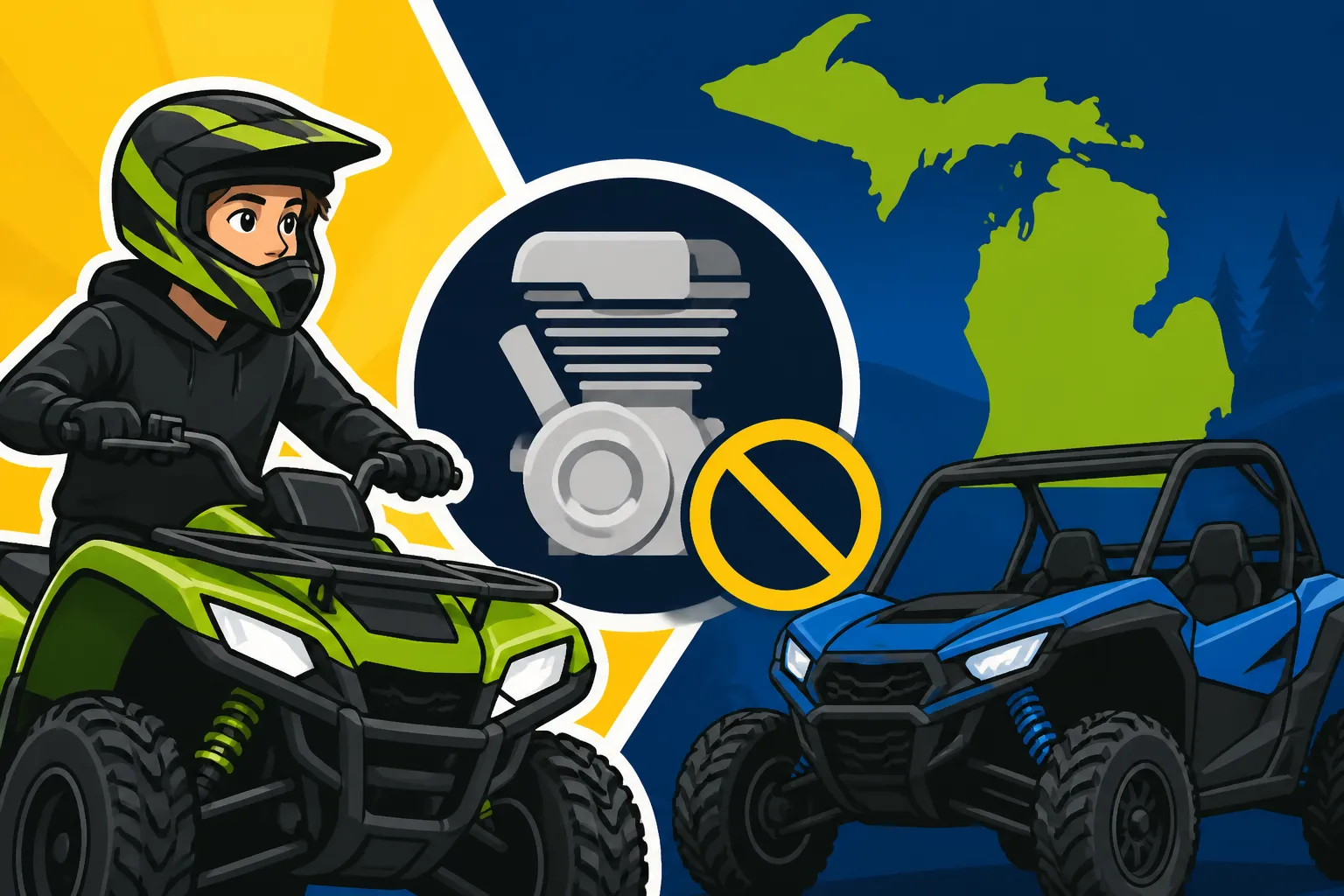
For children under 12 years of age, the rules are very stringent. They are only permitted to operate an ORV that has an engine displacement of 90 cubic centimeters (cc) or less. This typically means small, entry-level ATVs or youth-specific side-by-sides. These machines are designed to be lighter, have less power, and often come with features like speed limiters that can be adjusted as the child gains experience. The focus here is on learning basic control and developing foundational riding skills in a very controlled environment.
Once a child reaches the age of 12 years old but is still under 16 years of age, they can move up to slightly larger machines. For this age group, they are permitted to operate an ORV with an engine displacement of 90 cc up to 200 cc. This opens up a wider range of youth ATVs and some smaller UTVs. However, it's crucial to remember that this 200cc is still a maximum. Just because a 12-year-old can legally ride a 200cc machine doesn't mean it's automatically the best or safest choice for that specific child. Maturity, physical strength, and prior riding experience should always be the guiding factors.
Here's a quick reference table for clarity:
| Rider Age Group | Maximum Engine Displacement (ATV/UTV) |
|---|---|
| Under 12 | 90 cc |
| 12 to 15 | 200 cc |
| 16 and Over | No state-imposed engine size limit |
It's also important to note that these limits generally apply to ATVs and UTVs used off-road. Specific rules might vary slightly for other types of ORVs, but for the vast majority of four-wheelers and side-by-sides, these are the standards you need to follow. You can find more detailed breakdowns in resources like [Michigan ORV Age Rules for Young Riders].
Why These Limits Exist: Safety First
These engine size limits aren't arbitrary bureaucratic hurdles; they are deeply rooted in safety science and countless accident statistics. Imagine putting a new teenage driver in a high-performance sports car versus a modest sedan. The difference in control, reaction time, and potential for harm is immense. The same principle applies to ORVs.
Younger riders simply do not possess the same physical strength, coordination, reaction time, or judgment as adults. A machine with too much power or too much weight for a child can quickly become uncontrollable. When an ATV or UTV has a larger engine, it generally means it's heavier, faster, and requires more effort to steer, brake, and manage over varied terrain. A child struggling to control a machine is at a much higher risk of losing control, tipping over, or colliding with obstacles.
Furthermore, the limits acknowledge the developmental stages of children. Younger children, especially those under 12, are still developing critical cognitive and motor skills. They might not fully grasp the concept of risk, anticipate hazards as quickly, or have the physical stamina to handle a larger machine for extended periods. The rules are designed to give them a safer, more manageable platform to learn on, slowly building confidence and competence before moving to more powerful vehicles.
More Than Just Engine Size: Other Critical Rules for Young ORV Riders
While engine size is a primary concern, Michigan's regulations for young ORV operators extend beyond just the cc limits. There are other crucial requirements that parents and guardians must adhere to to ensure their child's safety and stay on the right side of the law.
Direct Visual Supervision: What It Actually Means on the Trail
For any ORV operator under the age of 16, Michigan law mandates direct visual supervision by a parent, guardian, or an adult over 18 authorized by the parent or guardian. This isn't just about being in the same general area; it's about active, immediate oversight.
"Direct visual supervision" means the supervising adult must be able to see and respond to the child's actions at all times. This usually translates to riding on another ORV immediately behind or alongside the child, or being close enough on foot or from a stationary position to intervene if necessary. It absolutely does not mean the adult is riding miles ahead or hanging back at camp while the child explores. The idea is that if the child encounters a problem – a tricky section of trail, another rider, or a mechanical issue – the supervising adult is right there to offer guidance or assistance. Think of it like supervising a child learning to swim; you wouldn't let them out of your sight. For more context, consider reading [Supervising a Young Rider on the Trail].
Safety Certificates and What They Prove
Another non-negotiable requirement for Michigan ORV operators under 16 years of age is possessing a valid ORV Safety Certificate. This certificate demonstrates that the rider has completed a state-approved safety education course.
These courses, often available online or in person, cover essential topics like safe riding practices, understanding trail signs, environmental ethics, basic machine maintenance, and Michigan's ORV laws. It's more than just a piece of paper; it's a foundational education that equips young riders with the knowledge to make safer decisions on the trail. Obtaining a safety certificate is a crucial step for any young rider, and it's something every parent should ensure their child completes. You can learn more about the specifics in [Michigan ORV Safety Certificate Requirements].
The Three-Wheeler Ban for Young Riders
Michigan has a very specific safety regulation regarding three-wheeled ATVs for young operators. Riders under the age of 16 are prohibited from operating three-wheeled ATVs at all. This rule exists due to the inherent instability of three-wheelers, which are significantly more prone to rollovers than four-wheeled ATVs, especially for inexperienced riders. While some adults still enjoy vintage three-wheelers, it's a critical safety point that Michigan law enforces to protect minors. If you're considering a three-wheeler for any reason, be aware of these strict age limitations. For more on this specific rule, check out [Three-Wheel ATVs and Riders Under 16].
Practical Advice for Parents Navigating Michigan's ORV Rules
Navigating the world of ORVs with kids can feel like a lot to take in, but with a bit of planning and knowledge, it's perfectly manageable. Beyond just the letter of the law, there's a lot of practical advice that can help ensure your family's riding experiences are fun and safe.
Choosing the Right Machine: Beyond Just Engine Size
While engine size limits are set by law, choosing the right machine for your child involves more than just staying within those cc boundaries. Think of it like buying shoes: you don't just pick a size, you pick a fit.
Consider these factors:
- Rider Fit and Ergonomics: Can your child comfortably reach the handlebars, brakes, and footpegs while seated? Can they stand up properly and shift their weight? A machine that's too big can make control difficult and tiring.
- Machine Weight: A heavier machine requires more physical effort to control, especially when turning or navigating obstacles. Ensure the ORV's weight is appropriate for your child's strength.
- Suspension and Ground Clearance: If your child will be riding on rough trails, adequate suspension and ground clearance are important for comfort and safety, preventing jarring rides or getting stuck.
- Automatic vs. Manual Transmission: For beginners, an automatic transmission often simplifies the learning process, allowing them to focus on steering and throttle control without worrying about shifting gears.
- Safety Features: Look for machines with adjustable speed limiters, clear safety labeling, and reliable braking systems.
Ultimately, a child should be able to sit on the machine with their feet flat on the ground (for ATVs) or comfortably reach all controls (for UTVs). Don't just rely on age; observe your child's physical build and coordination. A helpful resource for this decision is [Best First ATV Size for a 12-Year-Old].
Paperwork Pointers: Titling and Proof of Ownership
When you buy an ORV for your child, even if it's a small youth model, it still needs to be titled in Michigan. The title legally establishes ownership. Typically, as the parent or guardian, your name (or both parents' names) will go on the title since the child is a minor. This ensures you maintain legal responsibility and control over the asset. When it comes time to register and title the ORV, you'll need to submit the proper application and pay any associated fees. More details on this process can be found in [Michigan ORV Title Application and What It Costs].
Always make sure you have a solid bill of sale, especially if you're buying from a private seller or even if you're gifting the machine within the family. A well-written bill of sale protects both parties and provides clear proof of transaction. Online resources like LawDepot can be incredibly helpful for generating legally sound bills of sale quickly and easily, ensuring all the necessary details are included. This can prevent headaches down the road when dealing with [Michigan ATV Bill of Sale: What to Put in It]. Beyond the title, don't forget the annual ORV license and trail permit, which are usually required for riding on public trails. We cover those details in [Michigan ORV License and Trail Permit Explained].
Road Riding Restrictions and Age Limits
This is a point of frequent confusion for many parents. While some Michigan counties have adopted ordinances allowing ORVs on certain county roads, these allowances almost universally come with age restrictions that often prohibit riders under 16 from operating an ORV on public roads, even if an adult is supervising.
The intent of road riding is different from trail riding, often involving higher speeds, interaction with other vehicles, and more complex traffic laws. The added risks mean that children are generally kept off these public thoroughfares. Even in areas where adults can ride ORVs on specific road shoulders or routes, it's highly unlikely that a minor would be legally permitted to do so. Always check the specific county or local ordinance, but assume that your child under 16 should stick to designated trails and private property. For a deeper dive into these rules, consult [Michigan ORV Road Riding Age Minimum].
Common Pitfalls and How to Avoid Them
Even with the best intentions, it's easy to make mistakes or overlook certain aspects of ORV safety and regulations. Being aware of these common pitfalls can help parents avoid trouble and ensure their child's riding experience is as safe and enjoyable as possible.
Assuming Private Land Means No Rules
Many parents mistakenly believe that once they're on private property, all state ORV rules go out the window. While it's true that some regulations, like the need for an ORV license and trail permit, are typically waived when riding exclusively on land you own or have permission to use, safety rules and age restrictions for young riders often still apply or are strongly recommended for liability and common-sense safety.
Even on private land, if a child under 12 is riding a 250cc ATV, they are still at a much higher risk of injury due to the machine's inappropriate size and power. Should an accident occur, even on private land, you could face significant liability issues. The state's age and engine size guidelines are built on safety principles that don't magically disappear just because you're off public land. It's about protecting your child, first and foremost, regardless of property lines.
The Temptation of "Just This Once" or "They're a Good Rider"
Every parent wants to see their child succeed, and it's easy to think, "My kid is exceptionally skilled for their age," or "It's just for a short ride, what could happen?" This kind of thinking, however, can lead to serious consequences. The rules for engine size and age limits are not about questioning your child's talent; they are universal standards based on average physical and cognitive development.
Allowing a child to ride an ORV beyond their legal age or engine size limit, even "just this once," carries significant risks. Beyond the potential for serious injury, you could face fines, have the ORV impounded, and even receive a citation. Law enforcement, including Michigan DNR conservation officers, takes these rules very seriously because they understand the potential for tragedy. The penalties for operating an ORV without proper authorization or in violation of age limits can be steep. You can find out more about the financial implications of non-compliance in [Fines for Riding Without a Michigan ORV License]. It's always better to stick to the regulations and prioritize long-term safety over a momentary thrill.
Staying Informed: Rules Can Change
Michigan's ORV laws and regulations are subject to change. What was true last year might have been updated this year. This is particularly relevant for rules surrounding youth operators and road access ordinances, which can sometimes be modified at the state or even county level.
As a parent, it's your responsibility to stay current with the latest regulations. Regularly checking the Michigan Department of Natural Resources (DNR) website for ORV handbooks and updates is a great habit to form. Joining local Michigan ORV clubs or online forums can also be an excellent way to hear about upcoming changes, learn from experienced riders, and share information. These communities often have their finger on the pulse of local rules and trail conditions. Being proactive about staying informed ensures that your family can enjoy Michigan's ORV opportunities legally and safely for years to come.
Disclaimer
This article is for general informational purposes only and does not constitute professional advice. Laws, prices and regulations vary by location and change over time. Consult a qualified professional for guidance on your specific situation.