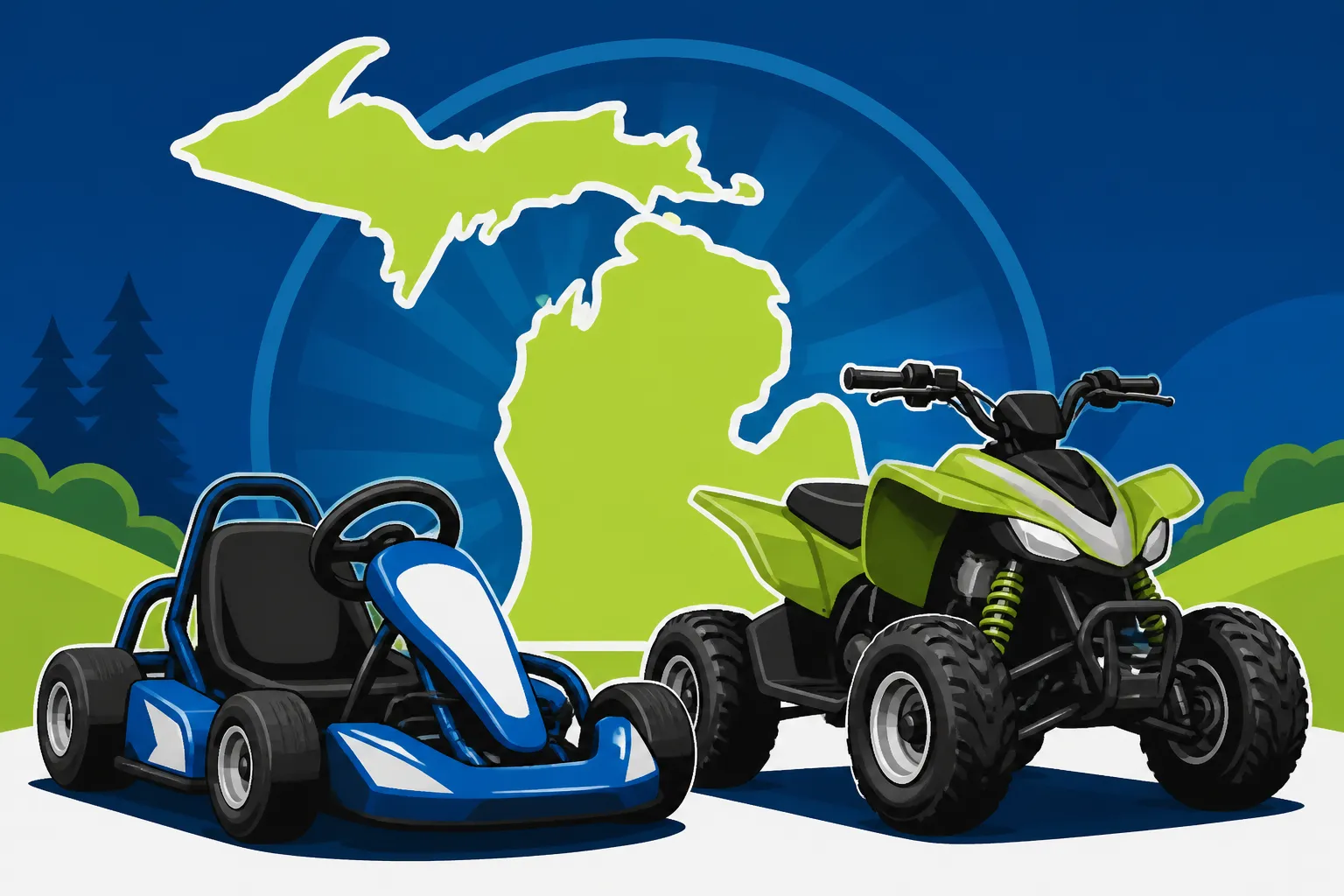
Titling a Go-Kart or Youth Quad in Michigan
Trying to figure out how to legally title that cool new (or new-to-you) go-kart or youth quad for your kid in Michigan can feel like navigating a maze blindfolded. You just want your child to have fun safely and legally, but the rules aren't always crystal clear, especially when you're dealing with different types of machines. This guide is here to cut through the confusion, explaining exactly what needs a title, who should be on it, and how to get it done at the Secretary of State so you can focus on the fun parts of off-road riding.
Understanding Michigan's ORV Titling Basics for Youth Machines
It’s easy to think of a child’s ATV or a backyard go-kart as just a toy, something that doesn't need formal paperwork beyond a purchase receipt. But in Michigan, the state takes off-road vehicles (ORVs) seriously, regardless of the rider's age. This means many youth machines, even smaller ones, fall under the same titling requirements as full-sized ATVs or side-by-sides. Getting this right from the start protects you as the owner and ensures you’re complying with state law.
What Qualifies as an ORV in Michigan (and Why it Matters for Youth Quads)
Michigan law defines an Off-Road Vehicle (ORV) as a motor vehicle capable of cross-country travel without benefit of a road or track, over land, snow, or other natural terrain. This includes vehicles like ATVs, UTVs (side-by-sides), motorcycles, and even certain go-karts. The key here is "capable of cross-country travel" and "motor vehicle." If it has an engine and can go off paved surfaces, there’s a good chance Michigan considers it an ORV.
For youth quads, this definition almost always applies. Whether it’s a 50cc, 90cc, or 125cc machine, if it's designed to traverse trails, fields, or rough terrain, it's an ORV. This designation is crucial because it triggers the requirement for a Michigan title. Without a title, proving legal ownership can become a nightmare if the machine is ever stolen, involved in an accident, or if you decide to sell it down the road. The title is your fundamental proof that you are the rightful owner, a legal document far more robust than just a bill of sale. It's the first official step in bringing your child's machine into legal existence in the eyes of the state.
Go-Karts: When Do They Need a Title in Michigan?
Go-karts are where the waters often get murky. Not all go-karts require a title, which adds to the confusion. The general rule of thumb is that if a go-kart fits Michigan's definition of an ORV, it needs a title. This usually means a go-kart specifically designed for off-road use, with features like suspension, knobby tires, and a robust frame, rather than a flat-track racing kart or a simple backyard cruiser. If it's capable of navigating trails or rough terrain similar to an ATV, it’s likely considered an ORV.
Consider a typical recreational go-kart you might buy at a big box store, perhaps with smaller engines and designed for smooth, flat surfaces like a driveway or paved cul-de-sac. These might not meet the "cross-country travel" aspect of the ORV definition. However, if you're looking at a larger, more powerful off-road go-kart, sometimes marketed as a "dune buggy" or "trail kart," it absolutely would fall under the ORV umbrella. These machines often have VINs (Vehicle Identification Numbers) stamped on their frames, which is a big indicator of their ORV status. If you're trying to figure out if your go-kart fits, look for a VIN. If it has one, it’s a strong sign the manufacturer intended it to be titled. If it's a homemade go-kart or an older model without a VIN, you might face a different set of challenges when trying to secure ownership, similar to [Titling a Rebuilt or Homemade UTV in Michigan]. Always err on the side of caution and assume it needs a title if there's any ambiguity, as this provides legal clarity for everyone involved.
The Titling Process for Youth ATVs and Go-Karts
Once you've determined that your youth quad or go-kart needs a title, the next step is navigating the actual process. It’s pretty similar to titling a full-size ATV, but with some specific considerations given that it's for a minor. Having all your ducks in a row before you head to the Secretary of State will save you a lot of time and frustration.
Gathering Your Documentation for a Youth Machine Title
The foundation of any title transfer is proper documentation. Without it, you won't get far. For a youth ATV or off-road go-kart, you'll generally need:
- Proof of Ownership: This is paramount. If you bought a brand new machine from a dealer, they will typically handle the initial paperwork and submit it for you, but you'll get a Manufacturer's Certificate of Origin (MCO) or Statement of Origin (MSO). If you purchased it used from a private seller, you'll need the previous owner's properly assigned title. The previous owner must sign the title over to you in the designated area. If they bought it new, they should have the MCO/MSO from the dealer which they would then assign to you.
- A Bill of Sale: Even with a properly assigned title, a detailed bill of sale is highly recommended, especially for private party transactions. This document clarifies the terms of the sale, the purchase price, and explicitly states the transfer of ownership. It protects both the buyer and the seller. Services like LawDepot can provide reliable templates to ensure you cover all the necessary information, such as VIN, make, model, and condition of sale. You can learn more about what to include by reading [Michigan ATV Bill of Sale: What to Put in It].
- Personal Identification: You, as the person applying for the title, will need a valid Michigan driver's license or state ID.
- The Michigan ORV Title Application: This form (TR-52L) will be filled out at the Secretary of State office or can be downloaded beforehand. You can find detailed information about this process in [Michigan ORV Title Application and What It Costs].
Problems often arise if the machine was purchased used without a title, or with a title that has missing signatures. In these scenarios, proving ownership becomes significantly harder and may require additional steps, which we'll discuss later. Always prioritize getting a clear, properly signed title or MCO/MSO from the seller.
Who Should Be on the Title: Parents, Guardians, or the Child?
This is a critical point when dealing with machines intended for minors. In Michigan, minors generally cannot legally own property, especially titled vehicles, in their own name. This means that while the machine is for the child, the title needs to be in an adult's name.
Here are the common scenarios:
- Parent(s) or Legal Guardian(s) as Owners: The most straightforward and recommended approach is for one or both parents, or a legal guardian, to be listed as the owner(s) on the title. This ensures that a legally responsible adult holds the ownership. If you put both parents' names on it, typically "John OR Jane Doe" is used if you want either person to be able to conduct transactions independently, or "John AND Jane Doe" if both signatures are required for future sales or transfers. You can get more details on this in [Putting an ORV Title in Two Names].
- Why Not the Child? Putting a child's name on the title directly isn't legally sound and can lead to complications. Should there be an accident, a need to sell the machine, or any other legal issue, a minor cannot enter into contracts or make binding legal decisions. The adult listed on the title is legally responsible for the vehicle.
- Liability Considerations: When a parent or guardian is on the title, they bear the legal responsibility for the machine. This is a significant factor in Michigan, where laws around ORV operation and liability can be strict. For guidance on this, especially if you're thinking about the specifics of who should hold the title, our article [Buying an ATV for a Child: Whose Name Goes on the Title] offers further insights. This structure ensures that the legal framework for ownership and responsibility is clear and adheres to state laws.
The Secretary of State Visit: What to Expect
Once you have all your documents ready, the next step is a visit to a Michigan Secretary of State branch office. It's often helpful to plan ahead to make this process as smooth as possible.
- Appointments are Your Friend: Many Secretary of State offices operate by appointment, or at least highly recommend them. Checking the Michigan SOS website for their current policies and scheduling an appointment can drastically cut down on your wait time. This is especially true if you want to avoid peak hours. For more on navigating the appointment system, check out [Michigan Secretary of State Appointments for ORV Title Work].
- What to Bring: Make sure you have all the documents we just discussed: the properly assigned title or MCO/MSO, your bill of sale, your driver's license or state ID, and any relevant forms you might have pre-filled (though they'll have copies there).
- Filling Out the Application: At the branch, you'll complete the Michigan ORV Title Application (Form TR-52L). This form asks for details about the ORV (VIN, make, model, year) and the owner's information. Be sure to accurately report the purchase price, as this will determine the sales tax (or use tax, if purchased privately).
- Paying the Fees: You'll be required to pay the titling fee. Additionally, if the machine was purchased from a private seller, you’ll typically owe Michigan’s use tax on the purchase price. If you bought it from a dealer, they would have already collected sales tax. The amount of these fees can vary, so be prepared for these costs. You can find more specific information on these fees by referring to [Michigan ORV Sales Tax at a Secretary of State Branch].
- Receiving Your Title: After all the paperwork is processed and fees are paid, the Secretary of State office will issue you a temporary registration and often a receipt. Your official title will then be mailed to you, usually within a few weeks. The timing can vary, so don't expect to walk out with the physical title in hand immediately.
Common Challenges and Solutions in Titling Youth Machines
Even with all the preparation, sometimes you hit a snag. Youth machines, especially older go-karts or those acquired through less-than-perfect channels, can present unique titling challenges. Knowing how to approach these issues can save you from a major headache.
What if the Go-Kart or Quad Has No VIN?
This is a common predicament, particularly for older go-karts, homemade builds, or machines where the VIN has become unreadable due to rust or damage. A Vehicle Identification Number (VIN) is absolutely essential for titling an ORV in Michigan. It's how the state identifies and tracks the machine.
If your go-kart or youth quad lacks a readable VIN, you won't be able to title it immediately. You'll need to go through a process to get a VIN assigned or verified. This typically involves:
- Contacting the Secretary of State: Your first step is to inquire with the Michigan Secretary of State about their specific process for VIN verification or assignment for machines without a manufacturer's VIN. They can guide you on the necessary forms and procedures.
- Inspection Requirements: Often, the state will require a physical inspection of the machine by a qualified law enforcement officer or a designated Secretary of State inspector. They will verify that the machine isn't stolen and confirm its characteristics (make, model, engine size) before a new VIN can be issued. This process is similar to what's described in [VIN Inspection Requirements for a Michigan ORV Title].
- Homemade or Kit-Built: If it’s a homemade go-kart, you'll be applying for a "Special Constructed" or "Homemade" vehicle title. This usually involves submitting detailed information about the components used, along with the inspection. Getting a new VIN stamped and officially recognized takes time and effort, but it's the only way to legally title such a machine. Without this, you can run into significant problems, including the possibility of your title being denied or needing to rectify a [Fixing a Wrong VIN on a Michigan ORV Title] situation.
Buying a Used Youth Machine Without a Title
This is a red flag situation that many buyers, especially those looking for a bargain, unfortunately encounter. While it might seem like a great deal, buying an ORV, including a youth quad or go-kart, without a title can lead to serious legal and financial issues down the road. In Michigan, the title is the definitive proof of ownership.
If you find yourself in this situation, here’s what you need to know:
- Extreme Caution is Advised: Without a title, there's no guarantee the seller is the legal owner. The machine could be stolen, or there could be an undisclosed lien on it. Always try to verify ownership before purchasing.
- Proof of Ownership: If you absolutely must proceed without a title, you'll need the strongest possible documentation of your purchase. A very detailed bill of sale is crucial here. It should include the seller's full name, address, driver's license number, the date of sale, the purchase price, a clear description of the ORV (make, model, color, any existing VIN), and a statement that the seller warrants they are the legal owner and have the right to sell the machine. You can find resources like LawDepot for robust bill of sale templates that can strengthen your claim. For more on what constitutes valid proof, see [Proof of Ownership When a Michigan ORV Has No Title].
- Bonded Title Option: In some cases, if you can prove you legitimately purchased the machine but the title is missing, you might be able to apply for a bonded title. This involves obtaining a surety bond, which is a guarantee to the state that you are the legal owner. If someone else later proves legitimate ownership, the bond would compensate them. This is a complex and sometimes costly process. You can learn more about this by reading [Bonded Title for an ATV in Michigan].
- Court Order: As a last resort, if all other avenues fail, you might need to pursue a court order to establish ownership and compel the state to issue a title. This is often expensive and time-consuming and highlights why avoiding untitled purchases is always the best advice.
Special Considerations for Youth Machine Operation Post-Titling
While getting the title sorted is a huge hurdle cleared, it’s important for parents and guardians to remember that titling is just one piece of the puzzle for legal and safe operation of a youth quad or go-kart in Michigan. There are other requirements that apply, especially if the machine will be ridden anywhere other than fully enclosed private property.
- ORV License and Trail Permit: If your youth quad or go-kart will be ridden on designated ORV trails, routes, or areas in Michigan, it will need a Michigan ORV license and trail permit. Even if you plan to mostly ride on private land, sometimes rules can still apply depending on the nature of the land and how accessible it is to the public. Our article [Michigan ORV License and Trail Permit Explained] provides a thorough breakdown of these permits.
- Safety Certificate Requirements: Michigan has strict rules about age and safety certification for ORV operators, especially for minors. Anyone under the age of 16 operating an ORV on public lands, trails, or routes must possess a valid ORV safety certificate. This certificate ensures they understand the rules of the trail and safe operating practices. There are specific rules for different age groups, which you can explore in [Michigan ORV Safety Certificate for Riders Under 16] and [Michigan ORV Age Rules for Young Riders].
- Supervision and Equipment: Beyond permits and certificates, parents must ensure that young riders are adequately supervised and use appropriate safety gear, including a helmet, eye protection, and protective clothing. These aren't just recommendations; they are critical for preventing injuries and are often legally mandated in various riding situations.
Understanding all these elements ensures that your child can enjoy their machine safely and legally, providing peace of mind for you as a parent.
| Machine Type | Titling Requirement | Common VIN Location | Ownership for Minors | Additional Requirements (Post-Title) |
|---|---|---|---|---|
| Youth ATV (e.g., 90cc) | Yes, standard ORV | Frame, usually front-right or left | Parent/Guardian's Name | ORV License/Permit, Safety Cert (if applicable) |
| Off-Road Go-Kart | Often, if ORV-spec | Frame, varies | Parent/Guardian's Name | ORV License/Permit, Safety Cert (if applicable) |
| Small Electric ATV/Quad | Rarely (check specs) | Varies, less common | Parent/Guardian's Name | Less likely to need permits, but check local rules |
| Backyard Go-Kart (simple) | Generally No | Unlikely to have VIN | Not applicable (not titled) | N/A (private land use) |
Disclaimer
This article is for general informational purposes only and does not constitute professional advice. Laws, prices and regulations vary by location and change over time. Consult a qualified professional for guidance on your specific situation.