Riding on a Friend’s Land Without a Michigan Permit
A friend’s permission can make a private-property ride possible without a Michigan ORV license or trail permit, but only while you stay on private land. The tricky part is knowing where that permission ends: a connecting road, public trail, or neighboring parcel may have different rules. Here’s how to sort out the permit question before you unload.
When you can ride without a Michigan ORV permit
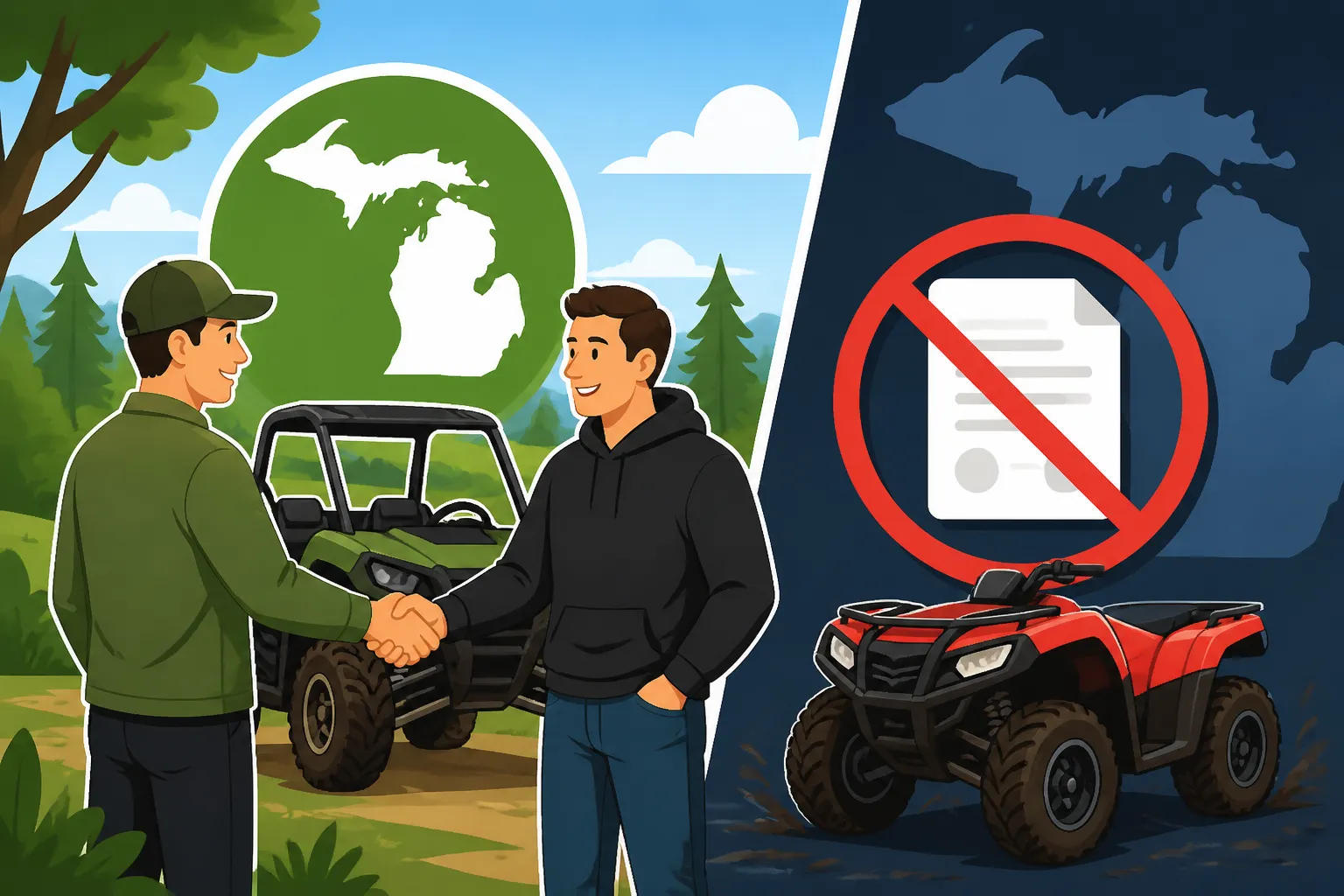
Michigan’s ORV license and trail permit requirements generally apply when you operate on designated public ORV trails and routes, state forest roads, and other public lands where permits are required. If you ride entirely on private property with the landowner’s permission, you generally do not need those permits just to ride there.
That can include riding on a friend’s private acreage, a private field, or a private trail on the property. The key conditions are that the property is actually private, the person giving permission has authority to do so, and your ride stays within the permitted area. The private-land exemption is not a pass to use nearby public trails or roads without the required permits.
Michigan has separate ORV license and trail permit requirements, and riders may need both when using certain public trails and routes. The permit rules can be easier to apply once you understand the difference between them; see Michigan ORV License and Trail Permit Explained.
| Where you ride | Michigan ORV license or trail permit generally required? | What to check |
|---|---|---|
| Entirely on a friend’s private property, with permission | Generally no | Confirm the property boundary and that permission covers your ride |
| On a designated public ORV trail or route | Usually yes | Check which permits apply to that route |
| On a public state forest road open to ORVs | Usually yes | Confirm the road is open and review permit requirements |
| On a public road or shoulder | Permit requirements are only part of the question | Check whether ORVs may use that road and what rules apply |
| Across a private parcel you do not have permission to use | No permission to ride there | Get permission from the owner or choose another route |
| On private land, then onto a public trail | Public-land requirements apply once you enter the trail | Have required permits before leaving the private property |
“Private land” is more specific than “land that looks open.” A wide field, woods, or two-track may be privately owned even if there is no fence or sign. Likewise, a trail near your friend’s property may cross a public parcel or another owner’s land. Do not rely on appearances to decide where you can ride.
If you are riding on someone else’s land rather than your own, the distinction between a friend’s permission and a formal land arrangement can matter. For other private-property situations, see Michigan ORV Permit Exemptions on Private Land and Michigan ORV Permit Rules on Leased Hunting Land.
Permission needs to cover the route, not just the starting point
Ask your friend for permission before riding, and be clear about what the permission includes. A casual invitation to use the property does not necessarily mean you may ride anywhere you choose, bring a group, cross a neighbor’s land, or use the adjoining public trail.
A useful conversation covers:
- Which parcel or area is okay to ride on
- Whether the permission includes trails, fields, woods, or all of them
- Whether passengers or additional riders are allowed
- Where to park and unload
- Which gates, driveways, or access lanes to use
- Whether there are areas to avoid, such as crops, livestock, buildings, or wet ground
- Whether the landowner has set hours or other restrictions
The landowner’s permission only reaches the land they control. Your friend may own one parcel but not a connecting strip, private road, or neighboring field. If the route crosses another owner’s property, you need that owner’s permission too. A friend who has permission to ride there may not have authority to invite you.
Be careful around property lines and public access
A private trail can meet a public trail without a clear sign or barrier. Before riding near a property edge, check a reliable map and ask the landowner where the boundary lies. If you are unsure whether a route is private or public, stop and clarify rather than assuming you can continue.
The same caution applies to riding from the property to a gas station, trailhead, or another parcel. A short stretch on a public road is still public-road use. Permission to ride on private land does not itself authorize riding on a road, shoulder, public trail, or state forest road. For the separate rules that apply to private roads, see Michigan ORV Rules on Private Roads.
A landowner may also allow access subject to conditions. For example, they may restrict certain areas, prohibit riding after a particular time, or ask you to avoid wet trails. Those conditions are separate from state permit rules, but they still define the access you have been given. Follow them, and leave if permission is withdrawn.
A permit exemption does not waive every other rule
Not needing an ORV license or trail permit on private land does not mean every other rule disappears. Safe operation, the machine’s condition, landowner restrictions, and rules that apply to the rider may still matter. In particular, do not assume that a rule for public-land riding automatically applies the same way on private land—or that all rider protections stop applying there.
Age and safety-training rules deserve special care. Requirements can depend on the rider’s age, the place of operation, and the type of machine. If a child will be riding, check the applicable rules before the visit rather than relying on the permit exemption alone. See Michigan ORV Safety Certificate Requirements and Michigan ORV Age Rules for Young Riders.
Permission also does not replace the need to operate responsibly. Keep clear of people, pets, livestock, buildings, and equipment. Avoid riding across crops or damaging trails, especially when the ground is soft. A route that is legal to use can still create problems if it damages the property or puts someone at risk.
Finally, a title is ownership paperwork, not a riding permit. The private-land permit exemption does not resolve questions about who owns the machine or whether its paperwork is in order. Keep the machine’s ownership documents handled separately from the question of where it may be ridden.
Before you unload, confirm the details
A quick check before the ride can prevent a misunderstanding or an accidental trip onto land where you are not authorized to ride.
- Confirm the property is private. Ask your friend whether the riding area is privately owned and whether any part of the route crosses other land.
- Get clear permission. Agree on the area, access route, riders, passengers, and any restrictions.
- Identify public connections. Check whether the private trail meets a public ORV route, state forest road, or public road.
- Bring the required permits for any public riding. If you plan to leave the private property and enter a public area where permits are required, make sure the machine has the correct permits before you do.
- Check rider-specific requirements. Confirm safety certificate, age, and operating rules for anyone who will ride.
- Respect the landowner’s conditions. Stay within the approved area and stop if the owner asks you to.
If you may ride on public land during the same outing, review Michigan ORV Permit Exemptions on Private Land alongside the public-land rules, and do not treat a private-property exemption as permission to continue onto a trail. When a conservation officer or another official asks about your ride, explain where you are operating and follow any directions. For broader paperwork questions, see Michigan ORV Paperwork During a DNR Stop.
The practical answer is straightforward: riding entirely on a friend’s private land with the owner’s permission generally does not require a Michigan ORV license or trail permit. The moment your route leaves that land, the permit and access rules may change. Confirm boundaries first, get permission from the right people, and check the requirements for every public segment you plan to ride.
Disclaimer
This article is for general informational purposes only and does not constitute professional advice. Laws, prices and regulations vary by location and change over time. Consult a qualified professional for guidance on your specific situation.