Michigan ORV Permit for State Forest Roads Only
If you plan to ride only Michigan state forest roads, it can be hard to tell whether you need the base ORV license, the extra trail permit, or both. The key is to distinguish a forest road from a designated ORV trail and check the route’s current status. That helps you buy the right permit without assuming every route has the same rules.
What you need for state forest roads
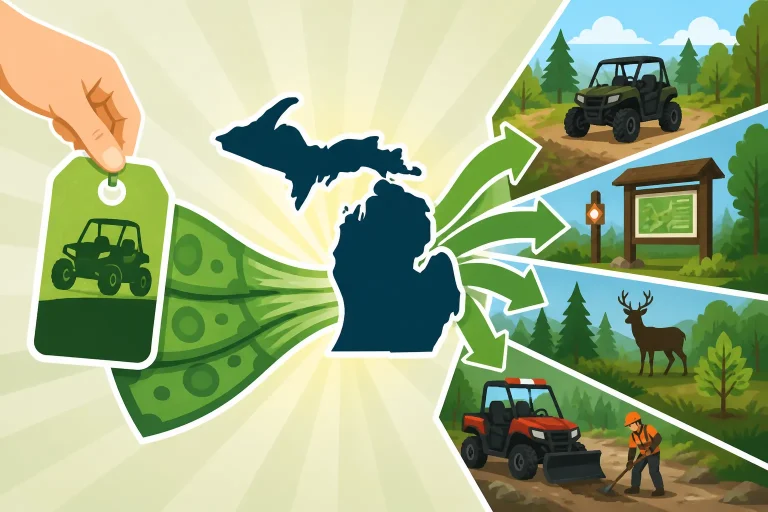
For an ATV or UTV operated on public state forest roads, plan on getting the base Michigan ORV license. The extra trail permit is a separate requirement for state-designated ORV trails; it is not automatically required just because you are riding in a state forest. According to the Michigan Department of Natural Resources, the annual ORV license costs $26.25, and the additional trail permit costs $10.00 when required, for a combined total of $36.25. Those prices are as of October 2026.
The important distinction is the type of route, not simply the land around it. A road can run through a state forest without being a designated ORV trail. Conversely, a designated trail may be nearby and have its own permit requirement. Before you ride, confirm whether your planned route is classified as a forest road, a designated ORV route, or a trail.
| Where you plan to ride | Permit to plan for | What to check |
|---|---|---|
| State forest road open to ORVs | Base ORV license | Confirm the road is open to ORV use and has no posted restriction |
| State-designated ORV trail | Base ORV license and trail permit | Confirm the route is designated and open |
| Frozen surface of public waters | ORV license; no trail permit for this use | Check local conditions and any applicable closures |
| Designated ORV route passable by a conventional passenger vehicle, using a street-licensed vehicle | No ORV license or trail permit under the stated exception | Confirm the route is designated and passable by a conventional passenger vehicle |
The Michigan Department of Natural Resources says state forest roads are generally open year-round to ORV use unless otherwise posted or seasonally closed. “Generally open” is not a promise that every road is available on every ride. A closure, sign, local restriction, or seasonal condition can change what you may use.
That’s why it helps to plan the route before leaving rather than treating a state forest as one continuous open riding area. Check the current map and signs for your intended roads and any connecting trails. For a broader explanation of how the two permit types work, see Michigan ORV License and Trail Permit Explained. If your riding plan truly excludes designated trails, Michigan ORV License Without a Trail Permit: Where You Can Ride can help you think through that distinction.
How to confirm a road is open and avoid the trail permit
A permit decision depends on where you actually ride. If your route includes a designated ORV trail, the trail permit applies even if most of the trip is on a forest road. A route that changes from road to trail can therefore change what you need. Review the route as a whole, including connections, rather than checking only the place where you intend to start.
State forest roads are often used as part of a longer ride, so look for points where a road meets a trail or designated route. Pay attention to trailhead signs and posted notices on the ground. If a map labels a segment as a trail, do not assume that it is covered by the forest-road-only plan. When the label or status is unclear, verify it with the Michigan Department of Natural Resources before riding.
The department can also close state trails and facilities because of weather or wet conditions. A route that appears on a map may therefore be temporarily unavailable. Wet conditions matter for more than access: riding a closed or vulnerable route can damage it and create problems for other users. Check for closure notices close to your trip, and follow signs even if a route was open on a previous visit.
For other road networks, don’t assume that the same permit distinction applies. The Michigan ORV Permit for National Forest Roads topic is useful if your trip crosses from state forest land to national forest land. If you are riding a designated trail, the extra permit is part of the plan; Michigan ORV Trail Permit Price explains the separate permit charge.
A practical pre-ride check looks like this:
- Identify every road, route, and trail segment you expect to use.
- Confirm which segments are state forest roads and which are designated ORV trails.
- Check current closure information and follow posted signs.
- Buy the base ORV license, and add the trail permit if your route includes a designated ORV trail.
- Keep your permit information available in case an officer asks to see it.
Annual licenses and trail permits expire on March 31 of the following year, regardless of when they were purchased, according to the Michigan Department of Natural Resources. A permit bought late in its cycle does not carry over based on the purchase date. Check the expiry before a trip, especially if the permit was bought well before the ride. The annual cycle is covered in more detail in Michigan’s April 1 ORV Permit Year.
Machine, rider, and equipment rules still apply
Having the right permit does not make every machine or riding situation legal. The Michigan Department of Natural Resources designates three ORV trail types by width: motorcycle-only trails maintained at a 24-inch width, trails maintained at a 50-inch width, and ORV routes maintained at a minimum 72-inch width. Check the rules for the particular route and vehicle instead of assuming a road open to one machine is suitable for another.
Age and supervision requirements matter on public lands. The Michigan Department of Natural Resources says anyone under 16 must have a valid ORV safety certificate and ride under an adult’s direct visual supervision; children under 10 may not operate 4-wheel ATVs on public lands. The department also requires youth under 16 to complete an approved ORV safety course and carry the certificate while operating an ORV on public lands. These rules apply regardless of whether the ride is on a forest road or a trail.
For non-resident youth riders, the Michigan Legislature recognizes an ORV safety certificate issued under Michigan law or a comparable certificate issued under the authority of another state or a Canadian province for operators aged 12 to 15. A visiting family should confirm that the certificate meets the requirement before setting out. More on permit questions for visitors is available in ORV Permits for Out-of-State Riders in Michigan.
Equipment and riding conduct matter on roads as well. The Michigan Legislature requires a United States Forest Service-approved spark arrester and a muffler in good working order and constant operation on ORVs operated on public lands. Michigan’s exhaust-noise limit is 94 dB(A) for vehicles manufactured after January 1, 1986, or 99 dB(A) for older models, when tested under the specified stationary test procedure, according to the Michigan Legislature. A noisy or modified exhaust is not a substitute for a compliant muffler and spark arrester.
The Michigan Legislature also requires headlights and taillights to be illuminated when operating an ORV from a half-hour after sunset to a half-hour before sunrise. If you ride near dusk or in darkness, check the lights before leaving rather than assuming they will work when needed.
Helmet and passenger rules are easy to overlook. The Michigan Legislature generally requires ORV operators and passengers to wear a Department of Transportation-approved crash helmet and protective eyewear, with exceptions under certain conditions. One exception can apply to a UTV equipped with an approved roof when occupants wear properly adjusted and fastened safety belts. The Michigan Department of Natural Resources also says seat belts are required for UTV occupants who rely on that helmet-law exception, and some state-managed areas, including the Silver Lake ORV Area, require a seat belt for each occupant regardless.
The Michigan Legislature prohibits carrying a passenger unless the vehicle’s design or manufacturing standards provide for passengers. Don’t add a passenger to an ATV built for one simply because a short forest-road trip seems low risk. Follow the machine’s seating design and use the required occupant restraints.
Alcohol is another safety and legal issue, even on a forest road. The Michigan Legislature sets the ORV blood alcohol concentration threshold at 0.08 grams or more per 100 milliliters of blood, per 210 liters of breath, or per 67 milliliters of urine. The safest plan is to keep alcohol out of the ride entirely.
Buying the permit and keeping your plan simple
If you will ride only eligible state forest roads, the practical approach is to buy the base ORV license and avoid the trail permit only if you have confirmed that your route does not include a designated ORV trail. If you might use a trail during the same outing, budget for the additional permit and verify the route before you go. The permit choice should follow the route, not a general assumption about the area.
Keep a record of which permit you purchased and when it expires. A document pouch or other weather-resistant way to protect your paperwork can help; a waterproof pouch from a retailer such as Amazon is one option. The goal is simply to keep the information legible and easy to find, not to rely on a phone or paper copy as a substitute for having the required permit.
There is a separate exception for street-licensed vehicles. According to the Michigan Department of Natural Resources, a street-licensed vehicle such as a truck or motorcycle may use a designated ORV route that is passable by a conventional passenger vehicle without an ORV license or trail permit. That exception is specific to the stated route and vehicle situation; do not assume it applies to an ATV or UTV because the route is called a road.
For certain other places, the requirements differ. The Michigan Department of Natural Resources says an ORV license is required to ride on the frozen surface of public waters, but a trail permit is not required for that use. That does not mean a permit for frozen-water riding covers a forest-road trip, or vice versa. Check the rule for each part of the ride.
If you are unsure whether a segment counts as a designated trail, whether a road is currently closed, or whether a vehicle fits the route, pause and confirm before riding. That small check is usually easier than sorting out a permit problem after the trip has started. For guidance on when an exemption may apply, see Michigan ORV Permit Exemptions on Private Land; private-property rules should not be treated as a general exemption for public forest roads.
Sources
- Michigan Department of Natural Resources — ORV FAQs – State of Michigan (checked October 28, 2026)
- Michigan Department of Natural Resources — Purchase permit, learn requirements – State of Michigan (checked October 28, 2026)
- Michigan Legislature — MCL Section 324.81133 (checked October 28, 2026)
- Michigan Legislature — MCL Section 324.81134 (checked October 28, 2026)
Disclaimer
This article is for general informational purposes only and does not constitute professional advice. Laws, prices and regulations vary by location and change over time. Consult a qualified professional for guidance on your specific situation.