What Direct Visual Supervision Actually Means
Direct visual supervision sounds simple, but it can be hard to judge on a trail: How close must an adult be, and does watching from a nearby vehicle count? Michigan’s youth rules make supervision a condition of riding on public land. Here’s how to apply that requirement safely, and how it differs from permits and road rules.
What direct visual supervision means in practice
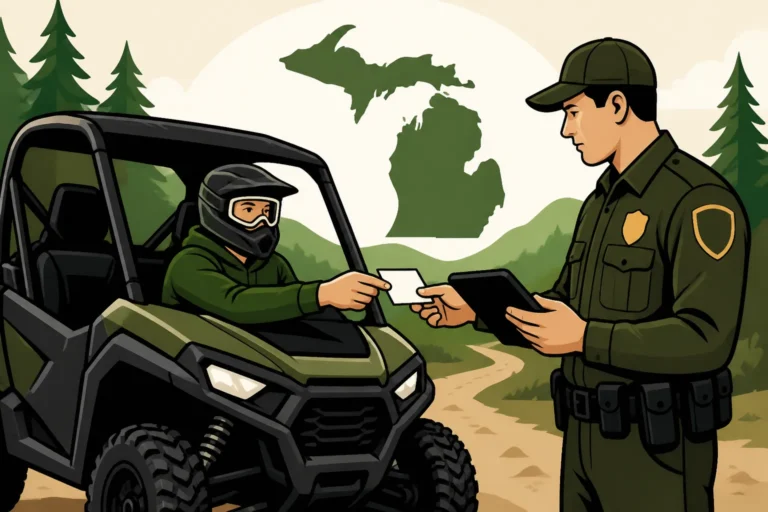
Michigan’s youth rule requires an adult to provide direct visual supervision when a rider under 16 operates an ORV on public lands. The Department of Natural Resources also requires these young riders to have a valid ORV safety certificate. The rule identifies the need for supervision, but the facts available here do not set out a precise distance or a detailed test for how close an adult must be.
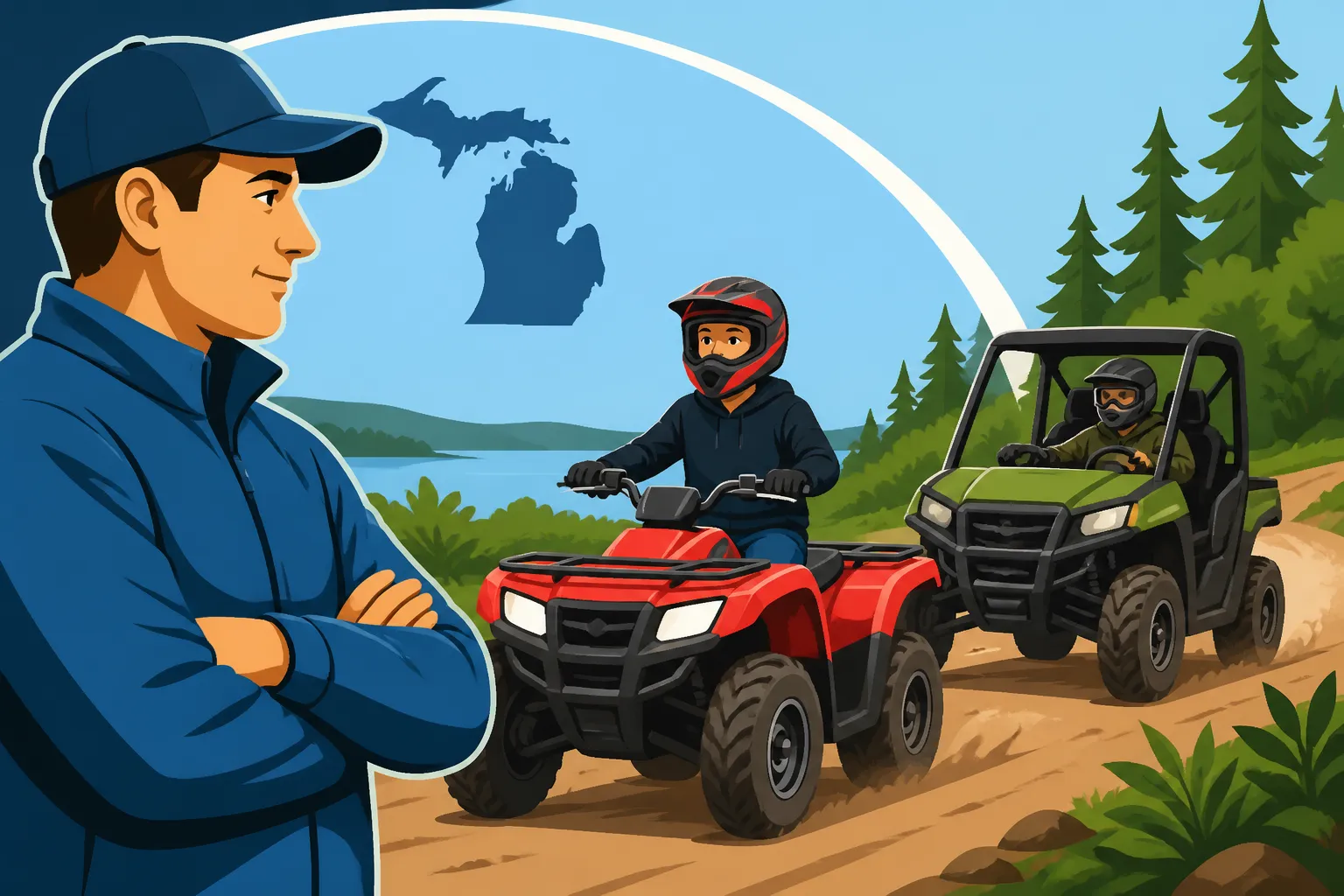
For a practical, safety-first interpretation, the supervising adult should be able to see the young rider directly and keep watching as the ride unfolds. That means more than knowing where the child is or checking in by phone or radio. The adult needs a clear view of the rider and the ability to notice a problem promptly.
A useful way to think about it is: if the rider moves behind trees, around a bend, over a rise, or out of sight in dust, the adult can no longer visually observe that rider. A radio may help with communication, but it does not replace seeing the rider. Nor does watching from a distant staging area provide the same kind of active oversight as staying with the child.
This is a conservative way to manage the rule, not a claim that Michigan law specifies a particular following distance or requires one exact riding formation. If the route makes it impossible to keep the child in view, pause and regroup, choose a route with better visibility, or have the adult ride closer. For questions about how an officer or land manager applies the requirement in a specific situation, confirm the answer with the Michigan DNR.
Direct visual supervision is about the adult’s attention and ability to observe, not simply being somewhere on the same trail. A supervising adult who is focused on another task, far ahead, or riding with a group that repeatedly blocks the view may not be providing effective oversight. The safest setup is one in which the adult can see the young operator, watch for changing terrain and hazards, and make a timely decision to stop or assist.
That responsibility also continues when the trail changes. A rider who is visible on a straight stretch may disappear around a corner or into a dip. Rather than assuming the child will catch up, the adult should adjust the pace and position so the child stays within sight. If the adult cannot do that without creating another hazard, it is better to stop in a safe place and reorganize the ride.
Who needs supervision and what a young rider needs
According to the Department of Natural Resources, anyone under 16 operating an ORV on public lands must have a valid ORV safety certificate and be under direct visual supervision of an adult. The same agency says children under 10 are prohibited from operating four-wheel ATVs on public lands. That prohibition is not something an adult can overcome by riding alongside a child.
According to the Department of Natural Resources, an operator must be at least 16 to operate an ATV unsupervised on public lands. In other words, supervision is not optional for a younger rider simply because the rider has experience or has completed a safety course. A certificate and supervision are both part of the stated requirements for riders under 16.
| Rider and riding situation | What the stated Michigan rule requires |
|---|---|
| Under 10 operating a four-wheel ATV on public lands | The Department of Natural Resources prohibits this. Adult supervision does not change that restriction. |
| Under 16 operating an ORV on public lands | The Department of Natural Resources requires a valid ORV safety certificate and direct visual supervision by an adult. |
| At least 16 operating an ATV unsupervised on public lands | The Department of Natural Resources sets 16 as the minimum age for unsupervised operation. |
| Under 18 on a public road designated for ORV use | The Michigan Legislature requires a valid ORV safety certificate and either a driver’s license or direct supervision by a parent or guardian. |
The table is a quick comparison, not a replacement for checking the rules for a particular machine and riding area. For a closer look at the age requirements, see Michigan ORV Age Rules for Young Riders and Michigan ORV Safety Certificate for Riders Under 16. Families choosing a machine for a young rider can also review Youth ATV Size Rules Michigan Parents Should Know.
A safety certificate and adult supervision serve different purposes. The certificate shows that the young rider has completed an approved ORV safety course; supervision means an adult remains actively able to observe the ride. One does not substitute for the other. According to the Department of Natural Resources, a youth under 16 must complete an approved ORV safety course and carry the certificate to operate an ORV on public lands.
Carrying the certificate matters because a parent’s assurance that a child completed a course is not the same as having the required certificate available. Before setting out, make sure the rider has the certificate and that it is legible and accessible. A parent or guardian can also check the ride plan against the certificate and the relevant land rules, rather than assuming that course completion alone makes any route or machine appropriate.
The rules can also matter to visitors from outside Michigan. According to the Michigan Legislature, non-resident operators aged 12 to 15 must present an ORV safety certificate issued under Michigan’s requirements or a comparable certificate authorized by another state or a Canadian province. A visiting family should check that the young rider’s certificate qualifies before planning a public-land ride. More on visitors’ permit considerations is covered in Non-Resident ORV Permits in Michigan.
How to keep supervision effective on a ride
Direct visual supervision is easiest to maintain when the adult plans around visibility instead of trying to manage it after the group has spread out. The aim is not to ride in a way that forces the adult to take unnecessary risks. It is to choose a pace and arrangement that keeps the young rider observable and makes it possible to stop safely when conditions change.
Before riding:
- Pick a route that suits the group. A narrow, winding route with frequent blind turns can make it difficult to keep a young rider in view. Check route conditions and access rules in advance, and choose a route that matches the rider’s skills and the adult’s ability to supervise.
- Agree on a simple regrouping plan. Decide where the group will stop if a rider loses sight of the adult or the adult loses sight of the rider. The plan should be easy to follow without requiring a child to continue alone to find the group.
- Set a pace that allows observation. If the adult has to ride quickly to catch up, or the child has to push beyond a comfortable pace to keep up, the setup is not working. Slow down or stop and reorganize.
- Check the certificate and permit situation. A safety certificate is not a permit, and neither replaces the other. Michigan ORV License and Trail Permit Explained can help distinguish the documents and access requirements.
- Review the machine and protective equipment. Supervising an inexperienced rider does not remove the need to use a machine suited to the rider or to follow the applicable safety rules.
During the ride, the adult should keep the young operator in view, not merely track the group by sound or through occasional glances. Dust, vegetation, changing light, and terrain can all make visibility worse. If the adult can no longer see the rider, the sensible response is to stop at a safe location, re-establish contact, and continue only when the supervision arrangement is effective again.
An adult does not need to hover so close that the child cannot ride independently within the group. But “independent” should not mean out of sight. The adult can let a young rider make decisions appropriate to their experience while maintaining a clear view and staying ready to intervene. That balance is easier when the adult avoids riding far ahead or putting multiple machines between themselves and the young operator.
Group rides need extra thought. A crowd of riders, a line of machines, or a dust cloud can hide the child even when everyone is nearby. The adult responsible for the young rider should take a position that preserves the view and communicate the plan to other adults. If the group splits, the young rider should remain with the supervising adult rather than being left in a separate group on the assumption that another adult is watching.
On a trail with poor visibility, stopping may be the safest way to restore supervision. Do not treat the child’s ability to follow a familiar machine as equivalent to direct visual oversight. If the child cannot see the adult and the adult cannot see the child, neither can reliably respond to a hazard, a breakdown, or a wrong turn.
Adults should also consider fatigue and distraction. A supervising adult who is managing navigation, equipment problems, or several riders at once may not be able to watch one child consistently. It can help to make the responsibility clear among the adults before the ride begins. The person supervising should know which rider they are responsible for and avoid assuming that someone else has taken over.
If an incident or mechanical issue separates the group, stop riding and re-establish the plan before proceeding. A young rider should not be expected to find their own way through unfamiliar terrain to reunite with the adult. Families can plan simple stop-and-wait instructions in advance, but those instructions are a backup, not a substitute for keeping the rider in view.
Public lands, roads, permits, and machine type
Supervision requirements are only one part of deciding where a young person may ride. A child may have a certificate and an attentive adult yet still be on a route that is closed, unsuitable for the machine, or subject to separate permit rules. Keep age, supervision, machine, land access, and permits as separate checks.
According to the Department of Natural Resources, an annual Michigan ORV license costs $26.25, and riding state-designated ORV trails requires an additional $10.00 trail permit, for a combined total of $36.25. Those figures are as of October 2026. The Department of Natural Resources says annual ORV licenses and trail permits expire on March 31 of the following year, regardless of when they were purchased. Check the current requirements before riding, especially if the ride includes state-designated trails. See Michigan’s Extra $10 ORV Trail Permit and Michigan ORV Permit Year: April 1 to March 31.
The permit question is not the same as the supervision question. An adult riding alongside a child does not make an otherwise required permit unnecessary. Conversely, having the correct permit does not make an underage rider eligible to ride unsupervised. For details about which documents apply to a particular trip, Do You Need Both a License and a Trail Permit in Michigan? is a useful companion.
Roads can involve a different supervision condition. According to the Michigan Legislature, a driver’s license is not required for adults operating an ATV on public roads designated for ORV use. For individuals under 18, the Michigan Legislature requires either a valid driver’s license or direct supervision by a parent or guardian while the rider holds an ORV safety certificate. That road rule is distinct from the public-land rule for riders under 16, so do not assume the same age threshold or adult relationship applies in every setting.
The phrase “direct supervision” on a designated road should be treated as an active responsibility, not permission for a young rider to travel out of sight. In particular, the Michigan Legislature specifies a parent or guardian for the under-18 road condition. A different adult may be able to supervise a child under the public-land rule, but that should not be assumed to satisfy the road requirement. Check Michigan ORV Road Rules for Riders Under 16 before planning a road route.
Vehicle width can also affect what a machine is called and where it can operate. According to the Michigan Department of Natural Resources, there are three ORV trail types designated by width: motorcycle-only trails maintained at a 24-inch width, trails maintained at a 50-inch width, and ORV routes maintained at a minimum 72-inch width. A family should not rely on the word “ATV” in everyday conversation to determine the machine’s legal classification or route access. See Michigan ORV Trail Widths Explained and Michigan ORV Rules on Private Roads.
Other riding conditions remain important for supervised groups. According to the Michigan Department of Natural Resources, state forest roads are generally open year-round to ORVs unless they are posted otherwise or seasonally closed. The Department of Natural Resources can also close state trails and facilities because of weather-related events and wet conditions. A route that was open during a previous visit may not be open or suitable now, so check closures and signs rather than relying on memory.
The Department of Natural Resources permits ORVs on the frozen surface of public waters when the required ORV license is in place; a trail permit is not required for that specific use. That does not remove the age, certificate, or supervision rules for a young operator. It also does not make a frozen surface safe simply because riding is permitted. Check conditions and make conservative decisions before taking a child onto ice.
A pre-ride supervision checklist
A short pre-ride check helps prevent a common mistake: focusing on one rule, such as the safety certificate, and overlooking the rest of the plan. Use this checklist before each public-land ride or designated-road trip:
- Confirm the rider’s age and machine. According to the Department of Natural Resources, children under 10 may not operate four-wheel ATVs on public lands, and riders under 16 need direct adult visual supervision there. Check the machine classification and the specific rider’s eligibility.
- Verify the safety certificate. According to the Department of Natural Resources, a youth under 16 must complete an approved ORV safety course and carry the certificate to ride an ORV on public lands. For a non-resident aged 12 to 15, the Michigan Legislature requires a Michigan certificate or a comparable certificate from another state or a Canadian province.
- Name the supervising adult. Be clear about which adult is responsible for watching the young rider. Do not rely on a vague group assumption that someone is keeping an eye out.
- Choose a route that supports visibility. Consider turns, terrain, dust, closures, and the group’s experience. A young rider should stay within the adult’s direct view, and the group should stop if that view is lost.
- Check route-specific permits and access. According to the Michigan Department of Natural Resources, state-designated ORV trails require the additional trail permit along with the ORV license. Check current requirements and route notices before departure.
- Review the road rules if the ride uses a designated public road. According to the Michigan Legislature, a person under 18 must have a valid driver’s license or be under the direct supervision of a parent or guardian while holding an ORV safety certificate.
- Agree on what to do if the group separates. Identify a safe place to stop and reunite. Make sure the child knows not to continue alone to search for the adult.
- Make a fresh decision when conditions change. Weather, visibility, trail closures, and fatigue can turn a manageable ride into an unsafe one. Stop or choose another route if the adult cannot keep the rider in view.
The checklist is not a substitute for the machine’s manual, posted signs, or current rules. It is a way to apply the supervision requirement consistently and to avoid confusing permission to ride with safe riding practice.
Frequently Asked Questions
Does direct visual supervision mean an adult has to ride on the same machine?
The stated requirement is direct visual supervision by an adult; the facts here do not say that the adult must share the young rider’s machine. A separate machine can still allow supervision if the adult can keep the rider directly in view and respond when needed. Confirm specific interpretations with the Michigan DNR.
Can a young rider use a radio instead of staying in sight?
No. A radio may help the group communicate, but it does not provide visual supervision. For a practical, cautious approach, keep the young rider in direct view and stop to regroup if visibility is lost.
Can a child under 10 ride a four-wheel ATV on public land if an adult supervises?
No. According to the Department of Natural Resources, children under 10 are prohibited from operating four-wheel ATVs on public lands. Supervision does not remove that restriction.
Does a safety certificate mean a young rider can ride alone?
No. According to the Department of Natural Resources, riders under 16 need both a valid ORV safety certificate and direct visual supervision by an adult on public lands. The certificate does not replace supervision.
Sources
- Michigan Department of Natural Resources — ORV FAQs – State of Michigan (checked October 28, 2026)
- Michigan Department of Natural Resources — Purchase permit, learn requirements – State of Michigan (checked October 28, 2026)
- Michigan Legislature — MCL – Section 324.81131 (checked October 28, 2026)
Disclaimer
This article is for general informational purposes only and does not constitute professional advice. Laws, prices and regulations vary by location and change over time. Consult a qualified professional for guidance on your specific situation.