Who Maintains Michigan ORV Trails
Michigan’s ORV trails can look like one connected network, but their upkeep is shared among several groups. The Michigan Department of Natural Resources helps oversee the system, while clubs, contractors, local agencies, and land managers may do work on the ground. This guide explains who handles what, where trail funding comes from, and how riders can report damage without creating more trouble.
Who is responsible for Michigan ORV trail maintenance
There is no single crew responsible for every ORV trail in Michigan. The organization that maintains a stretch depends on its designation, the land it crosses, and the work being done. A state-designated trail on public land may involve different partners than an ORV route on a county road or a path across private property.
The Michigan DNR oversees much of the designated trail system
The Michigan Department of Natural Resources plays a central role in Michigan’s designated ORV trail system. Its responsibilities can include planning and managing routes on DNR-administered land, coordinating trail work, setting program requirements, and distributing funds for eligible maintenance projects. The DNR may also work with local groups or contractors rather than sending state staff to complete every task.
That distinction matters when you see a muddy section, a downed branch, or a missing sign. The DNR may be the program administrator, but another group could have completed—or be responsible for—the field work. A project may be handled by an ORV club through an agreement, a contractor hired for specific work, or another public land manager.
The DNR’s role also extends beyond physical repairs. It helps organize the system riders use, including designated trails and routes, and works with partners to keep access and maintenance aligned with land-management rules. For background on the size and layout of the network, see Michigan’s 4,000 Miles of ORV Trails Explained.
ORV clubs and volunteers often do hands-on work
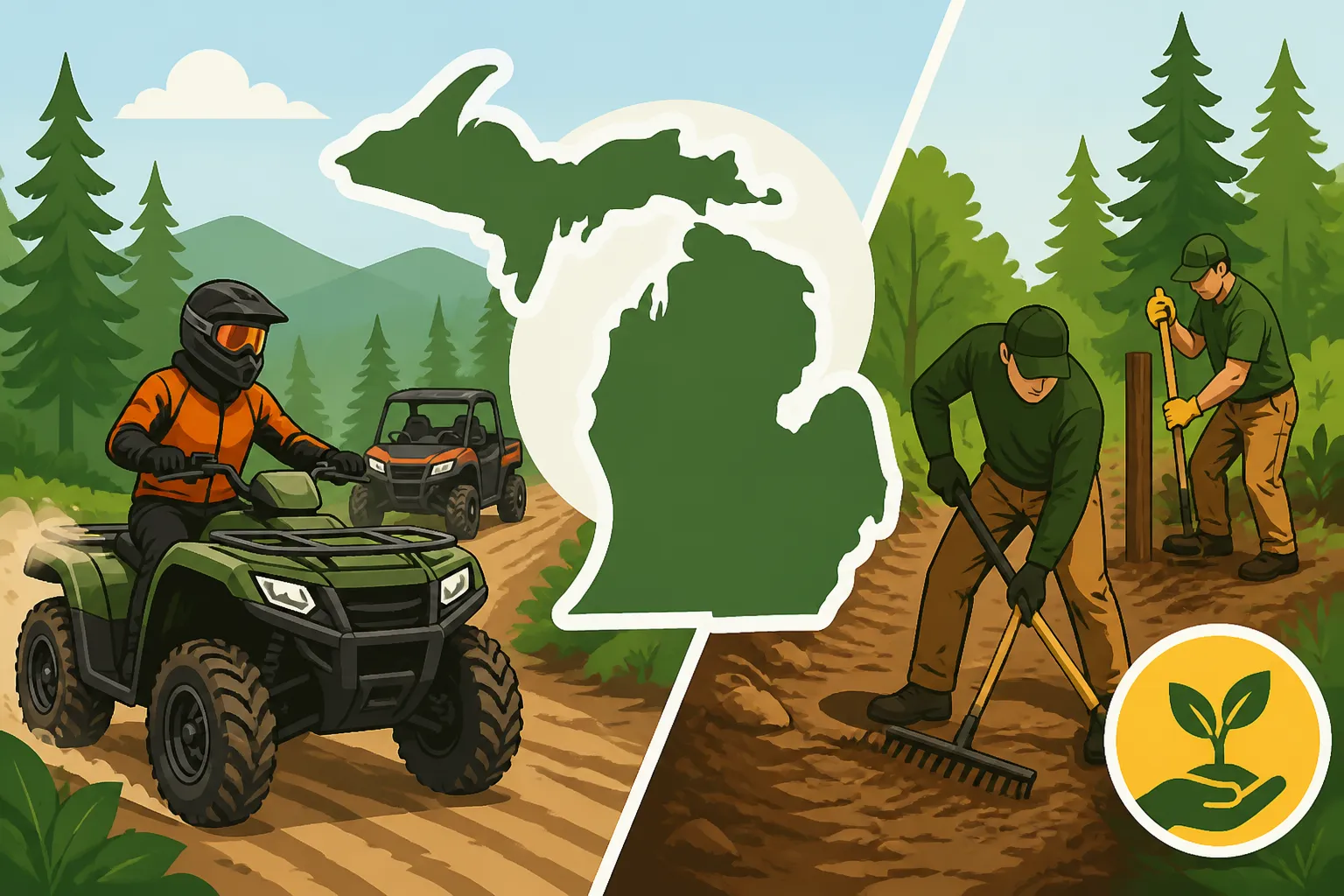
Local ORV clubs can be important maintenance partners. Depending on their agreements and the trail segment involved, club members may clear brush, pick up litter, help maintain signs, report hazards, or assist with organized workdays. They often know the local trail conditions well because they ride the area regularly.
Volunteer work is valuable, but it is not an open invitation to alter a trail. A well-meaning rider who cuts a new bypass around a mud hole can create erosion, damage plants, or send traffic onto land where riding is not allowed. Even a small change to a trail’s path or drainage can conflict with the route’s approved layout.
If you belong to a club, ask its trail coordinator what work is authorized and what tools or procedures are required. If you are not part of a maintenance effort, report the issue to the appropriate agency or partner instead of trying to repair it yourself. The same principle applies if you spot a trail sign that seems misplaced: report it rather than moving it.
Contractors and other land managers may be involved
Some maintenance is specialized or too large for a volunteer workday. Grading, bridge work, culvert replacement, erosion control, and substantial brushing may require equipment, trained crews, permits, or a contractor. The responsible agency can hire or coordinate that work, while other partners may help identify the problem or contribute to a project.
Trail users may also encounter roads and paths managed by entities other than the DNR. A route can pass through state forest land, connect with a county road, or approach land managed by another public agency. Private land may also be part of an authorized route, subject to the access terms established with the owner. In those cases, the land manager’s rules and the route designation matter.
| Trail setting or task | Groups that may be involved | What riders should do |
|---|---|---|
| Designated trail on DNR land | DNR, clubs, contractors, or project partners | Report hazards through the appropriate DNR or local channel |
| ORV route that uses a public road | Road agency, county or local government, and ORV program partners | Treat road-related damage differently from trail damage and identify the location clearly |
| Major bridge, drainage, or erosion work | Land manager, DNR, contractor, and possibly a club partner | Do not attempt an unsupervised repair |
| Volunteer brushing or cleanup | Authorized club or volunteer group | Join only through an organized, approved work effort |
| Segment near private property | Land manager or access partner, sometimes with the property owner | Stay on the designated route and respect posted restrictions |
These are general patterns, not a guarantee about a particular trail. If you are unsure who manages a segment, note its name, nearby road or trail marker, and approximate location when asking for help.
How Michigan ORV trail maintenance is funded
Trail work takes more than a saw and a Saturday morning. Crews need equipment, fuel, materials, transportation, planning, and sometimes professional services. Michigan’s ORV funding programs support eligible trail work, but individual projects can involve multiple sources and partners.
Permit revenue supports the ORV program
Michigan ORV license and trail permit revenue helps support the state’s ORV program and eligible trail-related work. That support can contribute to upkeep such as brushing, signing, grading, drainage improvements, and other approved projects. Funding is generally administered through program rules rather than handed directly to every person who notices a problem.
This is one reason it helps to distinguish between a general trail complaint and a maintenance request. A report can help managers identify a need, but a repair may still require review, authorization, funding, and scheduling. A bridge replacement, for example, is not the same kind of job as clearing a small branch from a trail.
To understand the broader connection between permits and trail work, read What Michigan ORV Permit Money Pays For and Michigan ORV Trail Maintenance and Who Pays for It. Permit revenue is an important part of the picture, but it does not mean every trail segment receives immediate repairs whenever a rider submits a report.
Grants and partnerships can help pay for projects
Some projects may receive funding through grant programs or other public partnerships. The exact process depends on the program, the applicant, the land involved, and whether the proposed work meets applicable requirements. A local club, public agency, or other eligible partner may help develop or support a project, while the relevant land manager remains involved in approvals.
Grant-funded work is usually planned rather than improvised. A project may need a defined scope, a budget, permission to work on the land, and an explanation of how the improvements support the trail system. That is why a rider’s report may be the first step in identifying a problem, not a promise that a crew will arrive right away.
Clubs interested in formal projects can explore Michigan ORV Trail Grant Applications. Individual riders can help by sharing clear, useful observations. “The trail is awful” is hard to act on; “a culvert is blocked near the marked junction north of the forest road” gives a manager something specific to investigate.
Not every stretch gets the same level of service
Maintenance priorities depend on safety, the type and severity of the damage, available resources, land conditions, and the trail’s intended use. A washout blocking passage may need faster attention than a rough patch that remains passable. Seasonal conditions can also affect when repairs are possible: wet ground, snow, or other environmental concerns may make equipment work impractical or harmful.
A trail can also be temporarily closed while crews complete work or while conditions recover. Riding around a closure can damage the very area managers are trying to restore, and it may put riders on an unauthorized path. Check Michigan ORV Trail Closures and Seasonal Dates before a trip, especially if you are planning to travel a long distance to a particular riding area.
What trail maintenance includes and why it can take time
Riders often use “maintenance” to mean smoothing out a rough trail, but upkeep involves much more. Managers try to keep routes usable while limiting damage to the surrounding land. Sometimes the right choice is not to make a section feel like a road, but to manage water, protect a vulnerable area, or temporarily restrict access.
Drainage and erosion control are major parts of the work
Water is one of the biggest challenges on many trail systems. When water runs along a trail instead of draining away from it, it can carry soil, deepen ruts, expose roots, and make the surface unstable. Maintenance may involve improving drainage, repairing an eroded section, or adjusting how water moves across the route.
A rut that looks like a simple inconvenience can become a larger environmental problem if riders widen it by repeatedly steering around the deepest part. That “temporary” bypass can spread the disturbed area and create multiple channels for water. Staying on the designated track helps prevent the damage from expanding while managers assess the site.
Some muddy stretches are also a sign that conditions are not suitable for heavy riding. Avoiding a trail during vulnerable conditions may prevent more damage than any repair crew can quickly undo. For more on why timing matters, see Mud Season Damage on Michigan Trails and ORV Trails After Heavy Rain.
Signs, brushing, and surface work help keep routes usable
Maintenance can include cutting back vegetation that blocks visibility, replacing or repairing signs, grading a surface, clearing fallen limbs, and checking structures. Each task has a different urgency. A broken sign at a confusing junction can affect navigation and route compliance, while a small branch off to the side may wait for a scheduled workday.
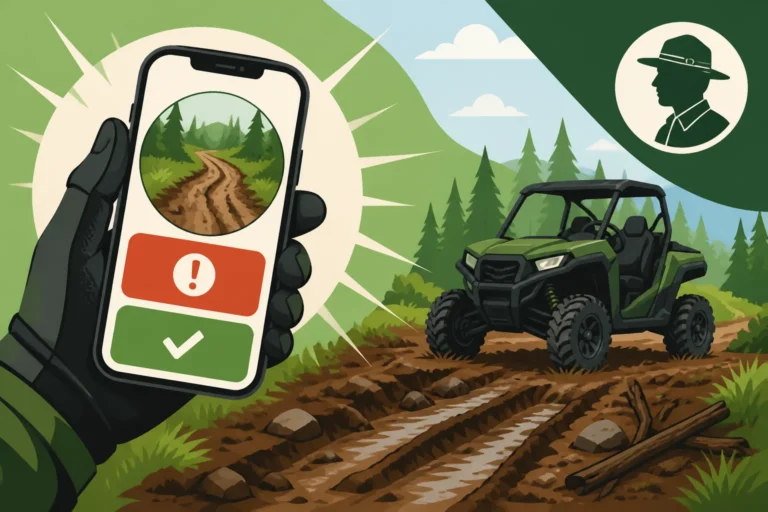
Riders can make this work easier by noting the exact location of a problem. Include the trail or route name, the nearest intersection or landmark, and the direction of travel. If it is safe and appropriate, a photo can help explain whether the issue is a blocked trail, a damaged sign, or a drainage problem.
Good navigation information is useful, but a map app should not be treated as permission to leave a signed route. Riders who use onX Offroad for Michigan Trail Maps can use it as a planning aid and to help describe where they encountered an issue. Check official maps, posted signs, and closure information as well; digital maps may not reflect a newly installed closure or a temporary field change. For more on interpreting route markings, see Michigan ORV Trail Maps and What the Signs Mean.
Maintenance schedules have to balance access and land protection
A trail may be rough because it has not yet been serviced, but that does not always mean managers have overlooked it. Crews have limited time and equipment, and some work must wait for an appropriate season or for approvals. A repair that is rushed under poor conditions can cause more damage than it prevents.
Managers may also need to protect habitats, prevent erosion, or coordinate with other land uses. A route crossing a managed forest, for example, may be affected by work that is not specifically about ORVs. Logging activity, weather, and public-land management decisions can influence access or maintenance timing.
This is why it is worth checking local conditions before setting out, rather than assuming a trail will be exactly as it appeared on your last visit. If your group is deciding between a rough or potentially closed section and another route, use the posted information and avoid taking an unauthorized detour. Trail Etiquette on Shared Routes offers useful guidance for reducing conflict with other trail users.
How riders can help protect and maintain Michigan ORV trails
Riders are not responsible for replacing the agencies and organizations that manage trails, but everyday decisions can reduce damage and make maintenance more effective. Staying on-route, reporting problems clearly, and respecting closures are practical ways to contribute.
Report damage with clear location details
When you report an issue, be as specific as you can. Include the trail or route name, the closest road crossing or junction, a nearby sign or landmark, and a plain description of the problem. If the route is long, a map coordinate or a clear screenshot can help narrow down the location, but be sure the information matches the official route rather than an unofficial track.
Describe what makes the issue important. For example, say whether the trail is fully blocked, whether a sign is missing at a junction, or whether water is flowing across the trail and washing out the surface. Avoid overstating a routine rough patch as an emergency, but do flag a condition that appears to create an immediate safety risk.
Use the relevant agency or local partner’s reporting channel when possible. If you are unsure where to send the report, start with the DNR or the managing agency for the area and ask who handles that segment. For step-by-step reporting guidance, see Reporting Trail Damage to the Michigan DNR.
Respect closures and do not make your own bypass
A closure is not just a suggestion to find another way around. It may be in place for maintenance, safety, environmental protection, or a land-access issue. Riding around a closure can widen damage, create an unauthorized route, or put the rider on land where ORV use is not allowed.
The same goes for marked trails that are wet or deeply rutted. Moving off the trail to avoid an obstacle can make the damaged area wider and harder to restore. If the route is unsafe or impassable, turn around when it is safe to do so and use a legal alternative rather than cutting a new line through brush.
Before riding, review the map and current notices for your destination. A planning app such as onX Offroad can help you understand where you are in relation to the trail network, but posted closures and official information should guide the final decision. On the ground, signs and barriers can provide important information that an older saved map does not show.
Volunteer through an authorized group
If you want to do more than report a problem, look for an established ORV club or organized trail workday in the area you ride. An authorized group can explain which tasks are permitted, what safety steps are needed, and how work should be recorded or coordinated with the land manager.
This is especially important for jobs involving chainsaws, bridges, drainage structures, grading, or work near sensitive land. Even experienced riders may not know the conditions attached to a specific trail agreement. An organized project gives volunteers a way to contribute without accidentally damaging the route or violating land-management rules.
Small actions matter, too. Pack out trash, avoid spinning tires when traction is poor, keep to the designated route, and let other riders know about a closure using the appropriate reporting channel. These habits do not replace funded maintenance, but they can reduce preventable damage and help keep Michigan’s ORV trails available for everyone.
Disclaimer
This article is for general informational purposes only and does not constitute professional advice. Laws, prices and regulations vary by location and change over time. Consult a qualified professional for guidance on your specific situation.