Michigan ORV Trail Maintenance and Who Pays for It
When a Michigan ORV trail is rutted, blocked by a fallen tree, or closed after heavy rain, it’s natural to wonder who is responsible for fixing it—and where the money comes from. The answer depends on who manages the land and what kind of route you’re riding. This guide explains how trail maintenance is organized, funded, and shared across Michigan.
Who maintains Michigan ORV trails
Michigan’s ORV routes cross different kinds of land, so there isn’t one crew responsible for every trail. The state, federal agencies, local governments, and partner organizations may all have a role. Before assuming a route will be repaired by the Michigan DNR, identify who manages the land beneath it.
State-managed trails and routes
The Michigan Department of Natural Resources manages many designated ORV trails and routes on state land. Its work can include assessing trail conditions, arranging repairs, clearing hazards, maintaining signs, and coordinating with local partners. The exact work at a particular location depends on the route, the land, the season, available resources, and current safety concerns.
A marked ORV trail is not necessarily maintained to the same standard as a paved road. A remote forest trail may be narrow, uneven, and subject to changing conditions. Maintenance generally aims to keep the designated route usable and safe for its intended type of riding, not to make every section smooth or free of mud, roots, sand, and rocks.
Routes on state land can also differ in how they are managed. Some are designated ORV trails, while others may be forest roads or routes with separate access rules. A map can help you understand what you’re looking at, but confirm route status and restrictions before setting out. [Michigan's 4,000 Miles of ORV Trails Explained] provides useful context for the scale and variety of the state’s trail network.
Federal, county, township, and private land
Some riding areas connect with federal land, including national forest property, where the responsible land manager may be a federal agency rather than the state. In places such as the Huron-Manistee National Forests, confirm the applicable route information with the relevant land manager. A route may also pass through or connect to county or township land, where local rules and responsibilities can apply.
On private land, maintenance may be handled by the landowner or by an organization operating under an agreement. Access can depend on permission, easements, or other arrangements, and a route that appears on one map may not mean riders have unlimited access to nearby property. Stay on the marked route and respect gates, signs, and closures.
The practical lesson is simple: the person or agency that maintains a route depends on where it is and how it is designated. If a trail crosses several jurisdictions, upkeep and reporting can be shared. [Who Maintains Michigan ORV Trails] explains that responsibility can vary by location, while [Michigan ORV Trail Maps and What the Signs Mean] can help riders distinguish route types and follow posted markings.
How Michigan ORV trail maintenance is funded
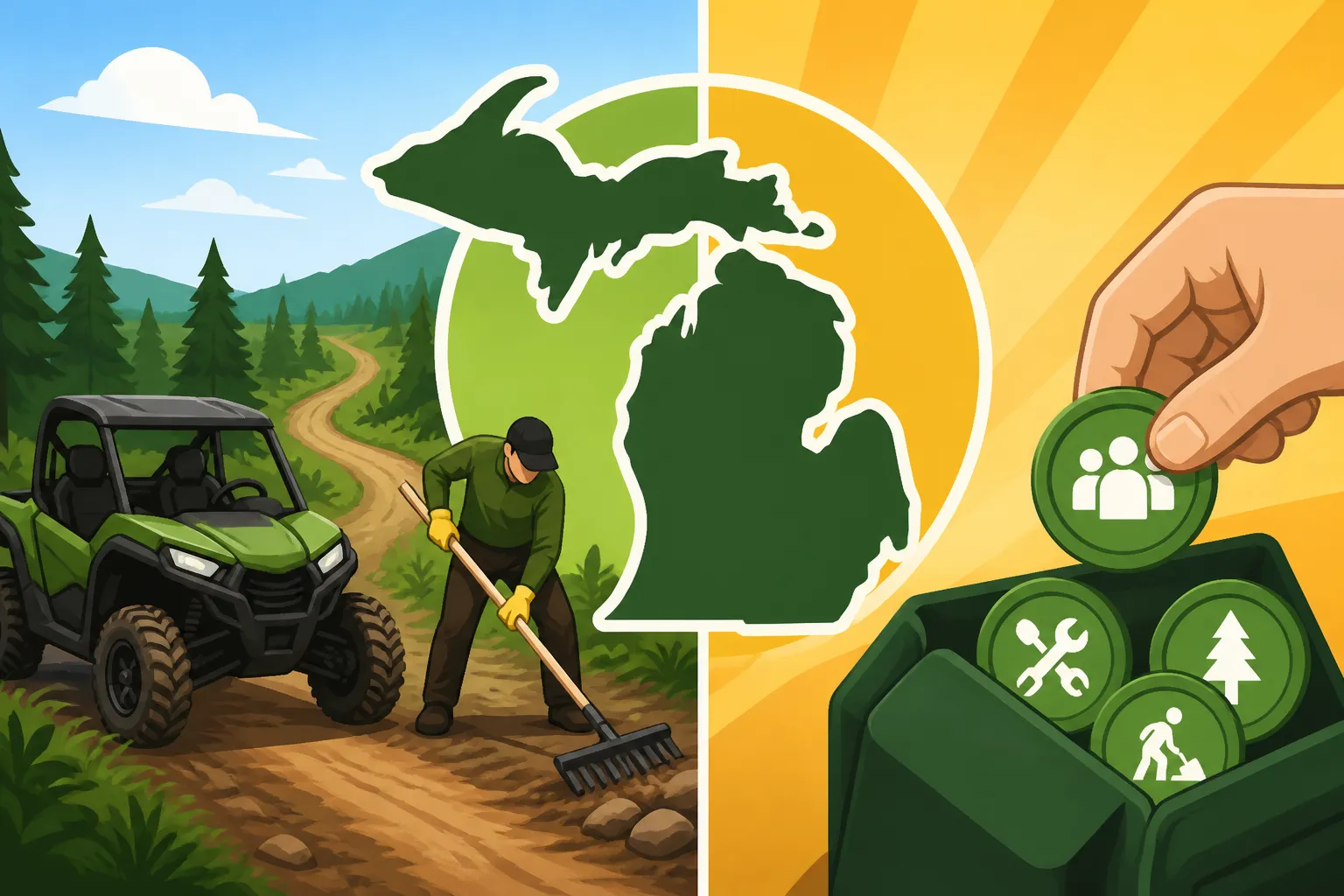
Maintenance takes more than a chainsaw and a willing crew. It can involve staff time, equipment, materials, planning, inspections, and coordination with land managers. Michigan supports ORV recreation through a mix of dedicated program revenue, grant funding, and contributions from partners.
ORV licenses and trail permits
Michigan ORV license and trail permit revenue are important parts of the funding picture. The requirements depend on where and how you ride, so it’s worth understanding the difference between the license and trail permit rather than treating them as interchangeable. Fees collected through the ORV program help support recreation-related services and trail work, subject to the rules governing how program funds are used.
Permit revenue doesn’t mean every trail receives the same amount of work or gets repaired immediately. Funds must be planned and allocated, and work may depend on land access, environmental conditions, project approval, equipment, and the needs of the route. A trail in a high-use area may have different demands from a remote connector or a route that is temporarily closed.
If you’re unsure what applies to your ride, review [Michigan ORV License and Trail Permit Explained] and [What Michigan ORV Permit Money Pays For]. Knowing how the permit system works helps explain why riders may pay into the program while still encountering rough conditions or temporary closures.
Grants and partner contributions
Grant programs can help pay for trail development, rehabilitation, equipment, and related work. Depending on the project and program rules, eligible governments or other organizations may apply for funding or participate as partners. A grant can support a defined project, but it doesn’t automatically create a permanent maintenance crew or guarantee that every future repair is covered.
Local governments and nonprofit organizations can contribute in several ways. They may coordinate with land managers, help identify work priorities, organize volunteer effort, or support grant applications. Some projects also involve contributions that are not simply cash, such as staff time, equipment, or volunteer work, when the program allows those contributions to count.
The funding picture is therefore a combination of public program resources and project-specific partnerships. [Michigan ORV Trail Grant Applications] offers a closer look at the grant side, while [Volunteer Trail Work on Michigan ORV Trails] covers the community effort that can help turn funding and plans into practical work on the ground.
| Funding or support source | How it can help | What riders should keep in mind |
|---|---|---|
| ORV license and trail permit revenue | Supports ORV program activities and eligible trail work | Requirements vary by riding location and route type |
| Grants | Can fund approved projects such as improvements or rehabilitation | Funding is tied to program rules and project scope |
| Land managers and local governments | Coordinate access, planning, repairs, and local priorities | Responsibility differs by jurisdiction |
| Clubs and volunteer groups | Provide labor, local knowledge, and project support | Volunteer work is coordinated and should be authorized |
| Federal or other eligible programs | May support projects that meet program requirements | Not every trail or repair qualifies |
What trail maintenance involves
Maintenance is not just clearing branches after a storm. Crews and partners may need to manage water, protect sensitive areas, maintain signs, and keep routes appropriate for the vehicle types allowed there. Some work is routine; other repairs become necessary after severe weather, heavy use, or damage.
Drainage, erosion, and surface repairs
Water is one of the biggest challenges for unpaved trails. When drainage is poor, runoff can cut channels into a trail, widen muddy sections, carry soil downhill, or leave deep ruts. Maintenance may involve directing water away from the riding surface, stabilizing damaged areas, or adjusting a route to reduce recurring erosion.
Surface work varies with the terrain. A trail in sandy country may need different attention from a rocky route in the Upper Peninsula or a forest trail with soft soil. Even a repair that looks straightforward from the seat of an ATV can require careful planning to avoid moving the problem somewhere else or harming nearby land.
Riders can help by not turning a wet, vulnerable section into a wider track. If a trail is muddy, staying on the designated route and avoiding attempts to bypass deep sections can limit damage. [Mud Season Damage on Michigan Trails] and [ORV Trails After Heavy Rain] explain why riding conditions can affect both the trail and its future availability.
Clearing hazards, maintaining signs, and managing closures
Fallen branches and trees, washouts, damaged markers, and blocked access points can all affect a ride. A hazard might be manageable for one vehicle but unsafe for another, particularly on a narrow trail or around a blind corner. Maintenance priorities often consider safety and route function, not just whether a rider finds a section inconvenient.
Signs and markers are also part of trail maintenance. Clear markings help riders stay on authorized routes and understand restrictions or intersections. A missing or unreadable marker can create confusion, so report the location as specifically as possible rather than assuming another rider will alert the responsible agency.
Closures are sometimes necessary to protect riders, allow repairs, prevent additional damage, or comply with land-management rules. A route shown on an older map may not reflect a current closure. Check official notices before heading out, and obey barriers and posted signs on the ground. [Michigan ORV Trail Closures and Seasonal Dates] is a useful companion when you’re planning around access changes.
How riders can help without damaging trails
Trail care isn’t limited to paid crews or organized workdays. Everyday riding choices influence how quickly a route wears down and whether managers can keep it open. Riders can also make maintenance more efficient by reporting issues clearly and using reliable route information.
Ride responsibly in changing conditions
When a trail is wet or visibly deteriorating, consider changing your plan instead of pushing through. Spinning tires can dig ruts, move soil, and tempt other riders to create a bypass. A short detour to a different designated route may help protect a trail that would otherwise require more extensive repair.
Stay within the marked route, avoid cutting corners, and don’t ride around a closure sign. Keep in mind that a route can pass near private property, wetlands, or sensitive habitat even when it feels remote. Respecting signs and barriers helps protect access as well as the land itself.
Trail etiquette matters on shared routes, too. Ride at a controlled pace, be considerate when passing, and leave gates and access points as you found them. [Trail Etiquette on Shared Routes] has additional guidance for reducing conflicts and keeping shared routes usable for others.
Report damage with useful details
A helpful report tells the responsible agency what is wrong and where to find it. Note the trail or route name, the nearest intersection or landmark, the direction of travel, and what you observed. A clear description such as “large tree blocking the marked route just east of the trail junction” is more actionable than “trail is bad.”
If it is safe and appropriate, a photo can help explain the issue. Avoid putting yourself or others in danger to document a problem, and don’t move signs, remove barriers, or attempt repairs unless you have permission and are part of an authorized effort. Contact the land manager or reporting channel responsible for that location; if you’re uncertain, include enough location detail for the report to be directed correctly.
Tools such as onX Offroad can help riders identify a route and describe nearby junctions or landmarks when preparing a report. Use that information as a navigation aid, not as a substitute for official closures or land-manager instructions. You can also consult [Reporting Trail Damage to the Michigan DNR] for practical reporting guidance.
Planning a ride with maintenance and funding in mind
A little preparation makes it easier to avoid closed routes, choose a suitable ride, and understand why conditions may differ from one trail system to another. Treat maps and current notices as part of your ride planning, just as you would check your machine and gear.
Check route information before leaving
Start with official information from the agency or land manager responsible for the area. Confirm that the route is open, appropriate for your machine’s width, and available to the type of vehicle you plan to ride. Pay special attention to seasonal access, recent weather, and any posted restrictions.
Use mapping tools to orient yourself, but don’t rely on a single source for every detail. onX Offroad can help you review route connections and prepare for navigation, while official land-manager information remains essential for current access rules and closures. If two maps seem to disagree, follow posted signs and seek clarification from the responsible manager before riding.
For a longer trip, identify fuel, parking, and alternate routes ahead of time. In remote areas, a closure or storm-damaged segment can affect your whole plan. A downloaded map or other offline navigation option can be useful where cell service is limited, but it doesn’t replace checking current trail status before departure.
Understand why a repair may take time
A reported problem is not always an immediate repair. The land manager may need to confirm the location, assess safety, arrange access, identify funding, or coordinate with another organization. Weather and ground conditions can also affect when work can be completed; repairing saturated soil at the wrong time may worsen the damage.
Not every rough patch represents neglect. Some trails are intentionally left with natural features, and the appropriate standard depends on the trail’s designation and the vehicles it serves. By contrast, a blocked route, missing marker, dangerous washout, or obvious erosion issue is worth reporting so the responsible party can assess it.
Riders who understand the funding and maintenance process can help set realistic expectations while still advocating for safe, usable routes. Follow closures, report problems clearly, volunteer through authorized organizations when possible, and ride in a way that limits avoidable damage. Those habits support the network alongside public funding and planned maintenance.
Disclaimer
This article is for general informational purposes only and does not constitute professional advice. Laws, prices and regulations vary by location and change over time. Consult a qualified professional for guidance on your specific situation.