Trail Etiquette on Shared Routes
A quiet Michigan trail can turn crowded quickly when ATVs, side-by-sides, motorcycles, trucks, and other users meet around a bend. Dust, limited sightlines, and changing trail conditions make small choices matter. This guide explains how to ride shared routes considerately, handle passing and busy spots, and plan ahead so your group can enjoy the ride without making it harder or less safe for everyone else.
What good shared-route etiquette looks like
Shared routes work best when riders expect to encounter other people and make room for them. A route may feel empty for miles, then suddenly bring your group alongside another machine, a family walking near a staging area, or a work vehicle using the same back road. Riding as if you are the only one there is a reliable way to create stress—and sometimes a dangerous surprise.
Etiquette is not just about being polite. It helps prevent collisions, reduces dust and noise for other users, and protects the trail surface. The habits below are useful across Michigan, but always follow the signs and local rules for the specific route you are riding.
Start with the route, not just the machine
Before leaving the staging area, make sure the route is open to your type of machine and that your group understands what kind of route it is. Michigan trail systems include different route and trail types, and posted access, width, and seasonal restrictions may vary. A path that looks wide enough at the entrance may narrow farther in, or a connecting road may have different rules from the trail you just left.
Check current maps and posted signs instead of relying on a memory of last season’s ride. A tool such as onX Offroad can help you review your planned route and keep track of where you are, but it should not replace official signs or closure information. Download maps or route details before you lose cell service, and keep a backup plan if a connector is closed.
It also helps to discuss the route with your group before engines start. Agree on where to regroup, what to do if someone falls behind, and how to handle a blocked or uncertain section. If one rider assumes the route is a broad ORV route and another expects a narrow trail, the mismatch can lead to last-minute braking and confusion. [Michigan ORV Trail Maps and What the Signs Mean] can help you get familiar with what route markers and signs communicate.
Ride at a speed that gives you time to respond
A speed that feels comfortable on a wide, empty stretch may be too fast around a blind corner, over a rise, or through a dusty section. Reduce speed when visibility drops, when the surface changes, and whenever you approach a place where another user could appear. That extra reaction time matters even when the trail looks familiar.
Keep enough space between machines that you can see the rider ahead and respond without sudden braking. On a dusty day, following closely can leave you riding in a cloud with almost no view of the trail. If dust hangs in the air, increase the gap or wait at a safe, visible place until conditions improve. The goal is not to keep the group packed together; it is to keep each rider in control.
Be especially cautious near trailheads, intersections, campsites, parking areas, and places where routes pass close to homes or businesses. People may be walking, loading gear, or trying to work out where they are going. The most considerate thing you can do is slow down early, avoid unnecessary revving, and leave room for others to move.
Passing, meeting traffic, and riding in a group
A shared route often involves a mix of machines with different widths, speeds, and handling. A small ATV and a wide side-by-side do not take up the same amount of trail, and a truck or service vehicle may need more room than either. Calm, predictable behavior makes passing easier for everyone.
Do not assume another rider sees you just because you can see them. Dust, helmets, engine noise, vegetation, and terrain can hide an approaching machine. Slow down, communicate clearly when appropriate, and avoid squeezing past when there is not enough room to do it safely.
Pass only when there is room and a clear view
Before passing, look well ahead and make sure the route is wide enough for both machines. Check for bends, soft shoulders, hidden dips, and oncoming traffic. If you cannot see far enough ahead to judge the space, wait. Being stuck behind a slower group for a few minutes is frustrating; forcing a pass in a blind spot can turn a pleasant ride into a crash or trail blockage.
When the other rider appears to be moving slowly, give them time to choose a safe place to pull over. Do not tailgate, rev repeatedly, or push them toward the edge. They may be managing a passenger, a new rider, a mechanical issue, or an unfamiliar section. If you are the slower rider, use a safe, stable pull-off when one is available and signal your intentions in a way the riders behind can understand.
Passing etiquette also means leaving room after you go by. Do not cut sharply in front of another machine or immediately brake for a turn. Let the passed rider keep their line and regain a comfortable following distance. On narrow trails, it may be safer for one group to stop at a suitable wide spot and let the other pass rather than attempting a close squeeze.
Keep group rides organized without crowding the trail
A long line of machines can be hard for other users to pass, especially on narrow routes. Keep the group compact enough to stay coordinated but spaced far enough apart to leave room for safe riding. If a faster user catches up, look for a safe place to let them through rather than allowing a queue to build behind your group.
Choose a lead rider who knows the plan and a sweep rider who can notice when someone falls behind. The lead should avoid racing away from the group, while the sweep should not pressure the last rider to go faster than feels safe. Agree on simple regroup points before the ride, such as a marked intersection or a known staging area, rather than stopping unpredictably in the middle of the route.
Groups should also avoid blocking intersections while they wait for everyone to catch up. Pull fully out of the traveled area where it is safe, and do not park around a crest, blind bend, narrow bridge, or trail entrance. For more detail on riding in a line on county roads, see [Riding Single File on Michigan County Roads]. On designated trail routes, [Michigan ORV Trail Widths Explained] is useful when deciding whether a machine or group fits the route.
Make room for wider or slower vehicles
A full-size truck, a side-by-side, and an ATV have different needs when they meet. On a narrow route, a wide machine may need more space to turn or move aside, while a smaller machine may have more options for a safe pull-off. Avoid treating vehicle size as a reason to claim the whole route; both riders should assess the space and cooperate.
If a vehicle cannot pass safely, one party may need to stop and carefully move to a suitable wider section. Do not drive into soft ground, fragile vegetation, or an unstable shoulder just to make room quickly. If you are not sure the edge will support your machine, stay put in a safe location and communicate rather than making a risky maneuver.
Work vehicles deserve particular patience. Logging trucks, maintenance equipment, and other service vehicles may have limited visibility and may need most of the road. Slow down, follow posted instructions, and give them generous space. [Sharing Back Roads With Logging Trucks] offers a closer look at the extra care these encounters call for.
Protect the trail and the people who use it
A route is more than a line on a map. It passes through land that may be managed for recreation, forestry, wildlife, or local access. The way riders treat the surface and surrounding area affects whether the route remains enjoyable and usable for the next person.
Trail damage can start with a single decision to ride around a muddy section or cut a corner. Those shortcuts may seem harmless in the moment, but repeated use can widen the route, erode the surface, or damage vegetation. Staying on the designated route is a simple habit with a lasting benefit.
Stay on the marked route and respect closures
Follow signs, markers, and barriers, even when a closed segment looks passable or appears to reconnect with the route. Closures can be related to conditions, maintenance, private property, safety, or seasonal management. Do not remove a barrier, ride around it, or follow tire tracks that appear to continue beyond it.
Route conditions can change after storms, heavy use, or maintenance work. If a section is closed, use an approved alternate route or turn around. Do not create a new bypass through the woods, across a field, or along the edge of a trail. A detour that begins as one rider avoiding mud can become a much wider scar once others follow it.
Use current maps, local notices, and signs together. onX Offroad can be handy for seeing your position and understanding how a planned loop connects, especially when cell service is unreliable, but a map app cannot make a closed trail open. If your map and a posted sign seem to disagree, do not assume the digital route is the one to follow. See [Michigan ORV Trail Closures and Seasonal Dates] for more on planning around closures.
Avoid rutting, corner cutting, and unnecessary noise
When you reach mud or a soft section, do not automatically swing around it. Going off the designated line can widen the trail and damage plants or soil. If the marked route is too difficult for your machine or skill level, turn back where safe or choose a more suitable route instead of making a new path.
Take corners at a controlled speed and stay on the established surface. Cutting across the inside of a turn can break down the edge, while spinning tires can deepen ruts and make the trail harder for the next rider. If traction is poor, smooth throttle and deliberate steering are usually kinder to the trail—and easier on your machine—than aggressive wheelspin.
Noise is part of motorized riding, but unnecessary revving, loud music, and repeated acceleration near homes or trailheads add avoidable irritation. Keep the machine maintained, use appropriate equipment, and ride smoothly through areas where other users or nearby residents are likely to hear you. If your group stops, choose a suitable pull-off and keep engines off when practical.
Be considerate around hikers, cyclists, horses, and other non-motorized users
Where a route or access area brings motorized and non-motorized users together, slow down early and give people room. A hiker may not hear an approaching machine until it is close. A cyclist may need more space to maintain balance. Someone walking a dog may be managing an animal that reacts unpredictably to engines.
Pass slowly and predictably, leaving as much room as the route safely allows. Avoid sudden acceleration or loud throttle blips as you go by. If the route is too narrow for a comfortable pass, stop at a safe place and let the other user move through first. Do not expect someone on foot to step into brush or onto an unstable edge simply because your machine is approaching.
Horses and other large animals require special care wherever they are permitted on or near a shared route. Stop at a safe distance, turn off the engine if asked, and wait for the rider or handler to direct you. Do not assume the animal is accustomed to ATVs or UTVs. A few patient minutes can prevent a frightening encounter for the animal, the rider, and your group.
Plan for Michigan conditions and busy riding areas
Good etiquette starts before the ride. Planning helps you avoid closed sections, last-minute route changes, and confusing stops in places where other people need to pass. It also gives your group a shared understanding of what to do when conditions are different from what you expected.
Michigan riding conditions can vary considerably across a route and from one trip to another. Sand, loose gravel, mud, wet leaves, and changing weather each affect traction and visibility. A route that was easy on a dry weekday may feel very different after rain or during a busy weekend.
Check access, signs, and conditions before setting out
Build in time to check the trail or route information before loading up. Confirm that your planned route is appropriate for your machine and that any connecting roads or trail segments are open to your group. Pay attention to posted signs on the ground as well as your map; signs may provide information that changes the way you should proceed.
Download useful maps before heading into areas where service may be weak. onX Offroad can help you follow your planned line and avoid losing your bearings, particularly on unfamiliar networks, but keep your phone charged and consider carrying a backup navigation option. Tell someone where you intend to ride and when you expect to return, especially if your group is heading into a remote area.
Pack for small disruptions, not just the ideal ride. A basic tool kit, water, first-aid supplies, and a way to contact help can make a delay less stressful. Give your group time to check machines and secure loose gear. A hurried departure is when people are most likely to miss a sign, forget a safety item, or ride off without confirming that everyone understands the plan.
Adjust your habits for sand, mud, dust, and rain
On sandy or dusty routes, increase following distance and reduce speed when visibility drops. Do not ride so close that the machine in front becomes the only thing you can see. If the dust is too thick to ride comfortably, stop in a safe place and wait for it to settle rather than continuing by guesswork.
After rain, expect slick roots, soft shoulders, puddles, and ruts. Avoid charging into water when you cannot judge its depth or what lies beneath it. If a section looks likely to be badly damaged by your machine, turn around rather than forcing a passage and leaving deeper ruts behind. The route should not have to bear the cost of a decision made for the sake of completing a loop.
In sand, gravel, or wet leaves, leave extra room for braking and cornering. A rider who is comfortable on a dry, firm surface may need to slow down considerably when traction changes. Keep the same courtesy for other users: do not roost sand or gravel at someone behind you, and do not accelerate hard beside people, parked machines, or trailhead traffic.
Make extra room during crowded weekends
On holiday weekends and other busy riding days, expect more machines at staging areas, intersections, and popular route connections. A large group that stops in the middle of a narrow route can create a bottleneck quickly. Pull over only where you can do so without blocking access, and make sure every rider knows where the group will regroup.
At a trailhead, keep loading and unloading organized. Move trailers and parked machines out of the way of traffic, avoid leaving gear spread across shared space, and give people room to turn around. If you are waiting for a rider, do not idle in a cloud of exhaust and dust beside another group’s staging spot. A little organization makes the area less stressful for everyone arriving or leaving.
If a route is crowded, consider shortening the ride, choosing a less busy section, or returning at a quieter time. Pushing through a crowded narrow route often means more dust, more close passes, and more frustration. [Michigan ORV Trail Crowding on Holiday Weekends] covers ways to plan around peak traffic, while [Michigan ORV Trail Difficulty Ratings] can help you choose a route that better suits your group’s experience and equipment.
A practical shared-route etiquette checklist
Etiquette is easiest to follow when it becomes part of the group’s routine. A short conversation before departure can prevent confusion later, especially when riders have different experience levels or are joining from out of town. Treat the checklist below as a starting point, then adjust it for the route and posted instructions.
| Before or during the ride | Considerate habit | Why it helps |
|---|---|---|
| Before departure | Check current maps, signs, access, and closures | Reduces wrong turns and avoids riding into closed areas |
| At the trailhead | Keep loading, parking, and waiting areas clear | Lets other riders enter and leave safely |
| On dusty stretches | Increase following distance and slow down | Preserves visibility and reaction time |
| When meeting another user | Slow early and pass only when there is room | Makes the encounter predictable |
| During a group ride | Use a lead and sweep rider and agree on regroup points | Helps prevent separation and sudden stops |
| In soft or muddy areas | Stay on the marked route and avoid bypasses | Limits trail widening and surface damage |
| Near homes or shared access points | Ride smoothly and avoid unnecessary noise | Reduces disturbance for nearby residents and users |
| When a route is closed | Turn back or use an approved alternative | Protects the route and respects posted restrictions |
Use a simple passing routine
When you notice another machine or user approaching, slow down before the encounter becomes close. Keep your line predictable and look for a safe place where both parties can pass without forcing anyone onto an unstable shoulder. If there is not enough room, stop and communicate rather than trying to squeeze through.
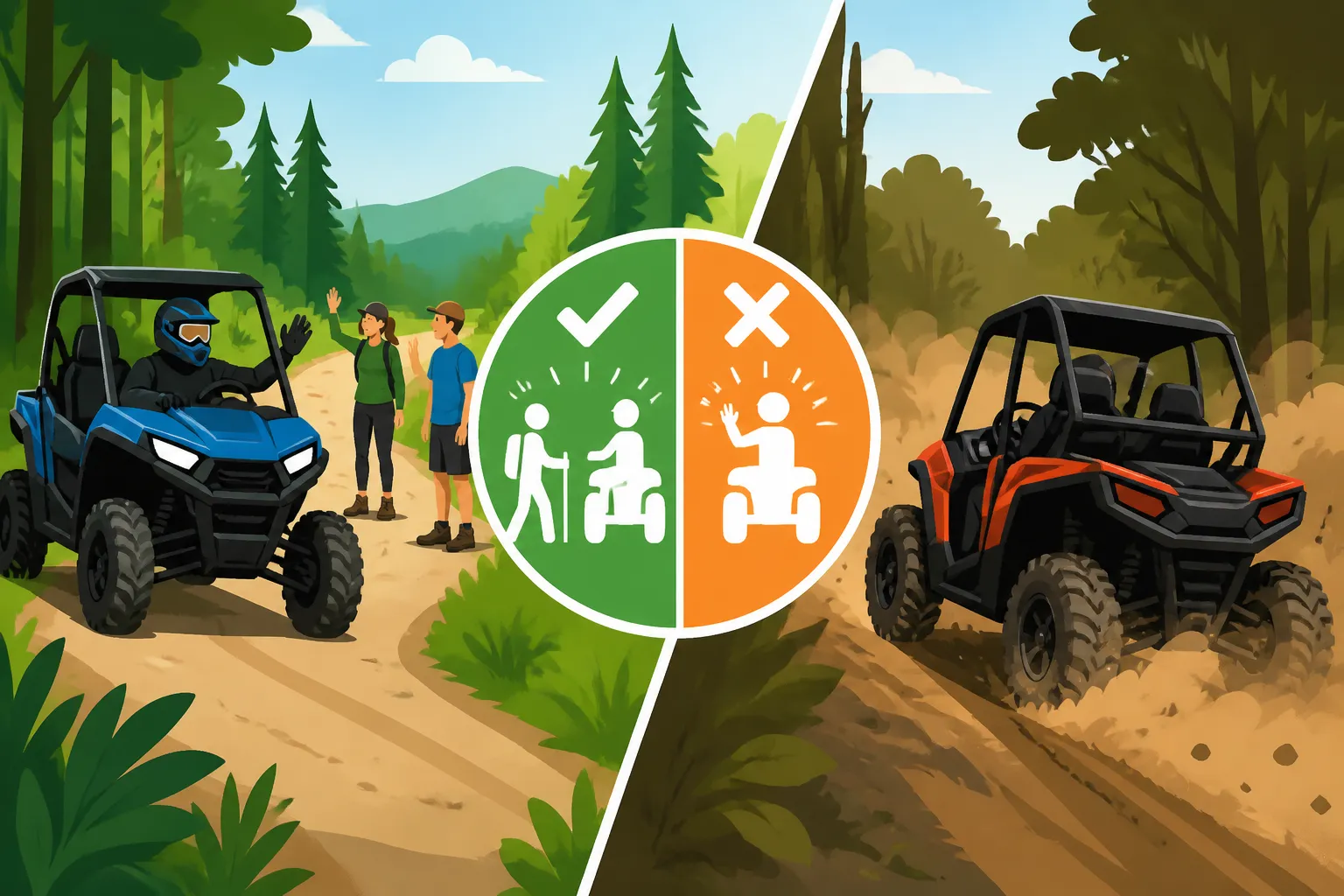
The same routine works when you are the one catching up. Leave a comfortable gap, wait for a clear opportunity, and do not pressure the rider ahead. Once you pass, give them space before slowing or turning. Small, consistent gestures—such as a clear wave when it is safe—can help signal that you have seen the other person, but gestures should never replace careful positioning.
Know when to pause or turn around
A courteous rider does not have to finish every planned loop. If visibility becomes poor, a route is blocked, the trail is too damaged, or a machine is struggling, stop somewhere safe and reassess. Continuing just because the group has already traveled a long way can increase risk and leave the route in worse condition.
Turning around can be the right choice when the route is beyond someone’s ability or the group’s equipment. Talk it through without embarrassment. New riders, children, passengers, and experienced riders may all have different comfort levels, and a safe ride is more important than reaching a particular destination.
When a route needs maintenance or appears damaged, do not attempt to repair it in a way that changes the trail or creates a hazard. Note the location and report the issue through the appropriate local or land-management channel. Riders help keep access available by following closures and supporting responsible maintenance practices. [Michigan ORV Trail Maintenance and Who Pays for It] explains why care and reporting matter to the long-term trail network.
Keep the ride pleasant for the next group
Before leaving a stopping place, check for dropped gear and take your rubbish with you. Avoid leaving broken straps, food packaging, or damaged parts behind. Even a small mess can make a staging area less welcoming and create hazards for animals and other visitors.
If another group is waiting, keep your stop brief and move to a more suitable place for a longer break. Give people room to park, turn around, and ask questions without making them feel they are in the way. A friendly, practical attitude can make shared riding areas feel more cooperative, even when they are busy.
The best etiquette is consistent: follow the posted route, ride within your ability, give other users time and space, and leave the trail in good condition. Those habits make shared routes safer and more enjoyable for your group and for the people who ride after you.
Disclaimer
This article is for general informational purposes only and does not constitute professional advice. Laws, prices and regulations vary by location and change over time. Consult a qualified professional for guidance on your specific situation.