Michigan Golf Cart and Low-Speed Vehicle Rules
It's easy to get confused when you see golf carts and similar small vehicles zipping around, especially when you're trying to figure out if you can legally take yours out on Michigan's public roads. Many folks assume that if it's small and slow, it must be fine for neighborhood errands or getting to the lake. The reality is far more complex, and misunderstanding the rules can lead to tickets, accidents, or even insurance nightmares. This comprehensive guide is here to unravel Michigan's specific laws for golf carts and low-speed vehicles, helping you understand where and how you can legally operate these machines.
The Core Distinction: Golf Cart vs. Low-Speed Vehicle in Michigan
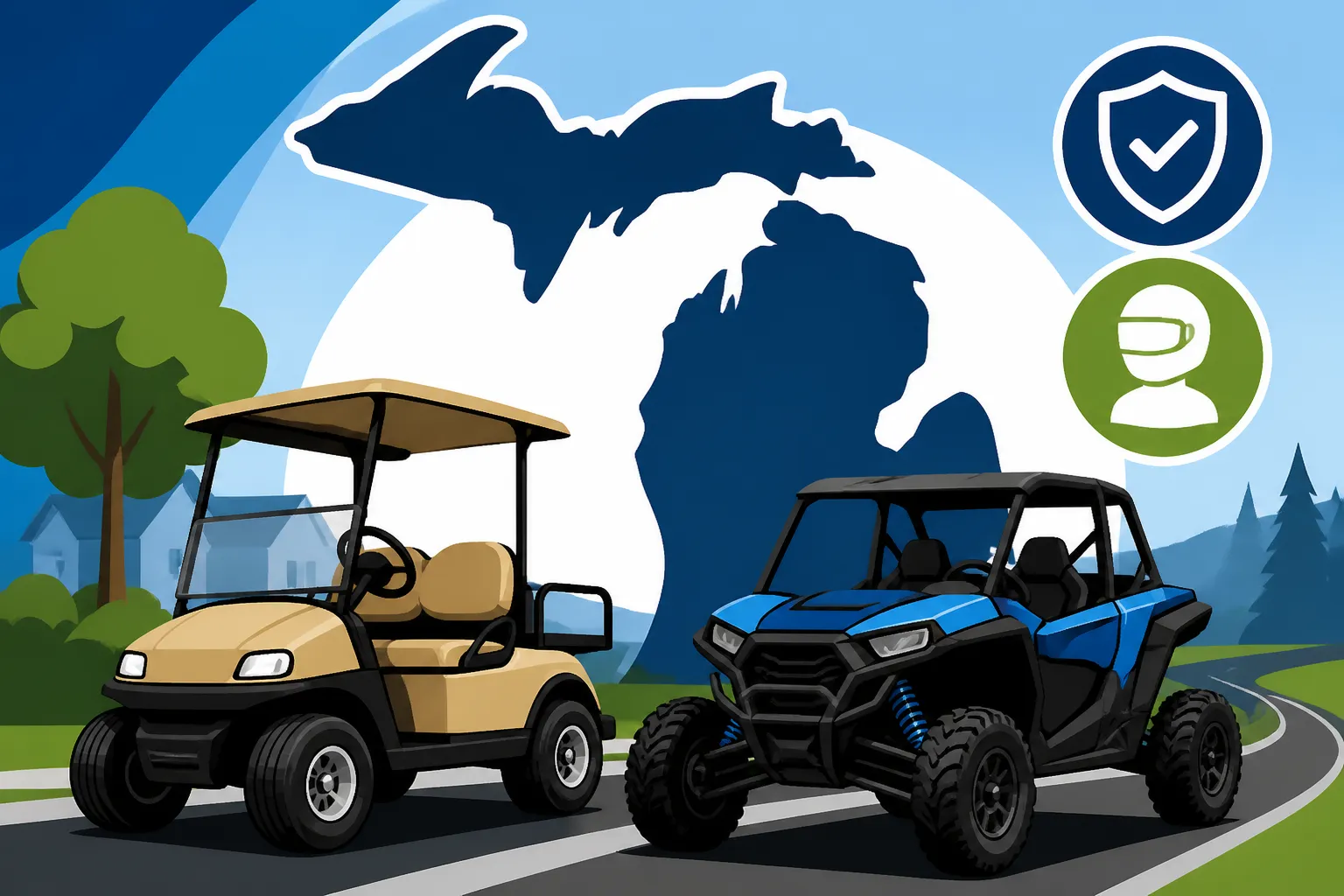
One of the biggest hurdles for Michigan residents is simply knowing the difference between a "golf cart" and a "low-speed vehicle" (LSV) in the eyes of the law. They might look similar, especially if a golf cart has been spruced up with some accessories, but their legal definitions and, more importantly, where you can legally drive them, are worlds apart. It's not just semantics; it's about safety, registration, and avoiding a hefty fine.
What Exactly is a Golf Cart in the Eyes of Michigan Law?
When Michigan law talks about a golf cart, it generally refers to a vehicle that is specifically designed and intended for use on a golf course. These machines are built to carry golfers and their equipment at speeds typically not exceeding 15 to 20 miles per hour. They are fundamentally designed for a controlled, off-road environment like a golf course, or private property with similar conditions.
The crucial point here is their design and purpose. They lack many of the safety features required for on-road vehicles, such as proper headlights, tail lights, turn signals, or even a vehicle identification number (VIN) in the traditional sense that registers with the Secretary of State. Because of this, standard golf carts are not generally considered street-legal in Michigan. Trying to use one on public roads without a specific local ordinance permitting it is usually illegal and unsafe. You'll often find that the only place a standard golf cart is truly welcome is on private land or within the confines of a golf course itself.
Michigan's Definition of a Low-Speed Vehicle (LSV)
In stark contrast to a golf cart, a Low-Speed Vehicle (LSV) is a motor vehicle that falls into a very specific legal category. Michigan law defines an LSV as a four-wheeled vehicle whose top speed is greater than 20 miles per hour but not greater than 25 miles per hour. This speed range is critical because it differentiates an LSV from a standard car (which goes faster) and a golf cart (which generally goes slower and lacks street-legal features).
To be considered a true LSV, the vehicle must be manufactured to meet federal safety standards for low-speed vehicles. This means it comes equipped from the factory with a host of mandatory safety features: headlamps, tail lamps, stop lamps, turn signal lamps, rearview mirrors, a parking brake, a VIN, and safety belts. Essentially, an LSV is a smaller, slower version of a car, built specifically for local street use where speeds are low. Because they meet these stringent safety and identification requirements, LSVs are eligible for titling, registration, and a standard license plate from the Michigan Secretary of State, just like any other motor vehicle. This is the key difference that allows them onto public roads where golf carts cannot go.
Where Can You Actually Ride a Golf Cart in Michigan?
The dream of cruising down a quiet Michigan backroad in your golf cart often bumps up against the reality of state law. While they’re fantastic for getting around the green or your sprawling property, public road access is much more limited than many people realize. It's a common area of confusion that leads to a lot of frustration, especially for those living in lakefront communities or small towns.
Private Property and Golf Courses: No Problem Here
Let's start with the easy part: if you own a golf cart, you can absolutely drive it on your own private property without any special permits, titles, or worries about Michigan's road rules. This is its primary domain. Whether it’s your backyard, a large farm, or a private hunting camp, your golf cart is a versatile tool for getting around. The same goes for golf courses themselves; these machines are, after all, designed specifically for that environment.
This unrestricted use on private land is where many people get the impression that golf carts are simply "unregulated" or "always legal." However, that assumption doesn't extend to public roads. Even if your private property abuts a public road, you cannot just hop on the asphalt and cruise. The moment those wheels hit public pavement, you're subject to an entirely different set of rules, or often, outright prohibitions.
Local Ordinances and Designated Community Use
Here's where it gets a little more nuanced and offers a glimmer of hope for golf cart enthusiasts. Michigan law does allow townships, cities, and villages to pass local ordinances that permit golf carts to operate on public roads within their specific jurisdiction. This is a crucial distinction: it's not a blanket state rule, but a local decision. You'll often find these types of ordinances in small, close-knit communities, retirement villages, or resort towns where the roads are generally slower, and the distances between points of interest are short.
For example, a quaint village might decide that golf carts can be used on certain municipal streets with speed limits under 25 mph, perhaps to allow residents to get to the local diner or the community beach. These ordinances typically come with their own set of rules, such as requiring certain safety equipment (like flags, lights, or mirrors) even if the state doesn't mandate them for a golf cart. Before you consider driving your golf cart on any public road, even in a small town, you must check with the local township or city clerk's office to see if such an ordinance exists and what its specific stipulations are. Simply assuming because your neighbor does it is a recipe for a ticket. This local control is why you might see golf carts legally rolling down the street in one town but not ten miles down the road. You can often find specifics by looking for [Michigan Cities With Golf Cart Ordinances].
Crossing Public Roads: The Limited Exceptions
Even without a full-blown local ordinance allowing golf carts to be driven on public roads, there are extremely limited circumstances where you might be permitted to cross a public road. This usually applies when a golf course is bisected by a public road, or if you need to move your golf cart directly from one piece of private property to another that's separated by a roadway.
The key here is "crossing," not "traveling." These crossings must typically be done at a 90-degree angle, yielding to all vehicular traffic, and only if the road is not a state highway or a major arterial. You cannot drive down the road, even for a short distance, to reach your destination. Think of it as merely traversing the road to get from point A to point B on private land, with the public road simply being an obstacle. This is a very narrow exception and should not be confused with general road access. Any other use on a public road, even a quick trip, is generally considered illegal without a specific local ordinance, leaving you vulnerable to enforcement by local law enforcement or the DNR.
Navigating Michigan's Low-Speed Vehicle (LSV) Rules
If your goal is to legally operate a small, slow vehicle on Michigan's public roads, a Low-Speed Vehicle (LSV) is almost certainly what you're looking for, rather than a golf cart. Unlike golf carts, LSVs are specifically designed and manufactured to meet certain federal and state safety standards, which makes them eligible for street use under specific conditions. However, getting an LSV ready for the road and understanding its operational limits requires careful attention to detail.
The Equipment Checklist for Street-Legal Status
Becoming street-legal isn't just about having four wheels and a steering wheel. For an LSV in Michigan, there’s a comprehensive checklist of safety equipment that must be present and fully functional. This isn't optional; these are mandates designed to ensure the vehicle is visible, controllable, and offers a basic level of protection to its occupants.
Your LSV absolutely needs headlamps, tail lamps, and stop lamps – just like a car – to ensure visibility both day and night, and to signal your braking. Turn signal lamps are also essential for indicating your intentions to other drivers, and reflective devices (reflectors) add an extra layer of visibility, especially from the side. Rearview mirrors, both on the driver's side and either a passenger-side mirror or a central rearview mirror, are necessary for awareness of surrounding traffic. A parking brake is a non-negotiable safety feature, preventing unintentional rolling. Perhaps most critically, seatbelts must be installed for every designated seating position. Some LSVs come factory-equipped with a robust, DOT-approved windshield. If you're building or modifying an LSV, or simply need a replacement, a high-quality, shatter-resistant windshield is crucial, and you'll find reputable suppliers like SuperATV offer options designed to meet demanding specifications for off-road vehicles that might be adapted for street use, or for LSVs needing robust components. Finally, the vehicle must possess a legitimate Vehicle Identification Number (VIN) that can be verified and registered. Without all of these components, your vehicle won't qualify as a Michigan LSV.
Registration, Titling, and Plating Your LSV
Once your vehicle meets all the equipment requirements, the next step is getting it officially recognized by the state. This process is much like registering a standard automobile, and it goes through the Michigan Secretary of State. You'll need to submit the proper application, along with proof of ownership (like a manufacturer’s certificate of origin or a previous title), and pay any applicable fees.
Upon successful application, your LSV will be issued a Michigan title, which officially establishes your ownership and the vehicle's legal status. Following that, you'll receive a standard Michigan license plate that must be properly displayed on the rear of the vehicle. This license plate is your official permit to operate on designated public roads, distinguishing your LSV from unregistered golf carts or ORVs. The entire process confirms that your vehicle has undergone the necessary checks and balances to be considered road-worthy within its specific class. For a detailed walkthrough of this administrative process, you can consult resources like [Registering a Low-Speed Vehicle in Michigan] or [Michigan Low-Speed Vehicle Registration in Michigan].
Insurance Requirements for Operating an LSV
Operating an LSV on Michigan public roads comes with a critical responsibility: insurance. Just like any other registered motor vehicle in Michigan, your LSV must be covered by a valid No-Fault insurance policy. This isn't a suggestion; it's a legal requirement. Michigan's No-Fault law is designed to ensure that medical expenses and wage loss are covered after an accident, regardless of who was at fault.
The minimum coverage requirements for an LSV are the same as for a car, including personal injury protection (PIP) and property protection insurance (PPI), along with residual liability insurance. Driving an LSV without the proper insurance can lead to severe penalties, including fines, suspension of your driver's license, and even impoundment of your vehicle. More importantly, it leaves you financially vulnerable in the event of an accident. If your LSV is involved in a collision, and you're uninsured, you could be personally responsible for significant damages and medical bills. It's always best to contact your insurance provider to discuss specific coverage options for your LSV and ensure you meet all state mandates. For more information on this vital topic, you might look into [Golf Cart Insurance on Public Roads] to understand the specific nuances.
Where Can Low-Speed Vehicles (LSVs) Operate in Michigan?
Understanding where you can legally drive your Low-Speed Vehicle (LSV) is just as important as knowing what equipment it needs. Michigan has clear rules designed to ensure the safety of LSV operators and other road users. These vehicles are not meant for every road, and knowing their designated operational zones can save you from a dangerous situation or an unwanted ticket.
Public Roads with Posted Speed Limits of 35 MPH or Less
The primary operational area for an LSV in Michigan is on public roads where the posted speed limit is 35 miles per hour or less. This restriction is fundamentally about safety. An LSV, by definition, has a top speed of 25 mph. Placing a vehicle capable of only 25 mph onto a road where traffic flows at 45 or 55 mph creates a significant speed differential, increasing the risk of rear-end collisions and other accidents.
Therefore, LSVs are perfectly suited for residential streets, quiet neighborhood roads, and many local city or village streets. These are typically areas where traffic moves slowly, and the presence of a 25 mph vehicle doesn't create a substantial hazard. This makes LSVs ideal for short commutes, running errands to local shops, or simply enjoying a leisurely drive through your community. Always pay close attention to speed limit signs; if the limit goes above 35 mph, your LSV must exit that road. This is a hard and fast rule that ensures everyone's safety on Michigan's diverse road network. For context, you might consider [Michigan's 25 mph Limit on County Roads] for further insight into how speed limits are managed on certain lower-speed public thoroughfares.
Prohibited Areas for LSVs
Just as there are designated areas where LSVs can operate, there are equally clear prohibitions. Low-Speed Vehicles are strictly forbidden from operating on any road with a posted speed limit greater than 35 miles per hour. This includes state highways, freeways, and many major county roads that act as arteries between towns.
The rationale is straightforward: these higher-speed roads are designed for faster-moving traffic, and an LSV would be a significant impediment and danger. Imagine an LSV attempting to merge onto a highway where vehicles are traveling at 70 mph – it's an immediate and severe safety risk. Even if a state highway passes through a small town, if its posted speed limit is above 35 mph, your LSV is not allowed on it. This prohibition extends to the shoulders and even crossing points on such roads unless explicitly designated and signed. Ignoring these rules puts yourself and others in extreme peril and will result in serious legal consequences.
Exceptions and Local Authority Over LSVs
While state law sets the general framework for LSV operation, it's important to remember that local municipalities (cities, townships, and villages) retain some authority. Even if state law allows LSVs on roads with a 35 mph limit or less, a local ordinance could further restrict their use. For instance, a particular city might decide that LSVs are only allowed on certain designated routes within its limits, or perhaps they ban them from specific busy commercial districts, even if those areas have low speed limits.
Therefore, while the state provides the baseline, it's always prudent to check with your local government's clerk or traffic department. These local ordinances are designed to address unique community needs and traffic patterns. What's legal in one Michigan city might not be in another, even for an otherwise compliant LSV. This is particularly relevant in areas known for recreational activity or heavy tourism. You'll want to be aware of any specific limitations your local municipality may have put in place, ensuring you're not caught off guard.
Driver Requirements and Operational Rules for LSVs
Operating a Low-Speed Vehicle (LSV) on Michigan roads isn't just about the vehicle; it's also about the driver. While LSVs are smaller and slower, they are still considered motor vehicles in the eyes of the law, and that comes with specific requirements for who can drive them and how they must be operated. It’s not like riding a bicycle; there are real responsibilities involved.
Who Can Drive an LSV in Michigan?
If you plan to operate an LSV on Michigan's public roads, you need to possess a valid Michigan driver's license. There's no special endorsement required for an LSV, but the fundamental requirement of having a full, unrestricted driver's license remains. This means that anyone whose driver's license is suspended, revoked, or expired cannot legally drive an LSV on public roads.
The age restrictions for driving an LSV mirror those for driving a standard car. You must be at least 16 years old and have completed all the necessary driver education and licensing steps to obtain your permit and then your full driver's license. This ensures that anyone behind the wheel of an LSV has demonstrated a basic understanding of traffic laws and has undergone some level of supervised driving experience. This is a key difference from many ORV rules, where younger riders might be allowed under specific conditions. For comparison, you can explore the distinctions outlined in resources like [Driver's License Rules for Michigan ORV Road Riding], which highlight the different requirements for various types of vehicles.
Traffic Laws and Safety Regulations
Once you're legally licensed and operating an LSV, you are bound by the same traffic laws as any other motor vehicle on the road. This means coming to a complete stop at stop signs, obeying traffic lights, yielding the right-of-way when required, and adhering to posted speed limits (up to the LSV's maximum of 25 mph, and never exceeding the road's 35 mph limit).
Safety regulations are also paramount. If your LSV is equipped with seatbelts (and it must be to be street-legal), then all occupants must wear them. Operating an LSV under the influence of alcohol or drugs is strictly prohibited and carries the same severe penalties as operating a car while impaired. Furthermore, if you're driving during periods of low visibility, such as at dusk, dawn, or during inclement weather, your LSV's headlamps and tail lamps must be turned on. These aren't suggestions; they are legal mandates designed to protect everyone on the road.
Carrying Passengers and Cargo
The rules for carrying passengers and cargo in an LSV are designed for safety and practicality. Just like in a car, every passenger in an LSV must be seated in a designated seating position and, if available, must wear a seatbelt. Overcrowding an LSV is not only illegal but extremely dangerous, as it can impair the driver's control and block their view, increasing the risk of an accident.
When it comes to cargo, it must be properly secured and must not obstruct the driver's view or interfere with the safe operation of the vehicle. Items should be placed in designated storage areas or tied down securely. Avoid stacking items too high or allowing them to hang off the sides, as this can create a hazard for other vehicles or pedestrians. Always adhere to the manufacturer's stated weight capacity for your LSV. Exceeding this limit can put undue stress on the vehicle's components, affecting its braking, steering, and overall stability, making it unsafe to operate.
Common Misconceptions and Practical Realities
Despite the clear legal definitions, there's still a lot of muddy water surrounding golf carts and LSVs in Michigan. Many people operate under assumptions that are simply not true, leading to unfortunate encounters with law enforcement, or worse, accidents. It's crucial to cut through the myths and understand the practical realities of owning and operating these unique vehicles.
"It's Just a Golf Cart, Who Cares?" – The Risks of Ignoring Rules
One of the most dangerous misconceptions is the idea that "it's just a golf cart, so the rules don't really apply." This casual attitude can have severe consequences. Michigan law enforcement, including local police, county sheriffs, and DNR conservation officers, do enforce vehicle codes. If you're caught operating a golf cart illegally on a public road where no local ordinance exists, you could face significant fines. Beyond that, your golf cart could be impounded, leading to additional towing and storage fees.
The financial hit isn't the only concern. In the event of an accident while operating an illegal golf cart on public roads, your personal liability could be enormous. Standard auto insurance policies will likely deny coverage, leaving you personally responsible for any medical bills, property damage, or legal fees. It's not just a minor slap on the wrist; it can be a devastating financial and legal nightmare. That brief convenience of driving your golf cart across town is simply not worth the immense risk, and law enforcement isn't going to give you a pass just because you "didn't know."
The "Street-Legal UTV" vs. LSV Confusion
Another area of frequent confusion lies between a factory-built Low-Speed Vehicle (LSV) and a "street-legal UTV." While both might share the goal of being driven on public roads, they are distinct categories with different requirements and capabilities. An LSV is purpose-built with a top speed limit of 25 mph, designed strictly for lower-speed roads, and typically comes from the manufacturer already compliant with LSV standards.
A street-legal UTV, on the other hand, is usually an Off-Road Vehicle (ORV) like a Polaris RZR or a Can-Am Defender that has been extensively modified to meet Michigan's "assembled vehicle" criteria. These modifications often allow the UTV to exceed the 25 mph limit of an LSV, and they require a rigorous inspection process through the Secretary of State to get a standard vehicle title and license plate. The conversion often involves adding turn signals, horns, mirrors, DOT-approved tires, and sometimes even safety glass windshields from reputable brands like SuperATV. The process for titling an assembled vehicle is more complex and usually aims for a vehicle capable of higher speeds on a broader range of roads than an LSV. It's critical to understand that simply having a street-legal UTV does not mean it is an LSV, and vice versa. Each follows a different legal pathway, as detailed in resources like [Michigan's Assembled Vehicle Route for a UTV].
What About Modified Golf Carts?
Many golf cart owners, wanting to enhance their vehicle's utility or appearance, will add accessories like lift kits, larger tires, brighter lights, or even "speed chips" to boost performance. While these modifications can certainly make a golf cart more fun to drive on private property, they do not automatically transform it into a legal Low-Speed Vehicle (LSV) or a street-legal machine.
Simply bolting on a set of headlights and a horn from, say, SuperATV, doesn't magically confer street-legal status. For a golf cart to become an LSV, it must meet all the federal and state safety equipment requirements for an LSV, and then go through the full titling and registration process with the Michigan Secretary of State as a bonafide LSV. This means it needs a verifiable VIN, factory-grade safety features, and a manufacturing standard that allows for LSV classification. A modified golf cart, no matter how tricked out, is still legally a golf cart unless it has been formally converted, inspected, and titled as an LSV or an assembled vehicle, which is a rare and often complex undertaking for a golf cart. The risk of driving a highly modified but unregistered golf cart on public roads is just as high, if not higher, than driving a stock one.
Making the Right Choice: Golf Cart, LSV, or ORV?
Deciding which type of small recreational or utility vehicle is right for you in Michigan can feel like a maze, especially with all the differing rules and regulations. Each category—golf cart, Low-Speed Vehicle (LSV), and Off-Road Vehicle (ORV)—serves a distinct purpose and comes with its own set of legal boundaries. Understanding these differences clearly will help you make an informed decision and avoid legal headaches down the road.
When a Golf Cart is Your Best Bet
A traditional golf cart is truly in its element when its use is primarily confined to private property, golf courses, or within specific planned communities that have enacted local ordinances allowing their use on designated private roads. If your needs involve short trips around a large private estate, traversing a golf course, or navigating a retirement community with its own set of internal rules, a golf cart is typically the most cost-effective and straightforward solution.
For these uses, you don't need to worry about state registration, titles, or complex insurance requirements for road use. They are perfect for leisurely rides, light utility work, or simply moving people and gear within a controlled environment. However, the moment your plans involve public roads outside of very specific, locally permitted areas, a golf cart's utility and legality quickly diminish, making it an unsuitable choice for general public road access.
When an LSV is the Ideal Solution
If your vision involves legitimate, legal travel on public roads, but only for short distances and at lower speeds, then a Low-Speed Vehicle (LSV) is likely your ideal machine. LSVs are factory-designed to be street-legal on roads with speed limits of 35 mph or less, offering a perfect blend of convenience and compliance for neighborhood errands, trips to the corner store, or cruising around a resort town.
An LSV provides the peace of mind of proper registration, titling, and insurance, meaning you can operate it on allowed streets without fear of legal repercussions. They are a fantastic option for those who want a street-legal vehicle that's more maneuverable and often more energy-efficient than a full-size car for local trips. They avoid the more complex and often more expensive modifications required to make a UTV street-legal as an assembled vehicle. If your daily drives are mostly within a 5-mile radius on residential roads, an LSV offers a practical and fully legal solution. For more details on this, you might review [Registering a Low-Speed Vehicle in Michigan] and [Michigan Low-Speed Vehicle Registration in Michigan].
The Versatility of an ORV (and its limitations on roads)
Off-Road Vehicles (ORVs), which include ATVs and UTVs, are built for rugged terrain, trails, and open country. Their design priorities are power, suspension, and durability in challenging off-pavement conditions. Michigan boasts thousands of miles of incredible ORV trails, and for pure off-road adventure, an ORV is unparalleled.
However, where ORVs become complicated is on public roads. While some Michigan county roads are open to ORVs via local ordinances, and specific routes may connect trails, ORVs are generally not street-legal in the same way an LSV or a modified assembled vehicle UTV is. They have different titling, licensing, and operational rules, and are often restricted to lower speed limits on these roads, and sometimes limited to road shoulders. You typically need an ORV license and trail permit to ride Michigan's extensive trail system, but that doesn't grant you free rein on all paved public roads. If your primary use is off-road recreation, then an ORV is the clear choice. But if you're looking for consistent, everyday street use, an ORV in its standard form is not the right tool for the job. Understanding [Michigan ORV Road Rules] is essential if you plan to ever take your ORV on public roads.
To help clarify the distinctions, here's a simple comparison:
| Feature | Golf Cart | Low-Speed Vehicle (LSV) | Off-Road Vehicle (ORV) |
|---|---|---|---|
| Primary Intended Use | Golf courses, private property | Low-speed public roads (35 mph or less) | Off-road trails, rugged terrain |
| Top Speed | ~15-20 mph | 20-25 mph (mandated by law) | Varies, often much higher than 25 mph |
| Street-Legal Status | Generally No (unless local ordinance) | Yes (with state registration/title) | Generally No (specific road rules apply) |
| Required Safety Gear | Basic lights often added, no state mandate | Headlights, tail lights, turn signals, mirrors, seatbelts, VIN, parking brake | Basic lights, often no turn signals/mirrors standard, VIN for title |
| Michigan Title/Plate | No (unless for specific off-road use) | Yes, standard vehicle title and license plate | Yes, ORV title, ORV sticker, no license plate |
| Driver's License | Not required for private use, local rules vary | Yes, valid Michigan driver's license | Yes, valid driver's license for road use; ORV Safety Cert for youth |
| Insurance | Homeowners policy may cover private use, check local | Yes, Michigan No-Fault required | Often optional, but recommended for liability/theft |
| Local Ordinance Impact | Essential for any public road use | Can further restrict use, but not enable above state law | Can open county roads to ORV use |
Disclaimer
This article is for general informational purposes only and does not constitute professional advice. Laws, prices and regulations vary by location and change over time. Consult a qualified professional for guidance on your specific situation.