ORV Parking Rules Downtown
There's nothing quite like the freedom of exploring Michigan's incredible trail systems or cruising designated county roads on your ATV or UTV. But that feeling of adventure can quickly turn to anxiety when you roll into a downtown area, heart set on grabbing a burger or checking out a local shop, and suddenly wonder: "Where on earth do I park this thing legally?" It’s a common frustration, and this guide is here to clear up the confusion surrounding ORV parking rules in Michigan's bustling downtowns.
The Nuances of Michigan's ORV Road Laws in Urban Settings
Riding your ORV on Michigan's designated routes and trails is one thing, but venturing into an incorporated city or village, especially its downtown core, introduces a whole new layer of rules and potential headaches. It’s not just about getting there; it’s about what you do when you arrive. Many riders assume that if a county allows ORVs on its roads, that permission automatically extends to every town within its borders. Unfortunately, that's often a costly misconception.
Why Downtowns Are Different: Beyond County Road Ordinances
When it comes to ORV use, Michigan operates on a hierarchy of laws. You have the overarching state laws governing ORV operation, then county ordinances, and finally, specific ordinances enacted by individual cities, villages, or even townships. This means that while a county might have a sweeping ordinance allowing ORVs on its maintained roads, an incorporated city or village within that county has the right – and often exercises it – to prohibit ORV use entirely on its streets, or to restrict it severely.
Imagine planning a weekend trip to a charming Northern Michigan town. You've checked the county website, and it clearly states ORVs are allowed on county roads. Great! You spend all day hitting the trails, and as evening approaches, you decide to ride your UTV right into the heart of town for dinner. You find a spot, park, and head inside, only to return to a parking ticket, or worse, find your machine gone. What happened? That specific city likely has its own ordinance that overrides the county's general rule, especially regarding its more congested downtown streets. Cities have different needs than rural areas; they have more pedestrian traffic, narrower streets, different emergency vehicle access requirements, and a desire to maintain a certain aesthetic and flow that doesn't always align with ORV traffic and parking. It’s a classic case where what seems logical in one setting is completely different in another, and it's a real frustration for riders who just want to enjoy what Michigan has to offer.
General Rules for Operating an ORV on Michigan Roads
Before we even get to parking, let's briefly recap the basics of operating an ORV on any public road in Michigan, as these foundational rules also apply when approaching a downtown area. To begin with, your ORV needs to be properly titled and you must have the required ORV license and trail permit. You can learn more about this process in [Michigan ORV License and Trail Permit Explained]. If you're riding on public roads, your ORV generally needs to be "street legal," meaning it's equipped with functional headlamps, tail lamps, brake lights, a horn, and at least one mirror. For many side-by-sides, this means adding specific accessories, sometimes with a kit from a company like SuperATV, to meet the requirements outlined in posts like [Safety Glass, Mirrors and Horns: Michigan's Street-Legal List].
Even when you're on an approved county road leading into a town, you must adhere to the posted speed limits, which often default to 25 mph on designated ORV routes, as highlighted in [Michigan's 25 mph Limit on County Roads]. Riders also need a valid driver's license, and all passengers must be seated properly. The key takeaway here is that getting your ORV ready for the road is just the first step. Operating it in a way that aligns with state and local laws is crucial, and that includes understanding where you can and cannot go, and certainly, where you can and cannot park, especially when entering denser areas. Ignoring these rules, even unknowingly, can lead to serious fines or even impoundment, which is exactly what we want to help you avoid.
Understanding Local Ordinances and Designated Parking
The biggest hurdle for ORV owners wanting to visit Michigan's downtowns isn't usually the ride in, but rather the legalities of stopping and leaving their machine unattended. This often boils down to specific local ordinances that can vary wildly from one town to the next. What's perfectly fine in Grayling might be strictly prohibited in Petoskey or Traverse City.
How to Research Local Parking Ordinances for ORVs
The best offense is a good defense, and in this case, that means doing your homework before you load up the trailer or hit the trail. The most reliable way to find out about local ORV parking rules is to directly consult the source. Start by checking the official website for the specific city or village you plan to visit. Many municipalities have sections dedicated to local ordinances, and some even have specific pages outlining ORV rules, often under sections like "Motorized Vehicles" or "Traffic and Parking."
If the website isn't clear, don't hesitate to call the local city or village clerk's office, or even the local police department (non-emergency line, of course!). Explain that you're an ORV rider planning a visit and want to understand their rules regarding ORV operation and parking downtown. They can often provide the most up-to-date and accurate information. Remember, making assumptions is the fastest way to a ticket or a towed vehicle. Some towns, particularly those that heavily rely on outdoor tourism, are actively working to accommodate ORV riders and might even have maps showing designated routes and parking areas. However, these are exceptions, not the rule. It's truly a grab bag, which adds to the confusion for riders. For a broader understanding of how cities handle ORVs, you might find [Michigan Cities That Ban ORVs on Streets] helpful, as it often touches on downtown restrictions.
The "Street Legal" Aspect and Parking Expectations
You've spent the time and money to make your side-by-side fully "street legal." You’ve added turn signals, a horn, DOT-approved tires, and maybe even a full windshield kit from a reputable brand like SuperATV. That's fantastic for operating your machine on approved public roads, and it’s a crucial step for gaining road access. You might have consulted a guide like [How to Make a Side-by-Side Street Legal in Michigan] to ensure you've covered all your bases. However, being "street legal" for operation does not automatically grant you special parking privileges in a downtown area.
Think of it this way: your street-legal UTV is now, in many respects, treated like any other motor vehicle when it comes to parking regulations. This means you are typically expected to adhere to the same parking rules as a car or truck. You can't just park it anywhere you please just because it's a smaller machine or a recreational vehicle. If a street has metered parking, you’ll need to pay the meter. If there are time limits, you must observe them. If certain areas are designated for "compact cars only," your side-by-side might fit, but always ensure it doesn't obstruct anything and fully complies with the spot's dimensions. The distinction here is crucial: operating on the road is one thing, but once you stop and exit your vehicle, you're bound by local parking codes that often don't differentiate between an SUV, a sedan, or a properly equipped ORV. This can be a bitter pill to swallow when you’ve invested so much in making your machine compliant for the road.
Practical Parking Strategies and Avoiding Fines
So, you've done your research, and the good news is the downtown area you want to visit does allow ORVs on its streets, or at least you can legally get there. Now comes the practical challenge: where do you actually park the thing? It's not always as straightforward as pulling into a car-sized spot, especially with wider side-by-sides.
Conventional Parking Spots and Your ORV
In most Michigan downtowns, if ORVs are allowed to be present, they'll be expected to use conventional parking spots, just like cars. This means understanding parallel parking, angled parking, and ensuring your machine fits entirely within the marked space. While some ATVs might fit neatly, many popular UTVs, like a Polaris Ranger or a Can-Am Defender, can be quite wide. You might be surprised to find that while they're shorter than a typical car, their width can make them feel cumbersome in a standard parking space. (For context, you might be interested in knowing [Where the VIN Sits on a Polaris Ranger Frame] or [Where to Find the VIN on a Can-Am Defender] as they relate to specific models.)
When parking:
- Metered Spots: If it's a metered spot, pay for the time you need. Don't assume your ORV is exempt. Ensure your entire machine is within the boundaries of the space.
- Time Limits: Watch for posted time limits (e.g., "2-hour parking"). These apply to ORVs just as much as to cars.
- Obstruction: Never park in a way that obstructs traffic, blocks a sidewalk, fire hydrant, crosswalk, or handicap access ramp. This is a surefire way to get a ticket or towed.
- Visibility: Position your ORV so it's clearly visible and doesn't create blind spots for other drivers pulling out or turning.
It's about being a courteous and legal road user, even when stationary. It shows respect for the community and helps foster a positive perception of ORV riders, which is something we all want to encourage.
Designated ORV Parking Areas (If They Exist)
While rare, some towns, especially those that serve as popular trailheads or have heavily invested in ORV tourism, might actually have designated ORV parking areas. These are like finding a unicorn for many riders! These spots are typically clearly marked with signage indicating "ORV Parking" or similar language.
What might a designated ORV parking area look like?
- Specific Bays: Wider, longer bays designed to accommodate side-by-sides and their trailers (though often the ORV parks separately from the trailer).
- Proximity to Amenities: Located conveniently close to restaurants, shops, or trail access points.
- Clear Signage: Unambiguous signs detailing rules, hours, and any payment requirements.
If you're lucky enough to find such a spot, embrace it! These are gold for riders. However, do not assume that just because a town is ORV-friendly that it must have these. Always revert to the conventional parking rules if specific ORV zones aren't present. These designated areas are usually a result of specific local initiatives to attract and accommodate riders, acknowledging the unique needs of ORV parking.
The Risks of Improper Parking
Let's be blunt: parking your ORV improperly in a downtown area can lead to a world of hassle and expense. The consequences aren't trivial, and they extend beyond a simple slap on the wrist. Local law enforcement, whether it's the city police or the county sheriff's department, will enforce parking ordinances, regardless of what type of vehicle is violating them.
Common parking violations for ORVs often mirror those for cars:
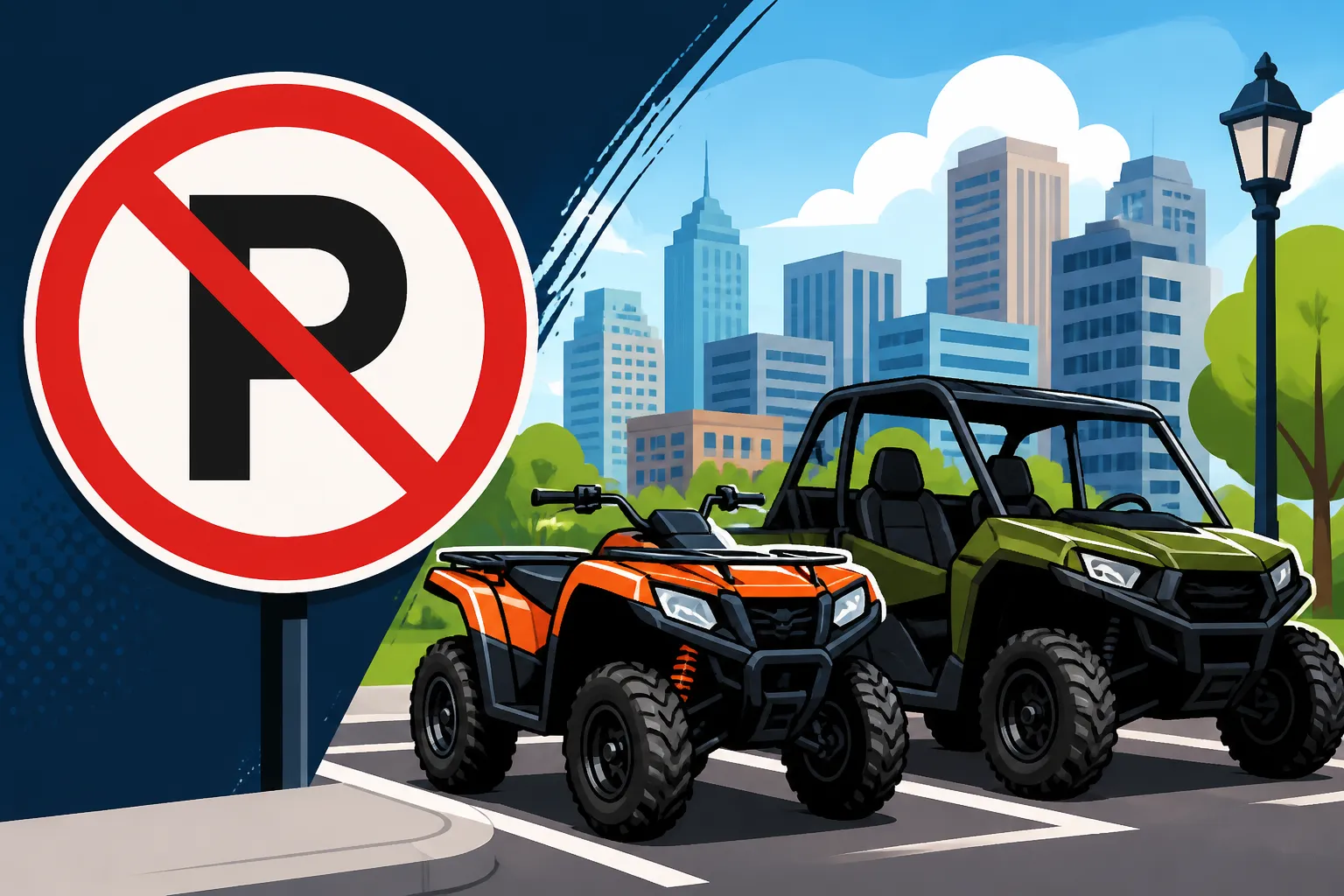
- Parking in a "No Parking" zone.
- Exceeding posted time limits.
- Blocking a fire hydrant or driveway.
- Parking too close to an intersection or crosswalk.
- Parking on private property without permission.
- Parking in a handicap space without a proper permit.
The consequences can include:
- Fines: These can range from minor infractions to significant penalties, especially if the violation creates a safety hazard. You can get a sense of typical enforcement in posts like [Tickets Deputies Write for Road Riding].
- Towing: This is arguably the biggest headache. Not only will you have a tow fee, but you'll also have impound lot fees for every day your machine sits there, plus the inconvenience of arranging transport to retrieve it. This can easily run into hundreds of dollars.
- Community Relations: Repeated improper parking reflects poorly on the entire ORV community, making it harder for advocacy groups to push for more ORV-friendly policies in the future.
The bottom line is that ignorance of a local ordinance is almost never accepted as an excuse. It's on you, the operator, to know the rules of the road and the parking lot wherever you choose to ride.
Best Practices for Downtown ORV Visits
Making a successful and stress-free downtown ORV trip in Michigan requires more than just knowing the rules; it demands a proactive approach and a commitment to responsible riding and parking. It's about planning ahead, being a good ambassador for the sport, and safeguarding your investment.
Pre-Trip Planning and Research
This is perhaps the most critical step. Before you even think about hitting a downtown strip with your ORV, invest some time in planning.
- Check Local Ordinances: As discussed, this is non-negotiable. Look up the specific city or village's rules online or call their municipal office. If they prohibit ORV use on city streets, then your decision is made: you won't be riding your ORV into town.
- Identify Parking: If ORVs are allowed, try to identify potential parking areas beforehand. Are there municipal parking lots? On-street parking? Are there any ORV-specific spots? Google Street View can sometimes offer insights into parking availability and signage.
- Backup Plan: Always have a backup. If parking looks too difficult or risky, consider parking your truck and trailer just outside the downtown core in a designated staging area or a large, permissible parking lot, and then walking, biking, or using a ride-share service into the main drag. This is often the safest bet, even if it means a little extra effort. For tips on trailers, check out [Trailer Registration for Hauling ATVs in Michigan].
- Weekend vs. Weekday: Consider the day of your visit. Weekends and holidays will inevitably mean more traffic and fewer parking options. A weekday visit might offer a more relaxed experience.
A little planning goes a long way in preventing frustration and ensuring your downtown visit is enjoyable, not problematic.
Being a Responsible ORV Ambassador
Every time you ride your ORV, especially in a public setting like a downtown, you are representing the entire ORV community. Being a good ambassador means being courteous, mindful, and respectful of others.
- Noise: Be mindful of your exhaust noise. While some aftermarket systems from brands like SuperATV can enhance performance, they can also increase noise. Downtown areas are often residential or have businesses sensitive to loud engines. Avoid revving your engine unnecessarily or making excessive noise. For more on this, see [Michigan ORV Noise Limits on Roads].
- Driving Habits: Drive slowly and cautiously. You're not on the trail or a scramble area. Be aware of pedestrians, cyclists, and other vehicles. Obey all traffic laws, including stop signs and traffic lights.
- Respect Property: Don't cut through private parking lots or across lawns. Stick to designated roads and parking areas.
- Appearance: A clean ORV makes a better impression than one covered in mud from head to toe, especially if you're pulling into a nice downtown district. While it might be impossible to avoid some dirt after a long trail ride, a quick wipe-down can make a difference.
Positive interactions and responsible behavior by ORV riders help foster good relationships with local communities and can influence future policy decisions in favor of more ORV access.
Securing Your ORV While Parked Downtown
Leaving your ORV unattended in a downtown setting, especially in a busy area, increases its vulnerability to theft or vandalism. While the thought of a stolen machine is terrifying, there are steps you can take to mitigate the risk. [Stolen ATV Recovery and the Title Trail] offers a deeper dive into what happens if your machine goes missing.
- Lock It Up: Treat your ORV like you would a valuable motorcycle. Use a steering wheel lock, a disc lock on the brakes, or even a chain lock if possible. Many UTVs have locking storage compartments for valuables.
- Remove Valuables: Don't leave phones, wallets, cameras, or other tempting items visible in your ORV. Take them with you or secure them out of sight.
- GPS Tracking: Consider installing a GPS tracker on your machine. This can be invaluable for recovery if it is stolen.
- Alarm Systems: Some aftermarket alarm systems are available for ORVs, offering an extra layer of security. Companies like SuperATV might offer various security accessories that could be beneficial.
- Park Smart: Whenever possible, park in well-lit, high-traffic areas where there are more eyes around. If there's a parking garage, check if ORVs are permitted and if it offers a more secure environment.
Taking these precautions helps protect your investment and gives you peace of mind while you're enjoying your downtown visit.
Summary of ORV Parking Rules Downtown
To help clarify the often-confusing landscape of ORV parking in Michigan's downtown areas, here's a quick overview of what you generally need to keep in mind:
| Feature | Standard Car Parking Rules (General) | ORV Parking Rules Downtown (Michigan) |
|---|---|---|
| Primary Authority | State and local municipal ordinances | Local municipal ordinances (city/village) override county rules |
| Legality of Access | Generally allowed on all public roads | Requires specific local ordinance permitting ORV access on streets |
| Street Legal Status | Assumed for operation | Crucial for operation, but doesn't guarantee special parking rules |
| Parking Spots | Must fit within marked lines (parallel, angled, perpendicular) | Must fit within marked lines; width can be a challenge for UTVs |
| Meters/Time Limits | Pay meters, observe posted time limits | Pay meters, observe posted time limits, no ORV exemption |
| Obstruction | Prohibited (hydrants, driveways, crosswalks, sidewalks) | Strictly prohibited; higher visibility risk due to machine type |
| Designated Parking | Common (garages, lots, street spots) | Rare, but worth researching; often in ORV-friendly trail towns |
| Enforcement | Traffic enforcement (tickets, towing) | Same as cars (tickets, towing); ignorance is not an excuse |
| Security Risk | Varies by location | Potentially higher due to value and visibility; extra precautions needed |
| Research Required | Minimal for driving | Essential for downtown access and parking |
This table highlights that while your ORV might be capable of operating on certain roads, its parking in downtown Michigan is almost entirely dictated by local, often stricter, rules that treat it much like any other vehicle, with its unique size and recreational nature sometimes adding complexity.
Disclaimer
This article is for general informational purposes only and does not constitute professional advice. Laws, prices and regulations vary by location and change over time. Consult a qualified professional for guidance on your specific situation.