Michigan Plate for an Assembled Vehicle UTV
It's incredibly frustrating when you've invested time, effort, and passion into building or heavily modifying your UTV, only to face a bureaucratic maze when you want to make it street legal in Michigan. You just want to drive your pride and joy on approved county roads, but the process of getting that official "assembled vehicle" plate can feel like a riddle wrapped in an enigma. This guide will meticulously walk you through the exact steps, requirements, and considerations for successfully plating your assembled or custom-built UTV for legal road use in Michigan, helping you understand each hurdle and how to clear it.
Understanding Michigan's Assembled Vehicle Classification for UTVs
Michigan has a specific pathway for vehicles that weren't originally manufactured for on-road use but have been modified to meet safety and equipment standards, or for vehicles custom-built from the ground up. This is where the "assembled vehicle" designation comes into play for UTVs. It’s not just about slapping on a couple of turn signals; it’s a comprehensive process to ensure your machine is truly safe for shared roadways.
What Defines an "Assembled Vehicle" in Michigan?
An "assembled vehicle" in Michigan refers to a vehicle that has been constructed by a private individual from new or used parts, or a vehicle that has been so extensively modified from its original design that it no longer resembles the manufacturer's original specification. For UTV owners dreaming of hitting paved or gravel county roads, this classification is usually the route they'll take if their machine wasn't sold as a street-legal unit from the factory. Think of it as certifying a one-of-a-kind creation for public consumption.
This often applies to custom builds where you've started with a bare frame and added components, or perhaps you bought a standard off-road UTV and added a full suite of road-legal accessories like a windshield, wipers, horn, turn signals, and DOT-approved tires. The key is that the state needs to verify that the sum of these parts, and their installation, meets specific safety criteria for highway use, rather than just off-road trails. It’s a completely different animal than simply getting an ORV title and trail permit. When you look at the requirements for a [Michigan Assembled Vehicle Title Application], you'll see a clear distinction from a typical ORV title process.
Why the Assembled Vehicle Route vs. Just an ORV Title?
This is a really common point of confusion for UTV owners. An ORV title, which you need for nearly any off-road machine in Michigan, simply identifies ownership for off-road purposes. It allows you to buy an ORV license and trail permit, enabling you to ride on designated trails and routes. However, an ORV title alone does not grant you permission to ride on public roads, aside from specific county road ordinances that allow ORVs to operate under very strict conditions (often a 25 mph limit, specific lighting, and only on the far right of the maintained portion of the road).
The assembled vehicle route, on the other hand, means you are essentially registering your UTV as a full-fledged motor vehicle for road use, albeit with limitations specific to its class. This gives you a standard vehicle license plate and registration, allowing you more freedom on approved roads, similar to how a car or motorcycle operates. It signifies that your UTV has undergone a rigorous inspection and meets the comprehensive safety equipment standards required by the state for street use. This is crucial for anyone hoping to truly enjoy their UTV beyond just the dirt trails, letting you travel from your cabin to the local store or link up different trail systems without breaking the law or risking a hefty ticket. Without taking this route, you could easily face a [Penalty for Operating an Untitled ORV in Michigan] or, more relevant here, an improperly registered one on the road.
The Michigan Street-Legal UTV Inspection Process
Once you've poured your heart (and probably your wallet) into transforming your UTV into a road-worthy machine, the next major hurdle is the inspection. This isn't just a quick look-over; it's a detailed check by the Michigan Secretary of State to ensure every single component meets the safety standards for street-legal vehicles. It can feel daunting, but being prepared is half the battle.
Scheduling and Preparing for Your Inspection
First things first, you'll need to schedule an appointment for an assembled vehicle inspection at a Michigan Secretary of State branch that handles these types of specialized appointments. Not all branches offer this service, so it's vital to call ahead or check the SOS website for locations and availability. It’s not the kind of thing you just show up for on a whim.
Before you even think about showing up, make sure your UTV is spotless. Seriously. A clean machine not only makes a better impression but also allows the inspector to easily see all the components they need to check. Have all your documentation in order: original proof of ownership for the UTV (even if it's just a bill of sale), receipts for major components you've added, and a detailed list of all modifications. You'll also need the completed [Michigan Assembled Vehicle Title Application] form. Many aftermarket companies, like SuperATV, provide comprehensive kits for street-legal conversions, and having documentation for these parts can be helpful. Think of it like bringing a comprehensive resume for your UTV – you want to highlight all its qualifications for road readiness.
What the Inspector Looks For
The inspection is comprehensive, covering all aspects of your UTV's safety equipment. The inspector will go through a checklist to ensure your UTV meets all the requirements to be considered safe for public roads. Here's a breakdown of common items they will be checking:
| Component Type | Specific Items Checked | Compliance Standard |
|---|---|---|
| Lighting | Headlights (high/low beam), Taillights, Brake lights, Turn signals (front/rear), Hazard lights, License plate light | DOT compliant, visible from required distances |
| Visibility | Rearview mirror (left/right, or single central), Side mirrors, Windshield, Windshield wipers | DOT approved, clear visibility, functional wipers |
| Braking System | Service brake, Parking brake | Fully functional, capable of stopping the vehicle |
| Audible Warning | Horn | Functional, audible from 200 feet |
| Tires | DOT-approved tires, Proper tread depth, Tire pressure | Proper size, load rating, and condition for road |
| Safety Features | Seat belts, Speedometer, Exhaust system, Fenders/Mudguards | Proper fit, functional, secure, noise limits met |
| Vehicle Identification | Visible VIN (Vehicle Identification Number), Proper VIN plate | Clear, legible, matches documentation |
The inspector will be particularly keen on items like [Safety Glass, Mirrors and Horns: Michigan's Street-Legal List]. They’ll check your [Turn Signals and Hazard Lights on a Street-Legal Build] to make sure they're properly installed and functioning. Your [Windshield or Goggles: Michigan's Eye Protection Rule] is crucial – if you have a windshield, it generally needs to be safety glass and have functional wipers. If not, you'll need to meet the eye protection requirements. Of course, your tires must be [DOT Tires on a Street-Legal Side-by-Side], meaning they are rated for highway use. They will also verify that your [Speedometers on a Street-Legal UTV] is working correctly, as this is a legal requirement for road-going vehicles. Anything that doesn't meet the standard could result in a failed inspection, requiring you to make adjustments and return for a re-inspection.
Essential Components for Street Legal Conversion
Converting your off-road UTV into a road-legal "assembled vehicle" involves more than just a few bolt-on parts. It requires a systematic approach to ensure every necessary safety feature is present and compliant. Overlooking even one small detail can mean the difference between getting your plate and going home empty-handed.
Lighting and Signals
This is often one of the first areas people think about, and for good reason—it's critical for visibility and communication on public roads. Your UTV needs a complete set of DOT-compliant lighting:
- Headlights: Must have both high and low beams, securely mounted, and properly aimed. They need to illuminate the road ahead to specific distances.
- Taillights: Clearly visible from the rear, functioning correctly.
- Brake Lights: These must activate when the brake pedal is pressed, signaling to drivers behind you that you're slowing down.
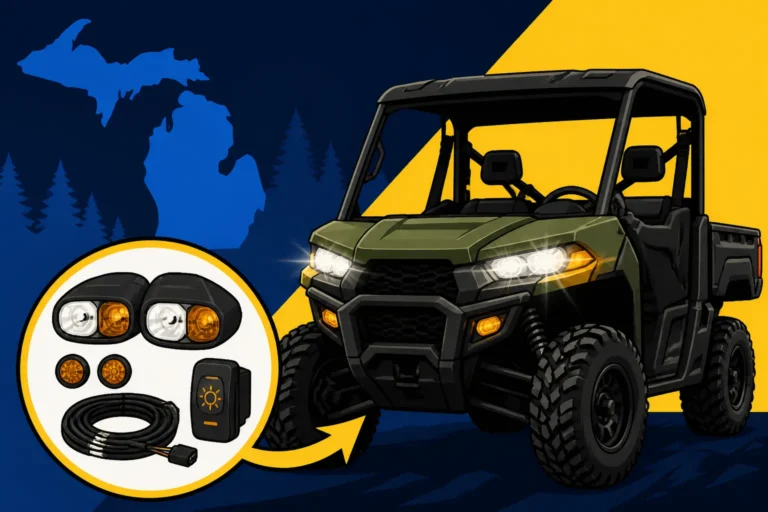
- Turn Signals: Both front and rear, on both sides, with an indicator for the driver. These are crucial for signaling your intentions to other motorists. Many riders opt for aftermarket kits from reputable brands like SuperATV, which offer integrated turn signal systems that are designed to meet DOT standards.
- Hazard Lights: Also known as "four-way flashers," these engage all turn signals simultaneously to warn others of a stopped or disabled vehicle.
- License Plate Light: A small white light that illuminates your license plate after dark, making it legible from a distance.
Ignoring any of these can easily lead to failing the inspection. It's not just about having lights; it's about having correctly functioning and compliant lights. You can find a detailed breakdown in a [Parts List for a Street-Legal Conversion].
Visibility and Warning Devices
Being seen and heard are paramount for safety on the road. Your UTV needs the following:
- Mirrors: Michigan generally requires at least one rearview mirror providing a clear view of the highway to the rear for at least 200 feet. Many riders install two side mirrors for better visibility, and these must also be securely mounted and provide an adequate field of view.
- Windshield and Wipers (if applicable): If your UTV has a windshield, it generally needs to be made of safety glass, not just plexiglass, and must be equipped with functioning windshield wipers. If your UTV does not have a windshield, you'll need to ensure you meet the state's eye protection requirements, usually by wearing DOT-approved goggles or a full-face helmet with a face shield.
- Horn: A working horn, audible from a distance of at least 200 feet, is not just a convenience but a legal requirement. It's there to warn pedestrians or other drivers of your presence. The type of horn isn't usually specified beyond its audibility, so most aftermarket options will suffice. [Where to Mount a Horn on a Side-by-Side] is a common question, and generally, any accessible, visible location works.
Tires, Brakes, and Seat Belts
These are core safety components that ensure your UTV can safely accelerate, stop, and protect its occupants:
- DOT-Approved Tires: Your off-road tires, while great in the mud, are likely not rated for highway speeds and conditions. You'll need to swap them out for [DOT Tires on a Street-Legal Side-by-Side] that have a proper speed rating and load capacity for road use. The tire size and condition will also be scrutinized.
- Braking System: Both your service brake (foot pedal) and parking brake must be fully functional and capable of safely stopping and holding the vehicle. The inspector will test these thoroughly.
- Seat Belts: All seating positions must be equipped with properly installed and functional seat belts. For most UTVs, this means three-point seat belts, though some older or specialized configurations might allow for lap belts if they meet historical or specific design standards. The key is that they are secure and provide occupant restraint. You’ll also want to review [Seat Belt Rules in a Michigan UTV] to ensure compliance.
Documentation and Fees for Your Assembled Vehicle Plate
Navigating the paperwork for an assembled vehicle plate can feel like a mountain of forms, but having everything in order before you head to the Secretary of State will save you immense frustration. It's not just about having the right parts; it's about proving you have them and that your vehicle is legitimate.
Required Forms and Proof of Ownership
When you show up for your assembled vehicle inspection, you need to bring a robust portfolio of documents. This isn't just one form; it's a collection that proves the origin of your UTV and its components:
- Original Proof of Ownership: This is paramount. If you built the UTV from scratch, you'll need bills of sale for the frame, engine, and any other major components you used. If you started with an existing ORV, you'll need its original title. Without clear proof of ownership, the process stops before it even begins. This could involve an [Michigan ATV Bill of Sale: What to Put in It] if you acquired parts privately.
- Receipts for Major Components: While not every nut and bolt needs a receipt, it's wise to keep records for significant purchases related to your conversion, especially safety items like lights, mirrors, windshields, and DOT tires. These receipts help validate the modifications and their origin.
- Application for Michigan Vehicle Title (Form TR-11L): This is the core form for titling your vehicle. You'll need to fill out all relevant sections accurately, including a detailed description of your UTV and how it was assembled.
- Vehicle Identification Number (VIN) Verification: If your assembled UTV doesn't have a recognizable VIN, or if the inspector needs to verify it, they may issue a new VIN or confirm the existing one. For custom builds, this often involves the state issuing a Special Assigned Identification Number. You should know [Where the VIN Is Stamped on an ATV or UTV] for easy verification.
It’s always a good idea to call the specific Secretary of State office where your inspection is scheduled to confirm their exact requirements, as sometimes local interpretations or additional requests can arise.
Fees and Taxes Associated with Titling
Getting your assembled vehicle plate isn't free, and you'll encounter a few different costs along the way. Be prepared for these financially, as they are part of the process:
- Assembled Vehicle Inspection Fee: There is typically a fee associated with the inspection itself. This covers the state's cost for having an inspector review your vehicle.
- Title Fee: Once your UTV passes inspection, you'll pay a fee to process the new title. This officially registers your machine in your name with the "assembled vehicle" designation.
- Registration Plate Fee: This is the annual cost for your license plate and registration sticker, which allows you to operate the UTV on public roads. This fee will depend on the weight and type of your vehicle.
- Sales/Use Tax: If your UTV was recently purchased or if you've brought it into Michigan from another state, you may be subject to Michigan's sales or use tax on the value of the vehicle and its components. This can be a significant cost, so be sure to factor it in. You can learn more about [Michigan Use Tax on a Private-Party ATV Sale] or even [Michigan ORV Sales Tax at a Secretary of State Branch] for context, though the assembled vehicle designation might change the exact calculation. The good news is that if you already paid sales tax when you originally bought the ORV, you might get a credit for that.
Remember, the specific amounts for these fees can change, so always check the official Michigan Secretary of State website or call ahead for the most current figures. Avoid any year-stamped claims, as prices can fluctuate.
What Makes a UTV Truly Street Legal in Michigan
Beyond the inspection, actually operating your street-legal UTV on Michigan roads comes with its own set of rules and responsibilities. Having a plate is one thing; understanding how and where you can legally ride is another.
Road Access and Restrictions
Even with an assembled vehicle plate, your UTV isn't suddenly a car. Michigan has specific rules governing where and how these types of vehicles can be operated:
- County Roads: This is generally where street-legal UTVs shine. Many Michigan counties have ordinances that allow ORVs (including street-legal assembled vehicles) on their county roads. However, always check the specific county's ordinance, as rules can vary regarding speed limits, time of day, and specific road types. You'll find that [Michigan's 25 mph Limit on County Roads] is a common restriction, even for plated machines.
- State Highways (M, US, and I Routes): In almost all cases, you cannot operate an assembled vehicle UTV on state trunkline highways. These roads are designed for higher-speed traffic, and UTVs simply aren't suited for them. There might be exceptions for crossing at designated points, but prolonged travel is generally prohibited. Knowing [Crossing a State Highway on an ORV in Michigan] is vital.
- City/Village Limits: Similar to county roads, municipal ordinances dictate UTV use within city and village limits. Some towns might allow it, others might not. Always check local laws before venturing into an urban area.
- Designated ORV Trails: A street-legal UTV can still be ridden on designated ORV trails, provided you have the necessary ORV license and trail permit. The assembled vehicle plate just adds the road-riding capability; it doesn't remove its off-road status.
Understanding these distinctions is crucial to avoid tickets and ensure safe operation. Familiarize yourself with [Michigan's Three Road Rules Michigan ORV Riders Must Follow] to stay compliant.
Insurance and Driver's License Requirements
Operating any vehicle on public roads comes with insurance and licensing requirements, and your street-legal UTV is no exception.
- Insurance: Your UTV, now considered a road-going vehicle, will need to be properly insured. This typically means carrying personal injury protection (PIP), property protection insurance (PPI), and liability coverage, just like a car. The specific coverage amounts and requirements are similar to those for motorcycles or other recreational vehicles. You will definitely need to learn about [Insurance a Michigan Street-Legal UTV Needs], as a basic ORV insurance policy might not cover road use. It's vital to speak with your insurance agent to ensure you have the correct policy for street-legal operation.
- Driver's License: You will need a valid driver's license (standard operator's license) to operate your assembled vehicle UTV on Michigan public roads. Unlike off-road ORV operation, which has different age and safety certificate rules, road use requires a licensed driver. This is a key difference to understand, especially if younger family members plan to operate the machine. Read up on [Driver's License Rules for Michigan ORV Road Riding].
It's a complete change of paradigm from simply riding an ORV on a trail. When you get a license plate, you're accepting all the responsibilities that come with being a road user, including all the legal and financial protections that entails. This comprehensive approach ensures that everyone on the road is adequately covered and properly licensed, contributing to overall safety.
Common Challenges and Solutions
The journey to getting a Michigan plate for an assembled vehicle UTV can have its bumps. It's rare for everything to go perfectly smoothly, so understanding common challenges and how to overcome them can save you headaches and re-inspections.
Dealing with Failed Inspections
It’s disheartening to hear that your UTV didn't pass inspection, especially after all your hard work. But it happens, and it's not the end of the road.
- Understanding the Reason for Failure: The inspector will provide a clear reason for the failure. It might be something simple, like a turn signal not blinking consistently, or something more significant, such as non-DOT-approved tires. Don't be afraid to ask for clarification if you don't understand the specific issue. Knowing [What Fails a Michigan Assembled Vehicle Inspection] can help you proactively address issues before your first appointment.
- Making the Necessary Repairs/Modifications: Once you know the issue, you can make the necessary repairs or modifications. This might mean sourcing a different part, adjusting an existing one, or even re-wiring a component. Many of the aftermarket parts from brands like SuperATV are designed specifically to meet DOT requirements, so if you used those, it might be an installation issue rather than a part issue.
- Rescheduling: After making the corrections, you'll need to reschedule another inspection appointment. Don't rush this; take your time to ensure everything is perfect. A second failure is even more frustrating. Sometimes, a quick trip to an auto parts store for a new bulb or a wiring harness adjustment is all it takes.
Remember, the inspector's job is to ensure safety, not to give you a hard time. View it as a collaborative process to get your UTV safely on the road.
Addressing VIN Issues and Salvage Titles
Sometimes, the UTV itself presents challenges before you even get to the modifications.
- Missing or Obscured VIN: If your UTV's VIN is missing, unreadable, or was removed during a custom build, this is a major hurdle. The Secretary of State cannot title a vehicle without a valid identification number. In these cases, you may need to apply for a special assigned VIN from the state, which involves additional paperwork and verification. This ensures that every vehicle on the road can be uniquely identified. You can find out more about [VIN Inspection Requirements for a Michigan ORV Title] which also applies to assembled vehicles.
- Salvage Titles: If your donor UTV had a salvage title, this adds another layer of complexity. A salvage title indicates that the vehicle was declared a total loss by an insurance company. To get a regular plate for a formerly salvaged UTV, it must undergo a much more stringent salvage vehicle inspection to ensure it has been rebuilt safely and accurately. This is a completely different process than a standard assembled vehicle inspection and involves an even deeper dive into the vehicle's structural integrity and repairs. Understanding [What a Salvage Title Means for an ATV Buyer] is critical if you start with such a machine.
These issues require extra steps and diligence. It’s always best to resolve any VIN or title history discrepancies early in your build process, rather than waiting until you're ready for the final inspection. Thorough due diligence when buying any UTV, especially for a street-legal conversion project, can save you a world of trouble down the line.
Disclaimer
This article is for general informational purposes only and does not constitute professional advice. Laws, prices and regulations vary by location and change over time. Consult a qualified professional for guidance on your specific situation.