Carrying a Firearm on an ORV in Michigan
For many of us who love Michigan's incredible outdoors, our ATVs and UTVs aren't just for recreation; they're essential tools for getting to that perfect hunting spot, checking remote property, or even just feeling prepared in the backcountry. But when it comes to carrying a firearm on your off-road vehicle, the rules can feel like a tangled web of state statutes, DNR regulations, and common sense. This guide will help you untangle that confusion, ensuring you can safely and legally transport your firearm while enjoying Michigan's trails and wild spaces.
The Basics of Michigan Firearm Law and ORVs
Michigan has a robust set of firearm laws, and these don't simply vanish when you hop on your ORV. In fact, operating an ORV adds another layer of specific regulations you absolutely need to understand. Many riders get tripped up by assuming "on my person" means the same thing on an ATV as it does walking down a city street, but that's often not the case once you're on two or four wheels in the woods. The key is knowing how Michigan law interprets carrying a firearm in a vehicle, and how an ORV is classified.
Open Carry vs. Concealed Carry on an ORV
Michigan is an open-carry state, meaning that generally, if you're legally allowed to possess a firearm, you can carry it openly without a permit. However, this general rule has nuances when you're operating a vehicle, especially an ORV. While openly carrying a holstered handgun on your person might be permissible in some situations, the moment that firearm is placed within the ORV itself, even in plain sight, it can move into a different legal category.
For example, a pistol carried in a console or under a seat in a UTV, even if visible, is generally considered "concealed" within the vehicle's interior. This is a critical distinction because carrying a concealed pistol (CPL) requires a permit. If you have a CPL, you can carry a pistol concealed on your person or anywhere in your ORV. If you do not have a CPL, carrying a pistol anywhere other than openly on your person (like in a holster on your hip) could be deemed illegal concealed carry. Long guns (rifles, shotguns) generally do not require a CPL to carry concealed in a vehicle, but they must be unloaded and encased, or unloaded and readily accessible for specific purposes like hunting during legal hours. The distinctions can be subtle but the penalties for misunderstanding can be severe.
Understanding ORV-Specific Regulations for Firearms
Beyond general firearm laws, Michigan's Department of Natural Resources (DNR) has specific rules that apply to firearms on ORVs, especially on designated trails, state land, and during hunting seasons. A major point of confusion for many riders is the requirement for firearms to be unloaded and encased when being transported on an ORV, particularly on designated ORV trails. This rule is in place to ensure public safety and prevent poaching or misuse of firearms in recreational areas.
Think of it this way: when you're on a multi-use trail, sharing it with hikers, cyclists, and other riders, the DNR wants to ensure that firearms are not readily available for quick use. This means that a rifle mounted openly in a gun rack, or a pistol simply tossed onto the passenger seat, is often a no-go on a designated trail. These regulations are designed to minimize risks and ensure that recreational areas remain safe for everyone. Always remember that even if you have a CPL, specific DNR rules for ORV transport might still require your firearm to be unloaded and encased when traveling on state-designated trails or certain public lands. Checking [Michigan ORV Paperwork During a DNR Stop] beforehand can save you a lot of grief.
Safe and Legal Transport of Firearms on Your ORV
Transporting a firearm on an ORV isn't just about following the law; it's also about safety. The bumps, jostles, and potential for rollovers mean that a firearm needs to be secured properly to prevent accidental discharge, damage, or loss. There's nothing worse than getting to your destination only to find your valuable hunting rifle has bounced out of its poorly secured mount or sustained damage.
Securing Your Firearm for the Ride
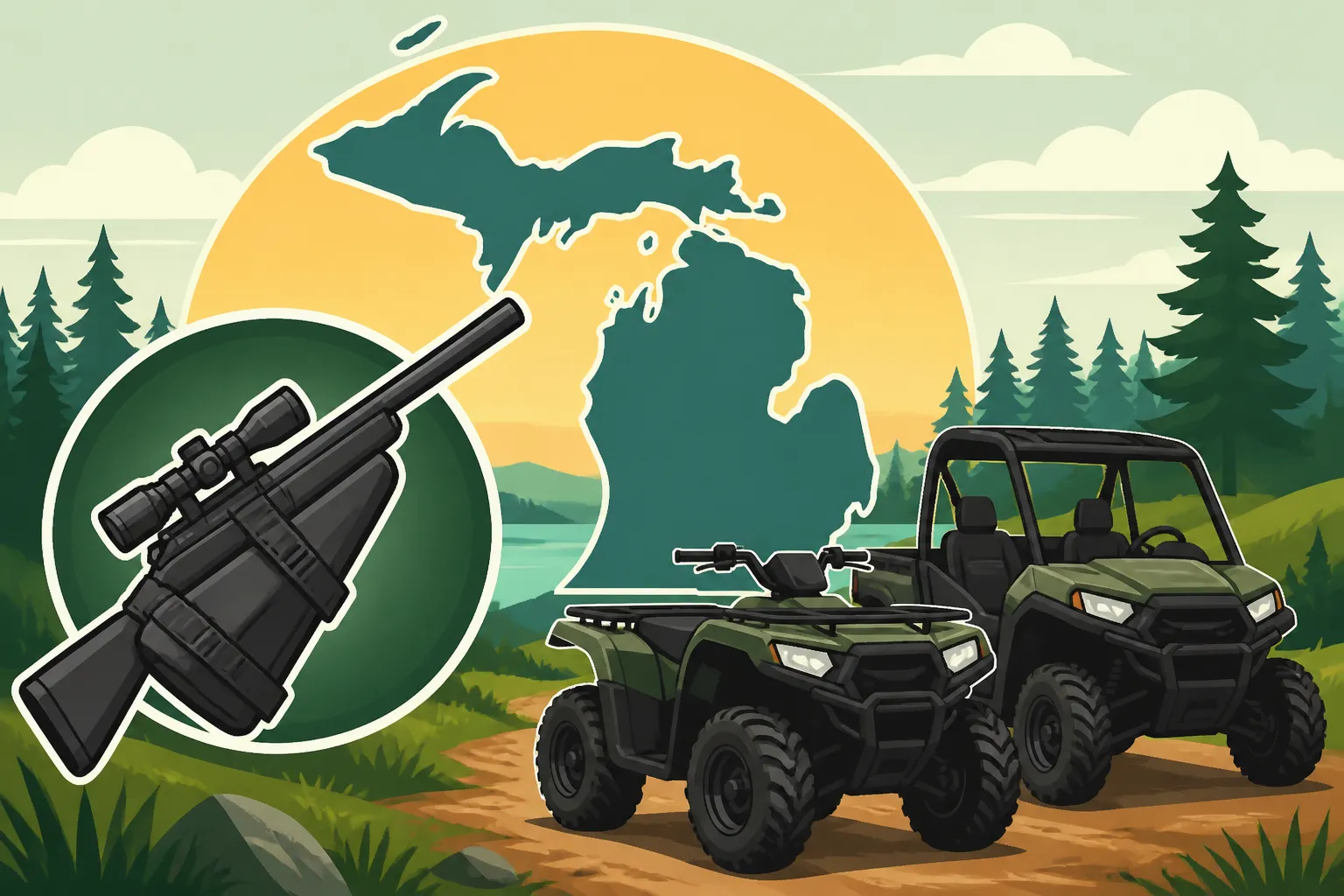
For long guns (rifles and shotguns), proper securement is crucial. Many ORV owners invest in robust gun scabbards or hard cases that attach securely to the machine's rack or roll cage. These cases offer protection from dust, water, and impacts, while also meeting the "encased" requirement for transport on many public lands. Brands like SuperATV offer a range of mounting solutions for gun scabbards and hard cases designed specifically for UTVs and ATVs, ensuring a snug fit and easy access when you're legally permitted to retrieve it. When choosing a mount, consider its quick-release capabilities for legal hunting scenarios, but also its ability to be locked for security when the ORV is unattended.
A common mistake is simply strapping a rifle to a rack with bungee cords or soft ties. While this might seem convenient, it rarely offers sufficient protection from the elements or impacts, and it certainly won't satisfy the "encased" requirement. Imagine hitting a deep rut or rolling your UTV; you want that firearm to stay exactly where you put it, protected and pointing in a safe direction. Investing in quality mounting solutions is not just about compliance; it's about preserving your equipment and ensuring your safety.
Ammunition Storage and Ready Access
Separate from the firearm itself, how you store ammunition on your ORV is another important consideration. When a firearm is required to be unloaded and encased, it means there should be no ammunition in the chamber, magazine, or clip attached to the firearm itself. Keeping ammunition separate from the firearm, typically in a secure container or dedicated ammo box, is always a good practice, especially during transport. This further emphasizes the "unloaded" status of the firearm and prevents any accidental loading or discharge.
For those with a CPL who are legally carrying a loaded, concealed pistol on their person, separate ammunition storage isn't as critical, as the pistol is considered ready for use. However, if you're carrying extra magazines, they should still be stored in a way that prevents them from falling out or being damaged. When you're out in the field, having your ammunition organized and protected from moisture and impact means you won't be fumbling when it's time to legally load up. Always confirm the specific requirements for your intended activity and location.
Special Considerations: Hunting, Camping, and Private Land
The context of why you're carrying a firearm on your ORV dramatically changes the rules. What's perfectly fine when transporting a hunting rifle to a deer stand on private land might be completely illegal when cruising a state trail with a pistol. Understanding these distinctions is paramount.
Firearm Carry During Michigan Hunting Seasons
Michigan offers fantastic hunting opportunities, and ORVs are invaluable for accessing remote areas. During legal hunting seasons, and if you possess the appropriate licenses, the rules for firearm carry on ORVs become more nuanced. Generally, during legal hunting hours, a hunter may transport a loaded firearm in or on an ORV if they are actively engaged in hunting. However, this is not a blanket permission to have a loaded firearm at all times. The firearm must still be pointed in a safe direction and handled responsibly.
Important distinctions to remember:
- Designated ORV Trails: Even during hunting season, many designated ORV trails (those specifically marked for ORV use) still require firearms to be unloaded and encased. You might be able to transport the firearm to the general hunting area via the trail, but you'll need to unload and encase it for that portion of the journey. Once you leave the designated trail and are actively engaged in hunting, the rules change.
- Forest Roads (open to licensed vehicles): On state forest roads that are open to licensed vehicles (including ORVs that are street-legal or have certain road privileges), the rules might align more with traditional vehicle carry laws, requiring long guns to be unloaded and encased unless actively hunting.
It's crucial to consult the current Michigan Hunting and Trapping Digest for the most up-to-date and specific regulations for the species you're hunting and the specific area. Pay close attention to sections on ORV use and firearm transport. Many tickets are written because hunters assume a general "hunting season" rule applies everywhere, which it doesn't. Remember to always have your [Michigan ORV License and Trail Permit Explained] current and visible.
Carrying on Private vs. Public ORV Trails
This is where a lot of confusion arises. On your own private land, or land where you have explicit permission from the owner, Michigan's ORV and DNR-specific firearm transport rules typically do not apply. If you're riding around your 40 acres, checking fence lines with your UTV and a loaded rifle in a SuperATV gun rack, you're generally fine, assuming you're legally allowed to possess the firearm and you're not violating any local ordinances. This is a common situation for landowners who use their ORVs as utility vehicles.
However, the moment your tires touch public land or a designated public ORV trail, the rules shift dramatically. As discussed, public trails generally require firearms to be unloaded and encased. This includes state forest roads, state-designated ORV trails, and sometimes even snowmobile trails when they are open to ORVs in the summer (refer to [Michigan Snowmobile Trail Access for ORVs]). It's not enough to simply know if you're on public land; you need to know if you're on a designated ORV trail or route where these specific transport rules are enforced. Always check [Michigan ORV Trail Maps and What the Signs Mean] to be sure.
Federal Lands and ORV Firearm Rules
Michigan is home to several national forests and national parks, and these federal lands operate under their own distinct set of regulations regarding firearms and ORVs. Generally, federal lands adhere to state and local firearm laws, but they can also add their own restrictions. For example, carrying firearms inside federal buildings, schools, or certain developed recreation areas is often prohibited.
When it comes to ORVs on federal land, you'll still need to follow Michigan's ORV licensing and trail permit requirements. Regarding firearms, the general "unloaded and encased" rule for transport on trails often still applies, unless you are actively hunting in a permitted area and during legal hours. Always verify the specific rules for the federal property you plan to visit. The U.S. Forest Service or National Park Service websites for that specific location will have the most accurate and up-to-date information. Never assume Michigan state rules perfectly align with federal regulations.
Avoiding Common Mistakes and Penalties
Misunderstanding firearm laws on ORVs can lead to serious consequences, from hefty fines to confiscation of your firearm and even criminal charges. It's far better to be overly cautious and informed than to face a Conservation Officer (CO) or local law enforcement with a poor excuse.
Checking Local Ordinances and DNR Rules
One of the biggest pitfalls for ORV riders is assuming that state law is the only law. Many counties, townships, and even cities in Michigan have their own local ordinances regarding firearm discharge, carrying, and ORV use. While state law generally preempts local ordinances on firearm possession, local governments can still regulate discharge and how firearms are transported, especially when it interacts with public safety and specific ORV use rules. For example, some townships might have specific rules about ORV noise or operating hours that could indirectly affect your ability to get to a hunting spot.
Before heading out, especially to a new area, take a moment to look up the local ordinances for that specific county or township. You can usually find this information on the local government's website. Similarly, always check the current Michigan DNR digest for any changes to ORV and firearm regulations, as these can be updated annually. Knowledge is your best defense against inadvertently breaking the law. [Michigan ORV Rules During Deer Season] is a common source of confusion if not thoroughly reviewed.
Consequences of Illegal Firearm Carry
Operating an ORV with a firearm in violation of Michigan law can lead to a range of penalties. For minor infractions, like an improperly encased firearm on a trail, you might face a civil infraction and a fine. However, more serious violations, such as carrying a concealed pistol without a CPL, or having a loaded firearm in a prohibited area, can result in misdemeanor or even felony charges.
Conservation Officers and local law enforcement are well-versed in these nuanced laws. During a routine stop, they'll ask for your [Michigan ORV Safety Certificate Requirements] (if applicable) and your ORV permit, and they're trained to observe how firearms are being transported. If you're found to be in violation, they have the authority to issue tickets, seize your firearm, and in severe cases, impound your ORV. It’s a moment nobody wants to experience, and the legal fees and hassle involved in retrieving a seized firearm or fighting charges can be substantial. Taking the time to understand and follow the rules is simply not worth the risk.
| Aspect | General Michigan Law (Open Carry) | On ORV (Designated Trails/Public Land) | On ORV (Private Land/Hunting) |
|---|---|---|---|
| Pistol (No CPL) | Open carry on person (holster) generally OK. | Must be unloaded & encased, or openly on person (holster) if legal. | Unloaded & encased, or openly on person (holster) if legal. Loaded if actively hunting and permitted. |
| Pistol (With CPL) | Concealed or open carry on person. | May be carried loaded & concealed on person or in ORV, but DNR trail rules may still require unloaded/encased. | May be carried loaded & concealed on person or in ORV. Loaded if actively hunting and permitted. |
| Long Gun | Unloaded & encased in a vehicle. | Unloaded & encased (mandatory for most trails). | Unloaded & encased for transport. Loaded if actively hunting and permitted. |
| Ammunition | Separate from firearm when unloaded. | Separate from firearm when unloaded & encased. | Can be attached to loaded firearm when actively hunting. Separate for transport. |
| Key Regulation | Michigan Compiled Laws | Michigan DNR Regulations & ORV Act | Michigan Hunting & Trapping Digest, Private Landowner Rules |
This table provides a general overview, but always double-check specific regulations based on your location and activity.
Disclaimer
This article is for general informational purposes only and does not constitute professional advice. Laws, prices and regulations vary by location and change over time. Consult a qualified professional for guidance on your specific situation.