Where Michigan ORV Permit Money Goes
Michigan ORV permit money is often described as funding trails, but that is only part of the picture. Michigan law sets minimum shares for trail grants and for law enforcement and equipment. Knowing what those minimums mean helps riders understand what their purchase supports—and why the figures do not show the exact amount spent on every trail or service.
What Michigan law says about ORV revenue
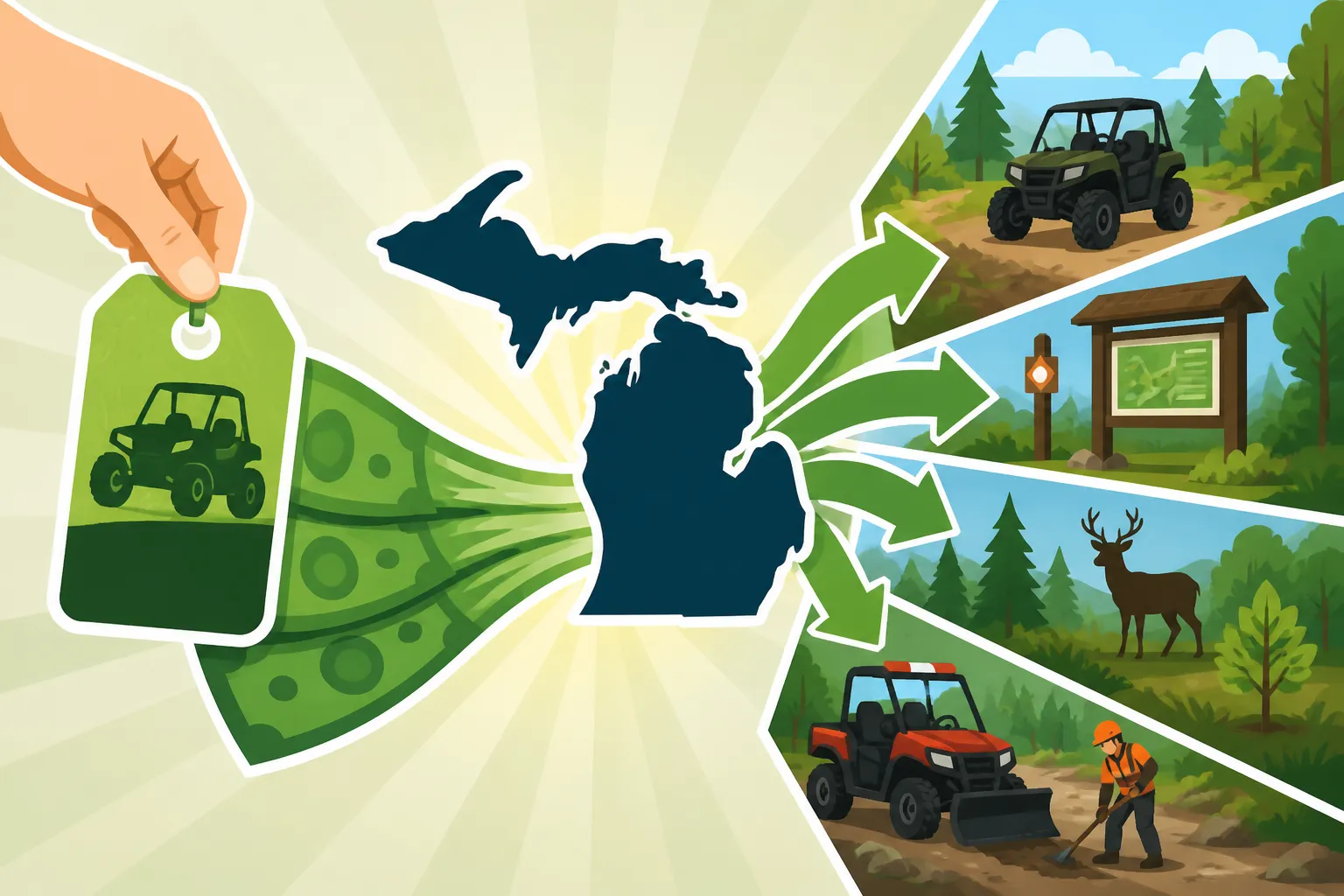
The clearest answer comes from the statutory breakdown for Michigan’s off-road vehicle account. According to the Michigan Legislature, not less than 50 percent of that account’s revenue is allocated for trail maintenance and development grants, and not less than 31.25 percent is designated for law enforcement and equipment.
Those percentages are minimums, not a promise that exactly those shares will be spent in every accounting period. Nor do they mean the remaining revenue automatically goes to a particular trail, region, or type of project. The figures describe statutory allocations from the ORV account; they are not a line-by-line report of every fee payment.
Riders often use “permit money” as shorthand for the revenue supporting the system. The purchase includes different components, however. According to the Michigan Department of Natural Resources, as of October 2026, the annual ORV license costs $26.25, and using state-designated ORV trails requires an additional $10.00 trail permit, for a combined total of $36.25. For more on what each purchase is for, see Michigan ORV License and Trail Permit Explained.
| ORV account allocation | Statutory minimum | What the category supports |
|---|---|---|
| Trail maintenance and development grants | At least 50% | Grants for trail maintenance and development |
| Law enforcement and equipment | At least 31.25% | Law enforcement and related equipment |
| Other account uses | No specific share stated here | Do not assume a particular use or exact remaining percentage |
The table is a summary of the minimums, not a complete budget. Because the law says “not less than,” actual allocations may be greater than the stated floors. The minimum percentages also should not be treated as a complete accounting of all revenue or as a receipt showing where a particular rider’s payment went.
The distinction matters when you are asking whether a specific road, trailhead, sign, machine, or enforcement activity was paid for by permit revenue. The statutory breakdown identifies broad funding purposes. It does not identify the precise project attached to an individual purchase.
How the trail grant allocation helps keep routes usable
Trail maintenance and development grants are the largest share named in the statutory breakdown. In practical terms, the category is meant to support work that maintains or develops ORV trails. A grant allocation is a way of directing funding to projects; it does not mean every trail receives the same level of work or that every rider’s preferred route is funded.
Maintenance needs can differ from one place to another. A route may need attention after use or weather, while another may face a closure or other access issue. The Michigan Department of Natural Resources can close state trails and facilities due to weather-related events and wet conditions. That means permit revenue does not guarantee that a trail will remain open in every condition. Before heading out, check Michigan ORV Trail Closures and Seasonal Dates and the current information for your destination.
Development and maintenance also have different goals. Maintenance helps keep existing routes in service; development supports creating or improving trail opportunities. The statutory category includes both, but the stated minimum does not tell riders how much is directed to either one in a particular budget cycle. For the broader question of who handles the work, Michigan ORV Trail Maintenance and Who Pays for It explains the maintenance picture in more detail.
Grants are not the same as a direct promise to maintain every trail to a rider’s preferred standard. A trail can be open but still have rough, muddy, or changing conditions. Route type and permitted machine width also matter: according to the Michigan Department of Natural Resources, Michigan designates motorcycle-only trails maintained at a 24-inch width, trails maintained at a 50-inch width, and ORV routes maintained at a minimum 72-inch width. Check the route designation before riding, and use Michigan ORV Trail Widths Explained if you are unsure whether your machine fits.
A useful way to read the grant allocation is as support for the trail network, not as a personal service guarantee. It can help explain why trail funding is a major purpose of ORV revenue while leaving room for differences among projects, places, and conditions. For details on the grant process, see Michigan ORV Trail Grant Applications.
Why law enforcement and equipment are included
Michigan law also reserves a minimum share of ORV account revenue for law enforcement and equipment. That allocation supports the enforcement side of the riding system, rather than trail construction or maintenance. The statute gives a broad category; it does not specify in the figures provided here which equipment is purchased, which activities receive support, or how much a specific enforcement effort costs.
This category is relevant to riders because permits are part of the rules that apply to using public ORV routes. According to the Michigan Legislature, operating an ORV without a required trail permit is a state civil infraction, with a civil fine of not more than $500. The permit requirement and its exceptions depend on where and how you ride, so it is worth checking Michigan ORV Permit Checks by Conservation Officers and Michigan ORV License Without a Trail Permit: Where You Can Ride before setting off.
Enforcement funding does not mean every trail has an officer present, and it does not make a permit a substitute for following other operating rules. Riders remain responsible for rules that apply to their machine and situation, including safety requirements. For example, according to the Michigan Legislature, ORV operators and passengers generally must wear a DOT-approved helmet and protective eyewear, with exceptions under certain conditions. Those requirements are separate from the revenue allocation itself.
A clear distinction helps avoid a common misunderstanding: the law names a minimum share for law enforcement and equipment, but it does not say that this amount is spent only on permit checks. The category is broader than one kind of contact between an officer and a rider. Likewise, the trail grant allocation should not be read as a promise that enforcement resources will be available at a particular location or time.
What riders can and cannot conclude from the percentages
The statutory percentages offer a useful high-level answer, but they are not a detailed spending report. They tell you which purposes have minimum allocations. They do not show an exact annual total, the cost of a particular trail project, or how much of a specific purchase reaches one county or route. To understand a particular project, look for the relevant official grant or account information rather than trying to infer it from the minimum percentages.
The purchase itself also has a limited period of validity. According to the Michigan Department of Natural Resources, annual Michigan ORV licenses and trail permits expire on March 31 of the following year, regardless of when they were purchased. That expiration rule is separate from the account’s spending rules, but it matters when deciding what you need for a ride. See Michigan’s April 1 ORV Permit Year for how the permit year works.
Not every permitted ride uses the same combination of license and trail permit. For example, the Michigan Department of Natural Resources says an ORV license is required to operate on the frozen surface of public waters, while a trail permit is not required for that specific use. If you are comparing where each item applies, Michigan’s Extra $10 ORV Trail Permit and Michigan ORV Permit Exemptions on Private Land can help clarify the difference.
For a practical reading of the funding rules, keep these points in mind:
- The allocation language applies to revenue in the ORV account; it is not a receipt-by-receipt statement.
- At least 50 percent is allocated for trail maintenance and development grants, according to the Michigan Legislature.
- At least 31.25 percent is designated for law enforcement and equipment, according to the Michigan Legislature.
- Those are minimum shares, not exact shares or a complete description of every use.
- A funded trail system does not guarantee that every trail is open, dry, or suitable for every machine.
- Permit requirements depend on the type of riding and location, so check the rules for the place you plan to use.
The short version is that Michigan law directs a substantial part of ORV account revenue toward two broad purposes: trail grants and law enforcement and equipment. The trail allocation supports maintenance and development, while the enforcement allocation supports a different part of managing ORV use. The percentages answer where minimum shares must go, but they do not replace project-level budget information or current trail and permit checks.
Sources
- Michigan Department of Natural Resources — ORV FAQs – State of Michigan (checked October 28, 2026)
- Michigan Department of Natural Resources — Purchase permit, learn requirements – State of Michigan (checked October 28, 2026)
- Michigan Legislature — Michigan Compiled Laws, Section 324.81147 (checked October 28, 2026)
- Michigan Legislature — MCL – Section 324.81119 (checked October 29, 2026)
Disclaimer
This article is for general informational purposes only and does not constitute professional advice. Laws, prices and regulations vary by location and change over time. Consult a qualified professional for guidance on your specific situation.