Michigan State Highway ORV Crossing Rules
You’re out on the trails in Michigan, enjoying the incredible scenery and the thrill of the ride, when suddenly you realize your path crosses an "M" road – a state highway. That feeling of uncertainty, maybe even a little panic, is completely normal. It’s a common frustration for riders who want to connect different trail segments or get to a gas station but worry about breaking the law or putting themselves in a dangerous situation. This guide will walk you through Michigan's specific rules for crossing state highways with your ATV or UTV, helping you navigate these points safely and legally.
Understanding Michigan State Highways in the ORV World
Before we dive into the how-to, it’s vital to understand what exactly a "state highway" means in the context of ORV operation in Michigan, because it's fundamentally different from other roads you might encounter. Misunderstanding this can lead to big problems, both legally and for your safety.
Defining "State Highway" vs. County Roads or Trails
When we talk about Michigan state highways, we're referring to those roads typically designated by an "M" followed by a number (like M-37 or M-119) or sometimes a "US" route number (like US-31). These aren't just any paved roads; they are part of Michigan's primary transportation network, maintained and managed by the Michigan Department of Transportation (MDOT). They are engineered for high-speed, high-volume vehicular traffic, and that distinction is paramount.
Contrast this with a typical county road, which might be paved or gravel. Counties in Michigan often have the authority to pass ordinances that open their roads to ORV use, sometimes allowing riding on the shoulder or even the maintained portion of the road under specific conditions and at lower speeds. Then there are the dedicated ORV trails themselves, which are entirely different, often unpaved paths designed specifically for off-road vehicles. State highways, however, fall into their own strict category, where ORV access is severely limited.
It’s easy to look at a map and see a gray line representing a state highway, and a lighter gray line representing a county road, and assume they're similar enough. But legally, and in terms of traffic dynamics, they are worlds apart. You might see a small, sleepy M-road out in the countryside and think, "What's the big deal?" The big deal is the legal designation and the inherent design for fast-moving vehicles, which dramatically impacts how ORVs are allowed to interact with them. Always know what kind of road you're approaching.
Why the Distinction Matters for ORV Riders
The strict rules around state highway crossings aren't arbitrary; they exist for very good reasons concerning safety and infrastructure. State highways are built for speed and efficiency. The flow of traffic is generally continuous, and drivers expect consistent speeds. An ORV, by its nature, is slower, has different acceleration capabilities, and a smaller profile, making it less visible in that fast-paced environment. Introducing an ORV to ride on a state highway for any distance dramatically increases the risk of a severe accident.
Furthermore, MDOT has different responsibilities and maintenance standards compared to local county road commissions. Their focus is on ensuring safe and efficient travel for traditional highway vehicles. Allowing widespread ORV access would complicate maintenance, traffic management, and significantly raise liability concerns. This leads to the very specific, highly restrictive rules you'll find regarding ORV interaction with state highways.
For us as riders, understanding this distinction is crucial for personal safety and for the future of ORV riding in Michigan. Ignoring these rules not only puts you at risk of fines and accidents but can also create negative perceptions of ORV enthusiasts, potentially leading to even tighter regulations on our beloved trails. [Michigan ORV Rules on Bridges and Causeways] is a great example of a rule born from these distinctions. Responsible riding means respecting these boundaries and planning your route accordingly.
The Specifics of State Highway Crossings
Alright, so we know what a state highway is and why the rules are tight. Now, let's get into the exact details of how, and where, you are permitted to cross them with your ATV or UTV. These aren't suggestions; they are legal requirements you must follow.
The "90-Degree Rule" and Crossing Conditions
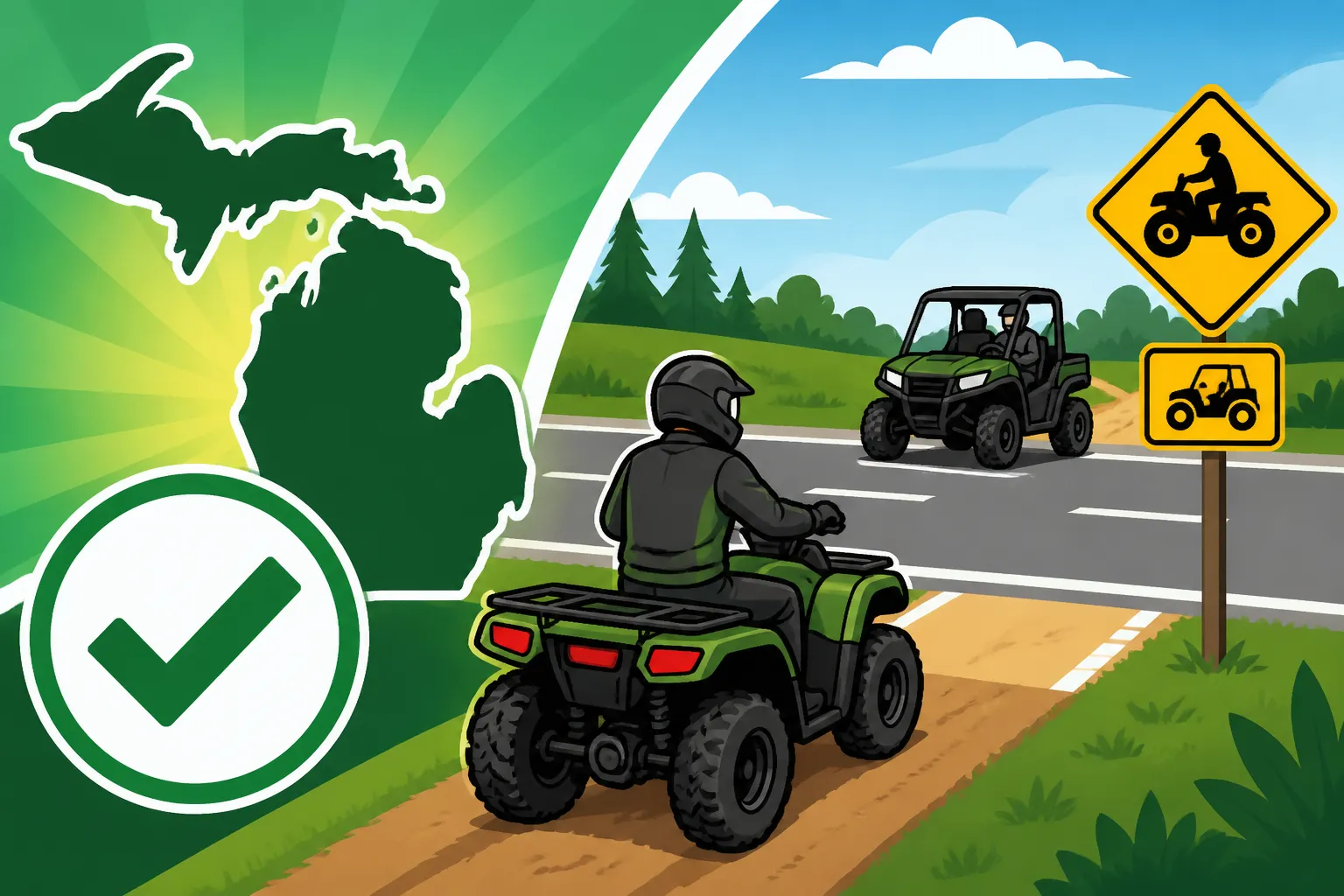
When you absolutely must cross a Michigan state highway, there is one non-negotiable principle: the "90-degree rule." This means you must approach the state highway, come to a complete stop, and then cross directly over it at a right angle – as close to 90 degrees as practically possible. You cannot ride along the shoulder, even for a short distance, and you cannot angle your crossing to make it feel easier or faster. The objective is to minimize the amount of time your ORV is on the paved surface of the state highway.
Crucially, you can only make these crossings where the state highway intersects with a designated ORV trail or a county road that is legally open to ORVs. You can't just pull off private property and decide to cross wherever you please. There has to be an established, legal connection point on both sides of the state highway. This often requires careful route planning. If your trail leads to a state highway without a corresponding trail or open county road directly opposite, you might need to reroute, sometimes for several miles, to find a legal crossing point.
Before even thinking about moving onto the pavement, you must stop completely. Take the extra moment to look left, then right, then left again. Seriously, give it your full, undivided attention. Vehicles on state highways are traveling at high speeds, and judging their distance and closing rate takes practice. Only proceed when you have a clear, safe gap in traffic that allows you to cross decisively and quickly. This isn't a race; it's a calculated, cautious maneuver for your own safety.
Crossing US-2 on an ORV
A common scenario that riders encounter involves state highways like US-2, especially in the Upper Peninsula, which often serves as a vital artery connecting communities. The rules for crossing US-2 with an ORV are exactly the same as for any other Michigan state highway. You must adhere to the 90-degree crossing rule at a legal intersection with an ORV trail or an open county road. You cannot ride along the shoulder, and you cannot cross any bridges or causeways that are part of US-2 itself.
Imagine you're near St. Ignace, trying to connect trails on either side of US-2. You can't simply ride down the shoulder to a convenient spot. You need to identify an intersection where a county road or another designated ORV route meets US-2, allowing for that strict perpendicular crossing. If your GPS or map app, like onX Offroad, doesn't clearly show a legal crossing point, you'll need to find an alternative route that avoids interacting with the main thoroughfare of US-2 except for a legal, quick, perpendicular passage.
The speed limits on US-2 can be high, and traffic, especially during peak seasons, can be considerable. This only amplifies the need for extreme caution and adherence to the crossing rules. Rushing or attempting an illegal crossing on a highway like US-2 is a recipe for a very bad day, risking both fines and a potentially devastating accident. Always prioritize safety and legality over convenience when dealing with major routes like US-2.
Bridge and Culvert Crossings on ORV Routes
This is where many riders get confused and often make critical mistakes. While you can cross a state highway at a proper intersection, Michigan law strictly prohibits ORVs from riding on the maintained portion of any bridge, causeway, or culvert that is part of a state highway. This means if the state highway itself spans a river, a gorge, or even a smaller ditch via a structural crossing, your ORV cannot legally use that structure.
Let's say your ORV trail leads you to an M-road that immediately turns into a bridge over a river. You might be tempted to just ride across the bridge to pick up the trail on the other side. Don't do it. That's an illegal act. Instead, you would need to find an alternative route, perhaps riding a county road (if permitted) for an extended distance, to cross the state highway before the bridge or to find a completely different way around the obstacle. This can add significant time and mileage to your trip, but it's the only legal and safe option.
These restrictions are in place because bridges and culverts often have limited shoulders, reduced visibility, and are not designed to safely accommodate mixed traffic that includes slower-moving ORVs. They are also subject to specific structural stresses. Always plan your routes with this in mind, and double-check your maps for any state highway bridges that might be on your intended path. It’s far better to discover you need to re-route while looking at a map than to be cited or, worse, involved in an accident on a bridge. [Michigan ORV Rules on Bridges and Causeways] further elaborates on this specific challenge.
Prioritizing Safety During State Highway Crossings
Safety isn't just a suggestion; it's the paramount concern whenever you interact with a state highway on your ORV. Even a legal crossing carries inherent risks, and it's your responsibility to mitigate those risks as much as possible.
Visibility, Speed, and Situational Awareness
When you approach a state highway crossing point, your entire focus needs to shift to safety. First, significantly reduce your speed as you near the pavement edge. Come to a complete, absolute stop. You need to be able to scan the highway clearly in both directions without your machine moving. Look, listen, and pay attention to everything around you. Are there approaching vehicles? How fast are they going? Are there any blind spots due to hills, curves, or vegetation?
Choose your moment to cross wisely. Don't try to "beat" traffic. Wait for a clear and ample gap where you can cross without having to rush or cause oncoming vehicles to brake. Once you commit, cross decisively and maintain that 90-degree angle. Don't weave, don't stop mid-crossing, and don't try to communicate with drivers. Your only goal is to get safely from one side to the other as quickly and directly as possible. Your small machine can be hard to spot for drivers traveling at highway speeds, especially if they're not expecting an ORV.
Situational awareness also means being aware of your group. If you're riding with others, ensure everyone understands the crossing procedure. Perhaps the lead rider waits until the whole group can cross safely, or each rider crosses individually after ensuring the path is clear. Always err on the side of caution. If visibility is poor, or if traffic is too heavy, consider finding an alternative route, even if it adds time to your journey. No ride is worth taking unnecessary risks on a state highway.
Rider and Passenger Requirements
All standard Michigan ORV safety requirements remain in full effect, and become even more critical, during state highway crossings. This means every rider and passenger must wear a DOT-approved helmet. [Michigan Helmet Law for ATV Riders] is clear on this. Eye protection is also mandatory, whether that's goggles, a face shield, or safety glasses, unless your ORV has an approved windshield. If you're in a UTV, everyone must be buckled into their seatbelts. These aren't just minor rules; they are crucial for protecting you in the event of an unforeseen incident.
If you have younger passengers or youth riders operating their own machines, ensure they are thoroughly briefed on the crossing procedure. Children should remain still and keep all limbs inside the ORV during the crossing. For young operators, ensure they meet all age and safety certificate requirements, and that they are under direct visual supervision if required. [Michigan ORV Safety Certificate Requirements] are critical for these moments. A responsible adult might even need to dismount and guide a young rider across if the situation demands it, always prioritizing safety over convenience.
These safety requirements are not just about avoiding a ticket; they are about minimizing harm. In an environment with fast-moving highway traffic, any impact, even a minor one, can have devastating consequences for an unhelmeted or unbelted rider. Always perform a quick check of everyone's gear before approaching the highway.
Machine Readiness: Lights, Brakes, and Tires
Your ORV itself needs to be in tip-top shape for any interaction with a state highway. First, ensure all your lights are functional. Your headlights should be on, and your taillights bright and visible. Good lighting increases your visibility to highway traffic, especially in less-than-ideal lighting conditions. Many riders upgrade their machines with brighter, more robust lighting, and aftermarket companies like SuperATV offer a range of options that can greatly enhance your ability to see and be seen.
Secondly, your brakes must be in perfect working order. You need to be able to stop quickly and reliably at the edge of the pavement, and potentially in an emergency. Check your brake fluid, pad wear, and ensure responsive braking on both front and rear. Thirdly, check your tires. Proper inflation and good tread are essential for maintaining traction on pavement, both when stopping and accelerating quickly across the highway. Worn or improperly inflated tires can compromise your control at a critical moment.
Finally, do a quick mechanical check. Is your engine running smoothly? Is your steering tight? Are there any odd noises or vibrations? A breakdown or stall in the middle of a state highway crossing is an absolute nightmare scenario. A pre-ride inspection is always recommended, but it becomes non-negotiable when your route involves crossing busy highways. A reliable machine is a safe machine, and SuperATV also carries many durable replacement parts that can help keep your rig dependable.
Penalties for Ignoring the Rules
While the thought of an accident is the most terrifying consequence, ignoring Michigan's state highway crossing rules also comes with significant legal and financial penalties that can quickly ruin your day, or even your season.
Potential Fines and Citations
If you're caught operating your ORV illegally on a state highway in Michigan – whether it's riding along the shoulder, making an improper crossing, or crossing a prohibited bridge – you can expect a citation. These aren't minor tickets. Fines for ORV violations on public roads can be substantial, often hundreds of dollars, and that's just for one offense. If law enforcement observes multiple violations (e.g., illegal crossing and no helmet and no ORV permit), those fines can quickly compound.
A conservation officer or sheriff deputy has the discretion to issue a citation that reflects the severity of the violation. Operating recklessly on a state highway will likely incur a higher penalty than a simple, unwitting error. These citations go on your record, and repeated offenses could lead to more serious legal consequences down the line. [Penalty for Operating an Untitled ORV in Michigan] is a good example of how a title issue combined with an operational violation can lead to even bigger headaches.
The financial hit alone is usually enough to deter most riders from deliberately flouting the rules. It's a costly lesson to learn, and one that's entirely avoidable by simply knowing and respecting the established regulations. Always assume that if you're doing something illegal on a public roadway, especially a state highway, someone will eventually notice.
The Risk of Accidents and Insurance Implications
Beyond the fines, the most severe consequence of ignoring state highway rules is the dramatically increased risk of an accident. As emphasized earlier, state highways are high-speed environments. An ORV is a small, relatively slow-moving vehicle. In a collision with a car or truck traveling at 55+ mph, the ORV and its occupants will almost certainly come out much worse. We're talking about severe injuries, permanent disabilities, or even fatalities.
Consider also the devastating financial impact of an accident if you're operating illegally. Most ORV insurance policies are designed to cover accidents that occur on designated trails, private property, or legally open county roads. If you're involved in a crash while violating state law on a state highway, your insurance provider could very well deny your claim. This means you could be personally responsible for all medical bills for yourself and your passengers, the damage to your ORV, and, perhaps most crippling, the damage and injury claims from any other vehicles or individuals involved in the accident.
This kind of financial liability could easily run into hundreds of thousands of dollars, potentially bankrupting you and your family. It's a grim reality, but one that every rider needs to consider. No amount of time saved or convenience gained by an illegal crossing is worth the potential for life-altering injury or catastrophic financial ruin. Protect yourself, your loved ones, and your assets by always operating legally.
Impoundment and Other Legal Headaches
In serious cases, especially if there's reckless operation, repeat offenses, or circumstances that endanger others, law enforcement has the authority to impound your ORV. Imagine having your machine seized miles from home, being left stranded, and then facing impound fees, storage costs, towing fees, in addition to any fines and court costs. It can quickly become an incredibly expensive and frustrating ordeal. And if there are any issues with your ORV's title or ownership, like those detailed in [Michigan ORV Title Problems and How to Clear Them], getting it back can be an even more prolonged nightmare.
Furthermore, if you're involved in an accident while operating illegally, or if there's any attempt to flee from law enforcement, you could face charges far more serious than a simple ORV violation. Charges like reckless endangerment, fleeing and eluding, or even criminal charges could be brought, depending on the severity of the situation. These are not minor infractions; they can lead to jail time, loss of your driver's license, and a permanent criminal record.
The regulations surrounding state highway crossings are in place for valid reasons. They protect ORV riders, other motorists, and the integrity of Michigan's transportation infrastructure. By understanding and adhering to these rules, you contribute to safer trails, maintain access for the ORV community, and protect yourself from severe legal and financial repercussions. Always choose the legal, safe path, even if it means a longer journey.
| Aspect | Permitted ORV Action | Prohibited ORV Action | Key Rule/Consideration |
|---|---|---|---|
| State Highway Riding | None (except for very specific crossing conditions) | Riding along the shoulder, driving for distance, cruising | State highways are for motor vehicles, not general ORV travel. |
| Crossing Angle | At a 90-degree angle to the highway | Angled crossings, riding partially down the highway | Minimize time on pavement; direct and quick is essential. |
| Crossing Location | At an intersection with a designated ORV trail or open county road | Anywhere else (e.g., from private property without an intersection) | Must be a legal connection point on both sides. |
| Bridges/Causeways | None (must find alternative route to cross highway before bridge) | Riding on any part of a state highway bridge, causeway, or culvert | These structures are off-limits for ORVs; plan your route to avoid. |
| Divided Highways | None (generally considered impassable) | Entering the median, crossing multiple lanes with a stop in between | Safety risk is too high; requires a full reroute. |
| Safety Equipment | Helmets, eye protection, seatbelts (for UTVs) mandatory | No helmet, no eye protection, unbuckled passengers | Standard ORV safety gear is legally required and critical for these high-risk areas. |
| Traffic Awareness | Stop, look multiple times, wait for a clear gap, cross decisively | Rushing, not stopping, assuming right-of-way, distracted crossing | High-speed traffic demands extreme vigilance and caution. |
Disclaimer
This article is for general informational purposes only and does not constitute professional advice. Laws, prices and regulations vary by location and change over time. Consult a qualified professional for guidance on your specific situation.