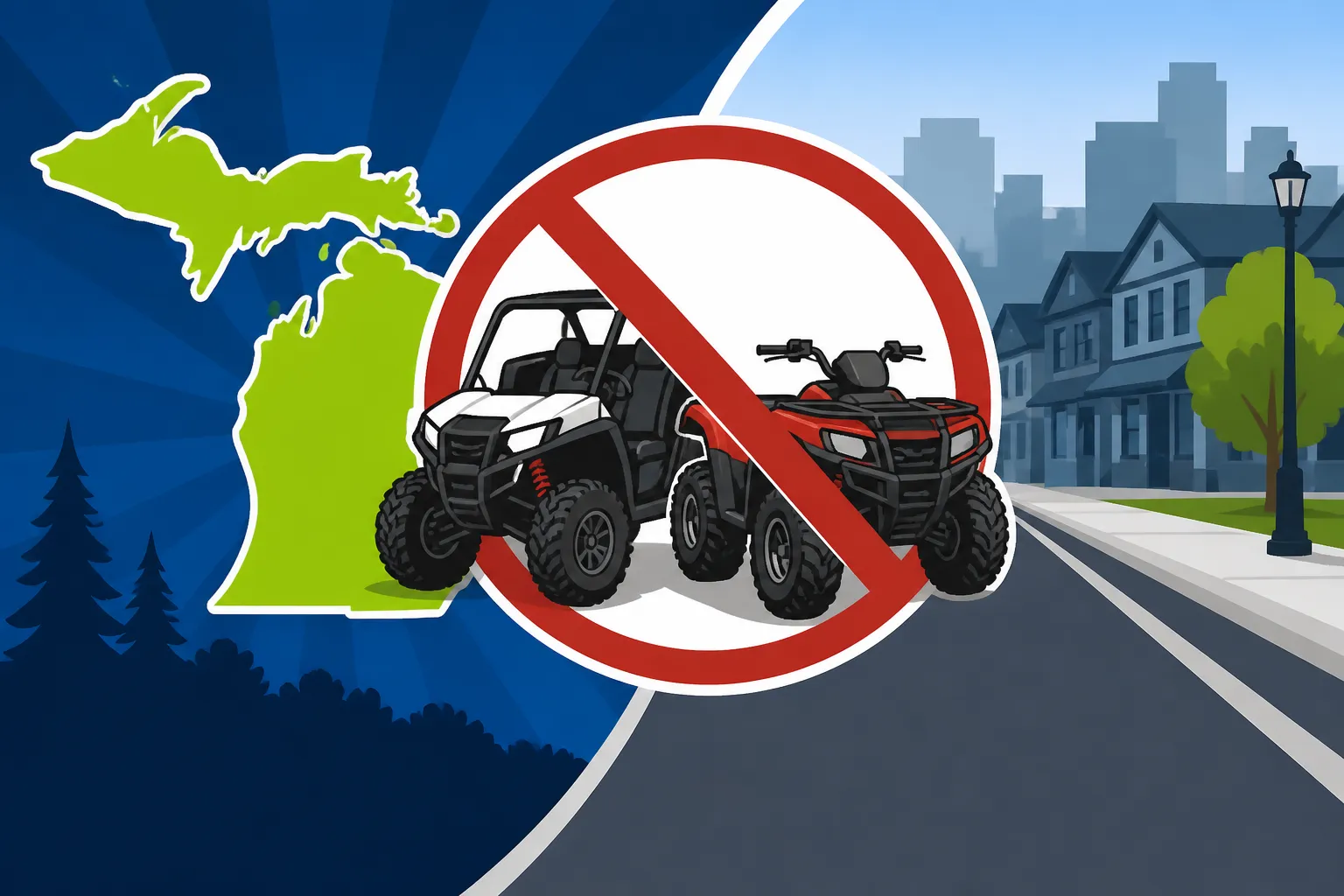
Michigan Cities That Ban ORVs on Streets
Riding your ATV or UTV is all about freedom, the open trail, and that exhilarating feeling of adventure. But that feeling can quickly turn to frustration when you're cruising down a county road, only to hit city limits and wonder, "Can I actually ride through here?" Many Michigan ORV enthusiasts face this exact dilemma, a confusing maze of state laws, county ordinances, and often, outright city bans. This guide is here to untangle that web, helping you understand why some Michigan cities close their streets to ORVs and how to figure out where you can and cannot ride without running into trouble.
The Complex Reality of City ORV Bans in Michigan
Michigan has made great strides in opening up county roads to ORVs, a welcome change for many riders. However, it’s not a blanket approval across every inch of the state. Cities and villages operate under their own sets of rules, and what's perfectly legal on a rural township road can become a ticket-worthy offense just a few blocks away in an incorporated city. This disconnect is a major source of confusion and disappointment for riders who just want to connect trails or grab a bite to eat.
The Clash Between State Law and Local Control
At its core, Michigan's ORV law allows counties to open their roads to ORV use, typically with certain conditions like speed limits (often [Michigan's 25 mph Limit on County Roads]), specific operating hours, and rider requirements like helmets. It feels like progress, right? And it is, for vast stretches of the state.
However, Michigan law also grants significant autonomy to local municipalities – cities and villages – to govern their own streets. This means that even if the county you're riding in has a robust ORV ordinance allowing road access, any city or village within that county can decide to prohibit ORVs on its streets. They don't have to follow the county's lead. This is why you might be riding legally on a gravel road, come to a city limit sign, and suddenly find yourself in a no-ORV zone. It's a classic case of overlapping jurisdictions, and for the rider, it means constant vigilance and knowing your local rules. The state provides the framework, but the local folks get to draw the lines that matter most to your ride.
Why Cities Prioritize Restrictions Over Road Access
So, why do so many cities, even small ones, choose to ban or heavily restrict ORVs? It's not always about being anti-fun; often, it boils down to very practical concerns that differ significantly from those in a rural setting.
- Safety Concerns: Cities have higher population densities, more pedestrian traffic, more cars, and often narrower streets. Integrating ORVs, which can be larger, heavier, and handle differently than standard vehicles, can raise significant safety concerns. There's worry about accidents involving cars, cyclists, and pedestrians, especially if ORV operators aren't accustomed to urban traffic.
- Noise and Nuisance: Let's be honest, many ORVs, particularly those with aftermarket exhausts, can be loud. In residential areas, especially quieter small towns, the noise from a passing convoy of ORVs can quickly lead to resident complaints about disturbances and a perceived decrease in quality of life.
- Infrastructure Impact: While modern ORVs like UTVs are incredibly capable, city infrastructure isn't always designed for them. Weight limits on smaller bridges, narrow lane widths, or the potential for damage to delicate paved surfaces (though less common than perceived) might factor into a city's decision.
- Perception and Image: Some cities worry about the "image" of ORVs on their main streets, fearing it might detract from a quaint downtown area or a family-friendly atmosphere. They might see ORVs as out of place in their urban or suburban environment.
- Vehicle Specifications: Even if you've done your best to make your UTV street-legal, adding turn signals, a horn, and mirrors (maybe even a full DOT-approved windshield from a brand like SuperATV), these modifications might meet state road requirements but still not address a city's underlying concerns about noise or size on their specific streets. A city ban often isn't about whether your machine is street-legal, but if any ORV is allowed at all.
These factors combine to create a compelling argument for city councils to err on the side of caution, leading to the bans we often encounter. It's frustrating when you see a perfect route through a charming downtown, only to realize it's off-limits, but understanding the city's perspective can sometimes help temper that disappointment.
Navigating the Unknown: How to Research a City's ORV Rules
The confusion is real, and the last thing you want is a ticket that could have been avoided. Before you ever roll a tire onto city pavement, you need to know the rules. "I didn't know" won't get you out of a fine. The good news is that with a bit of proactive research, you can usually find the answers you need.
Direct Engagement with City Officials and Websites
The most reliable source of information about a city's ORV policy is the city itself. Don't rely on hearsay from a buddy or a vague comment on a forum; go directly to the source.
- City Clerk's Office: This is often your best first stop. City clerks are responsible for maintaining official records, including ordinances. A quick phone call can usually get you pointed in the right direction, or they might even be able to tell you the policy outright. Be specific in your question: "Are ORVs allowed on any city streets in [City Name]?"
- City Website: Many cities now publish their ordinances online. Look for sections titled "Ordinances," "City Code," "Traffic," or "Motor Vehicles." Use the search function on their site for terms like "ORV," "ATV," "UTV," or "Off-Road Vehicle." You might find an entire ordinance dedicated to ORVs, or perhaps a section within a larger traffic code. Some cities might have a specific page under their police department or public safety section. For example, you could search for "[City Name] ORV ordinance."
- Local Police Department (Non-Emergency Line): If you're having trouble finding specific written ordinances, calling the non-emergency line of the local police department can also be helpful. The officers on patrol are the ones enforcing these rules, so they should be well aware of the city's stance on ORVs. Again, be specific in your questions.
Remember, if a city website or official tells you there's a ban, that's the definitive answer. Even if you've made your machine completely street-legal according to state requirements, a city's blanket ban still applies. It’s crucial to understand that even accessories like a robust street-legal kit from SuperATV, while excellent for compliance where permitted, don't override a local ban.
Understanding County Ordinances and Their Urban Limits
This is where much of the confusion truly lies. A county-wide ORV ordinance, which might open up thousands of miles of roads to riders, often has a critical caveat: it typically does not apply to incorporated cities and villages within that county, unless those specific cities and villages have opted in or passed their own similar ordinances.
Think of it like this: the county's ordinance applies to the "unincorporated" areas – the townships, the rural roads, the forest lands. Once you cross into an area with its own local government (a city or village), their rules take precedence. This means you might be legally riding on a county road in Roscommon County, but if you enter the village of Roscommon, their specific ordinance (or lack thereof) will dictate whether you can continue.
Always check the wording of any county ordinance you find. It will almost certainly include language clarifying that it doesn't extend into "incorporated municipalities" or "cities and villages." If you're unsure how to [How to Find Your Michigan County's ORV Ordinance], most county clerk websites or sheriff department pages will have this information. Therefore, even if you know your county is ORV-friendly, you still need to conduct due diligence for every city or village you plan to enter.
Deciphering Signage and Designated City Routes
While a full ban is common, some cities might have specific, limited allowances. This is less frequent than full bans, especially in denser areas, but it's worth knowing what to look for.
- Designated Routes: In rare cases, a city might have a specific "ORV Route" that allows for passage through a portion of the town to connect to trails outside its limits, or perhaps to access gas stations or restaurants. These routes should be clearly marked with official ORV route signs. If you don't see signs, assume there isn't a designated route. Don't just follow what seems like a logical path.
- "No ORV" Signage: Conversely, many cities that ban ORVs might not have specific "no ORV" signs at every single entry point. The absence of a positive "ORV route" sign, combined with your research indicating a ban, should be enough. However, some cities will have explicit "No ORVs on City Streets" signs, particularly at key entry points, which makes the message unequivocally clear.
- Parking Restrictions: Even if a city somehow allowed ORV passage, there might be specific parking rules. You can't just park an ORV anywhere you'd park a car; there could be local ordinances regarding vehicle type, size, or even the type of surface you can park on.
The takeaway here is that if a city allows ORVs, it will likely be very explicit about it, with clear signage indicating routes. If you find no such signs and your research points to a ban, then respect that boundary. You wouldn't want to receive a ticket because you misunderstood [Michigan ORV Rules Inside City Limits].
Life Under a City ORV Ban: Challenges and Alternatives
So, you've done your homework and confirmed that a particular Michigan city has banned ORVs on its streets. Now what? It's certainly a bummer, but it doesn't mean your riding adventures are over. It simply means you need to adjust your strategy.
The Dilemma of Trail Access Through Town
One of the biggest frustrations for riders is when a city sits squarely between them and their desired trail. You might live on the outskirts, or the best staging area is just on the other side of Main Street. When a city bans ORVs, riding through it to access trails or amenities like gas stations becomes illegal.
- Trailer Up: The most common and reliable solution is to trailer your ORV. If a city is a no-go, load your machine onto a trailer and drive it through town, or around it, to a designated staging area or trail access point. This might add a few minutes to your journey, but it beats a hefty fine or impoundment. Ensure your [Trailer Registration for Hauling ATVs in Michigan] is current.
- Rethink Your Route: Explore alternative routes that completely bypass city limits. Michigan boasts an extensive network of ORV trails and county roads open to ORVs. Sometimes, a slightly longer, more scenic route that avoids incorporated areas can be more enjoyable anyway. Use apps or maps like onX Offroad to scout routes that stick to permitted areas.
- Staging Outside City Limits: If possible, find staging areas or parking spots just outside the city boundaries. Many smaller towns that ban ORVs still have townships bordering them that are ORV-friendly. Look for public land access points or private businesses that offer parking for riders.
The Price of Disregarding City Restrictions
Ignoring a city's ORV ban is not worth the risk. Law enforcement in Michigan takes ORV regulations seriously, and penalties can be significant, far outweighing the convenience of a quick ride through town.
- Tickets and Fines: The most immediate consequence is a ticket. Fines for operating an ORV where it's prohibited can range from inconvenient to substantial, often in the hundreds of dollars. This is money that could be better spent on gear or trail permits.
- Impoundment: In more serious or repeat offenses, your ORV could be impounded. Retrieving an impounded vehicle is a costly and time-consuming process, involving towing fees, storage fees, and administrative charges, on top of the original fine. It's a real headache that can ruin your riding season.
- Criminal Charges: While rare for a first offense of simply riding on a banned street, continued defiance or combining it with other infractions (like reckless operation, operating under the influence—see [Michigan ORV Alcohol Limit and Penalties]—or riding without proper licensure) could escalate to more severe charges.
- Damage to ORV Community Reputation: Every time a rider ignores local rules, it reflects poorly on the entire ORV community. This can make it even harder for local clubs and advocates to push for more ORV-friendly policies in the future. Respecting local laws, even when frustrating, is crucial for preserving and expanding riding opportunities statewide.
Advocating for Change or Finding Permitted Riding Zones
If your favorite Michigan city has an ORV ban, you're not entirely powerless, but changing local laws is a long game.
- Engage with Local Government: Attend city council meetings, write letters, or speak with your local council members. Present a well-reasoned argument that addresses their concerns (safety, noise, etc.) and proposes solutions. Perhaps a designated bypass route or specific hours for ORV access could be explored. Showing them how street-legal modifications, like those from SuperATV, can make ORVs safer and quieter for road use might help, but prepare for an uphill battle. This process can be similar to [How a Michigan Township Passes an ORV Ordinance], requiring public input and council votes.
- Join ORV Clubs: Many Michigan ORV clubs actively advocate for rider rights and trail access. Joining forces with an organized group can amplify your voice and provide you with resources and strategies for engaging with local government.
- Focus on Permitted Areas: In the meantime, concentrate your riding efforts on the vast areas of Michigan where ORVs are welcomed. This includes thousands of miles of state trails, county roads where ordinances permit it, and dedicated ORV parks. Explore new areas and enjoy the freedom where it's explicitly allowed. Michigan has so much to offer, from the [Upper Peninsula ATV Trails Worth the Drive] to the famous [Silver Lake Sand Dunes in Michigan].
Understanding and respecting Michigan's complex ORV rules, especially when it comes to city streets, is key to being a responsible and long-lasting rider.
| Aspect of ORV Use | Reasons for City Bans | Conditions for City Allowance (if any) |
|---|---|---|
| Safety | High pedestrian/car traffic, unique ORV handling, speed concerns | Clearly marked, low-speed designated routes, strict operating hours |
| Noise & Nuisance | Residential complaints, aftermarket exhausts | Noise ordinances enforced, specific vehicle requirements (e.g., stock exhaust) |
| Infrastructure | Narrow streets, perceived damage to roads | Limited to specific road types, no heavy commercial ORV traffic |
| Local Control | City's right to govern its own streets, protect local character | Requires specific city ordinance to opt-in or create routes |
| Vehicle Types | Larger UTVs perceived as too big for city streets | May restrict to smaller ATVs, or require full street-legal conversions |
| Enforcement | Easier to enforce a blanket ban than complex rules | Requires dedicated law enforcement presence on routes |
Disclaimer
This article is for general informational purposes only and does not constitute professional advice. Laws, prices and regulations vary by location and change over time. Consult a qualified professional for guidance on your specific situation.