Trailhead Access Through Town
There’s nothing quite as frustrating as hauling your ATV or UTV all the way to a beautiful Michigan riding area, getting settled into your cabin or hotel, and then realizing the trailhead is just a mile down the road but you can't get there. You loaded your machine for adventure, not for moving it another mile on the trailer! This guide is all about helping you understand the rules for making those short, necessary hops through town to access the trails legally and without a headache in Michigan.
Understanding Michigan's ORV Road Riding Rules
Michigan offers an incredible network of ORV trails and routes, but getting to them often means you have to traverse some paved or gravel roads in towns or rural areas. This isn't just about convenience; it's about knowing the specific laws that govern where and how you can ride your Off-Road Vehicle (ORV) on public roads. It's a patchwork quilt of regulations, and if you don't know the pattern, you can quickly find yourself in a bind. The state provides a framework, but local municipalities often add their own rules, making it essential to do your homework.
The "Maintained Portion" and Designated Routes
First, let's talk about the big picture: what does the state allow? Michigan law generally allows ORV operation on the far right of the maintained portion of a road, or on the shoulder, provided it's a designated ORV route or a road that hasn't been specifically closed to ORVs by local ordinance. The "maintained portion" isn't just the paved part; it includes the shoulder and any graded area used for traffic. However, you're expected to stay as far to the right as safely possible. This isn't a free-for-all to cruise down the middle of Main Street. Think of it as sharing the road cautiously, much like a bicycle, but with a lot more rumbling.
Designated ORV routes are clearly marked, and those are your safest bet. These routes are usually county roads that have been approved for ORV use by the local county road commission. They are often crucial connectors between trails or provide access from small towns to the main trail system. If you see signs indicating an ORV route, you're generally good to go, assuming your machine meets the requirements (which we'll cover shortly). But just because a road looks like a good shortcut doesn't mean it's an approved route. You're specifically looking for those green and white signs. For more on the specifics, check out [The Three Road Rules Michigan ORV Riders Must Follow].
County and Local Ordinances
Here's where it gets tricky, and where most riders run into trouble. While the state sets baseline rules, Michigan law gives counties and townships the authority to pass their own ordinances regarding ORV use on local roads. This means that what's perfectly legal in one county or township might get you a ticket just a few miles down the road in another. It's a real head-scratcher sometimes, and it means you can't assume.
A county might have a blanket ordinance allowing ORV use on all county roads unless otherwise posted, while an adjacent county might ban them entirely on county roads unless specifically posted as an ORV route. And then there are townships, which can also pass their own rules, sometimes overriding the county. This is especially true for routes that go through downtown areas or residential neighborhoods. You might be able to ride a gravel road connecting to a trailhead, but the moment you hit the paved main drag of a small town, you could be breaking a local ordinance. Before you even think about firing up your machine and hitting the road, you absolutely must do your research on the specific county and township you're in. This really drives home the importance of knowing [Michigan County ORV Ordinances Explained].
Designated Trail vs. Road Shoulder
It's important to distinguish between riding on a designated ORV trail, which is typically off-road and specifically built for these machines, and riding on the shoulder or maintained portion of a public road to access that trail. When you're on a true ORV trail, the rules about speed, passing, and right-of-way are generally focused on trail etiquette and safety among other ORV riders. When you transition to a public road, even if it's an approved ORV route, you become part of the general traffic flow. This means you need to be aware of cars, trucks, and even bicycles.
On public roads, you're expected to maintain a safe speed, usually capped at [Michigan's 25 mph Limit on County Roads], and exercise extreme caution. You are sharing the road, not dominating it. You're also typically required to ride single file and as far to the right as possible. Don't assume the shoulder is always a legal place to ride; sometimes the rules specify "maintained portion," which might mean you're technically in the traffic lane (though always to the far right). Always look for signage and obey posted limits. For instance, sometimes a specific county ordinance will allow ORVs on the road shoulder but not the main travel lane. It's confusing, but the distinction matters to law enforcement.
| Scenario | Legal Status (General Michigan Rule) | Key Considerations |
|---|---|---|
| Designated ORV Trail | Legal | Follow trail signs, speed limits, and etiquette. |
| Designated ORV Route (Road) | Legal | Far right of maintained portion/shoulder; obey traffic laws, local ordinances, 25 mph speed limit. |
| Non-Designated County Road | Potentially Illegal | Check local ordinances first; often restricted unless specifically permitted. |
| State Highway / Freeway | Illegal | Absolutely prohibited; you cannot cross these unless explicitly marked. |
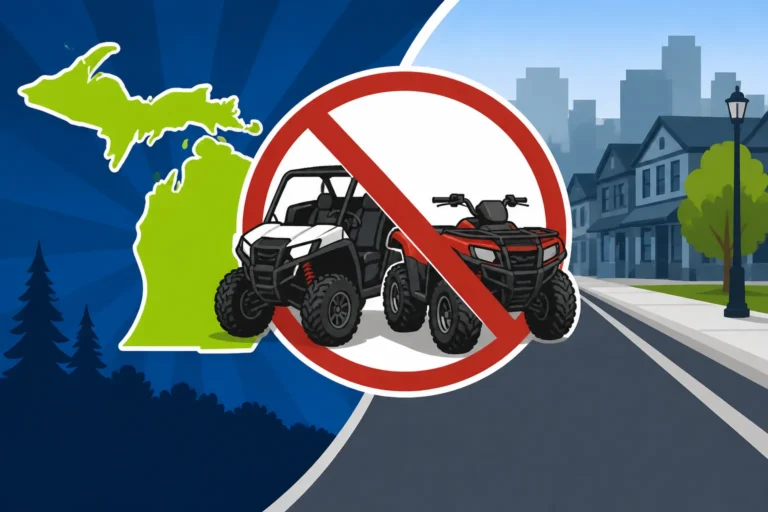
| City/Village Streets | Highly Restricted | Almost always illegal unless specific local ordinance allows; often requires "street legal" conversion. |
Essential Gear and Vehicle Requirements for Road Riding
Even for a quick jaunt through town to reach the trailhead, your ORV isn't exempt from certain requirements. It's not about making your machine fully "street legal" in the way a car is, but rather ensuring it has the basic safety features and you have the right gear to operate it safely and legally on a public road. Think of it as a bare minimum to blend into traffic for a short duration. Many riders are surprised by what’s expected, especially if they’re used to just hitting the dirt without a second thought about mirrors or turn signals. Even a temporary road use requires some preparation.
What Makes Your ORV "Road-Ready" for Short Stretches
For those short connectors or village access routes, your ORV needs to meet some basic criteria. The most critical are lights, brakes, and a muffler. Your machine needs working headlights and taillights, especially if there's any chance you'll be riding near dusk or dawn. Even during the day, having your lights on can increase your visibility to other motorists. Many riders choose to upgrade their lighting or add auxiliary lights, like those offered by SuperATV, for both trail and road use, ensuring they're seen no matter the conditions.
You must have working brakes on all wheels, and a functioning muffler to keep noise within reasonable limits – something that's particularly important when riding through residential areas. A horn is also usually required for an audible warning device. While turn signals aren't always explicitly mandated for all ORV road use unless it's a fully street-legal conversion, hand signals are always a good idea and can prevent misunderstandings with drivers. Make sure your ORV isn't leaking fluids and is generally in good repair; a breakdown on a public road is not only inconvenient but can also be dangerous. It's really about being a responsible vehicle operator, even if you're only going a mile. Check out [Michigan ORV Lighting Rules During Daylight] for more details.
Safety Gear and Best Practices
Personal safety gear is non-negotiable when you're on any public road, even for a short distance. While Michigan's helmet laws can vary depending on age and whether your UTV is street-legal, when you're making those short dashes through town, wearing a DOT-approved helmet is always the smartest move. It offers crucial protection in the event of an accident involving a larger vehicle. Combine that with proper eye protection – goggles or a face shield – to keep dust, debris, and bugs out of your eyes, ensuring you maintain clear vision.
Beyond helmets and eye protection, consider bright, visible clothing. Even if you have good lighting on your machine, a fluorescent vest or jacket can make a huge difference in how quickly drivers spot you, especially in low light or on winding roads. Remember, most drivers aren't expecting an ORV on the road, so anything you can do to stand out is a plus. Always keep your speed low, particularly on roads where traffic may be present or visibility is limited. It's not about getting there fast; it's about getting there safely. Also, be mindful of any passengers. If you're carrying a passenger, ensure they also have appropriate safety gear and that your machine is designed to safely carry more than one person. [Michigan Helmet Law for ATV Riders] is a good read.
Navigating Town: Practical Tips for Trailhead Access
So, you've got your machine ready, you're geared up, and you've done your research. Now it's time to actually make that run from your lodging to the trailhead. This isn't just about pushing the gas pedal; it involves careful planning, respectful operation, and a clear understanding of what to do if you encounter law enforcement. A little preparation here can save you a lot of grief and ensure your trip remains enjoyable.
Planning Your Route Legally
Before you even turn the key, you need a precise route. Don't just eyeball it. Use maps (paper or digital, like onX Offroad) to identify designated ORV routes or county roads that specifically allow ORV access. As we discussed, local ordinances are key. Many counties and townships publish their ORV ordinances online, often on the county clerk's or road commission's website. If you're staying in a small town, a quick call to the local sheriff's department or even asking at a reputable local outfitter or gas station can provide invaluable, up-to-date information. They'll know which roads are a no-go.
Plan your route to minimize time spent on public roads and to avoid busy thoroughfares, state highways (which are almost universally off-limits for ORVs), and areas with heavy pedestrian traffic. Look for the most direct, legally permissible path. Sometimes, this might mean a slightly longer route on a gravel road rather than a short cut on a paved county road. Always prioritize legality and safety over speed. Having a clear, legal path mapped out gives you confidence and reduces the chance of making a wrong turn into trouble. This due diligence is crucial, as highlighted in [How to Find Your Michigan County's ORV Ordinance].
Etiquette and Safety in Town
When you're riding your ORV through town, you're representing the entire ORV community. Be a good ambassador. This means keeping your speed well below the 25 mph ORV limit, being courteous to other drivers, pedestrians, and residents, and trying to keep noise to a minimum. Loud exhausts might be thrilling on the trail, but they can be a real nuisance in a quiet neighborhood. Avoid excessive revving or aggressive driving.
Always yield to pedestrians and bicycles, and give cars plenty of space. Use hand signals when turning, even if your machine has turn signals, as an added layer of communication. Pay extra attention at intersections and driveways. Remember, you're not just an ORV rider; you're also a driver sharing public infrastructure. If you need to stop for gas or a quick snack, choose businesses that are easily accessible and park responsibly, not blocking traffic or pedestrian walkways. Being considerate goes a long way in maintaining good relationships between ORV enthusiasts and local communities, especially when it comes to [Riding an ORV to a Gas Station].
Dealing with Law Enforcement
Despite your best efforts, there's always a chance you might encounter a DNR officer, county sheriff, or local police officer. If you are signaled to stop, do so immediately and safely. Pull over to the far right side of the road, shut off your engine, and keep your hands visible. Be polite and respectful. Officers are often just checking to ensure you're aware of the rules and that your machine meets requirements.
Have your paperwork ready: your Michigan ORV license and trail permit, a valid driver's license (if required for road operation, which it usually is), and proof of ownership or registration if applicable. Even if you're just traveling a short distance, having your [Michigan ORV Paperwork During a DNR Stop] is essential. If you've done your research and are confident you're following the local ordinances, calmly explain your route and your understanding of the rules. If you're unsure or realize you've made a mistake, acknowledge it respectfully. Arguing or being confrontational will only make the situation worse. Most officers appreciate a rider who is trying to be compliant and safe.
Common Pitfalls and How to Avoid Them
It’s easy to get caught up in the excitement of a ride and overlook some critical details when it comes to navigating your ORV through town. Many riders, even experienced ones, fall victim to common misunderstandings or assumptions, leading to fines or worse. Understanding these pitfalls ahead of time is your best defense against ruining a perfectly good day of riding.
Overlooking Local Ordinances
This is, without a doubt, the single biggest trap for ORV riders trying to access trailheads via public roads. The temptation is strong to assume that if you can ride on county roads in one area, you can ride on them everywhere. But as we've discussed, Michigan's local control over ORV ordinances means this is a dangerous assumption. A county might have a blanket "open unless posted closed" rule, while a township within that county might have a specific "closed unless posted open" rule for its own roads. It's a complex web.
Let's imagine you're heading up to Mio for a weekend of riding. You know Oscoda County allows ORVs on most county roads. You leave your cabin on a county road, but then you enter the actual village limits of Mio. The village might have its own ordinance prohibiting ORV use on any village streets. Suddenly, that quarter-mile stretch to the gas station or trailhead becomes an illegal maneuver. The only way to avoid this pitfall is diligent, pre-ride research. Check county and township websites, look for posted signs, and don't hesitate to ask local businesses or law enforcement if you're unsure. The peace of mind is worth the effort, and it prevents you from being among the [Tickets Deputies Write for Road Riding].
Assuming "Short Distance" Means Anything Goes
Another common misconception is that if you're "just going a little ways," the rules don't really apply, or that law enforcement will simply look the other way. This couldn't be further from the truth. A violation is a violation, whether it's for 100 feet or 10 miles. Law enforcement officers are often patrolling areas where ORVs are known to skirt the rules, precisely because of this assumption. They understand the need for trailhead access, but they also have a duty to enforce safety and community standards.
Consider this: you pull your UTV out of the driveway of your rental cabin, just 300 yards from the trailhead. You think, "It's so close, why bother with all the road rules?" But if that 300-yard stretch is on a paved state highway or a municipal street that explicitly bans ORVs, you're immediately in violation. Officers aren't going to excuse a lack of planning simply because the distance was short. This is especially true if your machine isn't equipped with basic safety items like mirrors or if you don't have your [Driver's License Rules for Michigan ORV Road Riding] in order. It’s about adherence to the law, not the length of your journey. Remember, even short trips through town still require common sense, respectful operation, and adherence to [Michigan ORV Noise Limits on Roads]. Equip your machine with quality accessories, like those from SuperATV, to help ensure you meet requirements and maintain visibility, even on short road stretches.
Disclaimer
This article is for general informational purposes only and does not constitute professional advice. Laws, prices and regulations vary by location and change over time. Consult a qualified professional for guidance on your specific situation.