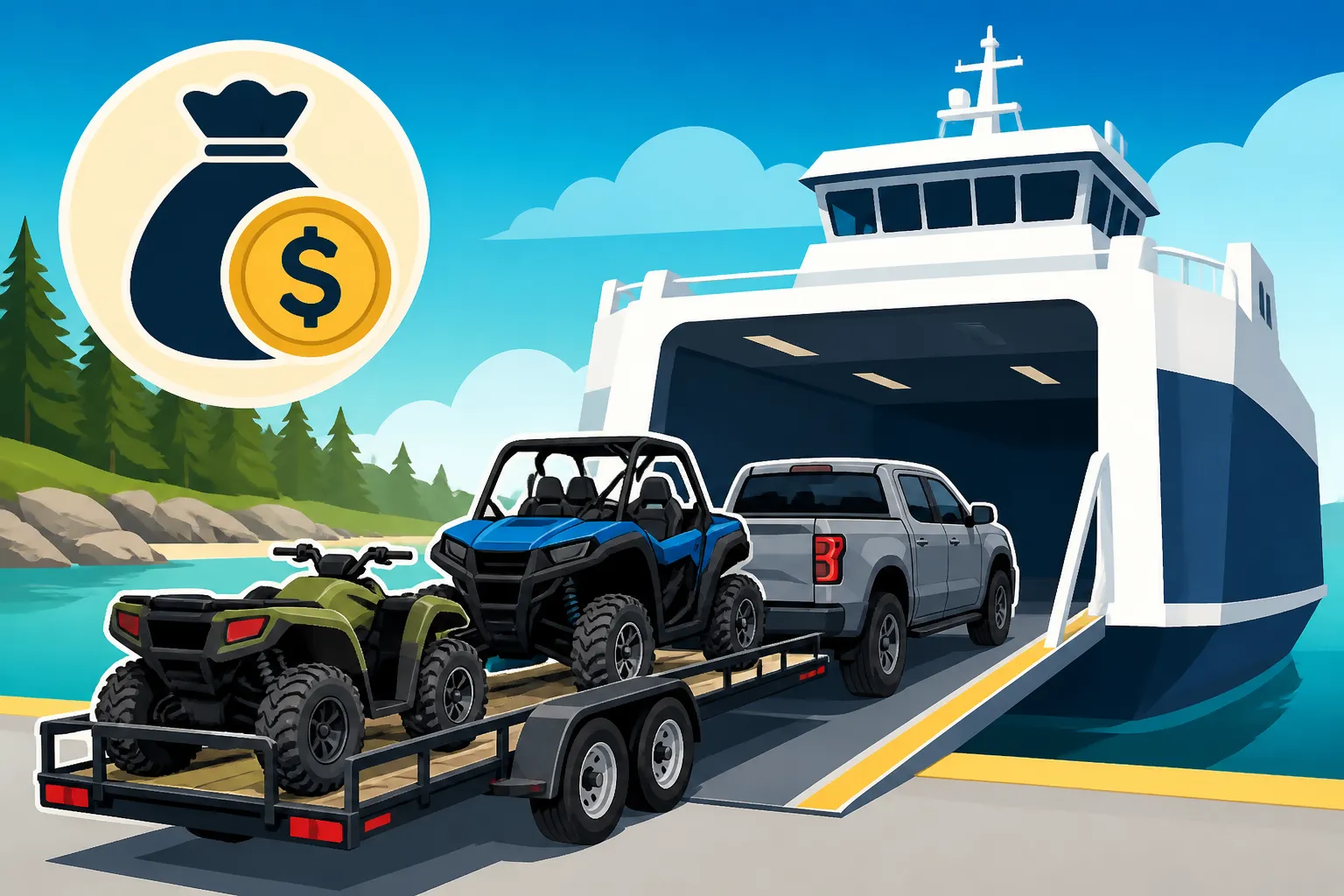
Drummond Island Ferry Cost With a Trailer
A Drummond Island ATV trip can get more expensive than expected when you arrive with a truck, trailer, passengers, and machines but have not checked how the ferry counts each piece. This guide explains what affects the crossing cost, what details to confirm before leaving DeTour Village, and how to plan the rest of your ride without guessing.
What affects the Drummond Island ferry cost with a trailer
Your vehicle and trailer may be counted separately
The ferry fare depends on the combination you bring, not just the fact that you are traveling to the island. A pickup towing an ATV trailer is different from a car carrying a machine on a hitch rack, and a long trailer may be treated differently from a short utility trailer. Don’t assume the trailer is included in the vehicle fare—or that the same fare category applies to every truck and trailer combination.
Before you travel, check the ferry operator’s current fare schedule and look for the categories that match your setup. If the schedule does not make your combination clear, call ahead. Have the towing vehicle type, trailer type, trailer length, and number of passengers ready. Include the hitch in your measurements if the operator asks for the total length of the combination.
A quick example: one group might tow a compact trailer with a single ATV behind a small SUV. Another might bring a full-size pickup, a long trailer, and several side-by-sides. Those are not safe to treat as equivalent when estimating the fare. The useful number to confirm is the total crossing cost for your exact vehicle, trailer, machines, and occupants.
Passenger counts and return plans matter
Check how passengers are handled in the fare schedule. Some transportation fares distinguish between the vehicle and the people traveling in it, so the number of occupants may affect what you pay. Confirm whether children are counted differently and whether the fare applies one way or to a round trip. Do not rely on a fare screenshot or an old trip report unless it matches the operator’s current information.
Also confirm the payment methods the ferry accepts and whether you need to make any arrangements before arriving. These details are easy to overlook when you are focused on packing helmets, tie-downs, and trail permits. A quick check can prevent a frustrating delay at the landing, especially if your group is traveling with more than one vehicle or trailer.
| Detail to confirm | Why it can affect your trip |
|---|---|
| Towing vehicle type | The vehicle may have its own fare category |
| Trailer length and type | A trailer may be charged separately or categorized by size |
| Total combination length | The ferry may need this to identify the correct fare |
| Number of passengers | Passenger fares or rules may apply |
| One-way or round-trip fare | Helps you compare the full crossing cost |
| Payment and boarding details | Avoids a last-minute problem at the landing |
How to estimate your crossing cost before you leave
Get an accurate measurement of your loaded setup
Measure the full combination you plan to take: towing vehicle, trailer, and any part of the load that affects the overall length. A trailer that looks short in the driveway can feel much longer once the ATV is loaded and tied down. If the ferry operator provides measurement instructions, follow those rather than relying on a rough estimate.
Write down your vehicle type, trailer type, trailer length, passenger count, and the number of machines. Then compare those details with the current fare information or use them when calling the operator. This is especially helpful when several families are meeting in DeTour Village and each vehicle has a different setup. You can estimate the group’s crossing expense more realistically before everyone sets out.
If you are carrying extra fuel cans, coolers, camping gear, or spare parts, make sure the load is secured and does not create a separate safety or access issue. The main cost question is still the vehicle-and-trailer combination, but a tidy, properly secured load also makes boarding and unloading less stressful.
Budget for more than the ferry fare
The crossing is only one line in an island riding budget. Include fuel for the drive to DeTour Village, fuel for riding, trail permits that apply to your machine and route, food, lodging, and any rental or repair needs. A group that calculates only the ferry fare may be surprised by the total once the trip is underway.
If you are riding your own machine, review [Getting to Drummond Island With an ATV] and check what permits apply to your planned riding. Michigan’s ORV license and trail permit are not the same thing as a ferry fare, and one does not replace the other. The guide [Michigan ORV License and Trail Permit Explained] can help you sort out which documents and permissions to check before you ride.
For route planning, look over [Drummond Island ATV Trail Mileage] and use a current map to match your planned ride to your machine and available time. onX Offroad can help you review route options and keep your navigation plan organized. Check map details before the trip, and carry a backup plan in case your phone loses service or its battery runs low.
Planning the crossing with an ATV or UTV trailer
Prepare for the DeTour Village landing
Treat DeTour Village as the start of the island portion of your trip, not just a place to pull up at the last minute. Before you arrive, make sure everyone knows which vehicle is towing, who is riding in each vehicle, and where the machines and gear are secured. Keep paperwork, payment, and anything you need to access quickly in the tow vehicle rather than buried in a trailer box.
Give yourself breathing room in the schedule. A tightly packed itinerary can become stressful if your group needs to reorganize gear, confirm a fare category, or wait for a suitable crossing. If you are traveling with multiple rigs, agree on a meeting point and a way to communicate if one vehicle arrives later than the others. Check the ferry operator’s schedule and boarding instructions before setting out, rather than assuming a past visit’s timing will work for this trip.
For a broader trip plan, [Where to Stay When Riding Drummond Island] can help you think through lodging and access. If you are not bringing a machine, or someone in your group would rather not tow one across, look into [Drummond Island ATV Rentals and Tours] and confirm what the rental arrangement includes. Do not assume that rental availability, permits, or pickup arrangements are automatic.
Secure the machines and gear before boarding
Check every tie-down before you reach the landing. The ATV or UTV should be secured at appropriate points, with straps in good condition and no loose gear that could shift during transport. Recheck the load after a stop on the drive, particularly if you have traveled over rough pavement or made a sharp turn. Keep helmets and frequently used items accessible, but avoid leaving them loose on top of the machine.
Think about unloading in reverse when you pack. If a cooler or luggage blocks access to the straps, you may have to move half the trailer before you can release the machine. Organizing the load before departure saves time and keeps the group from scrambling while others are waiting to board or unload.
For navigation once you reach the island, onX Offroad can be useful for reviewing the route before you start riding. Save the information you need in advance where offline access is available, and don’t rely on a cell signal as your only navigation plan. You can also review [Michigan ORV Trail Maps and What the Signs Mean] so the markings you encounter are easier to interpret.
Common cost surprises and ways to avoid them
Don’t assume a trailer is included or priced by the ATV
One of the easiest mistakes is budgeting based on the machine rather than the full towing setup. The ferry is transporting a vehicle combination, so an ATV on a trailer behind a truck is not necessarily priced like an ATV arriving by itself. Another common mistake is comparing a short trailer fare with a longer loaded trailer and assuming the quoted amount will be the same.
Avoid relying on a friend’s estimate unless their vehicle and trailer match yours. Even two pickups can have very different setups once trailer length and passenger count are included. If you are near a fare-category boundary, ask the operator which category applies instead of rounding down and hoping for the best.
The same caution applies to return travel. Confirm whether the fare information you are using covers one crossing or a round trip, and keep a little flexibility in your overall budget. That way, a difference between your estimate and the final fare is less likely to derail the rest of the trip.
Plan around trails, weather, and your group’s needs
Trail conditions can change how long a ride takes and what you need to carry. Drummond Island’s limestone routes may be slick or uneven after rain, so check conditions and adjust your plans rather than trying to force a long loop. [Drummond Island Limestone Trails After Rain] is a useful related read for thinking through wet-weather riding.
Use onX Offroad or another reliable mapping method to choose routes that suit the group’s machines and experience. A long route that looks manageable on a screen may be tiring for a beginner, a young rider, or someone who has not ridden for several hours. Build in time for breaks, fuel, and route changes. If your group includes inexperienced riders, agreeing on a shorter first ride can make the day more enjoyable than trying to cover every trail.
Finally, check [Michigan ORV Trailhead Parking Rules] and [Fuel Range on a Long Trail Loop] as part of your preparation. Confirm where you can park, where you can refuel, and what you need to carry. These checks do not change the ferry fare, but they help prevent extra driving, unnecessary delays, and avoidable costs once you reach the island.
Disclaimer
This article is for general informational purposes only and does not constitute professional advice. Laws, prices and regulations vary by location and change over time. Consult a qualified professional for guidance on your specific situation.