Getting to Drummond Island With an ATV
Getting an ATV to Drummond Island takes a little more planning than pointing your truck north: you’ll need to reach the ferry dock in DeTour Village, arrange the crossing for your tow vehicle and trailer, and make sure your machine and permits are ready for the island’s trails. This guide walks through the trip from mainland Michigan to a practical first ride.
Plan the drive to the Drummond Island ferry
Follow the road route to DeTour Village
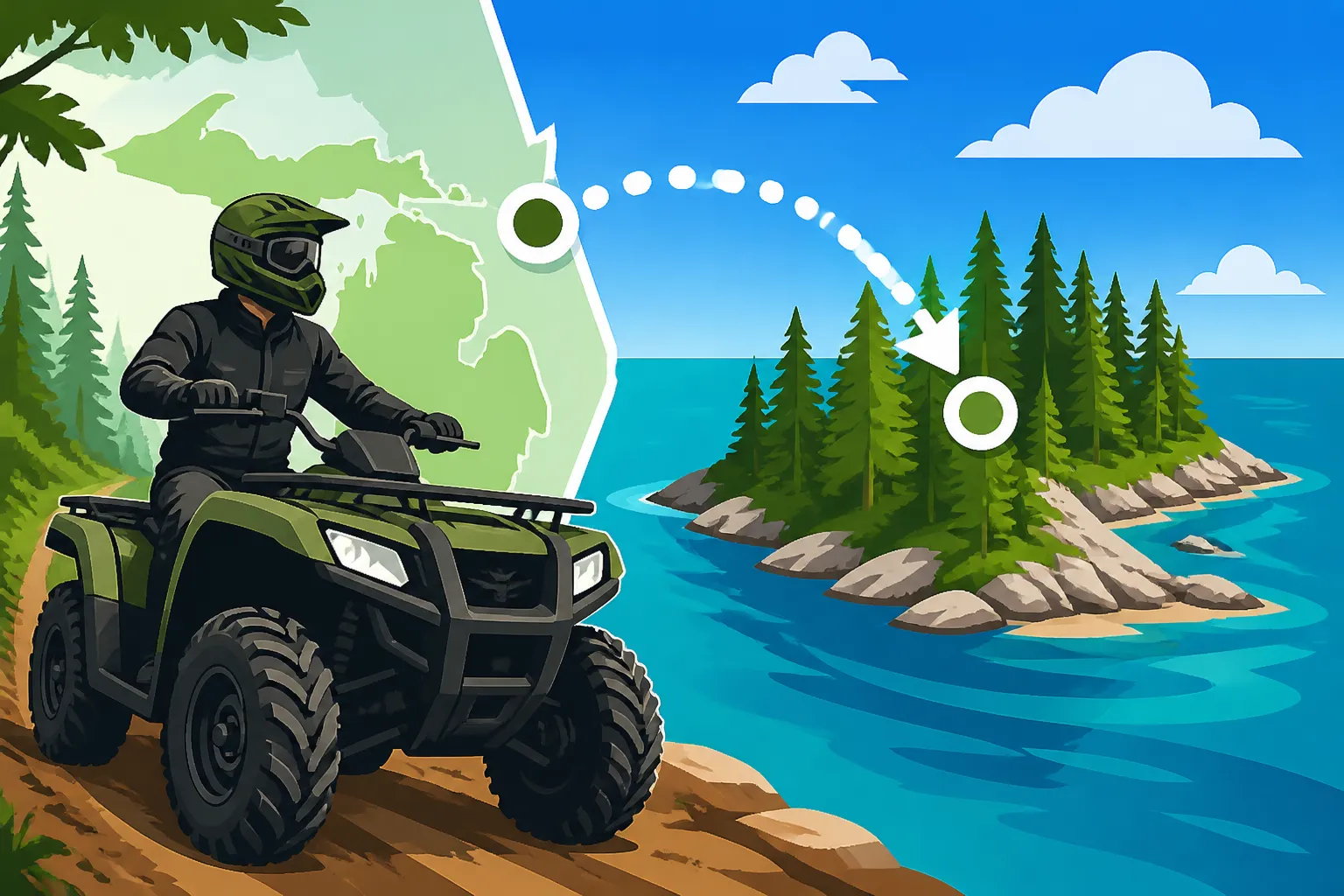
Drummond Island is reached by ferry from DeTour Village in Michigan’s eastern Upper Peninsula. For most visitors bringing an ATV, the simplest plan is to drive a road-legal tow vehicle to the dock with the machine secured on a trailer or in the truck bed, then cross with the vehicle and ATV aboard. The ATV itself isn’t a substitute for the drive to the ferry: don’t plan to ride it on public roads to reach the dock unless you have confirmed that the specific roads allow it and that your machine and paperwork meet the applicable requirements.
From the Mackinac Bridge area, follow your chosen route into the eastern Upper Peninsula and continue toward DeTour Village. A navigation app can help with the mainland drive, but it won’t tell you whether the ferry has room for your particular vehicle-and-trailer combination or whether conditions have changed. Before leaving, check the ferry operator’s current schedule, boarding instructions, and vehicle requirements. Confirm how to describe your setup, including the tow vehicle, trailer, and overall length. That can prevent a frustrating surprise at the dock.
Leave more time than your map estimate suggests, especially if you’re towing. Fuel stops, meals, roadwork, and slow travel behind other vehicles can all add time. If you’re arriving from southern Michigan, consider whether a stop on the mainland makes the drive less tiring. A rested driver has an easier time positioning a trailer, following dock directions, and securing gear for the crossing.
For a broader sense of what awaits after you arrive, read Drummond Island: Michigan's Largest Closed-Loop Trail. If you’re deciding whether the island works for your machine, also check Drummond Island ATV Trail Mileage and Turtle Ridge Trail Difficulty. Trail distance and difficulty are useful planning clues, but they don’t replace checking the route details and current riding conditions before heading out.
Prepare your ATV and trailer for boarding
Treat the ferry crossing as part of the trip, not as a quick stop where you can sort out loose equipment at the last moment. Secure the ATV to the truck or trailer using suitable tie-down points and straps. Check that the machine cannot roll, shift, or tip, and stow loose helmets, bags, tools, and fuel containers so they can’t slide around. If you’re carrying a spare can, follow the ferry operator’s instructions for transporting fuel.
Give the machine a quick pre-trip check: look over the tires, brakes, lights, straps, and hitch connection. Make sure the trailer’s lights work and that the load doesn’t block required lights or the license plate. If you have a side-by-side, be especially careful about width and overall height, including accessories such as a roof, windshield, or cargo rack. Share accurate dimensions when checking boarding arrangements rather than relying on a rough guess.
If you’ve never taken an ATV across on this route, call ahead with a simple description: “I’m towing a trailer with a two-seat side-by-side,” for example. Ask whether the operator needs vehicle dimensions or any other information before you arrive. Boarding procedures and available space can vary, so don’t assume that a setup which fit on a previous trip will automatically fit the same way next time.
Pack documents where you can reach them without unloading the ATV. That might include your machine’s title, proof of ownership, insurance information, and any required riding permits. For title-related questions, Michigan ORV Titles for Clubs and Businesses is relevant if you’re bringing a machine owned by a club or company; for an individual purchase, Michigan Title Rules for an ORV Bought Out of State may help you sort out paperwork before travel.
Handle the crossing and arrive ready to unload
Know what to confirm before you reach the dock
Ferry plans are easier when you separate what you can prepare from what only the operator can confirm. You can arrive with a secured load, current travel details, and a clear understanding of your vehicle dimensions. The operator can tell you the current schedule, boarding process, and space arrangements for your particular combination. Check those details close to your departure rather than relying on an old itinerary or a friend’s memory of a past crossing.
| Before you go | What to check | Why it matters |
|---|---|---|
| Mainland drive | Route to DeTour Village and planned fuel stops | Towing can make detours and delays more difficult |
| Ferry crossing | Current schedule, boarding directions, and vehicle requirements | Your tow vehicle and trailer need to fit the operator’s arrangements |
| ATV load | Tie-downs, straps, loose equipment, and fuel containers | A stable load is safer and easier to handle at the dock |
| Riding paperwork | Ownership documents, permits, and insurance details | You can address questions without unpacking the trailer |
| Island route | Trail access, machine width, and current closures | Not every route is suitable for every ATV or UTV |
On arrival, follow staff directions and leave room for other vehicles to maneuver. Don’t start repositioning a loaded trailer or unloading the ATV unless instructed and the area is safe for it. After the crossing, wait until you’re directed to move, then take a moment to confirm your route before leaving the dock area. It’s much easier to spot a missed turn on a map while parked than to make a rushed decision with a trailer behind you.
If you’re using a trail app, download the maps you need before you lose reliable service. For example, [onX Offroad for Michigan Trail Maps] can help you review routes and keep map information available for trip planning. Don’t rely on a phone’s live connection as your only navigation option. Save relevant maps offline, carry a backup power source, and keep a paper map or written directions if you have them.
Make the first ride a low-stress one
After unloading, resist the temptation to begin with the longest loop on your list. First, check that your ATV starts and runs normally after the drive, that the tires and straps show no problems, and that everyone has their helmets and other riding gear. If you’ve just arrived after a long tow, a shorter ride gives you time to get familiar with the area and notice anything you forgot to pack.
Confirm that the trail you intend to use is open to your machine’s width and type. An ATV and a full-size side-by-side may not be allowed on the same trail segments, and trail conditions can change after rain or maintenance. Check the signs at access points and use current route information rather than assuming that a line on a map means every machine can travel it. Michigan ORV Trail Widths Explained can help you understand why machine dimensions matter when you’re choosing a route.
Permits and license requirements depend on where and how you ride. Review [Michigan ORV License and Trail Permit Explained] before leaving home, and verify that your setup meets the rules for the routes you plan to use. Keep any required stickers displayed as directed and make sure every rider understands the plan, including where the group will stop and what to do if someone gets separated.
Choose a route that fits your machine and your group
Match trail width and difficulty to your vehicle
Start your trip by matching the route to the narrowest or least experienced rider in your group, not the boldest person in the group chat. A trail that sounds manageable on paper can feel very different when it’s muddy, rutted, or crowded. If you’re bringing a wider UTV, check width restrictions before you commit to a route. If you’re riding with children or newer operators, choose a route that leaves room for unhurried turns and breaks.
A useful planning habit is to keep a primary route and a shorter backup. If weather changes, a rider feels tired, or a trail proves more challenging than expected, you can turn the day into a manageable ride instead of pushing on just to complete a planned loop. Tell someone where you expect to ride and when you plan to return, especially if your group is unfamiliar with the island.
Before departing, set a few simple group rules: keep enough space between machines to stop safely, wait at major turns, and don’t leave a rider behind without checking in. Agree on what to do if a machine has a problem. Carry basic tools and water, and make sure riders know how to contact one another if the group gets spread out. Mobile coverage can be inconsistent in remote areas, so don’t make a phone call your only backup plan.
If you’re choosing between different areas, Turtle Ridge Trail Difficulty is a helpful place to start comparing the ride with your group’s experience. Also review Michigan ORV Trail Maps and What the Signs Mean so you’re prepared to interpret posted trail information rather than relying only on the route you saved.
Build in time for the ride back
The ferry is part of your return plan, too. Check the operator’s arrangements for the day you’re leaving, and allow enough time to get off the trail, inspect and secure your machine, and reach the dock. Don’t schedule your final ride so tightly that one wrong turn or minor repair puts the crossing at risk. If timing is important, make the last day’s route shorter and keep your machine fueled and ready.
At the end of the ride, inspect the ATV before loading it. Look for loose parts, damaged straps, tire problems, or mud and debris that might interfere with tie-downs. Secure helmets and loose gear, confirm the hitch and trailer connections, and check the lights again. A quick inspection takes less time than discovering a problem when you’re already in line to board.
Pack out everything you brought, including trash and any disposable items. Stay on open, permitted routes, respect private property, and follow posted signs. If you encounter a closure or a route that appears unsuitable for your machine, turn around rather than trying to squeeze through. The goal is to enjoy the island and leave its riding areas in good shape for the next group.
A practical checklist for getting to Drummond Island with an ATV
Before leaving home
Use this checklist a few days before your trip, then do a final walk-around before pulling out. If you’re carrying more than one ATV or bringing passengers, assign one person to check the trailer and another to check riding gear. That small division of responsibility makes it less likely that everyone assumes somebody else packed the tie-downs.
- Confirm your route to DeTour Village and choose fuel and rest stops that work for a tow vehicle.
- Check the ferry operator’s current schedule, instructions, and requirements for your vehicle and trailer.
- Secure the ATV and stow loose equipment. Check the hitch, safety chains, trailer tires, and lights.
- Gather ownership documents, insurance information, and permits needed for the riding areas you plan to use.
- Review trail width, access, and difficulty. Save maps for offline use and identify a shorter backup route.
- Pack helmets, protective gear, water, basic tools, first-aid supplies, and a way to keep devices charged.
- Share your route and expected return time with someone who isn’t riding with you.
If your trip crosses state lines or you recently bought the machine, make sure the ownership paperwork is settled before travel. These guides may help with common situations: Proof of Ownership When a Michigan ORV Has No Title and Michigan ORV Title Problems and How to Clear Them. Sorting out paperwork at home is far less stressful than trying to resolve a question while your loaded trailer is waiting.
At the dock and on the island
When you reach the dock, follow the posted directions and staff instructions. Keep your documents accessible, but don’t leave important items loose on the ATV. Once you’re on the island, take a moment to confirm your starting point and the route to your trail access. If your navigation app shows a tempting shortcut, verify that it’s an allowed road or trail before following it.
On riding days, check your machine before setting out and again before loading for the return. Keep the group together at turns and junctions, take breaks before riders are exhausted, and change plans when conditions call for it. For detailed local route planning, Drummond Island ATV Trail Mileage is a useful companion to the practical travel preparations above.
A smooth Drummond Island ATV trip comes down to three things: a well-planned drive to DeTour Village, a properly secured machine for the ferry crossing, and a riding plan that fits your group and your vehicle. Confirm the crossing details, prepare your paperwork and maps, and give yourself breathing room on both travel days so the ride itself can be the enjoyable part.
Disclaimer
This article is for general informational purposes only and does not constitute professional advice. Laws, prices and regulations vary by location and change over time. Consult a qualified professional for guidance on your specific situation.