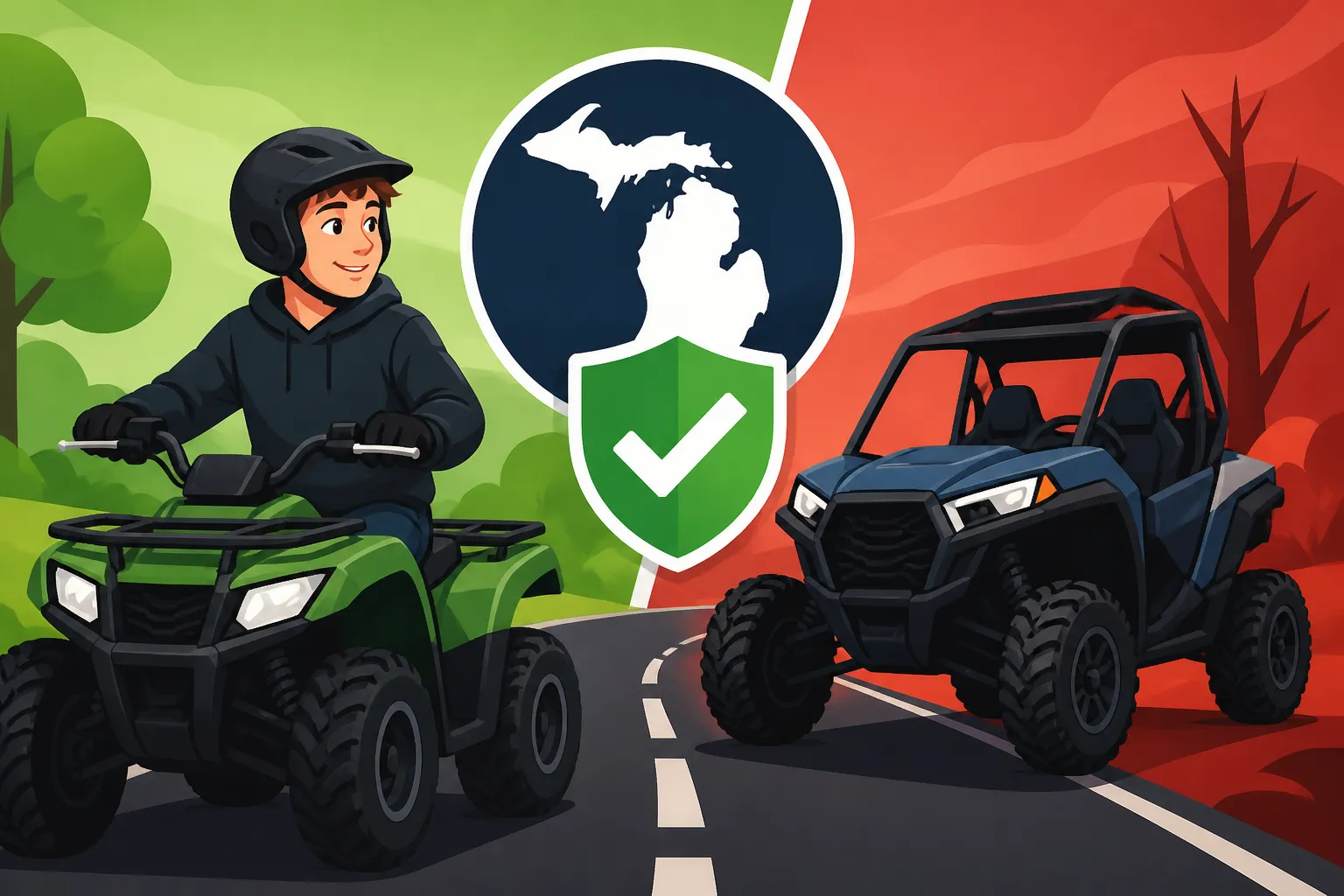
Can a 15-Year-Old Ride on a Michigan County Road?
Michigan county roads can feel like open invitations to adventure, especially for a 15-year-old eager to explore on their ATV or UTV. However, the dream of cruising down a gravel two-track often collides with Michigan's specific and quite strict rules for off-road vehicles on public roads. It's a common source of confusion and frustration for families, but this guide will clear up exactly what's allowed and, more importantly, what isn't, for young riders.
The Strict Rules for Young Riders on Michigan Roads
It's easy to assume that if an ORV is allowed on a county road, any rider can operate it. But Michigan law has a significantly different set of expectations for young riders, particularly when it comes to public roadways. The state aims to protect both the young riders and the public by imposing clear age, supervision, and training requirements that are far more stringent than riding on private property.
General Age Requirements for Road Riding
Here's the tough truth right upfront: a 15-year-old cannot legally ride an ORV unsupervised on a Michigan county road, even if that road is open to ORVs. The law is quite clear: to operate an ORV on a county road without direct adult supervision, the operator must be at least 16 years old. And even then, they must hold a valid driver's license if the ORV is operated as a street-legal vehicle (which involves a whole different set of certifications and equipment). This distinction is crucial because a typical ORV, even on a designated ORV route, doesn't automatically qualify as a "street-legal" vehicle in the eyes of the law. For most ORVs on county roads, the rules are geared towards recreational use, not typical vehicular travel, and the age barrier for independent operation is firm. It's a big hurdle that often catches families off guard, as the freedom of off-roading elsewhere might not translate to these public spaces. For more on this, you can check out [Michigan ORV Road Riding Age Minimum].
The "Under Direct Visual Supervision" Clause
Even if a 15-year-old doesn't meet the 16-year-old minimum for unsupervised riding, there is a provision that allows them to ride under direct adult supervision. But this isn't a casual "they're somewhere behind me" kind of supervision. Michigan law defines "direct visual supervision" quite specifically. The supervising adult (who must be a parent, guardian, or an adult at least 18 years old designated by a parent or guardian) must be within 100 feet of the young rider and maintain constant visual contact. This isn't just about being in the same general area; it's about active, immediate oversight. Imagine a parent riding their own ATV or UTV with their 15-year-old directly in front or behind them, always keeping them in sight. This means if you're riding in a group and your child is a few machines back or takes a different turn, that "direct visual supervision" is immediately broken, putting your child (and you) in violation of the law. This stringent requirement is in place to ensure that in an emergency or unexpected situation, the supervising adult can respond instantly. Understanding [What Direct Visual Supervision Actually Means] is key to staying legal and safe.
Mandatory Safety Certificates and Training
Beyond age and supervision, every rider under the age of 16 operating an ORV anywhere other than private property owned by their parents or guardians must possess an ORV safety certificate. This isn't just a suggestion; it's a legal requirement. These courses, available both online and in person, cover crucial topics like safe riding practices, Michigan ORV laws, environmental ethics, and basic machine maintenance. For a 15-year-old, completing one of these courses is non-negotiable before they can even consider riding on a county road, even with an adult watching them. The certificate demonstrates that they've received formal instruction on how to operate an ORV responsibly. Without it, even perfect supervision won't make their ride legal on a public road. It's a foundational step to ensure young riders understand the power and risks associated with these machines. Many parents find these courses invaluable for instilling good habits, regardless of where their child rides. For all the details on how to get this crucial document, refer to [Michigan ORV Safety Certificate Requirements].
Machine and Road Requirements for ORV Road Access
Even with a 15-year-old who has a safety certificate and is under direct supervision, the path to riding on a Michigan county road isn't automatically clear. The type of machine they're riding and, crucially, whether the specific road even allows ORVs, adds further layers of complexity to the rules. It's not a blanket permission; it's a patchwork of local ordinances and state statutes.
Not All Roads Are Open to ORVs
Perhaps the biggest misconception about ORV use on roads is that if a sign doesn't explicitly prohibit it, then it must be allowed. This couldn't be further from the truth in Michigan. ORVs are only permitted on county roads that have been specifically opened by a local ordinance passed by the county board of commissioners. If a county hasn't passed such an ordinance, or if a specific road isn't included in it, then ORVs are not allowed, regardless of the rider's age or supervision. This means a 15-year-old, even with all other requirements met, can only ride on county roads that are legally designated as ORV routes. State highways are almost universally off-limits, and most city and village streets have their own strict prohibitions. It's vital to research the specific county and road you plan to ride on. A quick search for "Michigan ORV ordinances [county name]" can help, or visiting the county clerk's website. The responsibility to know where you can and cannot ride falls squarely on the operator and their parents. Don't assume; always verify. For a deeper dive into this, see [Michigan County ORV Ordinances Explained] and [Michigan's Three Road Rules Michigan ORV Riders Must Follow].
Machine Size and Type Matters
Michigan also has specific rules regarding the engine size of ATVs that can be operated by riders under 16, typically limiting them to 90cc or less. While many 15-year-olds might be riding larger machines on private land, these size restrictions often come back into play when considering public access. For UTVs, the rules can be a bit more nuanced, but the underlying principle is safety. A UTV intended for multiple passengers or with a larger engine might present different challenges than a small ATV for a young rider. Furthermore, for any ORV to be legally operated on a county road (even if the road is open to ORVs), it must meet certain equipment requirements. This often includes things like a functioning brake system, a spark arrestor on the exhaust, and proper lighting if riding during certain hours. Some counties might also require additional items like mirrors or turn signals if they've designated certain ORV routes. If you're looking to add accessories to meet these kinds of requirements for a legally operating adult, companies like SuperATV offer a wide range of components, from turn signal kits to mirrors, that can help make a machine more compliant with general road use stipulations. However, it's critical to remember that adding these accessories doesn't magically make a 15-year-old legal to drive a machine that otherwise falls outside of Michigan's specific age, supervision, and engine size rules for county roads. The base laws about who can operate what, where, and when still apply, regardless of how tricked out the machine might be. For specific information on engine size restrictions, refer to [Youth Machine Engine Size Limits in Michigan].
Crossing vs. Riding Down a Road
There's a significant difference in Michigan law between simply crossing a county road and actively riding down it. Many trails might require an ORV to briefly cross a paved or gravel road to get from one section of a trail system to another. While this is generally allowed on roads that aren't designated as ORV routes, it comes with its own set of rules. However, for a 15-year-old, the same core requirements still apply: they must have their ORV safety certificate and be under the direct visual supervision of an eligible adult. They also have to follow specific safety protocols, such as stopping before crossing, yielding to vehicle traffic, and crossing at a right angle to the road. You cannot ride an ORV, regardless of age, on a state trunk line highway (like US, M, or I routes) except to cross at a designated intersection. The freedom to cross does not extend to riding along the shoulder or the main travel lanes. This distinction is crucial for safety and legality, and deputies are well-versed in the difference. Understanding rules around [Crossing a State Highway on an ORV in Michigan] can further clarify these specific situations.
Practical Realities and Avoiding Penalties
When considering whether a 15-year-old can ride on a Michigan county road, it's not just about what the law says, but also the real-world implications of those rules. Ignoring them can lead to significant headaches, financial burdens, and even serious safety risks. It's a conversation every family needs to have honestly, weighing the desire for adventure against the potential consequences.
The Risk of Tickets and Impoundment
Michigan law enforcement, including DNR conservation officers and county sheriff deputies, are very serious about ORV regulations, especially when it involves minors. If a 15-year-old is caught riding an ORV on a county road without the required safety certificate, without proper supervision, or on a road not designated for ORVs, the penalties can be steep. This isn't just a slap on the wrist. Fines can quickly add up, and in more severe cases, the ORV itself can be impounded. Imagine having to pay a towing fee, impoundment charges, and then still face fines on top of that. It's an expense and a hassle that can quickly overshadow any fun had. For the supervising adult, there can be penalties as well, as they are responsible for ensuring the minor follows the law. Getting a ticket for these violations can be a frustrating and costly experience, turning a planned family outing into a regrettable legal matter. Being informed about [Tickets Deputies Write for Road Riding] can help illustrate the seriousness of these infractions. While not directly about age, [Penalty for Operating an Untitled ORV in Michigan] also highlights the strict enforcement of ORV laws.
Insurance Implications
Beyond legal penalties, there's the critical issue of insurance. Most standard ORV insurance policies, while designed to protect you in case of an accident, often have clauses that can void coverage if the machine was being operated illegally. If a 15-year-old, riding in violation of Michigan's age, supervision, or location rules, gets into an accident on a county road, the insurance company might deny the claim. This could leave the family responsible for all repair costs, medical bills for any injuries (their own and others), and potential liability for property damage. The financial fallout from an uninsured accident could be devastating. It's a stark reminder that adherence to the law isn't just about avoiding tickets; it's about maintaining crucial financial protection. Always review your specific policy carefully and understand the conditions under which it remains valid. For more on this, consider [Michigan ORV Liability Insurance Minimums].
Making Smart Choices for Young Riders
Given the complexities and potential risks, the smartest approach for allowing a 15-year-old to enjoy their ORV is to prioritize safety and legality. Instead of pushing the boundaries on county roads, focus on designated ORV trail systems that are specifically designed and managed for off-road recreation. Michigan boasts thousands of miles of incredible trails where young riders can develop their skills in a more controlled and appropriate environment. These trails are typically well-marked, and the rules for minors, while still requiring a safety certificate and sometimes supervision, are generally clearer and more consistent.
Consider the following table for a clearer comparison of rules for different age groups when it comes to ORV road riding in Michigan:
| Feature/Requirement | Rider Under 16 (e.g., 15-year-old) | Rider 16 and Over |
|---|---|---|
| ORV Safety Certificate | Mandatory (for riding anywhere but parent's private land) | Recommended, but not legally required if 16+ (unless operating street-legal UTV). |
| Driver's License Required | No (but cannot operate unsupervised on roads) | Yes, if operating a street-legal UTV; otherwise, no for general ORV routes. |
| Supervision on County Road | Mandatory (Direct visual supervision by parent/guardian or designated adult 18+) | Not required (can operate unsupervised on open ORV roads). |
| Engine Size Limits (ATV) | Typically 90cc or less, depending on specific rules. | No state-mandated engine size limit for adults. |
| Road Type Permitted | Only county roads opened by local ordinance, under all conditions above. | Only county roads opened by local ordinance. |
| Crossing Roads | Permitted only with safety certificate & direct visual supervision. | Permitted, following stop/yield rules. |
| Penalties for Violation | Fines, potential impoundment; adult supervisor may also be cited. | Fines, potential impoundment. |
Ultimately, for a 15-year-old, the best and safest place to ride an ORV is on designated trails or private property where the rules are designed to accommodate their age and skill level. While the lure of county roads is understandable, the stringent requirements in Michigan mean that it's often more complicated and risky than it appears at first glance. Always prioritize legality and safety, and enjoy Michigan's incredible ORV opportunities within the bounds of the law.
Disclaimer
This article is for general informational purposes only and does not constitute professional advice. Laws, prices and regulations vary by location and change over time. Consult a qualified professional for guidance on your specific situation.