Michigan ORV Permit Reciprocity With Other States
Michigan’s ORV permit rules can be confusing when you’re bringing an ATV or UTV from another state. A permit or registration that works at home does not automatically let you ride Michigan trails. This guide explains what reciprocity does—and does not—cover, which Michigan permits visiting riders may need, and how to check the rules before you unload.
The short answer: other states’ permits generally do not replace Michigan permits
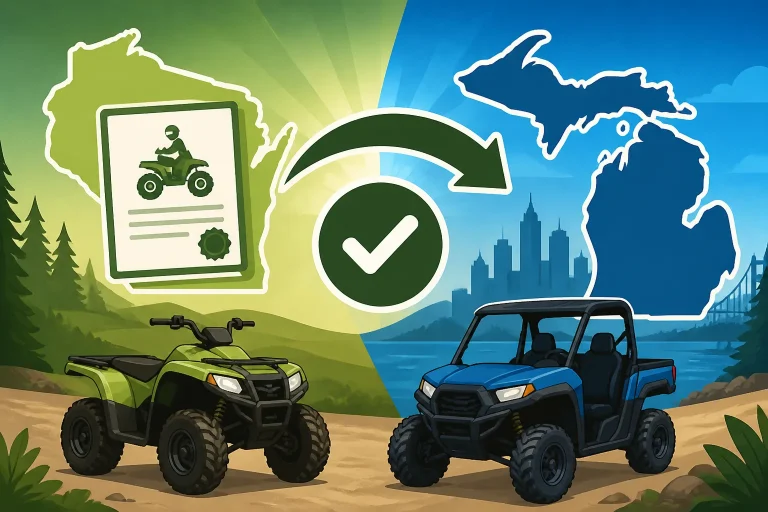
Michigan does not offer broad ORV permit reciprocity that lets you ride its public trails using only another state’s ORV sticker or registration. If you’re visiting with an ATV, UTV, or other qualifying off-road vehicle, plan to meet Michigan’s permit requirements for the places where you intend to ride.
That does not mean every visitor needs every permit. Requirements depend on the riding location and the machine, and there are exceptions. Riding private land with the owner’s permission, for example, is different from riding a state-designated ORV trail. A county road opened to ORVs may also involve rules that are different from those for a trail or state forest road.
The most useful starting point is to separate the two Michigan permits riders often confuse:
- The Michigan ORV license is generally required to operate an ORV on public land open to ORV use, subject to exceptions.
- The Michigan ORV trail permit is generally required to ride designated ORV trails and areas that require it. It is commonly needed in addition to the ORV license.
A permit issued by your home state may be valid where you live, but it is not a substitute for either Michigan permit unless Michigan’s official rules specifically recognize it for the activity in question. Don’t assume that a neighboring state’s annual sticker, registration card, or trail pass transfers across the border.
| What you have from home | Does it automatically replace a Michigan requirement? | What to check |
|---|---|---|
| State ORV sticker or permit | No, not as a general rule | Michigan ORV license and trail permit requirements for your destination |
| Vehicle registration or title | No | Whether Michigan requires an ORV permit where you plan to ride |
| Out-of-state safety certificate | Not necessarily; this is a separate issue | Whether Michigan accepts the certificate for the rider’s age and activity |
| Insurance card | No | Whether insurance is required for the specific machine or use |
| Permission to ride private property | It may mean a public-land permit is not required for that private ride | Land boundaries, owner permission, and rules for any public-road access |
| A Michigan permit bought for another machine | Usually not transferable to a different machine | Whether the permit is associated with the specific ORV |
If you want to ride a network of Michigan trails, verify both permit requirements before you travel. The overview in Michigan ORV License and Trail Permit Explained can help you identify which permit applies to which type of riding. For questions about riders coming from outside the state, see Non-Resident ORV Permits in Michigan as well.
What Michigan’s ORV license and trail permit cover
The word “permit” is often used loosely, but Michigan’s ORV license and trail permit are not interchangeable. Understanding the difference helps you avoid paying for the wrong thing—or arriving with only one of the permits you need.
The ORV license
Michigan’s ORV license is the basic license associated with operating an ORV on many public lands open to ORV use. That includes more than clearly marked trail loops. Depending on the location and the current rules, public forest roads or other public riding areas may have requirements of their own.
The ORV license is not a general permission to ride wherever you see an open-looking road. Land ownership, vehicle width, posted signs, closures, and local restrictions still matter. A valid license cannot override a gate, seasonal closure, private-property boundary, or a rule that excludes your machine from that route.
Think of the license as one part of legal access, not a pass that makes all public roads and trails available. Before you leave, identify the exact trail system, route, forest road, or riding area you plan to use. Then check the current Michigan Department of Natural Resources information for that location and machine type.
The ORV trail permit
The trail permit is generally associated with riding designated ORV trails and areas that require it. Riders using these routes commonly need the trail permit along with the ORV license. If your trip includes both a public forest road and a designated ORV trail, don’t assume that one permit automatically covers both.
Some riders buy a license but skip the trail permit because they expect to stay on roads. That may be appropriate for a particular itinerary, but it is not a safe assumption if the route could connect to a designated trail or ORV area. Check the map and the rules for each segment. A route that looks like one continuous ride may pass through areas with different requirements.
For a more detailed cost and coverage breakdown, use Michigan ORV License Cost and What It Covers. Current fees can change, so confirm the amount through the official Michigan licensing channel before purchasing.
Neither permit is the same as registration, title, or a Recreation Passport
An out-of-state title or registration establishes information about the machine. It does not automatically serve as a Michigan ORV license or trail permit. Likewise, a Michigan ORV permit does not title the vehicle, register it for highway use, or make it street legal.
The Michigan Recreation Passport is a separate access product associated with eligible state recreation facilities. It is not a replacement for an ORV license or ORV trail permit. A passport may be relevant to parking or entering a facility, while ORV permits concern operating the machine in places where those permits are required. Check each requirement independently rather than treating a single sticker as covering everything.
If you are trying to sort out the difference between public trail riding and public-road riding, the article Why Michigan Has No ORV Registration explains why the state’s ORV license is not the same thing as conventional vehicle registration. For facility access, see Recreation Passport vs ORV Trail Permit in Michigan.
Permits are not a substitute for route authorization
Even with the correct Michigan permits, you still need to know whether your machine can use a given trail. Trails and routes may have width restrictions, and some are intended for motorcycles or narrower machines rather than full-size side-by-sides. A permit does not change those limits.
You also need to distinguish a designated trail from a county road, township road, or road within city limits. Local decisions affect where ORVs may operate on many roads. A statewide permit does not create a statewide right to ride on every road shoulder or connect every trailhead by road.
Before you plan a long loop, check trail widths and route connections. Michigan ORV Trail Widths Explained and How to Find Your Michigan County’s ORV Ordinance can help you identify restrictions that a permit alone will not answer.
How reciprocity differs from permits, safety certificates, titles, and insurance
The term “reciprocity” can refer to several different things. A state might recognize another state’s safety certificate, allow an out-of-state vehicle to remain registered there temporarily, or have an agreement about a specific permit. Those are separate questions. Recognition in one category does not mean recognition in all the others.
ORV permits and trail passes
For ORV permit purposes, take the practical approach: assume your home-state permit does not replace Michigan’s required permit unless the Michigan DNR says it does. This applies even if your state has a similar sticker or charges its own fee for trail use.
Reciprocity arrangements can be narrow, change over time, or apply only to a specific vehicle class or activity. If someone tells you, “Michigan accepts our permit,” ask what exactly is accepted: a safety certificate, vehicle registration, ORV license, trail pass, or something else. Then confirm the statement with the official Michigan source before relying on it.
This is especially important for riders from nearby states. A trip across a state line may feel like a continuation of the same regional trail system, but each state sets its own access rules. To compare the issue for specific neighboring-state riders, see Do Wisconsin Riders Need a Michigan Permit?, Do Ohio Riders Need a Michigan ORV License?, or Indiana Riders Coming to Michigan.
Safety certificates
A safety certificate is about the rider, not the machine’s permit status. Michigan’s age-based ORV safety rules may apply to young riders even when the family is visiting from another state. Whether a certificate issued elsewhere is accepted can be a separate reciprocity question, and recognition may depend on the course or certificate and the situation.
Do not assume that a child’s home-state card automatically satisfies every Michigan requirement. Before traveling with a young rider, check Michigan’s current guidance on certificates and the rider’s age. The related articles Safety Certificate Reciprocity for Michigan Riders and Michigan ORV Safety Certificate Requirements address the certificate issue; neither should be confused with a trail permit.
A safety certificate also does not replace supervision, helmet, passenger, or operating rules. A rider who has completed a course still has to follow the rules that apply to their age, machine, and riding location.
Titles, registration, and proof of ownership
A title or registration from another state may be relevant to proving ownership or identifying the machine, but it does not by itself authorize riding on Michigan trails. Conversely, buying a Michigan trail permit does not settle a title problem or make a machine eligible for public-road use.
If you have recently moved, bought a machine in another state, or are visiting for a short trip, keep the issues separate:
- Ownership: Do you have the title, bill of sale, or other documents needed to show that the machine is yours?
- Michigan ORV access: Do you need a Michigan ORV license or trail permit for your intended riding?
- Route eligibility: Is your machine allowed on the specific trail, road, or area?
- Road use: If you plan to ride on a road, does a local ordinance allow it, and are you meeting the separate road-use rules?
For a longer move rather than a visit, Moving to Michigan With an Out-of-State ATV covers the separate questions that come with becoming a Michigan resident. If you are visiting with a machine titled elsewhere, Do Out-of-State Riders Need a Michigan ORV Title? can help distinguish title rules from riding permits.
Insurance
A home-state insurance policy does not serve as an ORV license or trail permit. Insurance requirements can also differ depending on whether the machine is being used off-road, on an approved public road, or as a street-legal vehicle. A policy designed for private-land use may not cover every type of road riding or every claim scenario.
Ask your insurer how the policy treats riding in Michigan, including trail use, passengers, road connections, rental or borrowed machines, and any modifications. Keep proof of coverage accessible if your policy requires it, but do not treat that proof as evidence that your permits are complete. Michigan ORV Insurance and When You Actually Need It is a useful companion for sorting out the insurance side.
A step-by-step permit check for out-of-state riders
A little planning can prevent a frustrating conversation at a trailhead—or a ticket after you have started riding. Use this process before leaving home, especially if you are traveling with several machines or planning to cross between trails and roads.
-
List every machine and rider.
Note whether each vehicle is an ATV, UTV, dirt bike, or another type of ORV. Record its width and identify who will operate it, including the ages of any young riders. Permit and route requirements can vary by machine type, while safety rules can depend on the rider. -
Write down the exact destinations.
“We’re riding in northern Michigan” is not specific enough to check. Identify the trail system, designated ORV routes, state forest roads, recreation area, or private property you plan to use. If you are linking several areas, list each segment. -
Separate trails from roads.
Mark which parts of the trip are on designated ORV trails, which are on public forest roads, and which involve county or local roads. A road connection may require local authorization that is separate from trail permits. Check the relevant county or township rules rather than assuming a trail map settles road access. -
Check the machine’s route eligibility.
Review width restrictions, signs, closures, and any rules that apply to your vehicle category. A side-by-side that is too wide for a particular trail does not become eligible just because it carries the correct permit. -
Confirm which Michigan permits apply.
Use Michigan’s official DNR or licensing information to determine whether you need the ORV license, the trail permit, or both for your itinerary. If an exemption appears to apply, verify its scope and conditions rather than relying on a summary from a forum or an old social media post. -
Purchase the required permit through an official channel.
Follow the current instructions for buying and displaying the permit. A receipt, account confirmation, or saved email may be useful, but don’t assume it substitutes for the required license or sticker unless the official instructions say so. -
Check expiration and display details.
Michigan’s ORV permit year follows a seasonal schedule, so an old sticker may no longer be valid for the trip. Confirm the current permit period, where the sticker must be placed, and whether it needs to be visible in a particular way. For placement, see Michigan ORV Sticker Placement on an ATV or Michigan ORV Sticker Placement on a Side-by-Side. -
Verify youth and passenger rules separately.
Check the age rules, safety certificate requirements, supervision rules, and passenger limits for each rider and machine. The fact that an adult has the right permits does not automatically make every passenger arrangement legal. -
Check for closures shortly before departure.
A route shown on an older map may be closed or restricted because of weather, maintenance, seasonal conditions, or land-management decisions. Confirm current notices close to your ride date. -
Keep records organized.
Carry the documents you may need to explain ownership, permits, and insurance. Store originals safely and keep copies or digital records where practical. For advice on what paperwork belongs with the machine, see Keeping Your ORV Paperwork With the Machine.
If you are unsure about an unusual situation—such as a machine borrowed from a friend, a permit bought for a fleet, or a route that crosses several types of land—ask the relevant Michigan agency before you ride. Give them the machine type and the exact location. A precise question is more likely to get a useful answer than asking whether “out-of-state permits work in Michigan” in general.
Common trip scenarios and how to think them through
The examples below are not substitutes for checking the current rules. They show how to apply the distinctions between permit type, riding location, and vehicle eligibility.
You have an annual permit from your home state
You are visiting Michigan with a machine that carries your home-state ORV sticker. Treat that sticker as proof of whatever it means in your home state, not as automatic Michigan authorization. Check whether Michigan requires its ORV license and trail permit for your destination, then obtain the Michigan permits that apply.
If your home-state sticker is valid for a full season, that does not necessarily change the answer. Annual validity in one state does not create cross-border recognition in another.
You are riding only on private property
A public-land trail permit requirement may not apply to a ride that stays entirely on private property with the owner’s permission. But make sure your planned route really remains on that property. Getting from the property to a trail, public forest road, or public road can introduce separate requirements.
Private land also does not eliminate every safety or liability issue. Follow the owner’s conditions, keep riders within the area they are authorized to use, and check insurance terms for private-property riding.
You plan to use public forest roads but not designated trails
Do not assume the trail permit is required simply because you are riding in a forest, or assume that the ORV license alone is always sufficient. Check the rules for the specific forest roads and any trail connections. Public land can contain a mixture of open roads, restricted roads, trails, and closed areas.
A map can help you plan, but signs and current closure notices matter too. If your route unexpectedly takes you onto a designated trail, the permit requirements may change.
You are bringing a wide UTV
The question is not only whether you have the permits. Confirm that your UTV is allowed on each trail or route. Michigan trail systems can include routes intended for different widths, and a large machine may have fewer options than a narrower ATV.
Plan legal turnarounds and connections before setting out. Don’t ride around a barrier or onto a narrower trail because the main route appears to continue. Michigan Trail Widths and 64-Inch Machines and Wide Side-by-Sides on 50-Inch Trails offer more detail on this issue.
You are traveling with a child
Check the child’s age, machine size, rider position, supervision requirements, and safety certificate status. Also confirm that the machine is designed for the number of riders you plan to carry. A permit attached to the machine does not authorize a child to ride without meeting the applicable age and supervision rules.
If the child has a certificate from another state, verify whether Michigan accepts it for the situation. Keep that question separate from whether the machine needs a Michigan permit. For age-specific guidance, see Michigan ORV Age Rules at 10, 12 and 16.
You are renting a machine in Michigan
A rental company may handle some permit arrangements, but don’t assume it includes every permit, fee, or facility requirement. Ask the rental provider what is already attached to the machine and what you must obtain separately. Confirm that the machine is permitted for your intended route and that your planned riders meet the rental and Michigan rules.
If your trip includes a guided tour or a private rental route, ask whether the route stays on land where the necessary permits are covered. Michigan ORV Rental Permit Requirements and What Michigan Rental Shops Include and What They Do Not can help you prepare questions before booking.
Buying permits, displaying them, and avoiding common mistakes
Once you know what your route requires, use Michigan’s official purchasing instructions. The permitted sales channels, display directions, and rules can change, so check the current DNR information rather than relying on an old receipt or a previous season’s sticker.
Buy for the machine and trip you are actually taking
Do not assume a permit can be moved from one ATV to another or that a permit for one family machine covers the whole group. Follow Michigan’s current rules on which machine the permit applies to and whether it can be transferred. If you are bringing multiple machines, check each one individually.
For a group ride, make a simple list with one line per machine: type, width, permit status, and intended routes. This catches the common mistake of checking the lead machine and forgetting the second or third vehicle.
Put the sticker where Michigan directs
A valid permit that is hidden, damaged, placed on the wrong machine, or difficult to see can create avoidable problems. Follow the current placement instructions for the vehicle type. Clean and dry the mounting surface first, and avoid placing the sticker where it will be covered by accessories or equipment.
If you want a small document sleeve for receipts or other paperwork, a camping or powersports shop—or Amazon—may carry options. The sleeve does not replace a required permit sticker, and it should not be used to obscure the sticker or prevent an officer from checking it.
Keep useful proof without treating a photo as permission
A photo of a sticker or purchase confirmation can help you remember details, and keeping digital records may be convenient. But a phone image does not necessarily replace the required display or any documents Michigan says you must carry. Follow the official instructions for proof and display.
A printed map in a water-resistant sleeve can be a useful backup where cell service is poor. You can find sleeves through outdoor retailers and Amazon, but the important part is having a current map that shows the route type, not the brand of sleeve. A phone mount, power bank, or compact tire-pressure gauge can also help with trip logistics; if you shop for one on Amazon, confirm that it suits your machine and riding conditions rather than relying on a product listing alone.
Don’t rely on old advice or a permit someone else used
Permit details are easy to mix up because riders may describe different machines, locations, or seasons as though they were the same. A friend’s permit may have been for a different type of ride, and a sticker on a used machine may be expired or assigned under conditions that do not apply to you.
Before departure, confirm:
- The current permit year and expiration date
- Whether your route needs the ORV license, trail permit, or both
- Whether your machine’s width and type are allowed
- Whether your chosen roads are open to ORVs under local rules
- Whether youth riders meet age, certificate, and supervision requirements
- Whether any closures or seasonal restrictions affect the trip
Keep permit checks separate from ticket and enforcement questions
Conservation officers and other enforcement personnel may check permits, machine eligibility, and compliance with route rules. A permit does not protect you from enforcement if you ride on a closed trail, ignore a width restriction, or use a road that is not open to ORVs.
If you are stopped, be prepared to explain where you are riding and show the required permit display or supporting documents. Stay calm, follow instructions, and avoid arguing from a map or a claim that another state’s permit “should count.” If you believe a citation is incorrect, handle that through the proper process afterward. Michigan Conservation Officer ORV Stops and Fighting a Michigan ORV Ticket cover those separate situations.
A practical pre-trip checklist
Use this final check before loading the trailer. It is deliberately short enough to run through with every rider in the group.
- Destination: Have you identified the actual trail, route, road, or private property?
- Michigan permits: Have you confirmed whether each machine needs an ORV license, trail permit, or both?
- Reciprocity: Have you avoided treating an out-of-state sticker or registration as a substitute without official confirmation?
- Machine fit: Is each ATV or UTV allowed on the routes you selected?
- Road access: Have you checked the relevant county or local ORV ordinance for road segments?
- Young riders: Have you verified age, certificate, supervision, helmet, and passenger rules?
- Ownership and insurance: Do you have the documents and coverage appropriate for the trip?
- Sticker: Is the current permit displayed as instructed?
- Conditions: Have you checked for current closures and route changes?
- Backup plan: Do you have a current map and a way to navigate if your phone loses service?
For permits, the safest rule is simple: treat Michigan’s requirements as their own system. Your home-state permit may be useful at home, but it does not automatically carry over to Michigan. Check the specific machine, route, and rider requirements, buy the Michigan permits that apply, and verify any unusual reciprocity claim with an official source before riding.
Disclaimer
This article is for general informational purposes only and does not constitute professional advice. Laws, prices and regulations vary by location and change over time. Consult a qualified professional for guidance on your specific situation.