What a Michigan ORV License Costs This Season
A rider can reach a trailhead near Cadillac or St. Helen and still be unsure whether the permit on the machine is the right one—or whether it covers the trail they came to ride. This guide explains how Michigan ORV license costs are structured, what the separate trail permit does, which expenses are easy to overlook, and how to check the current total before heading out.
What a Michigan ORV license pays for
The license and trail permit are different items
Michigan’s ORV license and ORV trail permit are separate permissions, even though riders often talk about them as if they are one sticker or one purchase. The license is the basic ORV authorization for riding in places where Michigan requires one. The additional trail permit applies to designated ORV trails and scramble areas. If your plans include those designated riding areas, the license alone may not be enough.
That distinction matters when you budget. A rider planning to use an open public route may need to confirm the license requirement for that route, while someone planning a trail weekend may need to account for both items. The details can depend on the land and route, so don’t assume that buying one permit automatically grants access everywhere.
For a closer explanation of how the two permissions work together, read Michigan ORV License and Trail Permit Explained. It’s also useful to check Do You Need Both a License and a Trail Permit in Michigan? before setting out. Those are different questions from whether a particular road, trail, or park is open to ORVs.
What the cost supports—and what it does not grant
Permit revenue supports Michigan’s ORV program, including trail-related work and management. For riders, that can mean better-maintained routes, signs, and facilities, though conditions vary by location and season. It’s reasonable to view the purchase as part of the cost of riding on the places the program covers, rather than as a universal access pass.
A permit is not permission to ride on any land you choose. It does not replace the landowner’s consent on private property, make a closed trail open, or cancel local restrictions. It also does not make a machine street legal. Road access depends on separate rules, including whether the road has been opened to ORVs and what requirements apply there.
If you’re planning to connect a trail ride with roads through town, read The Three Road Rules Michigan ORV Riders Must Follow. Before leaving, check local access information as well as your permit status. A valid permit and a permitted route are separate parts of a legal ride.
Why there may not be one simple “total cost”
When someone asks, “What does a Michigan ORV license cost this season?” they may mean the basic license, the license plus trail permit, or every fee needed for a particular day. Those totals can differ because they depend on what the rider is buying and where the machine will be used.
The precise current fee is best checked through Michigan’s official DNR licensing options or an authorized license agent before purchase. Fees can change, and an old receipt, saved social media post, or previous-season sticker is not a dependable way to confirm what a new purchase costs. For an overview of the separate fee categories, see Michigan ORV License Cost and What It Covers.
It helps to write down the exact plan before looking up the price: the number of machines, whether you’ll use designated trails or a scramble area, and whether you need any separate park-related access. That simple check prevents the common frustration of buying one item, arriving at the trail, and realizing another one is required.
How to work out your likely permit total
Start with the machine and the riding plan
Make a list of each ATV, UTV, or other ORV you plan to take. In general, permits are associated with the machine rather than serving as a group pass for all the vehicles in a trailer. If three family members bring three machines, don’t assume one purchase covers the whole group.
Next, write down where you expect to ride. A weekend on designated trails or at a scramble area may call for both the ORV license and the additional trail permit. A different route, such as riding on a public road where ORVs are allowed, may involve its own rules. Check the requirements for the exact destination instead of relying on what a friend needed for a different ride.
If you’re planning routes near Silver Lake, St. Helen, or the Upper Peninsula, don’t treat those names as a single permit category. Riding areas can have distinct land-management and entry requirements. For destination-specific planning, Permits Michigan Requires at Scramble Areas can help you identify questions to confirm before you travel.
Use this table as a budgeting checklist
The table below is a way to organize what to verify—not a fee schedule. It deliberately avoids quoting a current price because the amount should be confirmed at the time you buy.
| What you may need | What to check | Common budgeting mistake |
|---|---|---|
| ORV license | Whether the machine and planned location require a license | Assuming a trail permit replaces the license |
| ORV trail permit | Whether the route includes designated trails or scramble areas | Buying only the basic license for a trail ride |
| Permit for each machine | How many ORVs will be used | Treating a family or group purchase as a fleet pass |
| Recreation Passport or facility access | Whether the destination has a separate vehicle or facility requirement | Assuming an ORV permit covers every park or parking fee |
| Nonresident requirements | Which permits and safety rules apply to visitors | Assuming an out-of-state sticker automatically transfers |
| Optional trip costs | Parking, fuel, lodging, and equipment | Counting only the permit and overlooking the rest of the trip |
Use the official purchase channel to confirm the amount for each required item. If an online cart offers multiple permit choices, read the item names before paying. A few extra seconds of checking can save the hassle of trying to correct a purchase once you are already on the road.
Keep separate costs separate
A recreation-related charge may appear alongside an ORV permit in a rider’s planning notes, but that does not make it part of the ORV license price. For example, a Recreation Passport is a separate program with its own rules. Whether you need it depends on your destination and the kind of access you’re using. Don’t add it automatically to every trail ride, and don’t assume an ORV permit includes it.
Likewise, a permit does not cover fuel, trailer parking, camping, rentals, repairs, or any fee a private riding facility sets. Those costs can make a weekend feel more expensive than expected even when the permit purchase itself was straightforward. For a family trip, write the permit total and the travel budget on separate lines.
If you are organizing a group ride, tell participants which expenses are individual and which are shared. Permits are generally not something to split across several machines simply because riders are traveling together. A clear list reduces last-minute confusion at the trailhead and avoids an awkward conversation when one person discovers their machine is missing a required permit.
Who may need a license or additional permit
Michigan residents riding public routes and trails
For Michigan residents, the key question is not simply where you live. It is where you intend to operate the ORV and what kind of area it is. Michigan’s ORV requirements distinguish among public lands, designated trails, scramble areas, private property, and roads opened to ORV traffic. Those categories can overlap during a trip, so check each part of the route.
A rider who starts at a cabin and heads onto nearby public routes should not assume the cabin’s private driveway changes the rules for the public land beyond it. Similarly, the fact that a local road appears quiet or unpaved does not by itself mean ORVs are allowed there. Confirm the route’s status and any county or township ordinance that affects road riding.
If you are unsure whether a route needs only a license or both items, use Michigan ORV License Without a Trail Permit: Where You Can Ride as a starting point, then confirm the location-specific rules. Permit choice and route access are related, but they are not interchangeable.
Out-of-state visitors and neighboring-state riders
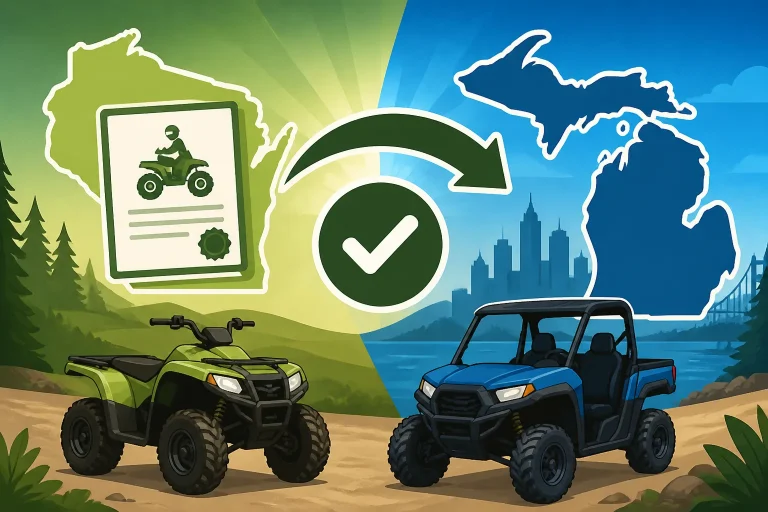
Visitors from Wisconsin, Ohio, Indiana, and elsewhere should avoid assuming that a home-state permit will automatically satisfy Michigan’s requirements. Reciprocity rules can be specific, and a permit accepted in one situation may not cover another. Before crossing the state line, check what Michigan requires for the machine, the rider, and the places on the itinerary.
The practical question is: “What must this machine carry to ride the Michigan routes we chose?” That is more useful than asking whether your home-state sticker is generally recognized. Also check whether the rider needs a safety certificate under the circumstances. Permit rules and operator training rules are separate issues.
For a broader visitor overview, see ORV Permits for Out-of-State Riders in Michigan. Riders coming from Wisconsin can also review Do Wisconsin Riders Need a Michigan Permit?. Check the requirements before loading the trailer, because discovering a missing permit after arriving in a town like Munising or Drummond Island can disrupt a carefully planned weekend.
Private land, exemptions, and special situations
Some riders use an ORV only on land they own or have permission to use. Private-land use can be treated differently from riding on public routes, but that does not make every nearby road or trail private. If your ride crosses onto public land, a county route, or a designated area, verify the rules for that portion rather than assuming the private-property situation carries over.
Farm use and other special circumstances can also raise questions about exemptions. An exemption may depend on the purpose of the ride, the machine, and the specific rule involved. A work-related trip does not automatically mean that every permit requirement disappears, and an exemption from one requirement may not exempt the machine from all others.
When a potential exemption affects your plans, confirm it through an official Michigan channel before relying on it. It is better to ask a precise question—where the machine will be operated, what it will be used for, and who owns it—than to build a trip around a broad assumption. The page When Michigan Riders Are Exempt From a Permit is a useful companion for sorting out the questions to ask.
Buying the permit and checking the current fee
Where to confirm the amount
Use Michigan’s official DNR license and permit information or an authorized license agent to confirm current prices. Look at the exact item name, not just a page headline or a search snippet. If you are buying more than one item, verify each line before payment so you can see whether the cart includes the basic license, trail permit, or both.
Prices and purchasing details can change. That is why the safest habit is to check the official listing close to the time of purchase, rather than relying on an amount quoted in an old forum discussion or a screenshot shared in a riding group. If you need help finding a seller near your route, Where to Buy a Michigan ORV License covers purchase options.
If buying in person, ask the agent to confirm that you selected the right products for the machine and route. If buying online, save the confirmation and review the permit instructions that come with it. A receipt can help answer purchase questions, but it does not make an incorrect permit selection correct.
Understand the permit year and timing
Michigan’s ORV permit year follows a seasonal cycle rather than simply matching the calendar year. A rider buying near the transition between permit periods should check the start and end dates shown for the specific permit. That is especially important if a machine is purchased mid-season or if a trip is planned just before or after a seasonal change.
Avoid assuming that a permit from last year remains valid because the sticker is still attached or because the machine has not been used since then. Check the dates and current requirements. The same applies if a used ORV comes with a sticker already on it: a visible sticker is not proof that it remains valid or is transferable to the new owner.
For timing details, see Michigan’s April 1 ORV Permit Year and When Michigan ORV Permits Expire Each Year. If your purchase happens in March or near the season change, look at Buying a Michigan ORV License in March before deciding when to buy. The right timing can depend on when and where you plan to ride.
What to do if a purchase looks wrong
If you realize that you chose the wrong permit, don’t assume it can be moved to another machine or converted into a different item. Transfers, refunds, and corrections may have specific rules. Contact the seller or official support channel as soon as you spot the issue, and keep your receipt and order details available.
Check the sticker or documentation as soon as you receive it. Confirm that the permit is for the intended machine and period, and follow the instructions for displaying it. If you are buying for multiple vehicles, label the paperwork by machine before applying anything. That small step can prevent confusion when several similar ATVs are parked together.
A misplaced or damaged sticker can also create an avoidable problem. Don’t scrape it off in a hurry or cover its identifying information with an accessory. If you need a replacement, look up the official procedure rather than buying a second permit without checking whether replacement is allowed. Replacing a Lost ORV License Sticker explains the issue to investigate.
Avoiding common permit-cost surprises
Don’t confuse a trail permit with road permission
A rider may have the right ORV license and trail permit and still be prohibited from using a particular road. Michigan road access depends on local rules and whether the route is open to ORVs. A permit does not override a township decision, a road closure, or a sign restricting access.
This catches visitors off guard because two roads can look nearly identical but have different rules. One may be part of an ORV route, while another nearby road remains closed to ORVs. Maps and signs help, but confirm current local access information, especially when a route passes through a village or city.
Before planning a ride from town to trail, read How to Find Your Michigan County’s ORV Ordinance. If your plan includes municipal streets, also consult Michigan ORV Rules Inside City Limits. The permit is one part of the legal checklist; it is not a blanket road pass.
Don’t assume one machine’s permit covers another
A family may have two ATVs and a UTV, all traveling on the same trailer or riding the same route. It can feel natural to treat the permit as a household purchase, but permit requirements are generally connected to each machine. Confirm what each vehicle needs and attach or display the permit as directed for that vehicle.
This is particularly easy to miss when one machine is a recent purchase, a rental, or a backup vehicle. A rider might remember to prepare the older ATV and overlook the side-by-side that will actually be used on the trip. Make a short machine-by-machine checklist before departure.
For groups, ask each rider to confirm their own permit status rather than relying on the trip organizer’s purchase. If a club is coordinating a ride, include a reminder in the pre-trip message: identify the required permits, tell riders to verify them for their own machines, and direct them to the destination’s route information.
Don’t treat storage products as permit substitutes
A permit needs to remain visible and legible in the way Michigan requires. A clear protective product may sound helpful in wet, muddy, or snowy conditions, but anything that covers a sticker could interfere with its visibility or violate display instructions. Check the official placement guidance before applying a cover, laminate, or adhesive film.
If you want to keep receipts and spare documents dry, a separate waterproof pouch can be useful. Some riders look at Amazon for document sleeves or small storage organizers, but those products do not replace an official sticker and should not be used to conceal one. Keep paperwork in a protected compartment and leave the permit displayed as instructed.
Amazon can also be a place to find a basic label organizer for keeping receipts and machine details together. Use it for records, not as a workaround for permit display. If a sticker is damaged or unreadable, check the replacement process instead of trying to make it look acceptable with tape or a homemade cover.
A practical pre-ride permit checklist
Before you buy
Start with the destination. Identify the trails, scramble areas, roads, and public lands you expect to use. If the route includes more than one kind of area, check each part. A route that begins at a private cabin and later joins a public trail can involve different requirements along the way.
Then list every machine and rider. Confirm which permits each ORV needs, whether the trail permit is required for your planned locations, and whether any rider has a separate safety-certificate requirement. For a group ride, don’t assume the lead rider’s permit or paperwork covers everyone.
Finally, confirm current fees and purchase details through an official or authorized channel. Save the receipt and the permit information together. A photo of the receipt on your phone can be a useful backup, but it should not be treated as a replacement for a required sticker or physical display.
Before you leave home
Check that each machine has the correct permit for the current permit period and that it is displayed according to instructions. Look for peeling edges, dirt, or damage that could make the information hard to read. If anything seems wrong, resolve it before traveling rather than hoping it will go unnoticed at the trailhead.
Review access information again, particularly if you are riding in a county or township with local ORV road rules. Seasonal closures, trail work, and local restrictions can affect a route even when your permit is valid. Share the route with the group so everyone knows where riding is allowed and where they should not continue.
Pack receipts and relevant documentation somewhere dry. A small organizer bought through Amazon may help keep papers together, especially on a multi-day trip, but keep the official permit visible on the machine as required. It can also help to photograph the sticker after it has been applied, so you have a record if it becomes damaged during transport or riding.
At the trailhead and during the ride
Before unloading, check posted signs and confirm that you are at the right access point. A paid permit does not guarantee that every nearby route is open to your vehicle’s width or type. Pay attention to trail markers and closures, and don’t follow another rider onto a route unless you have confirmed that it is open to your machine.
Keep the route’s permit requirements in mind if your plans change. A detour onto a designated trail or into a scramble area may call for a different permit than the road or route you originally intended to use. If you are uncertain, pause and check rather than guessing.
For a wider discussion of what to keep with the machine, see Keeping Your ORV Paperwork With the Machine. You generally do not need to carry the original title simply because you are riding, but don’t confuse title paperwork with permit requirements. The title proves ownership; the ORV permit addresses riding authorization.
Planning a realistic Michigan ORV budget
Estimate the full trip, not just the sticker
The permit purchase is only one line in the total cost of riding. For a weekend, include fuel for the tow vehicle and ORV, food, lodging or camping, trailer needs, and any facility or parking charges that apply. If you are renting a machine, ask the rental business what permits are included and what you must arrange separately.
A simple example: a family towing two ATVs to a trail system might need to account for the right permit items for both machines, plus fuel, a place to stay, and any separate access charges for the chosen destination. A solo rider on a local route may have a shorter list. Neither example has one universal total, because machine count and riding plan make a real difference.
Writing the costs down before departure helps distinguish mandatory expenses from optional ones. That matters when you are comparing two destinations or deciding whether to bring another machine. It also makes it easier to explain the plan to friends who are joining for only one day.
Decide whether a trail permit fits your riding habits
If you ride designated trails often, the additional trail permit may be a practical part of your regular season budget. If you rarely use those areas, check whether your usual routes require it rather than buying automatically or assuming you need it everywhere. The goal is not to buy the most items possible; it is to buy what applies to your actual riding plans.
Think about the places you return to. Riders who use well-known trail networks near St. Helen, Cadillac, or in the Upper Peninsula may have a different routine from someone who mostly rides on private land. Your preferred destinations, not a neighbor’s habits, should guide the permit check.
If your plans change during the season, revisit the rules before the next ride. A permit selection that worked for a road route may not cover a later trip to a designated trail. Keep the DNR’s official permit information bookmarked so you can check the current options without relying on old notes.
Build permit checks into your annual routine
At the start of each riding season, review the permit period, current costs, routes, and machine list. Replace outdated figures in your budget, and check whether any family member has changed machines or will ride in a new location. That annual reset is more dependable than assuming the same sticker, fee, or route rule remains unchanged.
When purchasing a used machine, ask what paperwork comes with it, but verify permit status independently. A seller’s old sticker does not establish that the machine is properly permitted for your ride. Ownership documents, current permits, and route access are separate things to check.
A tidy routine can be as simple as keeping a folder—paper or digital—with the machine’s ownership records, permit receipt, and route notes. Amazon offers document organizers and waterproof pouches that some riders use for storage, but the key is keeping the permit itself displayed correctly and the records easy to find. For replacement and display questions, review Michigan ORV Sticker Placement on an ATV or Michigan ORV Sticker Placement on a Side-by-Side, depending on the machine.
Disclaimer
This article is for general informational purposes only and does not constitute professional advice. Laws, prices and regulations vary by location and change over time. Consult a qualified professional for guidance on your specific situation.