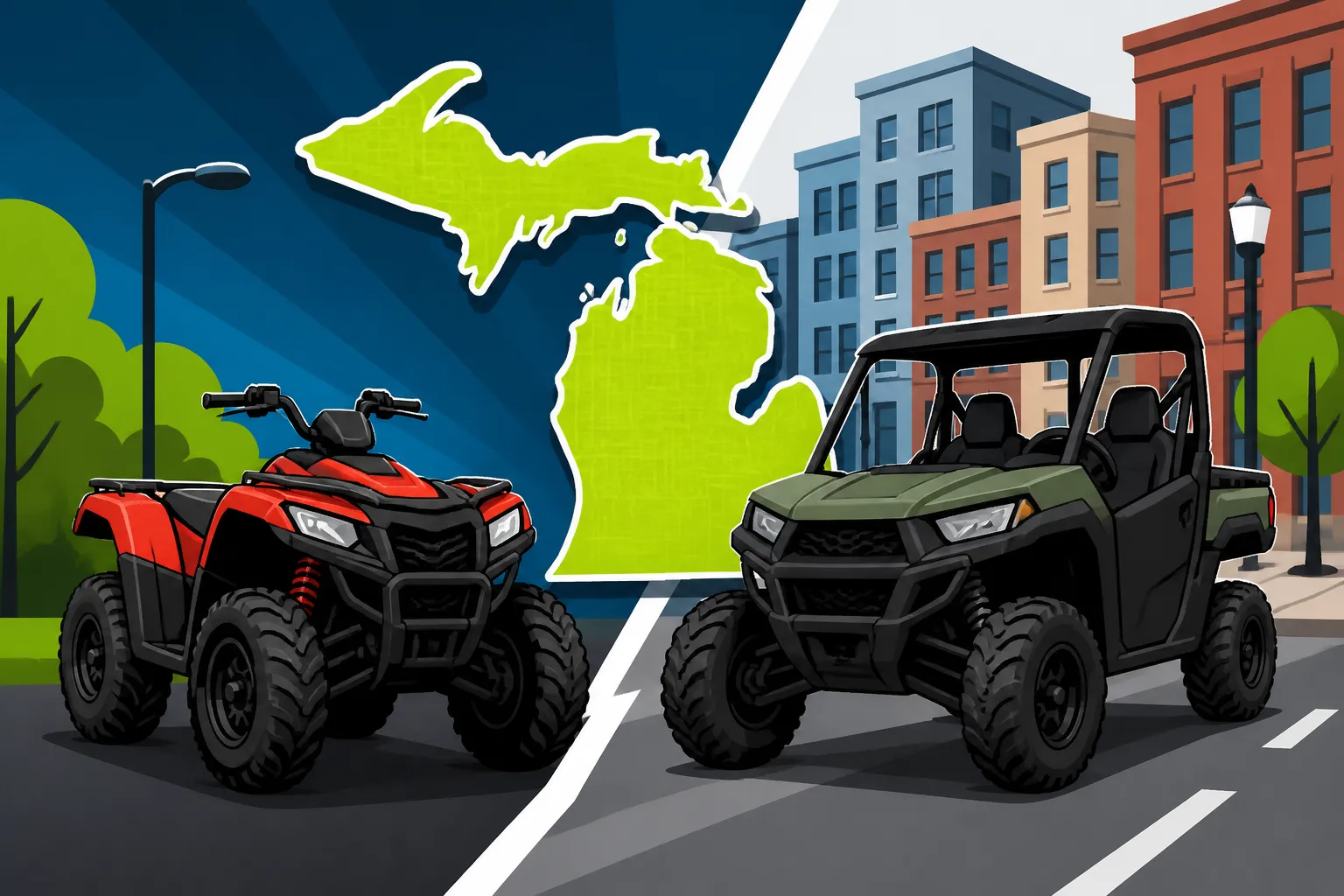
Michigan ORV Rules Inside City Limits
Oh, the age-old question that plagues so many of us who just want to enjoy our ATVs and UTVs in Michigan: can I actually ride this thing in town? It’s a frustrating maze of state laws, county ordinances, and then, just when you think you’ve got it, city-specific rules that can shut your fun down faster than a Michigan winter storm. This guide is here to untangle that knot, so you can understand exactly where your ORV is welcome – and where it definitely isn't – within Michigan's city and village limits.
The Core Challenge: Why City Limits Are Different
Riding an Off-Road Vehicle (ORV) in Michigan is a fantastic way to explore, whether it's hitting a challenging trail system or cruising down a scenic county road. But the moment you approach the edge of a city or village, things often change dramatically. It's like a whole new set of rules suddenly applies, leaving many riders scratching their heads and worrying about a ticket. This isn't just an urban myth; there's a real legal framework that makes municipal boundaries a game-changer for ORV enthusiasts.
State vs. Local Control: Understanding the Nuance
Here’s the deal: Michigan state law sets the overarching framework for ORV operation. It dictates where ORVs are generally allowed and where they are generally prohibited, particularly on public roads. However, the state also grants local governmental units—counties, townships, cities, and villages—the authority to adopt their own ordinances that can either permit or further restrict ORV use within their specific jurisdictions. This is where the confusion often comes in.
A county, for example, might pass an ordinance that opens up all eligible county roads to ORV use, like many have done across the Lower and Upper Peninsulas. You might be cruising along a two-track or a quiet gravel road in rural Kalkaska, completely legal according to the county ordinance. But then, you hit the city limits of Kalkaska, and suddenly, that county ordinance doesn't necessarily apply anymore. Cities and villages can, and often do, have their own distinct rules, or they may simply defer to the more restrictive state law that generally prohibits ORV operation on maintained roads within their borders. It's a critical distinction to understand: just because you can ride on county roads doesn't mean you can ride in the city that sits within that county. For a deeper dive into these broader rules, check out [Michigan County ORV Ordinances Explained].
The Fear of Tickets and Impoundment
Let's be real: no one wants a ticket, especially not for something they genuinely thought was legal. The frustration is palpable when you're just trying to get from your cabin to the local gas station in town, or maybe grab a bite to eat, and you're suddenly facing a hefty fine or, even worse, the impoundment of your machine. This scenario is incredibly common because the rules aren't always clearly marked, and local ordinances can be tough to track down if you're not a resident.
Imagine you're at your seasonal spot up north, say near a small village like Atlanta. You've been riding the designated ORV routes and county roads all day. It's getting dark, and you realize you're low on fuel. The closest gas station is just a mile into the village. You think, "It's just a quick hop." But if that village hasn't passed an ordinance specifically allowing ORV use on its streets (or on the particular street you're on), you could be pulled over. The consequences can range from a civil infraction with a fine to a misdemeanor, depending on the severity of the violation and how the local ordinance is structured. This can also include your ORV being impounded, which means a tow bill, storage fees, and a massive headache just to get your machine back. It's a stressful situation that riders desperately want to avoid, and it highlights the need to be absolutely certain about the local rules before you venture into town.
Navigating Specific City/Village Ordinances
The key to avoiding trouble within city limits is understanding that Michigan municipalities have the power to create their own rules for ORVs. This means a patchwork of regulations across the state, making pre-trip research absolutely essential. You can't just assume what's okay in one town is okay in the next.
How to Research Local Rules for Your Destination
So, how do you figure out if you can ride your UTV down Main Street in Traverse City, or even a smaller town like Reed City? It takes a little legwork, but it's far better than facing a ticket.
First, your best bet is to check the municipal website for the specific city or village you plan to visit or pass through. Look for sections related to "city ordinances," "public safety," or "police department." Use the search function on their site to look for terms like "ORV," "ATV," "UTV," "off-road," or "vehicle regulations." Many towns will publish their full code of ordinances online, and you might find a specific chapter or section dedicated to ORVs. Smaller villages might not have an extensive online presence, or their ordinances might be less specific. In those cases, they may simply defer to the default state law, which generally prohibits ORV use on city streets.
If you can't find anything definitive online, the next step is to call the local police department or the city/village clerk's office. These individuals are usually very familiar with local regulations and can tell you outright if ORVs are allowed on any of their streets, and if so, under what conditions. Be specific with your questions: "Can I ride my UTV on city streets in [Town Name]?" "Are there designated ORV routes or connector roads to trails?" "Are there any time restrictions?" It's always best to get this information directly from the source. Remember, many [Michigan Cities That Ban ORVs on Streets] simply have no ordinance allowing them, meaning the state's default prohibition applies.
Common Provisions in City ORV Ordinances
When cities or villages do decide to allow ORVs on their streets, they rarely just open everything up without conditions. These local ordinances often come with very specific provisions that differ significantly from county road rules. You might encounter:
- Specific Approved Roads/Routes: Instead of allowing ORVs on all paved or gravel roads, a city might designate only a few specific streets or connector routes. These are often intended to link a trail system to a gas station, restaurant, or parking area, rather than allowing general touring of the town.
- Speed Limits: While county roads often have ORV-specific speed limits (like Michigan's 25 mph rule on county roads, as discussed in [Michigan's 25 mph Limit on County Roads]), cities might impose even lower speed limits or enforce existing street limits strictly.
- Hours of Operation: Many city ordinances restrict ORV use to specific daylight hours, often prohibiting them after dark or early in the morning, to minimize noise disturbance to residents.
- Equipment Requirements: This is a big one. Even if your ORV meets the basic state requirements for county road use, a city might demand additional equipment. This could include things like DOT-approved tires, fully operational turn signals, mirrors on both sides, and even a full windshield. While you might use a SuperATV aftermarket kit to equip your UTV with necessary items like a windshield and mirrors for a full street-legal conversion, a city might have its own specific safety glass or mirror requirements. These are often more stringent than what's needed for general ORV trail riding. It's a good idea to check out common requirements like [Safety Glass, Mirrors and Horns: Michigan's Street-Legal List] and [Turn Signals and Hazard Lights on a Street-Legal Build] for broader context, but always verify city specifics.
The "Street-Legal" UTV Dilemma Within City Limits
You've spent time and money making your UTV "street-legal" according to Michigan's assembled vehicle laws. You've added a windshield, wipers, horn, turn signals, DOT tires, and you've gone through the inspection process. You feel confident, thinking you can now take your machine anywhere a car can go. But here's a hard truth: "street-legal" at the state level doesn't automatically mean "city-legal" at the municipal level.
When "Street-Legal" Doesn't Mean "City-Legal"
This is perhaps one of the most confusing and frustrating aspects for UTV owners. Michigan's "assembled vehicle" process (which allows UTVs to be licensed and plated for road use) primarily pertains to the state's motor vehicle code, granting you the ability to operate on state and county roads where permitted. However, local municipalities—cities and villages—retain significant authority over the use of vehicles on their own local roads.
What this means is that even if your UTV is fully plated and insured as a street-legal vehicle, a city ordinance can still:
- Prohibit ORVs (including street-legal UTVs) on all city streets.
- Restrict ORVs to specific designated routes within the city.
- Impose additional equipment or operational requirements that go beyond the state's "street-legal" checklist.
The intent behind the assembled vehicle statute was largely to allow UTVs on lower-speed county and state roads, not necessarily to grant blanket access to bustling urban streets or residential neighborhoods within cities. It's a frustrating reality when you've invested in [Street-Legal UTV Kit Prices] from companies like SuperATV and gone through all the hassle, only to find a "No ORV" sign at the city limits. This distinction often catches riders off guard, leading to unexpected tickets.
Specific Examples of City-Level Requirements
Let's look at some hypothetical but realistic scenarios to illustrate this point:
- City A (Trail Hub): This city is surrounded by popular ORV trails and wants to cater to riders. They pass an ordinance allowing street-legal UTVs (and potentially even non-street-legal ORVs with specific trail permits) to use designated connector roads to access fuel, food, and lodging. They might have signs clearly marking these routes, and perhaps a 15 MPH speed limit on them. However, if you try to take your street-legal UTV down a residential side street or through the main shopping district outside of these designated routes, you could still be ticketed.
- City B (Residential Focus): This city has no desire to see ORVs on its streets. Perhaps they've had noise complaints or safety concerns in the past. They might have a specific ordinance (or simply rely on state law) that prohibits all ORV operation on any city street, regardless of whether the vehicle is technically "street-legal." Your shiny new street-legal side-by-side, complete with [Mirrors Required on a Street-Legal Side-by-Side] and full lighting, would still need to be trailered through this town.
- City C (Limited Use): This city might allow ORVs only for specific purposes, such as snow removal by residents, or for parades. Outside of those very narrow exceptions, ORVs are otherwise banned from city streets.
These examples highlight why simply having a street-legal license plate isn't a golden ticket everywhere. Always check the specific city or village ordinance, even if your machine is technically road-ready for other jurisdictions.
Practical Scenarios and Workarounds
Let's face it, when you're out riding, there are times you just need to get into town. Whether it's for gas, a quick bite, or just to get to the trailhead, these common situations can quickly turn into a legal headache if you don't know the local rules.
Riding to a Gas Station or Restaurant
This is perhaps the most common reason riders want to venture into a city or village. You're out on the trails or county roads, having a blast, and suddenly your fuel gauge is dipping, or hunger strikes. The nearest amenities are often just inside the municipal limits.
As we've discussed, whether you can make that quick hop to the gas station or local diner depends entirely on the city or village's specific ordinance. If the municipality has passed an ordinance designating specific roads as ORV routes or connector links to commercial areas, then yes, you might be in luck. These routes are usually clearly marked, so keep an eye out for signage. However, if no such ordinance exists, or if you're not on a designated route, then operating your ORV on city streets, even for a short distance, is likely illegal. [Riding an ORV to a Gas Station] often feels like a minor transgression, but enforcement can be strict.
Workaround: The safest and most reliable workaround is to plan ahead. Check fuel stops and food options that are located outside city limits, or along known ORV-friendly county roads. If your destination is unavoidable within city limits and no ORV route exists, your only legal option is to trailer your ORV through town and park it legally before walking or using another vehicle to access the amenities. It's less convenient, but it prevents fines and potential impoundment.
Trailhead Access Through Town
Another frequent scenario involves needing to pass through a city or village to get to an ORV trailhead or staging area. Many fantastic trail systems are located just beyond or around small towns, making direct access by ORV seem logical.
Again, the answer hinges on local ordinances. Some cities and villages, particularly those that embrace ORV tourism, have specifically created ORV routes that allow riders to transit through town to reach major trail systems or public land. These are often clearly signed as "ORV Routes" and lead directly to staging areas or continue into the state or national forest lands. If you're fortunate enough to be in one of these forward-thinking communities, following the designated route will keep you legal. For more specific guidance on this, see [Trailhead Access Through Town].
Workaround: If there are no designated ORV routes through the town to the trailhead, you absolutely must trailer your ORV. Do not attempt to ride through unapproved city streets, even if the trailhead seems just around the corner. The temptation is strong, but the risk of a ticket or impoundment is high. Plan your route using maps that show ORV trails and designated road routes, and make sure your staging area is accessible without breaking any municipal laws.
Parking and Noise Considerations
Even if a city does permit ORVs on certain streets, parking can be a whole other issue. You might be allowed to ride on a specific road, but then find there are no legal parking spots for an ORV. Standard parking regulations often apply, and some cities might have specific rules for ORVs, like not allowing them in certain municipal lots or requiring them to park perpendicular to the curb. Always be mindful of "No Parking" signs, time limits, and general traffic flow.
Noise is also a significant factor, particularly in residential or mixed-use areas within city limits. While you might love the rumble of your aftermarket exhaust, city residents might not. Many municipalities have strict noise ordinances that apply to all vehicles. Even if your ORV's exhaust is technically legal by state standards for off-road use, it could still be considered a nuisance or a violation of a local noise ordinance within a quiet neighborhood. While brands like SuperATV offer performance parts, always be aware of local noise regulations, as these can vary widely. For a broader look at this issue, refer to [Michigan ORV Noise Limits on Roads]. Be a good neighbor: ride quietly and respect local residents.
Key Differences: City Limits vs. County Roads
It's clear by now that city and village rules often stand apart from the regulations governing county roads. This distinction isn't just a minor detail; it impacts everything from what equipment your ORV needs to the kind of trouble you could get into. Understanding these fundamental differences is crucial for any Michigan ORV rider.
Equipment and Operating Hour Discrepancies
When you ride on designated county roads in Michigan, the equipment requirements are typically quite straightforward. You generally need functional brakes, a muffler with a spark arrestor, headlights and taillights if riding after dark, and perhaps a whip flag in specific areas like the sand dunes. Many county ordinances are fairly permissive, focusing more on route designation and safe operation.
Cities and villages, however, can introduce a much more rigorous set of equipment demands. Because they are often dealing with higher traffic densities, closer proximity to homes, and a different perception of what constitutes a "vehicle," their ordinances might require:
- DOT-Approved Tires: While standard off-road tires are fine for trails and county roads, some cities might mandate tires that are certified for street use.
- Full Lighting System: Beyond basic headlights and taillights, a city might require functional turn signals on the front and rear, brake lights, and even hazard lights, similar to a standard automobile.
- Mirrors: Side mirrors (one on each side) and a rearview mirror might be required, even if not strictly needed for the state's general ORV law.
- Windshield and Wipers: Though optional for many off-road situations, a city might demand a full, safety-glass windshield with functional wipers, especially if they are trying to regulate ORVs more like conventional vehicles.
- Horn: A working horn is often a city requirement for any vehicle operating on public streets.
Beyond equipment, operating hours often differ significantly. County ordinances might allow ORV use from dawn till dusk, or even 24/7 on certain routes. City ordinances, by contrast, frequently restrict ORV operation to specific daylight hours (e.g., 8 AM to 8 PM) to mitigate noise and ensure public safety during lower visibility times. This is especially true for residential areas within city limits.
Here's a quick comparison of typical differences, but always remember to check the specific ordinance for your destination:
| Feature | Typical County Road ORV Rules | Typical City/Village ORV Rules (if permitted) |
|---|---|---|
| Routes | Generally all eligible county roads (unless restricted) | Often limited to specific, designated connector routes |
| Speed Limit | Usually 25 mph or lower posted limits | Can be much lower, or strictly adhere to posted street limits |
| Operating Hours | Often dawn-to-dusk, sometimes 24/7 | Frequently restricted to daylight hours, e.g., 8 AM to 8 PM |
| Required Equipment | Brakes, muffler w/spark arrestor, headlights/taillights (if dark) | May include all county requirements PLUS: DOT tires, turn signals, mirrors, windshield, horn |
| Enforcement | DNR, County Sheriff, State Police | City Police, Local Sheriff, State Police |
Enforcement and Penalties
Another critical difference lies in who enforces the rules and what happens if you break them. On county roads and state trails, you're most likely to encounter a Department of Natural Resources (DNR) Conservation Officer, a County Sheriff's Deputy, or a Michigan State Police Trooper. These agencies are well-versed in ORV regulations, and their enforcement typically follows state guidelines and county ordinances. For specific examples, you can look at common issues like [Tickets Deputies Write for Road Riding].
Within city and village limits, however, you'll primarily be dealing with the local police department. While county sheriffs and state police also operate in these areas, the municipal police have direct jurisdiction over their city's ordinances. They may not be as familiar with the nuances of state ORV laws or assembled vehicle rules, but they will certainly know and enforce their own local ordinances.
The penalties for violating a city ORV ordinance can also vary significantly. While a violation on a county road might often be a civil infraction, a city's ordinance could classify certain ORV infractions as misdemeanors, leading to more severe fines, potential points on your driver's license (even if you're not driving a registered vehicle), and, as mentioned, the impoundment of your ORV. It's a stark reminder that ignorance of a local ordinance is rarely accepted as an excuse. Always research before you ride into town!
Disclaimer
This article is for general informational purposes only and does not constitute professional advice. Laws, prices and regulations vary by location and change over time. Consult a qualified professional for guidance on your specific situation.