Michigan ORV Sticker Placement on a Side-by-Side
A side-by-side has plenty of places to stick a decal, but not every spot is easy to see or keeps the sticker intact. In Michigan, the front and rear locations matter because the ORV license and trail permit serve different purposes. Here’s how to place each sticker, prepare the surface, and avoid common visibility and wear problems.
Which Michigan ORV stickers go on a side-by-side
Michigan’s ORV license and ORV trail permit are separate items. A side-by-side may need one or both depending on where it will be ridden. The license sticker is displayed at the front of the machine; the trail permit sticker is displayed at the rear. Use the current instructions that come with each decal, since requirements and placement guidance can change.
The stickers are not a substitute for a title, registration plate, or permission to ride on a particular road or trail. Nor does putting a decal on the machine make an otherwise prohibited route legal. Before choosing where to ride, check Michigan ORV License and Trail Permit Explained and Do You Need Both a License and a Trail Permit in Michigan?.
| Item | Where to display it on a side-by-side | What to keep in mind |
|---|---|---|
| ORV license sticker | On the front of the machine, in a clearly visible location | Choose a spot that can be seen from outside and is not hidden by equipment |
| ORV trail permit sticker | On the rear of the machine, in a clearly visible location | Keep it visible when the cargo bed, tailgate, or accessories are in their normal position |
| Recreation Passport, if applicable | It is not an ORV decal for the side-by-side | Do not confuse vehicle park-entry requirements with ORV sticker placement |
A side-by-side’s panels vary by make and model, so the rule is about the front or rear of the vehicle, not one universal mounting point. A flat body panel is usually more practical than a curved edge, removable accessory, or surface that gets covered during ordinary use. For a separate explanation of each sticker’s role, see Where Michigan ORV Sticker Goes on Your Machine.
Where to put each sticker
Put the ORV license sticker at the front
Select a front body panel where the decal is plainly visible from outside the side-by-side. The hood or a front fender area may work if it is flat enough for the sticker to adhere and the decal will remain unobstructed. Check the view from several angles before applying it. A sticker that is visible only when the hood is raised, or only from the driver’s seat, is not a useful placement.
Avoid tucking the license sticker behind a brush guard, winch, bumper, light bar, or other accessory. These parts can block the decal from view and may also expose it to more impacts. If the front panel is already crowded, look for another unobstructed location on the front of the vehicle rather than putting the sticker on a loose accessory.
Put the trail permit sticker at the rear
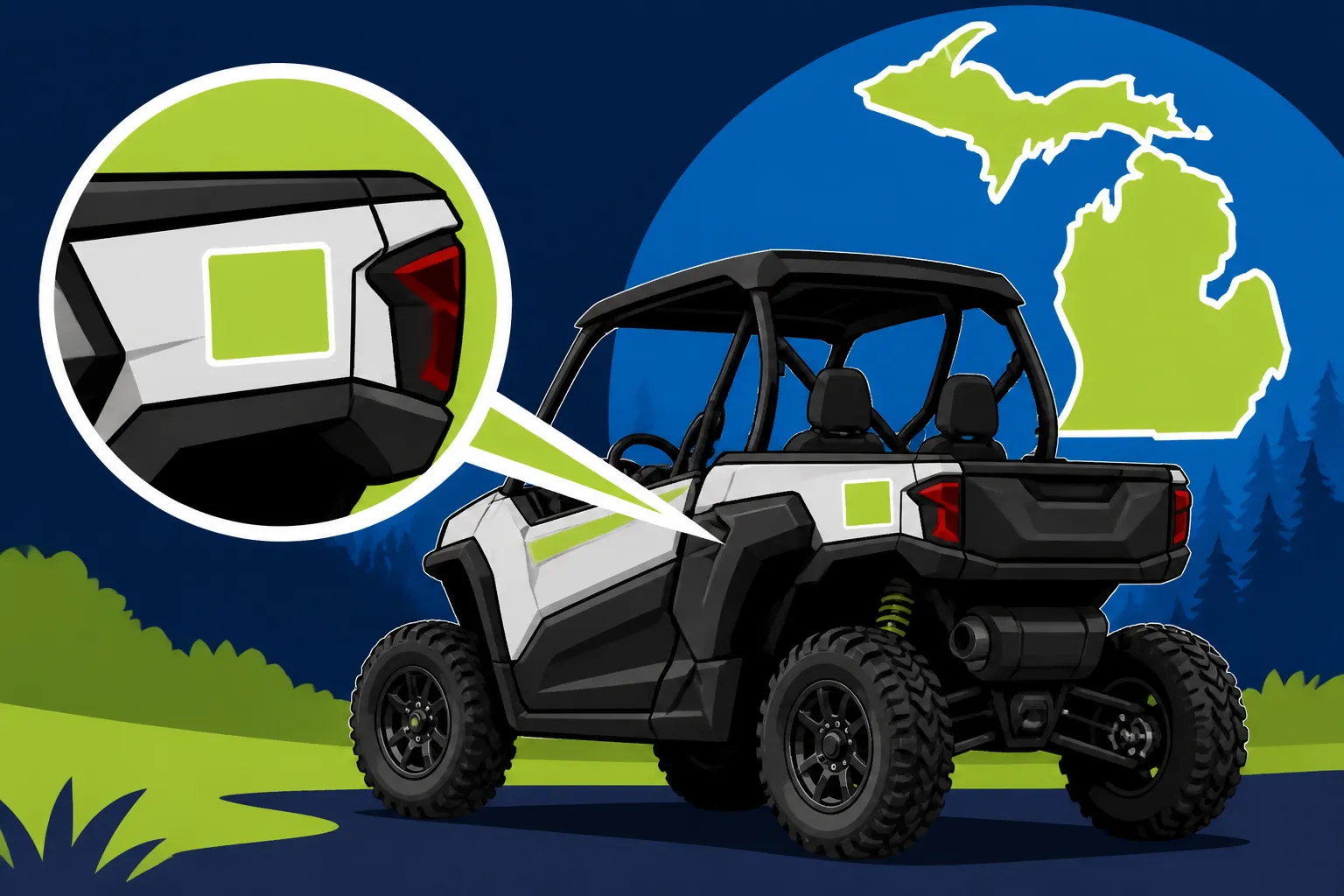
Place the trail permit sticker on a rear body panel where it remains visible from outside. On some machines, a rear fender or fixed panel is a better choice than the tailgate. If the cargo bed is frequently loaded, check whether gear or a cover would conceal the sticker. The same applies to a spare tire, cargo rack, tool box, or other add-on.
Do not choose a spot that is easy to see only when the bed is empty or the tailgate is open. Stickers placed on removable or movable parts can end up facing inward, covered, or separated from the vehicle during ordinary use. A fixed rear panel is generally a more reliable choice.
Keep the two locations distinct
The front license sticker and rear trail permit sticker are not interchangeable. Putting both on the hood, or both on the tailgate, can leave one in the wrong location even if both are visible. Before peeling either backing, set the decals beside the machine and confirm which one belongs at the front and which belongs at the rear.
If you are unsure which decal is which, check the accompanying paperwork or the issuing agency’s instructions rather than relying only on color. Colors and designs can vary. Riders who use different types of public land can also review Michigan ORV License Without a Trail Permit: Where You Can Ride to understand why having a license does not always mean a trail permit is unnecessary.
How to apply the stickers so they stay readable
Good placement starts with surface preparation. Dirt, dust, oil, wax, and dampness can all weaken adhesion. A few minutes of cleaning is easier than trying to repair a decal that has lifted at the edge or fallen off.
- Choose the spot before removing the backing. Check that the panel is on the correct end of the machine, visible from outside, and not covered by normal cargo or accessories.
- Clean the panel. Use a cleaner suitable for the vehicle’s finish and follow its instructions. Remove mud and oily residue, then let the surface dry completely. Avoid harsh solvents that could damage plastic or paint.
- Check the panel temperature and shape. A very cold, wet, rough, or sharply curved surface can make application less reliable. A broad, smooth body panel is usually easier to work with than a narrow edge or textured trim.
- Apply the decal carefully. Follow the instructions supplied with it. Align it before pressing it down, then smooth it from the center outward to reduce wrinkles and trapped air.
- Inspect the edges. Make sure the entire sticker is attached and not folded around a seam where it could peel. Keep it uncovered and avoid washing or scraping the area until the adhesive has had time to set according to the decal instructions.
A soft cloth is useful for cleaning, and a small plastic decal applicator can help smooth a sticker without scratching a panel. Those basic supplies are available from many automotive retailers and on Amazon. Use a tool intended for decals or trim; a metal blade can gouge plastic or paint.
Do not laminate, tape over, or put a clear cover on a sticker unless the issuing agency’s current instructions allow it. A protective layer can make a decal harder to read, change its appearance, or affect whether it meets the display requirement. A roof, windshield, or storage compartment is also a poor substitute for attaching the sticker to a suitable vehicle panel.
Keep stickers visible and deal with problems promptly
Mud, snow, dust, and trail grime can make a correctly placed decal hard to read. Check both stickers before a ride and clean them gently when needed. Avoid aggressive scraping or pressure washing directly at the edges, since either can lift the decal. If the sticker is damaged, missing, or no longer readable, check the current replacement process rather than trying to recreate it with a printout or a homemade copy.
A quick pre-ride check helps catch problems early:
- Is the license sticker still attached at the front?
- Is the trail permit sticker still attached at the rear?
- Can someone outside the machine see each decal?
- Are either of them hidden by cargo, a cover, a rack, or an accessory?
- Has mud or damage made the lettering or identifying details difficult to read?
If you replace a bumper, panel, bed, or other part, check whether the work has covered or removed a sticker. Do not leave a decal on a panel that has been taken off the machine. When changing the location, follow the current display instructions and make sure the sticker remains attached to an appropriate part of the vehicle.
If you buy a used side-by-side, do not assume the previous owner’s stickers meet your needs or can simply be transferred. Confirm what permits are required for the places you plan to ride and how they must be obtained or displayed. A bill of sale or title does not replace a required ORV license or trail permit. For the wider permit rules, see Michigan ORV Permit Year: April 1 to March 31 and Michigan ORV Permit Checks by Conservation Officers.
Sticker placement also cannot resolve a route-access question. A machine can display the right decals and still be prohibited from a particular road, trail, or property. Check route signs, land-manager rules, and local restrictions before setting out. If you’re comparing placement for another machine type, Michigan ORV Sticker Placement on an ATV covers the ATV version.
The practical rule for a side-by-side is straightforward: keep the license sticker at the front and the trail permit sticker at the rear, both firmly attached and clearly visible. Choose fixed body panels, not places that disappear behind gear or accessories, and confirm the current instructions supplied with the decals.
Disclaimer
This article is for general informational purposes only and does not constitute professional advice. Laws, prices and regulations vary by location and change over time. Consult a qualified professional for guidance on your specific situation.