Do You Need Both a License and a Trail Permit in Michigan?
Michigan’s ORV license and trail permit are separate requirements, so buying one does not always cover the other. The key question is where you plan to ride: state-designated ORV trails require both, while some other uses have different rules. Here’s how to tell which document you need, how the costs work, and what not to confuse them with.
The short answer: designated trails require both
If you plan to ride a state-designated ORV trail in Michigan, you need the base ORV license and the additional trail permit. They are separate authorizations, not two names for the same sticker. Buying only the license does not satisfy the trail-permit requirement for those trails.
According to the Michigan Department of Natural Resources, as of October 2026, the annual ORV license costs $26.25 and the additional trail permit costs $10.00, for a combined total of $36.25. The trail permit must be purchased along with the base license.
The basic distinction is straightforward:
- ORV license: the base license.
- Trail permit: the additional permit required for state-designated ORV trails.
- Both together: the documents you need for riding those designated trails.
For a broader explanation of how the two fit together, see Michigan ORV License and Trail Permit Explained. If you’re trying to pin down the additional permit’s role, Michigan’s Extra $10 ORV Trail Permit addresses that specific requirement.
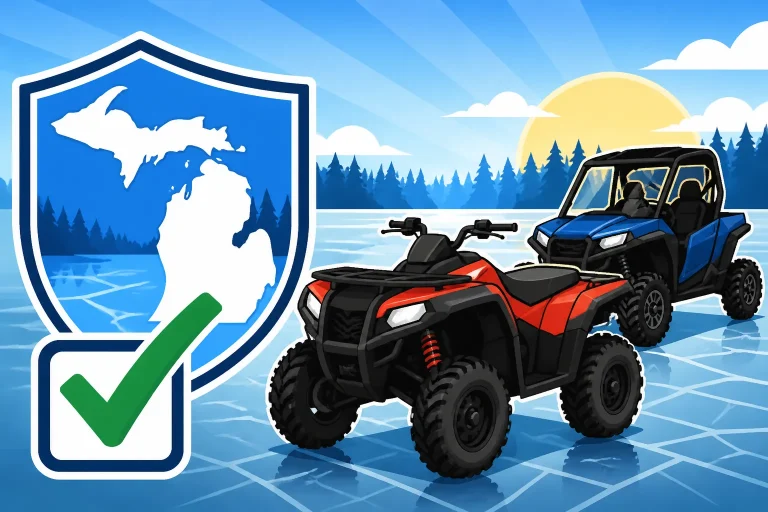
A trail permit is not automatically required for every kind of ORV use. For example, the Michigan Department of Natural Resources says an ORV license is required to ride on the frozen surface of public waters, but a trail permit is not required for that use. That exception is specific to frozen public waters; don’t assume it applies to a nearby trail, route, or other riding area.
The practical rule is to check the type of place you’ll ride before setting out. If it is a state-designated ORV trail, plan on having both. If you’re riding somewhere else, verify the requirement for that location and use rather than relying on the trail permit rule alone.
What the license and trail permit do, and what they do not mean
The terms can be confusing because riders may use “license” to mean several different things. In this context, an ORV license is not a driver’s license, and a trail permit is not a substitute for the ORV license. Each item answers a different question.
| Item | What it means | When it matters |
|---|---|---|
| ORV license | The base Michigan ORV license | Required for the situations specified by Michigan rules, including riding on frozen public waters |
| Trail permit | An additional permit for designated ORV trails | Required when operating on state-designated ORV trails |
| Driver’s license | A credential for driving, subject to the rules for the person and setting | It is a separate issue from buying an ORV license or trail permit |
The Michigan Department of Natural Resources identifies the ORV license and trail permit as separate purchases, with the trail permit added to the license for designated-trail use. Having the trail permit without the required base license does not make the pair complete. Likewise, an ORV license alone does not cover the additional permit required on designated trails.
A driver’s license is different again. According to the Michigan Legislature, adults do not need a driver’s license to operate an ATV on public roads designated for ORV use. For individuals under 18, the Michigan Legislature says the requirement is either to possess a valid driver’s license or to be under the direct supervision of a parent or guardian while holding an ORV safety certificate. Those road-use rules do not replace the separate license and trail-permit requirements.
That distinction is useful when planning a ride that includes more than one type of riding area. You may need to consider the ORV license and trail permit for access, while also checking age, supervision, safety-certificate, and road-use requirements for the riders and route. A permit sticker is not proof that every rider is eligible to operate, or that every road is open to ORVs.
The trail permit follows the trail, not the machine’s name
ATVs and UTVs are both commonly discussed as ORVs, but the label on a machine does not tell you by itself whether a trail permit is required. The relevant question here is whether you are operating on a state-designated ORV trail. Before riding, check the status and rules for the specific trail or area.
This matters especially when a ride begins on one kind of land and continues onto a designated trail. A rider who starts out thinking “I only need the license” may still need the trail permit once the route enters a designated trail. Plan for the whole route, not just the starting point.
Where the extra trail permit is and is not required
The clearest case is state-designated ORV trails: have both the ORV license and trail permit. The Michigan Department of Natural Resources also gives a specific exception for riding on the frozen surface of public waters: an ORV license is required there, but a trail permit is not.
Those examples show why “Do I need both?” cannot be answered without knowing where you intend to ride. The license is the base requirement, while the extra permit is linked to designated-trail use. A location that is not a designated trail may have its own access rules, closures, or operating conditions.
State forest roads are one area riders may want to check separately. The Michigan Department of Natural Resources says state forest roads are generally open year-round to ORV use unless otherwise posted or seasonally closed. That access statement does not, by itself, settle every permit question for a particular road or connecting route. Confirm the rules for the exact road and the rest of your planned ride. Michigan ORV Permit for State Forest Roads Only may help if your route is limited to those roads.
Likewise, don’t treat a trail permit exception as permission to ride wherever you like. A permit does not override a closure, private-property restriction, posted limit, or other operating rule. The Michigan Department of Natural Resources can close state trails and facilities because of weather-related events and wet conditions. Check for current closures before leaving, especially after wet weather.
If your planned route includes frozen public waters, note the distinction carefully: the Michigan Department of Natural Resources says the ORV license is required for that use and the trail permit is not. That is a narrow exception, not a general “license only” rule for every place that is not a designated trail. For details focused on that setting, see [Michigan ORV Permit for Frozen Lakes].
When you cannot tell whether a route is designated, don’t guess based on the road surface, signage you remember from a previous trip, or what another rider purchased. Verify the route designation and current requirements before riding. Michigan ORV License Without a Trail Permit: Where You Can Ride is also relevant when you are planning a ride that may not involve designated trails.
Buying, renewing, and checking your requirements
The simplest way to avoid buying the wrong combination is to decide where you will ride first, then purchase the documents that fit that use. If your plan includes state-designated ORV trails, budget for the combined ORV license and trail permit. If you plan to ride only in a setting with a stated exception, such as frozen public waters, check that the exception applies to your exact activity.
Michigan’s annual ORV license and trail permit do not last for a full year from the day you buy them. According to the Michigan Department of Natural Resources, both expire on March 31 of the following year, regardless of their purchase date. A purchase close to that expiration date therefore does not extend the permit for a full twelve months. Check the permit year before assuming a recently purchased sticker will cover a later ride.
A practical pre-ride check:
- Identify whether your route uses state-designated ORV trails.
- If it does, make sure you have both the ORV license and trail permit.
- If you are relying on an exception, confirm it applies to that specific use.
- Check the permit expiration date and any applicable closures.
- Review separate rider eligibility and operating rules.
For a closer look at the permit cycle, see Michigan ORV Permit Year: April 1 to March 31. If you are unsure whether the permit is needed for every machine in your group or household, Do You Need a Permit for Each ATV You Own? addresses that separate question. Riders visiting from outside Michigan can also check [Out-of-State Riders and the Michigan ORV License] rather than assuming a home-state credential automatically covers every Michigan requirement.
A permit is only one part of legal riding
Possessing the right documents does not settle every safety or operating requirement. According to the Department of Natural Resources, anyone under 16 operating an ORV on public lands must have a valid ORV safety certificate and be under an adult’s direct visual supervision. The Department of Natural Resources also says children under 10 may not operate four-wheel ATVs on public lands. For non-resident operators aged 12 to 15, the Michigan Legislature says a qualifying Michigan safety certificate or a comparable certificate issued under another state or Canadian province’s authority must be presented.
Other operating rules may matter, too. The Michigan Legislature requires a Department of Transportation-approved crash helmet and protective eyewear for ORV operators and passengers in general, while recognizing exceptions under specified conditions. The rules also address equipment and use, including passengers, lighting, and spark arresters. Check the requirements that apply to the machine, rider, and riding area; neither the ORV license nor the trail permit replaces them.
For visitors, owners, and families, the safest approach is to treat paperwork and operating rules as separate checklists. First confirm the license and trail permit for the route. Then confirm that each rider, vehicle, and location meets its own requirements. If the route changes during the ride, revisit the permit question too: adding a designated trail can change what you need even if you already have the base license.
In short, buy both documents when you plan to ride Michigan’s state-designated ORV trails. The ORV license is the base credential; the trail permit is the added requirement for those trails. Some uses have specific exceptions, but those do not erase the need to verify the rules for the rest of your route.
Sources
- Michigan Department of Natural Resources — ORV FAQs – State of Michigan (checked October 28, 2026)
- Michigan Department of Natural Resources — Purchase permit, learn requirements – State of Michigan (checked October 28, 2026)
- Michigan Legislature — MCL – Section 324.81131 (checked October 28, 2026)
Disclaimer
This article is for general informational purposes only and does not constitute professional advice. Laws, prices and regulations vary by location and change over time. Consult a qualified professional for guidance on your specific situation.