Michigan Low-Speed Vehicle vs ORV
It can be incredibly confusing when you're trying to figure out where you can legally ride your ATV or UTV in Michigan, especially when terms like "Low-Speed Vehicle" and "Off-Road Vehicle" start getting tossed around. Many riders just want to use their machine for more than just trails, perhaps to run into town for gas or traverse a short stretch of road, only to find themselves lost in a maze of regulations. This guide will cut through the confusion, clearly defining what each term means under Michigan law and how those distinctions impact where and how you can ride.
Understanding Michigan's Low-Speed Vehicle (LSV) Definition
Let's start by demystifying the Low-Speed Vehicle, or LSV. In Michigan, an LSV isn't just any old golf cart or slow-moving machine; it's a very specific category of vehicle designed primarily for use on certain public roads. The legal definition is quite precise, and if your vehicle doesn't meet all the criteria, it's not an LSV, no matter how slow it goes.
What Makes a Vehicle an LSV?
Michigan law defines a low-speed vehicle as a four-wheeled motor vehicle whose top speed is greater than 20 miles per hour but not greater than 25 miles per hour. This is a crucial speed range. If your machine can only hit 15 mph, it's too slow. If it can easily cruise at 30 mph, it's too fast to be an LSV without modification.
Beyond the speed, an LSV must also meet several federal safety standards for motor vehicles. This is where many off-road vehicles (ORVs) stumble when trying to become street legal. An LSV needs to be equipped with a range of safety features that are standard on cars, not typically found on trail-focused ATVs or UTVs. Think about things like headlamps, tail lamps, stop lamps, turn signals, reflex reflectors, an exterior mirror on the driver's side (and often a passenger side or rearview mirror), a parking brake, a VIN (Vehicle Identification Number), and safety belts. All these components must be Department of Transportation (DOT) approved. So, while your side-by-side might have headlights, are they DOT-approved headlights? Do your tires have a DOT rating? [Safety Glass, Mirrors and Horns: Michigan's Street-Legal List] delves deeper into these requirements. This is where an aftermarket supplier like SuperATV might come into play, offering conversion kits or individual components that meet these stricter road-legal standards.
Where Can You Drive an LSV in Michigan?
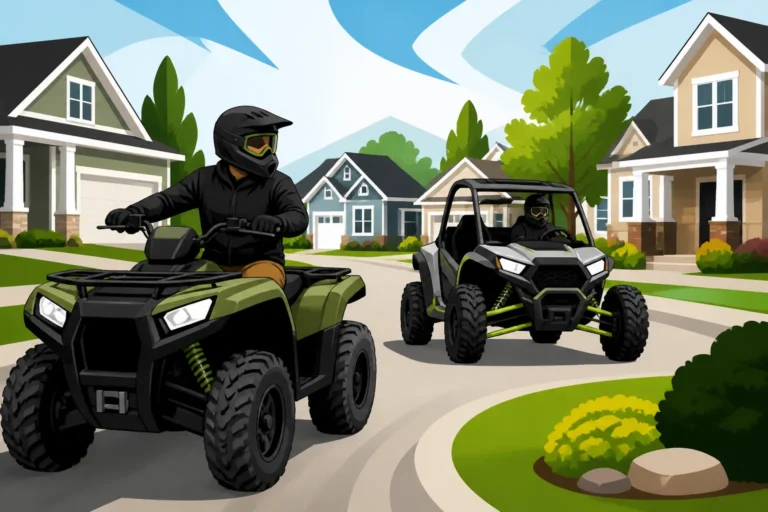
The rules for where an LSV can operate are also very specific. LSVs are generally allowed on public roads where the posted speed limit is 35 miles per hour or less. This means you won't be taking your LSV out on state highways or busy county roads with higher speed limits. It's really designed for local travel within communities, neighborhoods, and smaller towns.
However, even on roads with a 35 mph limit, local municipalities (cities, townships, villages) still have the authority to restrict or even prohibit LSV operation on their streets. So, just because the state law allows it, you always need to check with your specific local government's ordinances before assuming you can zip around. This patchwork of local rules can be a real headache, making it tough to know if your short road trip is legal or not. LSVs must also be titled and registered with the Michigan Secretary of State, similar to a traditional car, and require a valid driver's license to operate.
Unpacking Michigan's Off-Road Vehicle (ORV) Designation
Now let's switch gears to the Off-Road Vehicle, or ORV. This is likely the category most of us are familiar with when we think of ATVs, UTVs, dirt bikes, and even some snowmobiles. Michigan defines ORVs broadly, focusing on their design for off-highway use.
What Qualifies as an ORV in Michigan?
An ORV is a motor-driven off-road recreation vehicle capable of cross-country travel without benefit of a road or trail, on or over land, snow, ice, marsh, swampland, or other natural terrain. This includes vehicles like all-terrain vehicles (ATVs), dirt bikes, utility terrain vehicles (UTVs or side-by-sides), and even certain types of golf carts if they're used off-road. The key here is "off-road recreation." These machines are built for adventure, for tearing up trails, mudding, or cruising through the woods, not for commuting to work on paved streets.
Unlike LSVs, ORVs are not primarily designed to meet federal motor vehicle safety standards for on-road use. They might have powerful engines, aggressive tires, and robust suspension, but their lighting, braking, and occupant protection systems are typically geared towards off-road conditions, not highway speeds or compliance. While ORVs require a title from the Michigan Secretary of State, they do not get a traditional license plate. Instead, they require an ORV license and a trail permit if you're riding on designated trails or public lands. [Michigan ORV Title Application and What It Costs] covers the titling process, while [Michigan ORV License and Trail Permit Explained] dives into the permits.
Where Can You Ride an ORV in Michigan?
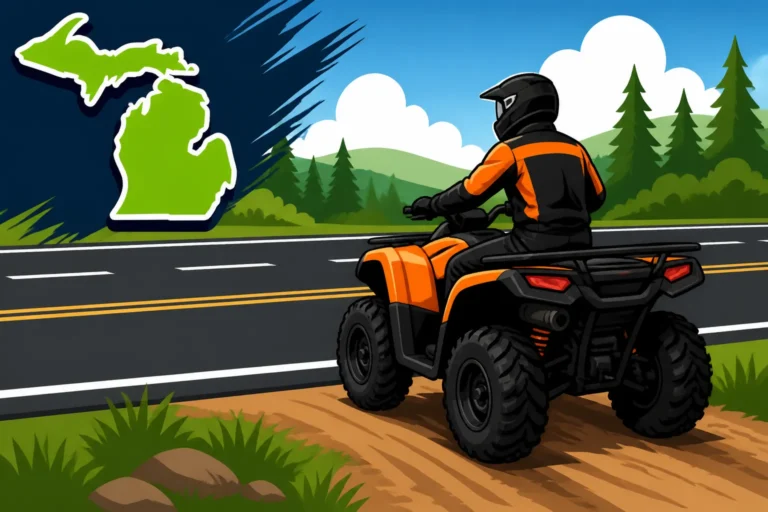
Michigan boasts an incredible network of designated ORV trails, routes, and scramble areas where these machines are welcome. This includes state forest lands, some county roads (where ordinances allow), and private property (with permission). The state is very clear: ORVs are generally not permitted on public roads and highways unless that specific road is designated as an ORV route or unless you are crossing a road.
There are specific, often county-level, ordinances that open certain county roads to ORV use, but these always come with strict rules, such as speed limits (often 25 mph), riding on the far right shoulder, and requiring specific safety equipment like helmets (for ATVs and sometimes UTVs, depending on the rules). [Michigan's 25 mph Limit on County Roads] and [Michigan County ORV Ordinances Explained] provide more context here. It's a common misconception that if a county allows ORV riding on its roads, your UTV magically becomes a street-legal vehicle like a car or an LSV. That's simply not the case. You're still operating an ORV with specific restrictions.
Key Differences: Michigan LSV vs. ORV
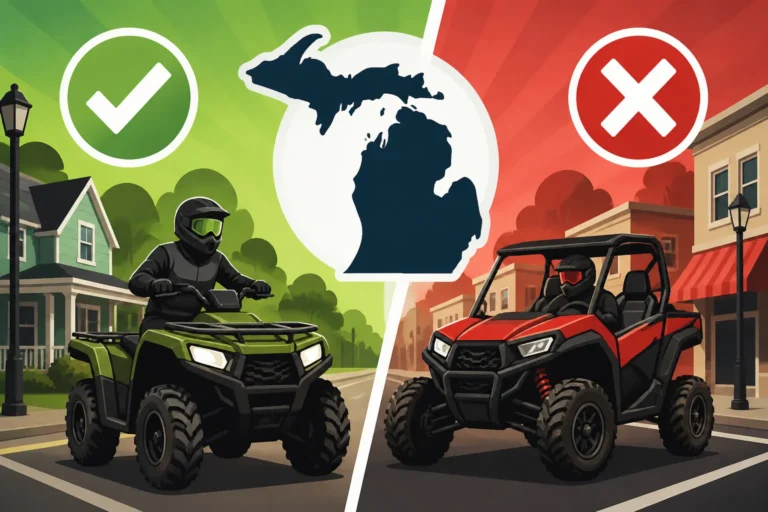
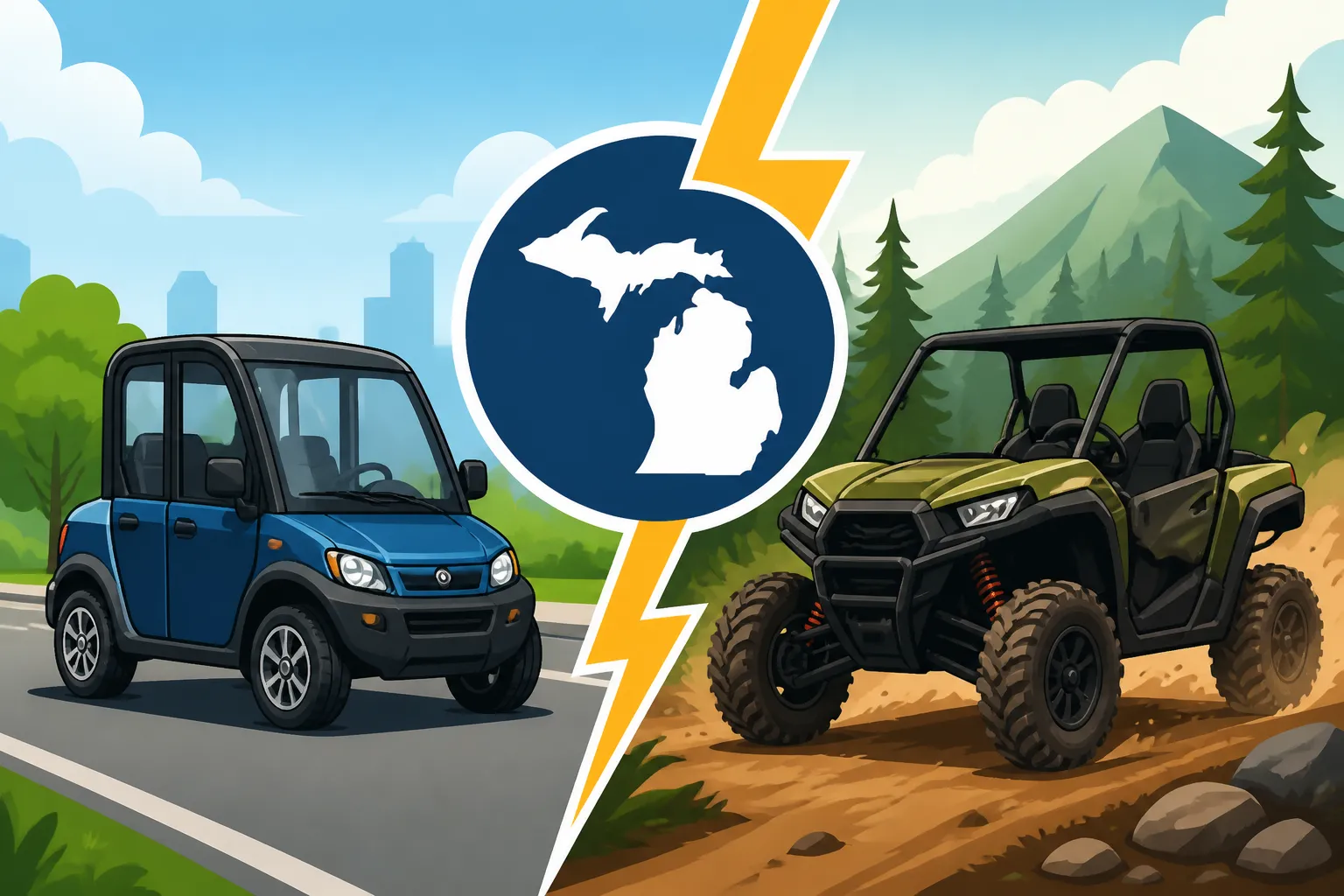
The distinction between a Low-Speed Vehicle and an Off-Road Vehicle in Michigan boils down to their intended design, the specific safety equipment they must carry, and, most importantly, where they are legally permitted to operate. Misunderstanding these differences can lead to tickets, accidents, or even legal complications if you're involved in an incident.
Intended Use and Design Philosophy
At their core, the two vehicle types have fundamentally different purposes. An LSV is a street-legal, low-speed commuter or neighborhood vehicle. It's designed to operate safely on specific public roads, interacting with cars and other traditional traffic, albeit at lower speeds. Think about the golf cart communities in Florida or Arizona; that's the kind of environment an LSV is built for.
An ORV, on the other hand, is built for the rugged, unpredictable conditions of off-road terrain. It's about recreational adventure, navigating trails, hills, and mud. While a UTV might seem like it could be a good fit for road use, its construction, tires, and suspension are optimized for traction and durability off-pavement, not necessarily for smooth, controlled handling on asphalt at higher speeds.
Equipment and Safety Standards
This is where the rubber meets the road, quite literally. An LSV must meet a stringent list of federal motor vehicle safety standards (FMVSS) to be deemed road-legal. This includes items like proper windshields, DOT-approved tires, mirrors, seat belts for all occupants, headlamps, tail lamps, stop lamps, and turn signals. These aren't just accessories; they are critical safety components. A vendor like SuperATV offers many components for UTVs, but specific "street legal" kits often aim to bridge this gap for ORVs to meet LSV-like or street-legal requirements, though it's a complex process to actually get an ORV reclassified.
ORVs, while they have safety features (like roll-over protection systems in UTVs), are not held to the same FMVSS for road use. Their equipment is designed for visibility and safety on trails. For example, an ORV might have headlights, but they might not provide the specific beam pattern or brightness required for street driving. Similarly, ORV tires are typically aggressive knobbies, excellent for grip in dirt but not ideal for pavement wear or noise.
Road Legality and Operating Requirements
This is arguably the most critical difference for Michigan riders.
| Feature | Low-Speed Vehicle (LSV) | Off-Road Vehicle (ORV) |
|---|---|---|
| Primary Use | On-road (low-speed public roads) | Off-road (trails, private land, designated routes) |
| Maximum Speed | > 20 mph, <= 25 mph | Varies greatly (can exceed 25 mph) |
| Roads Allowed | Public roads with posted speed <= 35 mph (local rules apply) | Designated ORV routes, certain county roads (with ordinances), private property |
| Titling | Yes, with Secretary of State (like a car) | Yes, with Secretary of State (specific ORV title) |
| Registration | Yes, requires traditional license plate | No traditional license plate, requires ORV license & trail permit |
| Driver's License | Valid Michigan driver's license required | Valid Michigan driver's license or ORV safety certificate (age dependent) |
| Safety Equipment | Full FMVSS compliance (DOT tires, windshield, mirrors, seat belts, full lighting suite) | Basic safety features for off-road use (less stringent than LSV) |
| Fuel Source | Gasoline, electric | Gasoline, electric |
| Insurance | Michigan no-fault insurance required | ORV liability insurance recommended, sometimes required for road use |
An LSV, once titled and registered, is treated much like a traditional motor vehicle within its limited operating parameters. It must carry Michigan no-fault insurance, and its operator must have a valid driver's license.
An ORV, on the other hand, is inherently an off-road machine. Any road use is an exception, not the rule. When an ORV is allowed on a county road (via ordinance), it must still follow very specific ORV road rules, which often include riding on the far right of the paved portion or shoulder, maintaining slow speeds, and sometimes requiring helmets. It's a different legal framework entirely. [Driver's License Rules for Michigan ORV Road Riding] outlines who can operate these machines on public thoroughfares.
Why This Distinction Matters for Michigan Riders
Understanding the difference between an LSV and an ORV isn't just a matter of legal jargon; it has real, practical implications for every rider in Michigan. It impacts what you buy, how you equip it, where you can ride, and the potential legal consequences if you get it wrong.
Avoiding Legal Headaches and Fines
Trying to use your UTV (an ORV) as if it were an LSV on public roads where it's not permitted can quickly land you a ticket for illegal operation. Law enforcement officers are well-versed in these distinctions. They know that a side-by-side, even if it has some aftermarket street-legal accessories, typically does not meet the full definition of an LSV. The fines can be significant, and you could even face impoundment of your vehicle.
Similarly, if you're driving an LSV and venture onto a road with a speed limit over 35 mph, you're breaking the law. Ignorance of the law is rarely an excuse, and these regulations are in place for public safety.
Safety Concerns on Public Roads
Beyond the legal aspect, there's a significant safety concern. ORVs are not designed for road speeds or interaction with standard traffic. Their suspension, braking, and tires perform differently on pavement compared to dirt. At 45 mph on a paved road, an ORV can be unstable and difficult to control, especially if it encounters uneven pavement or needs to stop suddenly. Their often-knobby tires have less contact patch and grip on asphalt compared to an LSV's smoother, DOT-approved tires.
Conversely, an LSV, while designed for low-speed road use, is not built for the rigors of off-road trails. Taking an LSV onto a challenging ORV trail could damage the vehicle and put occupants at risk, as its components are not engineered for such stresses.
The Street-Legal UTV Conversion Conundrum
Many UTV owners want to make their machine "street legal" to enjoy more versatile use. This is where the LSV vs. ORV debate gets particularly sticky. [How to Make a Side-by-Side Street Legal in Michigan] is a great resource, but it's important to recognize that making an ORV "street legal" often means one of two things in Michigan:
- Meeting ORV Road Rules: This involves adding specific equipment (like a horn, certain lights, sometimes a whip flag) so your ORV can be operated on county roads that specifically allow ORVs. You're still operating an ORV under ORV rules, not a fully street-legal vehicle like an LSV.
- Becoming an Assembled Vehicle: This is a much more intensive process. If your ORV is modified to meet all federal safety standards, it might be titled as an "assembled vehicle" or "specially constructed vehicle" by the Secretary of State, which would allow it to operate more like a traditional car. This route requires a thorough inspection by law enforcement or the Secretary of State, ensuring it meets all the stringent requirements, which go far beyond what an LSV needs. This is the path many custom builders or enthusiasts take if they truly want their UTV to operate freely on most roads.
The key takeaway here is that simply adding a turn signal kit from a company like SuperATV doesn't automatically transform your ORV into an LSV or a fully street-legal vehicle. It merely makes it compliant with some ORV road rules, or it's a step toward the much more involved assembled vehicle process. Always clarify which set of rules you're trying to meet.
In Michigan, whether you ride an LSV or an ORV, understanding the specific laws, equipment requirements, and permitted operating areas is paramount. It ensures your safety, the safety of others, and keeps you on the right side of the law.
Disclaimer
This article is for general informational purposes only and does not constitute professional advice. Laws, prices and regulations vary by location and change over time. Consult a qualified professional for guidance on your specific situation.