Michigan ORV Permit Exemptions on Private Land
Michigan ORV Permit Exemptions on Private Land
A private property ride can seem simple until you wonder whether your ATV or UTV needs an ORV license, a trail permit, or the landowner’s permission. The key is where the machine actually goes: private property, public land, a trail, or a road can bring different rules. Here’s how to think through the exemption and avoid carrying it beyond its limits.
When a private-land ride may be exempt
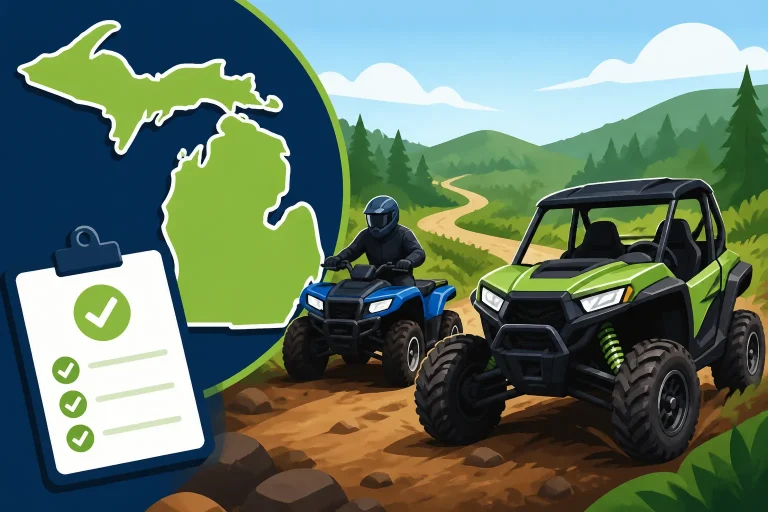
If you ride entirely on private property and have permission to be there, the Michigan ORV license and trail permit generally are not required for that ride. The important condition is that the ride stays on private land. A private-land exemption is not a permit to continue onto a state trail, public road, or other public riding area.
That distinction can be easy to miss when private property connects to a trail or road. A machine might begin its trip at a cabin, farm, or home and then cross a public section to reach another part of the property or a riding area. Don’t assume that starting on private land makes the entire trip exempt. Confirm whether each section is private or public, and check the rules that apply to any public section.
Permission matters, too. Owning the ORV does not give you permission to ride on someone else’s property. If you are visiting a friend, using leased hunting land, or staying at a family cabin, get clear permission from the person responsible for the property and check any limits they set. A landowner may allow riding in one area but prohibit it elsewhere, or may restrict access at certain times. The permit question and the land-access question are separate.
For related situations, see Michigan ORV Permit Exemption on Your Own Land, Riding on a Friend’s Land Without a Michigan Permit, Michigan Permit Rules on Leased Hunting Land, and Permit Rules for a Family Cabin Property. These distinctions matter because a ride that is exempt while it stays on private land may need permits once it enters a public riding area.
A private-land ride may still be affected by other rules. Permit status answers whether a particular permit is needed; it does not settle every question about safe operation, equipment, passengers, noise, or access. Rules can also differ depending on whether the machine is an ATV or a UTV and where it is being operated. If the boundary or legal status of a route is unclear, check with the Michigan Department of Natural Resources and the landowner before riding.
Where the exemption stops
The safest way to apply a private-land exemption is to consider the route one section at a time. Identify where the ride begins, where it will go, and whether it crosses onto public land or a public route. A map can help, but property lines and public access designations are not always obvious on the ground. If you cannot confirm that a section is private, don’t treat it as covered by the private-land exemption.
Trails and other public land
A state-designated ORV trail is not the same as a private path, even if it runs near private property. According to the Michigan Department of Natural Resources, an annual ORV license costs $26.25, and riding on state-designated ORV trails requires an additional $10.00 trail permit, for a combined total of $36.25 (as of October 2026). The distinction between the base license and trail permit matters: the added trail permit is required for designated trails, while other public riding may have different requirements.
According to the Michigan Department of Natural Resources, annual ORV licenses and trail permits expire on March 31 of the following year, no matter when they were purchased. If you buy a permit partway through its term, do not assume it remains valid for a full year from the purchase date.
For help sorting out which documents apply to a planned ride, see Do You Need Both a License and a Trail Permit in Michigan? and Michigan ORV License Without a Trail Permit: Where You Can Ride. A permit that covers one kind of public use does not necessarily cover every other type of public riding.
Roads and crossings
A private-land exemption does not make a public road a private route. If your plan involves riding on or crossing a road, confirm that ORV use is allowed there and review the rules for that road. Whether a road is open can depend on its designation and local rules, so don’t rely on the fact that it connects two private areas.
According to the Michigan Legislature, a driver’s license is not required for adults operating an ATV on public roads designated for ORV use. Individuals under 18 must either have a valid driver’s license or ride under the direct supervision of a parent or guardian while holding an ORV safety certificate. Those road-use conditions are separate from whether the private-land permit exemption applies to another part of the ride.
Public waters and state forest roads
A frozen public waterway is still a public riding area, not private land. According to the Department of Natural Resources, ORVs may be operated on the frozen surface of public waters with an ORV license, but a trail permit is not required for that specific use. For more detail, see Michigan ORV Permit for Frozen Lakes.
State forest roads are also public areas. According to the Michigan Department of Natural Resources, they are generally open year-round to ORVs unless posted otherwise or seasonally closed. Check signs and closure information before riding; the fact that a road is normally open does not guarantee access on a particular day.
Other rules to check before riding
A permit exemption does not mean every other operating rule disappears. Requirements may depend on the riding location, the type of machine, the operator’s age, and the machine’s equipment. Check the rules for the place and activity you have planned, rather than treating “private land” as a blanket exception from all ORV requirements.
Young riders
The public-land requirements for young riders are important if a trip leaves private property. According to the Department of Natural Resources, a person under 16 operating an ORV on public lands must have a valid ORV safety certificate and be under an adult’s direct visual supervision. Children under 10 are prohibited from operating four-wheel ATVs on public lands. The Department of Natural Resources also says that anyone under 16 must complete an approved ORV safety course and carry the certificate to operate an ORV on public lands.
These are public-land rules, so do not use them as a substitute for checking what applies on private property, at a trail, or on a road. If a young rider’s route may enter public land, confirm that the rider meets the applicable requirements before the machine leaves the private parcel. See Michigan ORV Safety Certificate for Riders Under 16 for more on that subject.
Non-resident families should check certificate recognition as well. According to the Michigan Legislature, non-resident operators aged 12 to 15 must present a Michigan Part 811 ORV safety certificate or a comparable certificate issued under another state or a Canadian province’s authority.
Helmets and safety belts
Helmet requirements have exceptions, but they are not a reason to guess about equipment. According to the Michigan Legislature, ORV operators and passengers generally must wear a Department of Transportation-approved crash helmet and protective eyewear. Exceptions include certain private-property use with permission and riding in a UTV with an approved roof and properly fastened safety belts.
According to the Department of Natural Resources, UTV occupants need properly adjusted and fastened seat belts, along with a roof that meets the applicable standard, to use the helmet-law exception. Some managed riding areas have their own additional requirements: the Department of Natural Resources says every occupant at the Silver Lake ORV Area must wear a seat belt. Check the rules for the specific destination, even if the ride begins on private land.
Passengers and machine design
Do not assume that an ATV can carry a passenger just because there is room to sit. According to the Michigan Legislature, carrying a passenger on an ORV is illegal unless the machine’s manufacturing standards or design explicitly provide for transporting passengers. Follow the machine’s intended seating capacity and any applicable site rules.
Equipment and operation
Some operating requirements apply in public riding environments regardless of whether the rider needs a trail permit. For example, according to the Michigan Legislature, ATVs operated on public lands must have a United States Forest Service-approved spark arrester and a muffler in good working order and constant operation. The Michigan Legislature also sets ORV exhaust noise limits: no more than 94 dB(A) for vehicles manufactured after January 1, 1986, or 99 dB(A) for older models, when tested using the SAE J1287 stationary test procedure.
Lighting rules matter if a ride uses public routes after dark. According to the Michigan Legislature, an ORV must have a lighted headlight and taillight from a half-hour after sunset to a half-hour before sunrise. These are not details to postpone checking until the machine reaches a trailhead.
Alcohol is another reason to treat every ride seriously, including one that begins on private property. According to the Michigan Legislature, the legal blood alcohol concentration limit for operating an ORV is 0.08 grams or more per 100 milliliters of blood, per 210 liters of breath, or per 67 milliliters of urine. The Michigan Legislature sets the first-offense OUI fine range at $100.00 to $500.00 (as of October 2026). Do not ride after drinking.
A practical way to confirm your permit status
Before heading out, run through the planned ride from start to finish. The aim is to confirm that the private-land exemption fits the whole route, not just the first few minutes.
-
Confirm who controls the land. Identify the owner or person responsible for the property and ask for permission if you do not own it. Clarify where riding is allowed and whether the permission includes access roads or paths.
-
Trace the full route. Mark any state trail, public road, state forest road, public water, or other public area the machine might enter. Do not assume that a route is private because it begins at a private home or cabin.
-
Check the permit requirement for each public section. The ORV license and trail permit are not interchangeable. According to the Michigan Department of Natural Resources, a state-designated ORV trail requires the base ORV license plus the additional trail permit. For other public settings, check the applicable rules rather than relying on trail-permit guidance alone.
-
Check the machine and rider requirements. Confirm that the ORV is appropriate for its intended use, that the operator and passengers meet relevant requirements, and that required safety equipment is in place. For trips involving public land, check the young-rider, helmet, lighting, and spark-arrester rules that apply.
-
Look for closures and posted restrictions. According to the Michigan Department of Natural Resources, weather and wet conditions can lead to state trail or facility closures. Check current notices and signs before riding, and be prepared to change plans if access is closed.
-
Keep your documents and plans accessible. If your route includes public land, carry or have access to the documents required for that ride, including any applicable permit and a young rider’s safety certificate. Keep the landowner’s permission clear as well, especially when other people in your group may not know the property boundaries.
This process is useful for common edge cases. A machine stored at a cabin may be ridden on the cabin’s private property without the same permit requirements as a state trail, but a ride from the cabin onto a public route needs a separate check. A leased hunting parcel may be private, but you still need permission and should verify the lease’s access terms. And if you plan to use frozen public water, the private-land exemption does not apply to that section; check the ORV license requirement for that use.
If a planned route crosses a public trail, see Michigan ORV License Without a Trail Permit: Where You Can Ride and Michigan ORV Permit for Frozen Lakes for the permit distinctions. If you are unsure about a boundary, ask the landowner and confirm the public-land rules with the Michigan Department of Natural Resources before riding.
Frequently Asked Questions
Do I need a Michigan ORV permit to ride only on my own private land?
If the machine stays entirely on private property, the ORV license and trail permit generally are not required for that private-land ride. The exemption does not cover a section of public land or a state-designated trail.
Can I ride on a friend’s property without a permit?
A private-land ride may be exempt from the ORV license and trail permit, but you still need the landowner’s permission. If the route leaves private property, check the permit and access rules for the public section.
Does private-land permission let me ride on a public trail?
No. Permission to use private property does not make a public trail private or replace any permits required there. Check the trail’s rules before using it.
Do I need an ORV license on frozen public water?
According to the Department of Natural Resources, an ORV license is required to ride on the frozen surface of public waters, but a trail permit is not required for that specific use.
Sources
- Michigan Department of Natural Resources — ORV FAQs – State of Michigan (checked October 28, 2026)
- Michigan Department of Natural Resources — Purchase permit, learn requirements – State of Michigan (checked October 28, 2026)
- Michigan Legislature — MCL – Section 324.81131 (checked October 28, 2026)
- Michigan Legislature — MCL Section 324.81133 (checked October 28, 2026)
- Michigan Legislature — MCL Section 324.81134 (checked October 28, 2026)
- Michigan Legislature — Michigan Compiled Laws, Section 324.81147 (checked October 28, 2026)
Disclaimer
This article is for general informational purposes only and does not constitute professional advice. Laws, prices and regulations vary by location and change over time. Consult a qualified professional for guidance on your specific situation.