Non-Resident ORV Permits in Michigan
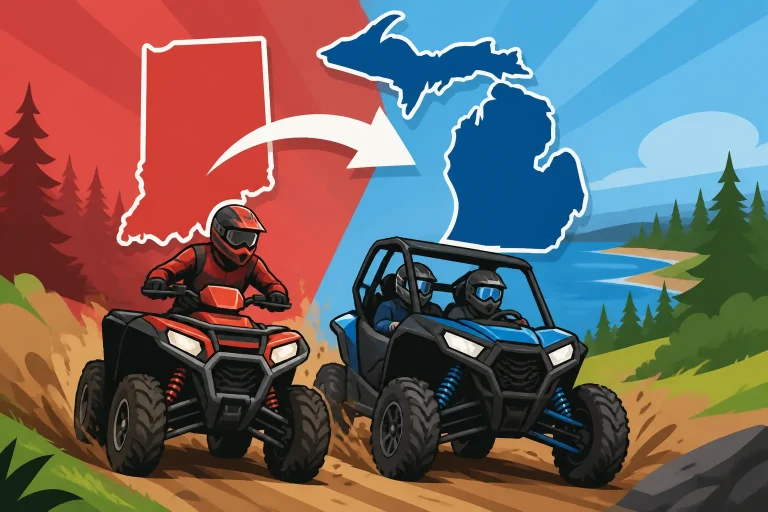
Non-residents can ride Michigan’s trails and other public riding areas, but permit rules, safety requirements, and exceptions can be easy to mix up. The key is to understand the difference between the base ORV license and the extra trail permit, check which one applies to your planned ride, and sort out purchase and youth-certificate requirements before you travel.
What non-resident riders need to know about Michigan permits
Michigan’s permit system has two parts: an annual ORV license and, for riding on state-designated ORV trails, an additional trail permit. A trail permit does not replace the base license. According to the Michigan Department of Natural Resources, the annual ORV license costs $26.25, the extra trail permit costs $10.00, and the combined cost is $36.25 as of October 2026.
For non-residents, the practical question is not simply whether you live in Michigan. It is where you plan to operate the machine and which permit rules apply there. The Michigan DNR says non-residents can purchase Michigan ORV licenses and trail permits through the same listed channels as residents. That lets visiting riders obtain the Michigan credentials needed for their plans rather than assuming a home-state permit automatically substitutes.
| Planned use | Permit point to check |
|---|---|
| State-designated ORV trails | The Michigan DNR requires the base ORV license and an additional trail permit for this use. |
| Other public riding areas | Check the rules for the specific land or route; do not assume a trail permit covers every place or that it is needed everywhere. |
| Frozen public waters | The Department of Natural Resources requires an ORV license for this use, but says a trail permit is not required. |
| State forest roads | The Michigan DNR says these roads are generally open year-round to ORV use unless posted otherwise or seasonally closed. Confirm the road’s status before setting out. |
The distinction matters because a rider may need both credentials for a trail ride, while a different kind of use may have a different permit requirement. If a ride combines trails, forest roads, and other areas, check each part of the route rather than relying on one general assumption. The article Do You Need Both a License and a Trail Permit in Michigan? explains the two-part structure in more detail, while Michigan ORV Permit Rules for Frozen Lakes covers the frozen-water exception.
Do not treat a license or trail permit as permission to ride anywhere. Land managers can close trails and facilities, and roads or routes can have separate restrictions. Permits address permit requirements; they do not override closures, land access rules, or operating and safety laws.
Out-of-state permits and safety certificates are also different things. A safety certificate concerns rider training and eligibility; it is not a substitute for a Michigan ORV license or trail permit. Likewise, buying a Michigan permit does not by itself establish that a rider meets the applicable age or supervision rules.
Where and how non-residents can buy permits
The Michigan Department of Natural Resources allows non-residents to purchase Michigan ORV licenses and trail permits online through eLicense, through the Michigan DNR Hunt Fish mobile app, or in person at an authorized DNR license agent or dealer. Choose whichever option fits your trip, but give yourself time to complete the purchase and understand how the permit must be carried or displayed according to current instructions.
Before buying, identify the kind of riding you expect to do. If your route includes state-designated ORV trails, plan for both the base license and trail permit. If you will only use a location with a stated exception, confirm that the exception applies to your exact activity and place. For example, the Michigan DNR says riding on the frozen surface of public waters requires an ORV license but not a trail permit. That does not mean the trail-permit exemption carries over to a nearby designated trail.
The purchase process is a good time to check that you have selected the right machine and use. The Michigan Department of Natural Resources designates three ORV trail types by width: motorcycle-only trails maintained at a 24-inch width, trails maintained at a 50-inch width, and ORV routes maintained at a minimum 72-inch width. Because route access can depend on machine width and designation, verify that your machine fits the route rules as well as the permit category.
After purchase, keep a record of the transaction and make sure you know how to show the permit if asked. A phone record can be useful for reference, but do not assume a screenshot or purchase confirmation is the same as any required license or sticker. Follow the Michigan DNR’s current instructions for proof and placement. For more on the buying process, see Where to Buy a Michigan ORV License and Michigan ORV License on Your Phone.
Michigan ORV licenses and trail permits expire on March 31 of the following year, regardless of when they were purchased, according to the Michigan Department of Natural Resources. Buying late in the permit year does not move the expiration date forward. If your visit crosses that date, or you return for another season, check whether you need to renew before riding.
A simple pre-purchase checklist can prevent the most common mix-ups:
- List the trails, roads, and other areas you intend to ride.
- Check the posted rules and closures for each location.
- Confirm whether the route requires the base ORV license, the trail permit, or both.
- Check the machine’s width and the route’s vehicle limits.
- Confirm the permit is valid for your riding dates and know how the DNR instructs riders to display or carry it.
- If a young person will ride, check certificate, supervision, and age rules separately from the permit purchase.
For broader background on cross-border permit questions, [Michigan ORV Reciprocity With Neighboring States] and [Out-of-State Riders and the Michigan ORV License] are useful companion reads. Reciprocity can concern one requirement without resolving every other requirement, so check permit rules and safety-certificate acceptance as separate matters.
Exceptions and route rules that can change what you need
The most reliable way to apply Michigan’s permit rules is to match the permit to the activity. “Public land” is not a single, uniform riding category, and having an ORV license does not guarantee that every trail or road is open to your machine. A state-designated trail, a state forest road, and a frozen public water surface can have different requirements.
The frozen-water rule is a clear example of a limited exception. The Department of Natural Resources says an ORV license is required to operate on the frozen surface of public waters, but a trail permit is not required for that specific use. Keep the exception narrow: it does not waive the license, and it should not be treated as an exemption for ordinary trail riding.
State forest roads are generally open year-round to ORV use unless otherwise posted or seasonally closed, according to the Michigan Department of Natural Resources. “Generally open” is not the same as guaranteed access. A closure notice, road sign, seasonal restriction, or local restriction can change what is allowed. Weather and wet conditions can also lead the DNR to close state trails and facilities. Check before leaving and again if conditions change.
This is especially important for visitors who have planned a long route or are towing a machine to a specific trailhead. A map may show a route, but it may not tell you whether the route is currently closed, whether a machine of your width is allowed, or whether a connected road has a separate rule. Build flexibility into the plan rather than treating a permit purchase as proof that the entire route is accessible.
Private land is a separate subject. Do not assume that the public-land permit rules and private-land exceptions work the same way in every situation. If most of your riding will take place on private property, confirm the landowner’s permission and check the precise permit exemption that applies. Michigan ORV Permit Exemptions on Private Land provides a focused explanation of that issue.
If you will ride a mix of public and private land, plan for the public portion on its own. A private-land exception does not automatically carry over to a trail, road, or public facility later in the trip. Similarly, a permit that is sufficient for one area does not settle questions about closures, vehicle width, youth eligibility, or equipment.
Safety and operating rules for visiting riders
Permit compliance is only one part of a lawful and safe ride. Non-residents should check Michigan’s rider, vehicle, and road rules before arriving, even if the rules at home are familiar. The requirements can differ, and an out-of-state permit or training credential does not necessarily remove Michigan operating obligations.
Youth riders and safety certificates
According to the Michigan Legislature, non-resident operators aged 12 to 15 must present an ORV safety certificate issued under Michigan law or a comparable certificate issued under the authority of another state or a province of Canada. The Department of Natural Resources says youth under 16 must complete an approved ORV safety course and carry the certificate when operating an ORV on public lands.
Michigan’s supervision requirements are important as well. The Department of Natural Resources says operators must be at least 16 to operate an ATV unsupervised on public lands. Anyone under 16 must have a valid ORV safety certificate and be under an adult’s direct visual supervision. The Department also prohibits children under 10 from operating four-wheel ATVs on public lands altogether.
Do not rely on a certificate alone to answer every question. For a young non-resident, check that the certificate is comparable and issued under the authority described by the Michigan Legislature, and make sure the rider’s age and supervision fit the applicable Michigan rule. A parent or guardian should be prepared to supervise closely, not merely be somewhere nearby.
The related articles Safety Certificate Reciprocity for Michigan Riders and Michigan Rules for 12- to 15-Year-Old Riders can help clarify which certificate questions to resolve before travel.
Road riding, helmets, and passengers
Some Michigan roads may be designated for ORV use, but road access does not mean ordinary road-vehicle rules disappear. The Michigan Legislature says adults do not need a driver’s license to operate an ATV on public roads designated for ORV use. People under 18 must either have a valid driver’s license or be under a parent or guardian’s direct supervision while holding an ORV safety certificate. Check the specific road’s designation and restrictions before riding on it.
Helmet and eye protection rules also require attention. The Michigan Legislature says ORV operators and passengers generally must wear a Department of Transportation-approved crash helmet and protective eyewear. It describes exceptions under certain conditions, including operation on private property with permission or riding in a UTV with an approved roof and properly fastened safety belts. Because an exception depends on the conditions being met, do not assume that a roof alone means helmets are optional.
Passengers may be carried only when the vehicle’s manufacturing standards or design explicitly provide for transporting passengers, according to the Michigan Legislature. A passenger should not be added to a machine simply because there is room to sit. UTV occupants who rely on the helmet exception must use properly adjusted and fastened safety belts with a roof that meets the applicable standard. The Michigan DNR also says specific state-managed areas, including the Silver Lake ORV Area, require a seat belt for each occupant.
If you need to buy protective eyewear before the trip, a retailer such as Amazon may offer a range of options, but a product listing is not proof that the item meets Michigan’s requirements. Check the product’s stated specifications and use protective eyewear that meets the applicable rule.
Equipment and conduct
Michigan’s equipment and operating rules apply regardless of where the rider’s machine is registered. Under Michigan law, ORVs must have a United States Forest Service-approved spark arrester and a muffler in good working order and constant operation when operated on public lands, according to the Michigan Legislature.
The legislature also sets exhaust noise limits: for vehicles manufactured after January 1, 1986, exhaust noise may not exceed 94 dB(A), and for older models the limit is 99 dB(A), when tested using the SAE J1287 stationary test procedure. If your machine has an aftermarket exhaust, check that it remains compliant rather than assuming the part is acceptable because it is sold for off-road use.
Lighting matters during evening rides. The Michigan Legislature prohibits operating an ORV without a lighted headlight and taillight from a half-hour after sunset to a half-hour before sunrise. Prepare the machine before the ride; do not count on another vehicle’s lights to make an unlit ORV compliant.
The Michigan Legislature sets the legal blood alcohol concentration limit for operating an ORV at 0.08 grams or more per 100 milliliters of blood, per 210 liters of breath, or per 67 milliliters of urine. The legislature lists a first-offense OUI fine range of $100 to $500. The safest plan is not to operate after drinking.
If an ORV is operated without a required trail permit, the Michigan Legislature classifies the violation as a state civil infraction, not a misdemeanor, with a civil fine of not more than $500. A possible fine is not a reason to treat the permit as optional: it does not cover the inconvenience of being stopped or the risk of disrupting a trip.
A practical checklist for a Michigan riding trip
Handle the administrative questions before loading the machine. Permit issues are easier to fix at home than at a trailhead, and a few quick checks can prevent a long drive from ending with a ride you cannot legally take.
Start with the route. Identify which sections are state-designated trails, forest roads, frozen public waters, or private land. Verify current closures and access rules with the relevant official information, especially after wet weather. The DNR has authority to close state trails and facilities because of weather-related events and wet conditions, so a route that was open when you planned the trip may not remain open.
Next, check machine fit and condition. Confirm the machine’s width against route restrictions. Inspect the spark arrester, muffler, lights, and any safety equipment the occupants will rely on. If carrying a passenger, confirm the machine is designed to carry one. For a UTV, make sure occupants use seat belts as required and understand whether the vehicle actually qualifies for a helmet exception.
Then deal with permits and rider documents. Buy the Michigan license and, if riding state-designated ORV trails, the additional trail permit. Check the expiration date instead of relying on when you bought it. If a non-resident youth will ride, bring the appropriate safety certificate and plan for direct adult visual supervision where required. Keep the rider documents accessible, but follow the DNR’s directions for displaying or carrying the permit itself.
Finally, make a backup plan. Weather closures, seasonal restrictions, and local access rules can change the day’s options. Know another permitted route or activity before setting out, and do not cross a closure because a trail appears rideable. Permits are only one part of preparation; they do not guarantee that a route will be open or suitable for your machine.
The essential takeaway is straightforward: non-residents can buy Michigan ORV licenses and trail permits, but they should not assume a home-state credential replaces Michigan requirements. Match the permit to the place you intend to ride, check current access conditions, and verify youth and equipment rules before the machine leaves the trailer.
Frequently Asked Questions
Do non-residents need to buy a Michigan ORV license?
The Michigan DNR provides purchase options for non-residents. Check the requirements for the specific land and activity you plan to use; the DNR says an ORV license is required for riding on the frozen surface of public waters.
Do non-residents need both the license and trail permit?
For riding on state-designated ORV trails, the Michigan DNR lists an additional trail permit alongside the base ORV license. The DNR identifies a trail-permit exception for riding on the frozen surface of public waters, where an ORV license is still required.
Can a non-resident youth use an out-of-state safety certificate?
For non-resident operators aged 12 to 15, the Michigan Legislature recognizes a comparable ORV safety certificate issued under the authority of another state or a province of Canada. The rider must also meet Michigan’s age and supervision requirements.
When does a Michigan ORV permit expire?
According to the Michigan Department of Natural Resources, annual ORV licenses and trail permits expire on March 31 of the following year, regardless of purchase date.
Sources
- Michigan Department of Natural Resources — ORV FAQs – State of Michigan (checked October 28, 2026)
- Michigan Department of Natural Resources — Purchase permit, learn requirements – State of Michigan (checked October 28, 2026)
- Michigan Legislature — MCL – Section 324.81131 (checked October 28, 2026)
- Michigan Legislature — MCL Section 324.81133 (checked October 28, 2026)
- Michigan Legislature — MCL Section 324.81134 (checked October 28, 2026)
- Michigan Legislature — Michigan Compiled Laws, Section 324.81147 (checked October 28, 2026)
Disclaimer
This article is for general informational purposes only and does not constitute professional advice. Laws, prices and regulations vary by location and change over time. Consult a qualified professional for guidance on your specific situation.