Michigan UTV Plow Use on Public Roads
You've got that new (or new-to-you) UTV, complete with a beefy plow setup, and you're probably looking out at the Michigan winter wondering if you can finally put it to good use clearing not just your own driveway, but perhaps the private road in your subdivision, or even a short stretch of public road for a neighbor. It's a common thought – these machines are incredibly capable snow movers! But the rules for using an Off-Road Vehicle (ORV) on Michigan's public roads, especially with an attachment like a plow, can be confusing and lead to some serious fines if you get it wrong. This guide will help you understand the ins and outs of plowing public roads with your UTV in Michigan, distinguishing between what's allowed and what might just get you a ticket.
The Core Question: Can My UTV Plow Michigan Public Roads?
It's tempting to think of your UTV as a mini-truck, especially when it's equipped with a powerful plow. You see them tearing through snowdrifts on trails and private property with ease, so why not on public roads? Unfortunately, Michigan law draws a pretty clear line between an ORV and a vehicle permitted for general public road use, and that distinction heavily impacts your ability to plow.
Understanding Michigan's ORV Road Rules
At its heart, a UTV is classified as an Off-Road Vehicle in Michigan. This means it's primarily designed and intended for use off paved roads, on designated trails, private property, or specific ORV routes. While Michigan has become more ORV-friendly in recent years, allowing for increased access on county roads and even some city streets under specific ordinances, this access comes with significant caveats.
Generally, operating an ORV on a public road is restricted. Even on county roads where ORV use is permitted by local ordinance, there are often strict conditions regarding speed, time of day, and the type of road. For example, many county ordinances limit ORVs to a speed of [Michigan's 25 mph Limit on County Roads], and prohibit them from state highways or within the "maintained portion" of the road. Your UTV, even with all the bells and whistles, isn't considered a standard street-legal vehicle like a car or truck, and that's the hurdle you face when you want to use it for plowing a public way. Plowing inherently means operating on the road, which often conflicts with the spirit and letter of ORV road access laws that focus on recreational transit.
The "Agricultural Exception" and Other Specific Use Cases
Here's where a glimmer of hope might appear for some UTV owners, though it's a very narrow path. Michigan law does provide certain exceptions for ORV use on public roads, particularly for agricultural purposes. The [Michigan Agricultural ORV Road Exemptions] can allow farmers to operate their ORVs, which would include UTVs, on public roads for direct agricultural activities. This might involve moving between fields, accessing equipment, or, yes, even plowing a short stretch of road that directly serves their farm operations, like a path to a barn or a shared farm lane that happens to be a public right-of-way.
However, this exception is not a blanket authorization for anyone with a plow-equipped UTV to clear public roads. It's specifically tied to agricultural use. If you're not a farmer using your UTV for farm-related activities, this exception likely doesn't apply to you. Beyond agriculture, there can sometimes be limited, highly specific exceptions for emergency services or utility work, but these are typically for government-owned machines or contractors working directly for a municipality, not private citizens. Always remember that even with an exemption, operating your UTV on public roads for any purpose requires adherence to basic safety standards, including proper lighting and often a slow speed limit.
Making Your UTV "Road Legal" for Plowing
If the agricultural exception doesn't apply to you, and you're determined to use your UTV on public roads for plowing, your next thought might be to convert it to a street-legal vehicle. This is indeed a route many Michigan UTV owners explore, but it's important to understand what "street legal" truly entails and its implications for snow removal.
Street-Legal Conversion for Limited Road Use
Michigan allows for the conversion of an ORV, like a UTV, into an "assembled vehicle" that can be titled and licensed for street use. This is often referred to as [Michigan's Assembled Vehicle Route for a UTV]. The process involves outfitting your UTV with a specific list of equipment to meet state safety standards, essentially making it more akin to a low-speed vehicle or even a car in terms of legal requirements for road operation.
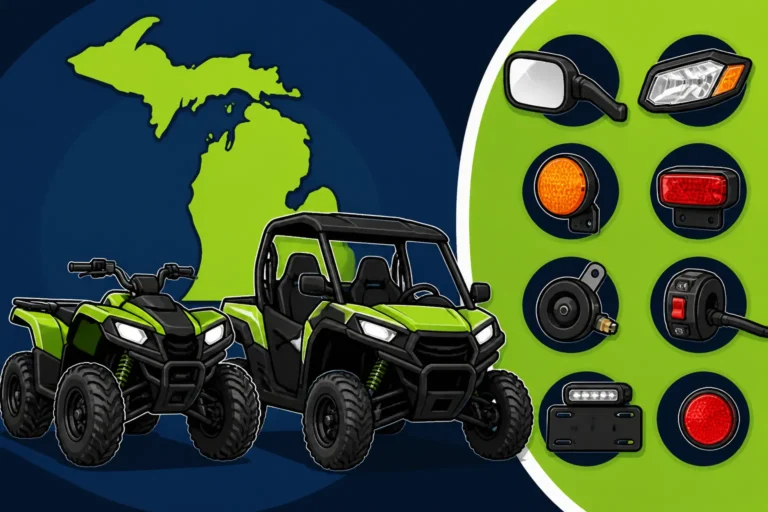
This equipment typically includes:
- Headlights and Taillights: Meeting brightness and visibility standards.
- Brake Lights: Functioning correctly.
- Turn Signals: Front and rear.
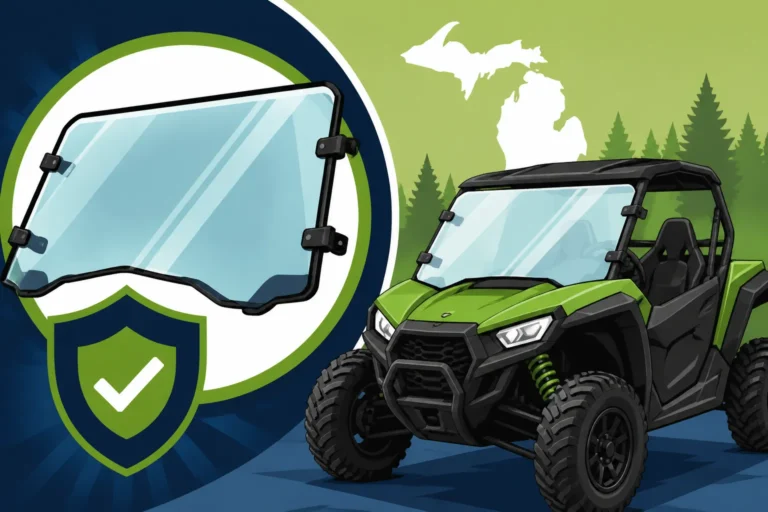
- Windshield: Made of safety glass, not just a clear plastic protector.
- Wipers: Functioning to clear the windshield.
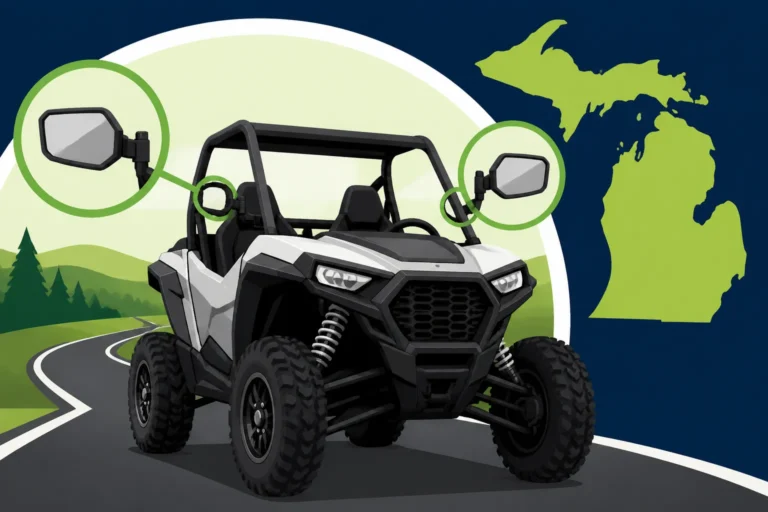
- Mirrors: Side mirrors and a rearview mirror.
- Horn: An audible warning device.
- DOT-Approved Tires: Designed for road use, not just off-road. You can often find these, along with other conversion parts, from aftermarket specialists like SuperATV.
- Speedometer: A working device to show your speed.
After installing these components, you'll need to go through an inspection process at the Secretary of State to verify compliance. Once approved, you'll receive a special assembled vehicle title and a standard license plate. For a full breakdown of what you might need, check out a [Parts List for a Street-Legal Conversion].
Even with this conversion, it's crucial to understand that a street-legal UTV is still not a commercial snowplow truck. While it grants you greater access to public roads for general transportation, using it for commercial plowing or extensive plowing of public thoroughfares might still fall outside the intended scope of a private street-legal ORV, particularly if you are charging for services. The primary benefit here is that you're now legally able to operate on roads where ORVs are typically restricted, allowing you to access a neighbor's driveway across a public road, for example, without violating ORV laws.
Insurance and Licensing Considerations
Once your UTV is street-legal, it's no longer just an ORV in the eyes of the law; it's a motor vehicle operating on public roads. This shift brings new requirements for insurance and driver licensing. You'll need to secure proper auto insurance, including no-fault coverage, just like you would for a car or truck. This is a significant step beyond standard ORV insurance, which typically only covers off-road incidents. For more details on what's required, you can look into [Insurance a Michigan Street-Legal UTV Needs].
In terms of licensing, operating a street-legal UTV on public roads requires a valid driver's license, just like any other motor vehicle. The specific requirements can vary, so it's always a good idea to confirm with the Secretary of State. You can also review [Driver's License Rules for Michigan ORV Road Riding] for general information. The combination of proper insurance and a valid driver's license is fundamental to legally operating your converted UTV on public roads, regardless of whether you're just cruising or tackling a snowdrift. Remember, failing to meet these requirements, even with a street-legal conversion, can lead to severe penalties.
Practicalities and Pitfalls of Plowing Public Roads with a UTV
Even if you manage to navigate the legal landscape of exemptions or street-legal conversion, using a UTV to plow public roads presents a unique set of practical challenges and potential pitfalls that are worth considering before you hit the snow.
Equipment Limitations and Road Damage
UTVs are incredibly versatile, but they are not designed to be heavy-duty snowplows for large public thoroughfares. While they excel at clearing driveways, parking lots, and smaller private roads, their size and power output are simply not comparable to a dedicated plow truck or heavy equipment. A UTV's plow system, even a robust one from a company like SuperATV, is typically lighter and has a smaller blade width, meaning it will take significantly longer to clear a given stretch of road, requiring many more passes.
Furthermore, the tires on your UTV, even DOT-approved ones, might not be ideal for extensive plowing on paved surfaces. Off-road tread patterns can wear quickly on asphalt or concrete, and if you use studded tires for ice traction, you run the risk of damaging the road surface itself. This is a real concern, especially if you're plowing for a municipality or even a neighborhood association. Reviewing your tire options, such as those discussed in [Street-Legal UTV Tires for Pavement Wear], is crucial. Improper plow setup, such as incorrect attack angles or insufficient downforce, can also lead to ineffective plowing or damage to the road, the plow, or even your UTV's frame. It's a delicate balance to achieve efficient snow removal without causing unintended harm.
Local Ordinances and Enforcement
Here's a critical point that often catches people by surprise: state laws and exemptions are one thing, but local ordinances can be another. Even if your UTV is technically street-legal or falls under a state exemption, individual counties, cities, and villages in Michigan have the authority to enact their own, stricter rules regarding ORV use (and by extension, street-legal ORV use in some contexts) within their boundaries.
This means that while a county might generally allow ORV use on certain roads, a specific city within that county might have a blanket ban on ORVs, regardless of whether they're street-legal or not. For more insight into these variations, you might want to read [Michigan County ORV Ordinances Explained]. Before you even consider plowing a public road, whether it's a village street or a small access road, you absolutely must contact the local municipal office (township, city, or village clerk) to understand their specific ordinances. Violating a local ordinance, even unknowingly, can result in tickets, fines, and even impoundment of your vehicle. Don't assume that just because your UTV is street-legal statewide, it's universally permitted to plow every road everywhere. This is particularly true if you are looking to plow roads listed in [Michigan Cities That Ban ORVs on Streets].
Alternative Approaches for Snow Removal
Given the complexities and potential liabilities of using a UTV to plow public roads in Michigan, it’s worth considering where these machines truly shine for snow removal and alternative strategies for areas they shouldn't tackle.
Plowing Private Drives and Parking Lots
This is where your UTV, with its plow attached, truly becomes a hero! UTVs are incredibly efficient and maneuverable for clearing snow from private driveways, residential sidewalks (where permitted by local rules, and with extreme caution!), and smaller private parking lots. Their compact size allows them to navigate tight turns, intricate landscaping, and around parked vehicles much more easily than a full-size pickup truck.
For homeowners, a UTV plow can transform a back-breaking chore into an enjoyable task. Many UTV owners find immense satisfaction in clearing their own property, and often those of friends, family, or immediate neighbors (on their private property, of course). The agility of a UTV means you can clear snow right up to garage doors, along fences, and around obstacles with precision. From small business parking areas to long, winding cabin driveways, a UTV is perfectly suited for private property snow removal, offering a blend of power and nimble handling that larger equipment can't match.
Hiring a Commercial Service vs. DIY UTV Plowing
When it comes to plowing public roads or even very large private areas, you have to weigh the capabilities of your UTV against the cost and efficiency of dedicated commercial services. A professional snow removal company will use trucks, skid steers, or other heavy equipment specifically designed for large-scale plowing. They have the appropriate insurance, licenses, and experience to handle public right-of-ways and are equipped to clear snow much faster and more thoroughly than most UTVs.
If you're considering using your UTV for extensive plowing of public access points, such as a long private road shared by multiple residents that is technically a public right-of-way, it's essential to compare the time, effort, wear and tear on your machine, and legal risks against the cost of hiring a professional. While the initial appeal of DIY plowing with your UTV is strong, especially with accessories from companies like SuperATV that make the job easier, the scale of the task for public roads often pushes beyond the practical limits of a UTV. For light-duty tasks, or strictly private property, your UTV is an excellent choice. But for municipal-level snow removal or anything that approaches it, professional services often prove to be more efficient, safer, and legally sound.
Ultimately, while your UTV is a snow-moving marvel on your own land, using it on Michigan's public roads for plowing is a nuanced matter that requires careful consideration of state laws, local ordinances, and the practical limits of your machine. Always err on the side of caution and verify legality before you start moving snow off public asphalt or gravel.
| Aspect | UTV Plowing on Private Roads/Property | UTV Plowing on Public Roads (Michigan) |
|---|---|---|
| Legality | Generally permitted, fewer restrictions | Highly restricted; requires specific exemptions (e.g., agriculture) or street-legal conversion. Local ordinances apply. |
| Scope of Work | Driveways, private lanes, small lots | Limited, short stretches, specific to agricultural use or transit for street-legal machines. |
| Equipment Fit | Excellent maneuverability, sufficient power for residential tasks | Smaller scale, slower, potential for tire/road damage over extensive use. |
| Insurance Needs | Standard ORV insurance, possibly homeowner's coverage | Requires street-legal auto insurance (including no-fault) if converted; specific commercial liability if charging for service. |
| Driver's License | Not always required for private land | Required if operating on public roads, even with an ORV exemption or street-legal conversion. |
| Local Variances | Minimal | Crucial to check; local cities/townships can have stricter bans or specific rules. |
| Best Use Case | Efficient, nimble snow removal for personal property and immediate neighbors (private land) | Very limited, niche applications (e.g., farm access, or simply transiting to a private plow job if street-legal). |
Disclaimer
This article is for general informational purposes only and does not constitute professional advice. Laws, prices and regulations vary by location and change over time. Consult a qualified professional for guidance on your specific situation.