Are Helmets Required in a Street-Legal UTV in Michigan?
One of the most common head-scratchers for Michigan ORV enthusiasts eyeing the open road is the question of helmets for their street-legal UTV. It feels like a confusing maze of rules, especially when you see other street vehicles cruising by without them. This guide will cut through the confusion, explaining precisely when helmets are required, when they aren't, and what makes all the difference for your street-legal side-by-side in Michigan.
The Nuance of Michigan's Helmet Law for ORVs
Michigan's laws regarding helmets for off-road vehicles (ORVs) are pretty clear-cut when you're on the trails. But when you start talking about taking your UTV onto county roads, things get a bit more complex. Many riders get frustrated trying to decipher the various vehicle classifications and their associated safety gear requirements. It feels like you need a law degree just to figure out if you're going to get a ticket!
Standard ORV Helmet Rules
For the vast majority of off-road riding in Michigan, whether you're on an ATV or a UTV, a helmet is absolutely mandatory. This applies to all designated ORV trails, routes, and scramble areas across the state. The law is designed to protect riders in an environment where rollovers, impacts, and unexpected obstacles are a constant possibility. It doesn't matter how experienced you are or how careful you ride; the risks are inherent to off-road terrain.
Think of it this way: when you're tackling the sandy climbs at Silver Lake or navigating a rocky two-track in the Upper Peninsula, you wouldn't dream of going without a helmet. That hard hat, eye protection, and often other gear are your first line of defense. And if you're under 16, a helmet is always required, no exceptions, regardless of where you're riding or what kind of ORV you're on. There are also specific requirements for [Michigan ORV Safety Certificate Requirements] that reinforce the importance of safety gear.
The Street-Legal UTV Distinction
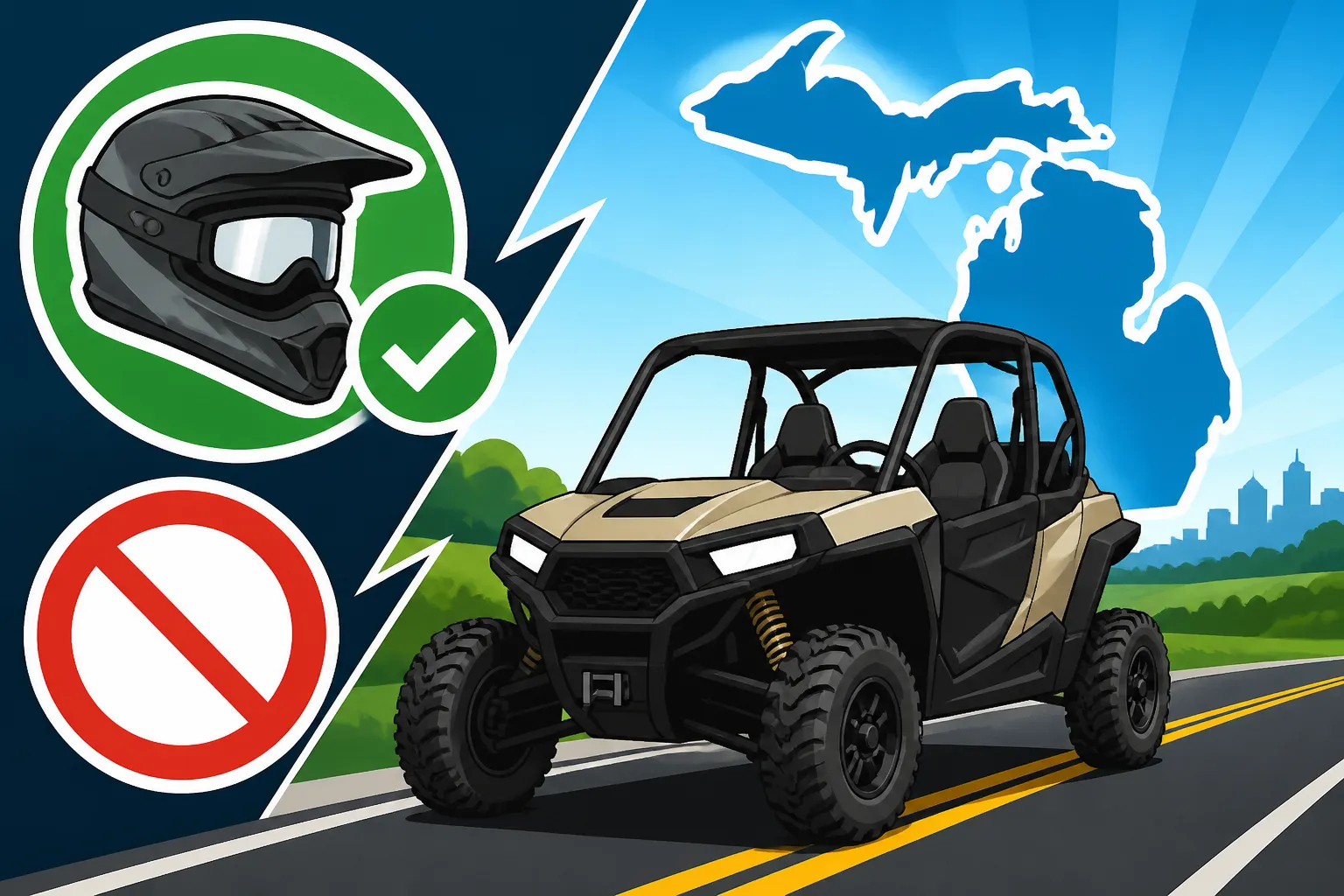
Here's where the waters get a little clearer for street-legal UTV owners. Once your UTV has successfully completed the rigorous process to become a Michigan "assembled vehicle" and is titled and registered for road use, the helmet rules shift. In Michigan, once your UTV is street-legal, it's generally treated like any other motor vehicle on the road when it comes to helmet requirements for adults. This means that, for adult operators and passengers, helmets are typically not required if the vehicle meets specific criteria, primarily having a proper windshield.
This exemption is a huge relief for many UTV owners who want to enjoy road access without the constant encumbrance of a helmet, especially for short trips to a local store or gas station. However, this doesn't mean you can just slap a license plate on your UTV and hit the road. There's a stringent conversion process involved, and failing to meet every single requirement can void your street-legal status and put you right back under the standard ORV helmet laws – not to mention facing potential fines. The state is very particular about the details.
What Makes a UTV "Street-Legal" in Michigan?
Achieving street-legal status for your UTV in Michigan is more than just an ambition; it's a journey through state regulations and a detailed inspection process. Many owners get bogged down in the minutiae, wondering if they've dotted every 'i' and crossed every 't'. But understanding the specific components and the inspection steps is key to unlocking that freedom to drive on approved roads without an ORV helmet. For a full breakdown, you should check out [How to Make a Side-by-Side Street Legal in Michigan].
Key Components for Street Legality
To be considered a legitimate "assembled vehicle" for road use and gain helmet exemption for adults, your UTV must be equipped with a specific list of Department of Transportation (DOT) approved components. This isn't a suggestion; it's a non-negotiable checklist. These items transform your off-road machine into something that can safely share the road with cars and trucks.
Here's a breakdown of the critical components:
- DOT-Approved Windshield: This is paramount. The windshield must be made of safety glass and provide adequate protection from the elements and road debris. It's often the single biggest factor in determining if a helmet is required or not. Many riders look to reputable aftermarket brands like SuperATV for their high-quality, DOT-approved windshields that fit a wide range of UTV models. Without a proper windshield, the helmet exemption simply doesn't apply. You can find more details in [Michigan Eye Protection Requirement Without a Windshield].
- Mirrors: You'll need at least one rear-view mirror, and often two (one on each side) to provide adequate visibility of traffic behind and beside you. These must be securely mounted and offer a clear field of vision.
- Horn: A working horn, audible from a reasonable distance, is required to signal other drivers and pedestrians.
- Headlights, Taillights, Brake Lights, and Turn Signals: Your UTV must have a full complement of street-legal lighting, including high and low beam headlights, red taillights, brake lights that illuminate when the pedal is pressed, and amber turn signals both front and rear. These need to be visible from appropriate distances. Many aftermarket kits, including those from SuperATV, offer integrated turn signal solutions that meet these specifications.
- DOT-Approved Tires: Your tires must be rated for road use. Off-road-only knobby tires typically won't pass inspection due to their aggressive tread not being designed for pavement.
- Seatbelts: Occupant restraint systems (seatbelts) are mandatory for all seating positions.
- Brakes: A fully operational braking system that can stop the vehicle effectively.
- Speedometer: A working speedometer is essential to ensure you can comply with posted speed limits, such as [Michigan's 25 mph Limit on County Roads].
It’s worth noting that simply adding these parts isn’t enough; they must be correctly installed and fully functional. The state wants to ensure these vehicles are genuinely safe for public roads. A comprehensive list can be found under [Safety Glass, Mirrors and Horns: Michigan's Street-Legal List].
The Assembled Vehicle Inspection Process
Once your UTV is outfitted with all the necessary components, the real test begins: the Michigan Secretary of State's assembled vehicle inspection. This process is designed to verify that your UTV meets all state and federal safety standards for road use, effectively reclassifying it from an ORV to a motor vehicle. It's not just a quick glance; it's a thorough check of everything you've added and modified.
You'll need to gather all your paperwork, including proof of ownership, receipts for parts (if applicable for valuation), and the completed [Michigan Assembled Vehicle Title Application]. This application itself details many of the requirements. Then, you'll need to schedule an appointment for an inspection at a Secretary of State branch that handles these types of vehicle inspections. They will meticulously go through your UTV, checking each required item. They're looking for compliance with specific standards, not just the presence of a part. For instance, is the windshield made of actual safety glass, not just plexiglass? Do the turn signals flash at the correct rate? They will confirm that the VIN matches your paperwork, and that all safety equipment is in working order.
If your UTV passes this inspection, you'll receive the necessary documentation to apply for a standard vehicle title and license plate. This is the moment your UTV officially becomes street-legal, and adult operators and passengers are then typically exempt from the helmet law, provided the vehicle maintains its windshield and other essential safety features. For a detailed guide on what the inspectors look for, see [Michigan Street-Legal UTV Inspection at the Secretary of State]. Be aware that any component not up to snuff can lead to a failed inspection, as described in [What Fails a Michigan Assembled Vehicle Inspection].
When Helmets Are (Still) a Good Idea for Street-Legal UTV Riders
While Michigan law may exempt adult riders in street-legal UTVs with windshields from wearing helmets, it doesn't mean you should immediately toss yours aside. The law provides minimum requirements, but savvy riders often consider going beyond the letter of the law for their own protection and peace of mind.
Beyond the Letter of the Law: Prioritizing Safety
Even with a full windshield and all the required road-legal equipment, a UTV is not a car. It handles differently, has a higher center of gravity than many street vehicles, and offers less protection in a collision. The open-air design, while exhilarating, also means you're more exposed to potential impacts.
Many experienced riders, even those with street-legal machines, choose to wear helmets for several reasons:
- Increased Protection: A helmet provides crucial head protection in the event of an accident, a rollover, or even just an unexpected impact from road debris. While a windshield helps, it doesn't eliminate all risks.
- Changing Environments: If your "street-legal" UTV is still primarily used off-road, or if your road riding involves connecting segments between trails, you'll be switching between environments where helmets are mandatory. It's often easier and safer to just keep the helmet on rather than constantly taking it off and putting it back on.
- Youth Riders: Remember, the helmet exemption only applies to adults. Any passenger or operator under the age of 16 must wear a helmet, even in a street-legal UTV, regardless of a windshield. If you're riding with children, you'll be ensuring their compliance anyway, so why not set a good example? Keep [Michigan ORV Road Riding Age Minimum] in mind for any young riders.
- Enhanced Visibility: Some riders appreciate the added visibility and focus a helmet provides, especially if it includes a visor or integrated eye protection.
Ultimately, safety is a personal choice, but it's one worth making with all the information at hand. While the law might say you don't have to, your instincts (and your head) might thank you for choosing to wear one. It’s also important to ensure any helmet you wear, on-road or off, meets [DOT Helmet Standards for ORV Riding].
Insurance Considerations and "The What Ifs"
Another often-overlooked aspect of going helmet-free, even when legally allowed, is how it might impact you in the event of an accident. Insurance companies are always looking at factors that contribute to injuries and damages. While your street-legal UTV needs [Insurance a Michigan Street-Legal UTV Needs], the specifics of a claim can get complicated.
In a worst-case scenario where you're involved in an accident and sustain a head injury without wearing a helmet, an insurance company or even a court might scrutinize whether reasonable precautions were taken, even if you were legally exempt. This isn't to say your claim would be denied outright, but it could potentially become a complicating factor in liability or payout discussions. It's about risk management.
Think about it this way: a car has airbags, a robust frame, and crumple zones for protection. A UTV, even a street-legal one, offers a more open design. While seatbelts are mandatory, the level of protection in a high-speed collision is simply different. Wearing a helmet adds another layer of personal protection that could mitigate injury and, by extension, reduce potential medical costs and legal headaches. It's an extra precaution that can save you a lot of grief and expense if "the what ifs" become reality.
Common Misconceptions and What to Watch Out For
Navigating the world of street-legal UTVs in Michigan is full of potential pitfalls and misunderstandings. Many riders, eager to get on the road, inadvertently cut corners or misinterpret rules, only to find themselves facing fines or, worse, involved in an accident without proper coverage. It’s crucial to understand these common traps to ensure your ride is both legal and safe.
Not All Street-Legal is Created Equal
This is perhaps the biggest misconception: that once you've done some modifications, your UTV is automatically "street-legal" everywhere. Unfortunately, this isn't true. Michigan has its own specific set of requirements for [Michigan's Assembled Vehicle Route for a UTV], and these can differ significantly from other states or even from what some aftermarket conversion kits claim. Just because a kit says "street legal" doesn't mean it automatically meets Michigan's specific interpretation of those laws.
For instance, some states might allow a basic plastic windshield for helmet exemption, but Michigan often requires a DOT-approved safety glass windshield. Or, a kit might provide basic turn signals, but they might not be visible enough or meet the exact mounting specifications required for Michigan inspection. Always, always verify that the components you install, like the ones you might get from SuperATV, specifically meet Michigan's requirements, not just a general "street legal" standard. This also includes ensuring your vehicle meets the broader [Michigan Helmet Exemptions for Street-Legal Vehicles] criteria.
Furthermore, even within Michigan, "street-legal" doesn't mean you can ride anywhere. There are still restrictions on which roads ORVs can operate on, typically focusing on county roads and often excluding state highways, freeways, and specific city limits unless explicitly allowed by local ordinance. [Michigan's 25 mph Limit on County Roads] is a key example of a restriction that applies even to street-legal machines. Always check local ordinances before riding in a new area.
Staying Compliant with Local Ordinances
Even with your UTV proudly displaying its Michigan license plate, the ride isn't entirely unrestricted. Just because the state permits street-legal UTVs on certain roads doesn't mean every single city, village, or township has opened its arms to them. Local ordinances can and do impose additional restrictions or even outright bans on ORV operation within their municipal boundaries, even for street-legal machines.
Imagine you've just converted your UTV, you're excited to cruise to the local ice cream shop, only to be pulled over by the local police because that specific town has an ordinance prohibiting ORVs, even street-legal ones, on their streets. This is a real frustration many riders face. It’s a patchwork of rules across the state, and it means the onus is on you to know the local laws.
Before venturing into any new municipality, make it a habit to check their local ordinances regarding ORV use. A quick call to the local sheriff's department or city clerk's office can save you a lot of headache and potential fines. This is especially true if you plan on riding in areas that aren't traditional ORV hotspots. Staying informed and compliant is key to a hassle-free experience with your street-legal UTV.
| Feature | Standard Michigan ORV (Off-Road Only) | Michigan Street-Legal UTV (Assembled Vehicle) |
|---|---|---|
| Helmet Required | Yes, for all riders (always for under 16) | No, for adults if proper windshield installed |
| Eye Protection | Recommended/Required with open-face helmet | Required if no windshield or open cab |
| Windshield | Optional | Required (DOT safety glass) for helmet exemption |
| Mirrors | Optional | Required (rear-view, potentially side mirrors) |
| Horn | Optional | Required |
| Turn Signals | Optional | Required (front & rear) |
| DOT Tires | Not required | Required (rated for road use) |
| License Plate | ORV sticker only | Standard vehicle license plate |
| Road Access | Limited to designated ORV routes/trails | Allowed on approved county roads (check local ordinances) |
| Inspection | No state inspection for operation | Required assembled vehicle inspection by SOS |
Disclaimer
This article is for general informational purposes only and does not constitute professional advice. Laws, prices and regulations vary by location and change over time. Consult a qualified professional for guidance on your specific situation.