Michigan Fine for No ORV Trail Permit
A Michigan ORV ride can turn into a citation if you have the basic ORV license but not the separate trail permit required for a designated trail. The key is knowing which permit covers the place you plan to ride, what the fine can be, and what to check before heading out. Here’s how to avoid confusing the two.
What the fine is and what it applies to
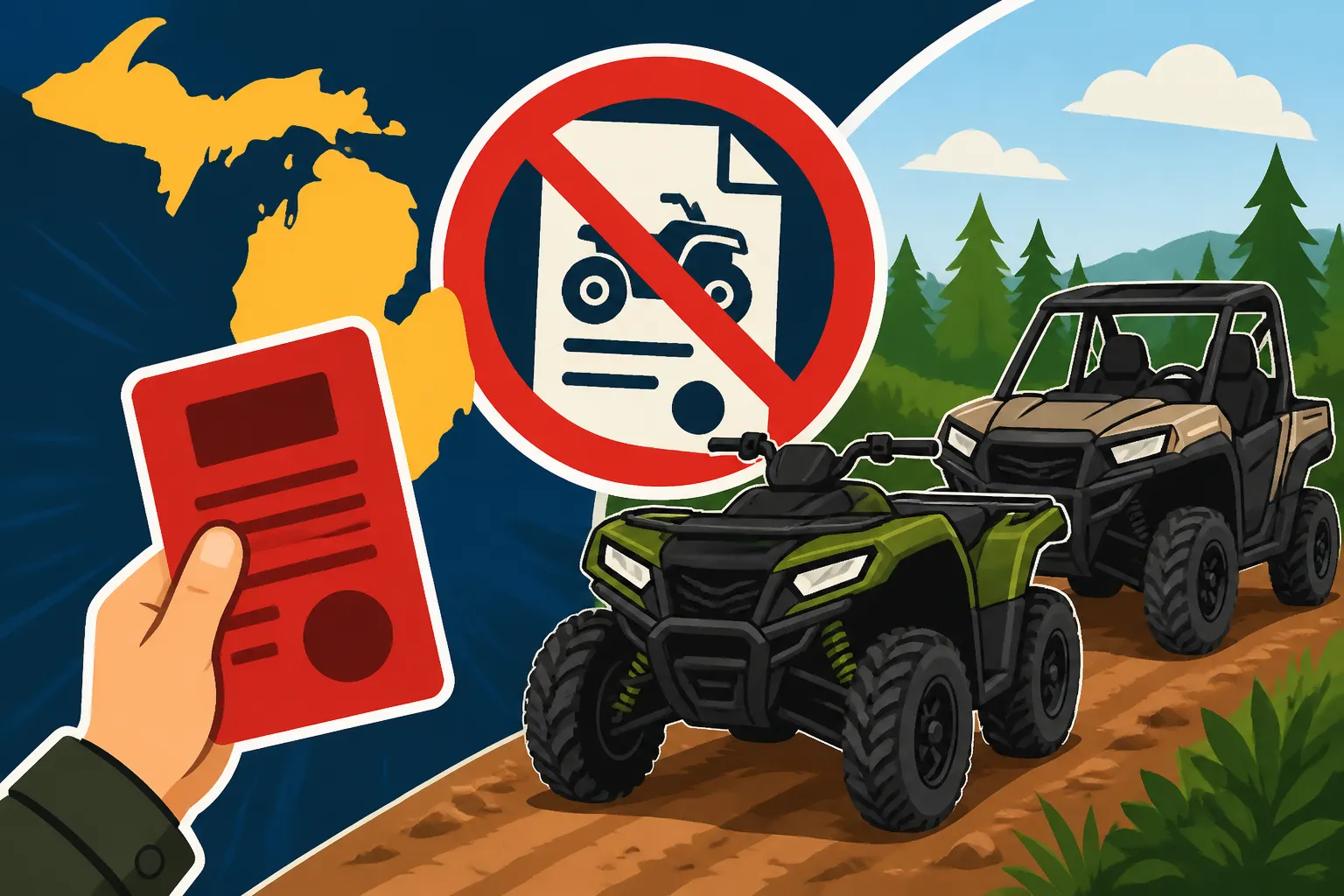
Operating an off-road vehicle without a required trail permit in Michigan is a state civil infraction, not a misdemeanor. The Michigan Legislature sets the civil fine at not more than $500; the maximum fine is not an automatic charge in every case. The exact outcome depends on the circumstances, so check the citation and confirm any case-specific questions with the appropriate authority.
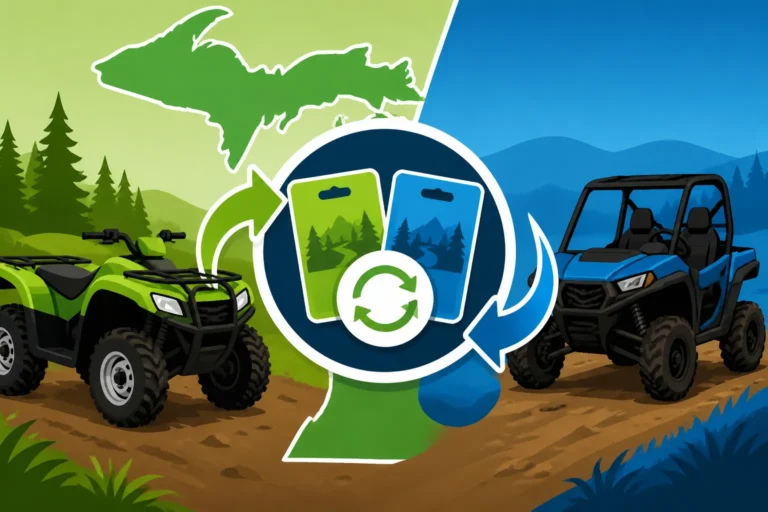
The important word is required. Michigan has both an ORV license and a separate trail permit. Having one does not necessarily mean you have the other. According to the Michigan Department of Natural Resources, the annual ORV license costs $26.25, and riding state-designated ORV trails requires an additional $10.00 trail permit, for a combined cost of $36.25. Those amounts are as of October 2026.
| What you plan to ride | What the Michigan DNR says about the permit |
|---|---|
| State-designated ORV trail | The ORV license and the additional trail permit are required for trail use. |
| Frozen surface of public waters | An ORV license is required, but the Michigan DNR says a trail permit is not required for this specific use. |
| State forest road | State forest roads are generally open to ORVs year-round unless posted otherwise or seasonally closed. Check the road’s status and the permit rules for your planned ride with the Michigan DNR. |
The table is a starting point, not a substitute for checking the exact route or riding area. A trail, road, or recreation site can have its own designation or closure status. A general assumption that “public land” means the same permit applies everywhere can lead to an avoidable mistake. The distinction between the license and trail permit is explained in Michigan ORV License and Trail Permit Explained and Do You Need Both a License and a Trail Permit in Michigan?.
It also helps to separate the fine for lacking a trail permit from other ORV violations. The fine discussed here concerns operating without a required trail permit. It does not describe the consequences of unrelated violations, such as operating unsafely or failing to follow a closure. If an officer cites more than one issue, read each allegation carefully rather than assuming the trail-permit fine covers the whole citation.
When you need the trail permit and when you may not
The trail permit matters when your ride takes you onto a state-designated ORV trail. Before leaving, confirm that the place you plan to ride is actually designated as a trail and that the permit you hold is valid for that use. Do not rely only on a map label, an old ride plan, or another rider’s understanding of the area. Conditions and access designations can change.
The Michigan DNR says frozen public waters are a specific exception: an ORV license is required there, but a trail permit is not required for that use. That exception is narrow. It does not mean the trail permit can be skipped for a nearby designated trail, or that the license is unnecessary. Keep the two requirements distinct when planning a ride across more than one type of surface. See Michigan ORV Permit for Frozen Lakes for the lake-specific issue, and Michigan ORV License Without a Trail Permit: Where You Can Ride for the distinction between a license and trail access.
State forest roads are another place where riders should check the details instead of making assumptions. According to the Michigan Department of Natural Resources, state forest roads are generally open year-round to ORV use unless otherwise posted or seasonally closed. That statement describes access conditions; it should not be treated as a blanket declaration that every road has the same permit requirement or is open on the day you arrive. Check the specific road and any signs or closures before riding.
Private-property riding and public-land riding are not interchangeable. A permit exception or different rule may apply in a particular situation, but do not assume that a private-land exception carries over to a public trail. Confirm the rules for the property and activity with the responsible authority before riding. For an overview of how exemptions are handled, see Michigan ORV Permit Exemptions on Private Land.
How to avoid a no-permit citation
The simplest approach is to match your documents to your route before the machine leaves the trailer or storage area. A valid base license is not a substitute for the trail permit when the route requires both. And a permit that has expired will not solve the problem simply because it was valid during an earlier trip.
Use this pre-ride check:
- Identify the riding area. Confirm whether your planned route includes a state-designated ORV trail, a state forest road, frozen public water, or another type of land.
- Check which requirements apply. For a state-designated ORV trail, the Michigan DNR requires the annual ORV license and the additional trail permit.
- Check the expiration date. Michigan DNR annual ORV licenses and trail permits expire on March 31 of the following year, regardless of when they were purchased. A permit bought late in the season does not extend beyond that expiration date.
- Look for closures and posted restrictions. The Michigan DNR can close state trails and facilities because of weather-related events and wet conditions. A permit does not authorize riding on a closed trail.
- Keep proof and details accessible. Before setting out, make sure you can confirm which permit you bought and when it expires. If you are unsure whether a purchase went through or covers your intended use, resolve that with the Michigan DNR or the authorized seller before riding.
- Recheck the plan if the route changes. A ride that begins on a road or frozen water may later connect to a designated trail. If it does, confirm the trail-permit requirement before continuing onto it.
For a detailed look at the permit year, see Michigan ORV Permit Year: April 1 to March 31. If you are buying a permit partway through the season, Michigan ORV License for a Machine Bought Mid-Season can help you think through timing and expiration.
The same check is useful when riding a machine owned by someone else. Do not assume the owner’s paperwork automatically answers whether the machine has the permit needed for your route, or whether it remains valid. Ask to see the relevant permit information and verify that it has not expired. For a group ride, each operator should know which machine they are using and what applies to the route; do not rely on a single rider’s general assurance that the group is “covered.”
If an officer asks about your permit, stay calm and be clear about what you have and where you were riding. If you receive a citation, read the listed violation and follow the instructions provided with it. The amount in the law is a maximum civil fine, not a promise that every case will be resolved at that amount. For questions about a specific citation or its process, use the contact information on the citation or ask the relevant court or agency.
The permit fine is only one part of a legal ride
A trail permit does not replace other ORV requirements. A rider can have the right permit and still face a problem by riding on a closed trail, ignoring posted restrictions, or failing to meet safety rules. Before a trip, check both access and equipment rather than treating the permit as the only legal requirement.
For example, the Michigan Department of Natural Resources says operators must be at least 16 years old to operate an ATV unsupervised on public lands. Anyone under 16 must have a valid ORV safety certificate and be under direct visual supervision of an adult, and children under 10 are prohibited from operating four-wheel ATVs on public lands. Those rules are separate from the trail-permit requirement. The DNR also requires youth under 16 to complete an approved ORV safety course and carry their certificate when operating an ORV on public lands.
The Michigan Legislature also sets equipment and operating rules. ORV operators and passengers generally must wear a Department of Transportation-approved crash helmet and protective eyewear, though exceptions apply in certain circumstances. A UTV with an approved roof and properly fastened safety belts may qualify for a helmet exception under the conditions described in the law. The Legislature also requires a United States Forest Service-approved spark arrester and a muffler in good working order and constant operation on ORVs operated on public lands.
These rules are worth checking before a ride, but they should not distract from the permit question: the correct permit depends on where you are riding. If your route includes a designated trail, confirm the trail permit as well as the base ORV license. If the route is different, verify the applicable rules for that specific place rather than assuming the trail-permit rule applies everywhere—or nowhere.
If you are unsure whether your plan includes a designated trail, contact the Michigan DNR before setting out. A short check of the route, permit status, expiration date, and any closures is more useful than trying to sort out an unclear requirement after a ride has begun.
Sources
- Department of Natural Resources — Operator age restrictions (checked October 28, 2026)
- Michigan Department of Natural Resources — Purchase permit, learn requirements – State of Michigan (checked October 28, 2026)
- Department of Natural Resources — Age restrictions and safety certificate (checked October 28, 2026)
- Michigan Legislature — Michigan Compiled Laws, Section 324.81147 (checked October 28, 2026)
Disclaimer
This article is for general informational purposes only and does not constitute professional advice. Laws, prices and regulations vary by location and change over time. Consult a qualified professional for guidance on your specific situation.