Taking a Michigan ATV to Wisconsin Trails
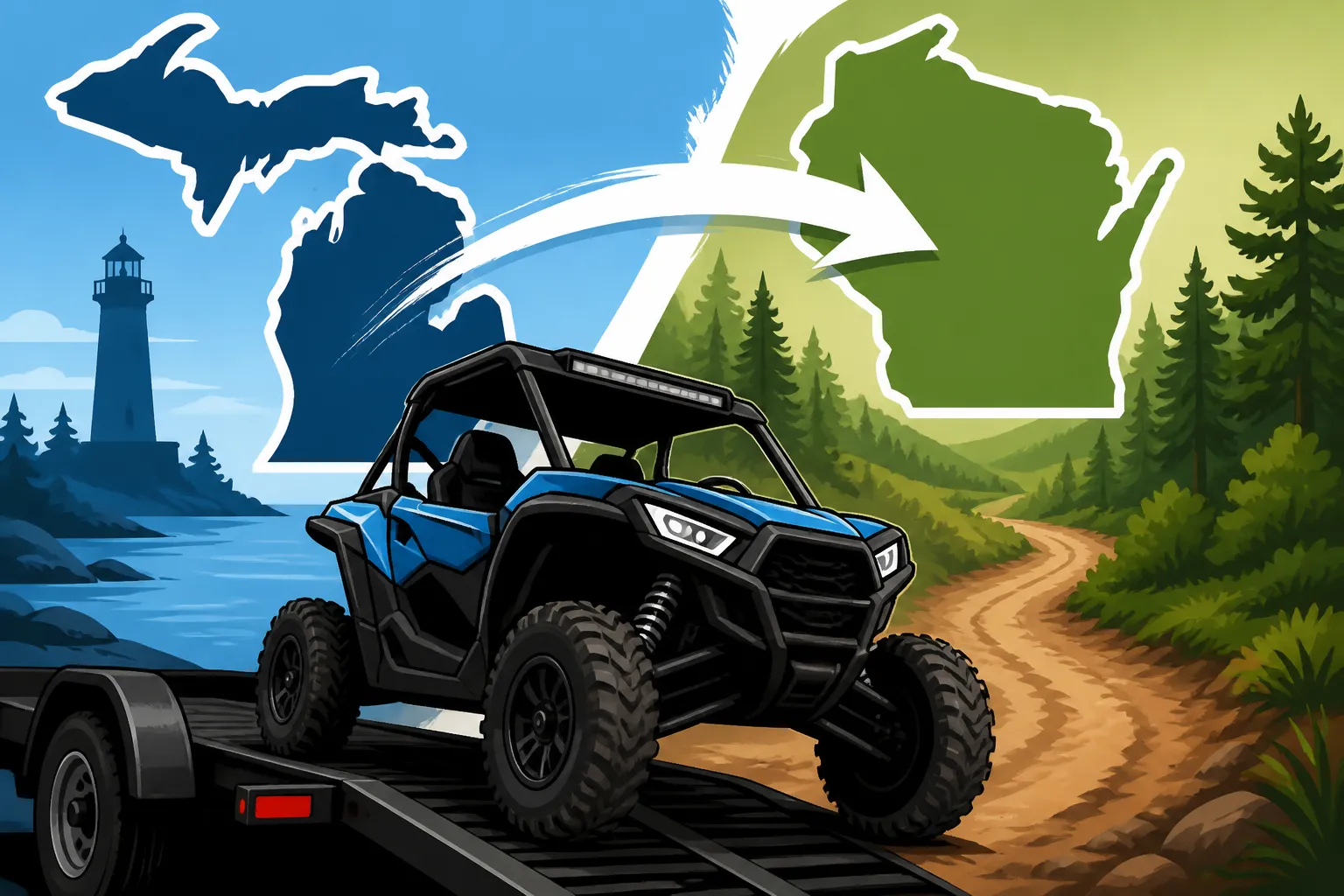
Taking a Michigan ATV or UTV to Wisconsin means checking a different state’s trail rules—not just carrying the Michigan permit. Your Michigan ORV license and trail permit do not automatically authorize riding on Wisconsin trails. Before you load up, confirm Wisconsin’s pass requirements, machine rules, and where your route is legally open.
What carries over from Michigan and what does not
Your Michigan paperwork may help identify the machine and show that it is yours, but it does not replace Wisconsin’s requirements for using public trails. Michigan’s ORV license and trail permit apply to riding in Michigan; they are not Wisconsin trail passes. The same principle works in reverse: a Wisconsin pass does not authorize riding on Michigan trails.
It helps to separate three kinds of paperwork:
| Paperwork | What it generally does | Does it replace Wisconsin’s trail pass? |
|---|---|---|
| Michigan ORV license or trail permit | Authorizes qualifying use in Michigan under Michigan rules | No |
| Michigan title | Records ownership of a titled machine | No |
| Wisconsin nonresident trail pass | Covers eligible out-of-state machines for Wisconsin public trail use under Wisconsin rules | It is the relevant Wisconsin trail credential |
Wisconsin’s rules distinguish between a machine registered in Wisconsin and one registered in another state. A Michigan-registered ATV or UTV should not be assumed exempt from Wisconsin’s nonresident trail pass requirement simply because it has Michigan paperwork. Confirm the current rule and pass instructions with the Wisconsin Department of Natural Resources before riding, especially if your machine has unusual registration or title status.
This is not a case where “reciprocity” means one state’s permit works everywhere. Michigan and Wisconsin have separate systems, and a permit issued for one state’s trails generally does not serve as the other state’s required pass. For context on how the distinction works from the other direction, see Michigan ORV Reciprocity With Neighboring States and ORV Permits for Out-of-State Riders in Michigan.
A title is also different from registration and trail permission. A title is proof of ownership; it does not, by itself, authorize trail riding. A trail pass addresses access under the state’s trail rules, while registration may identify the machine under that state’s vehicle system. Keep ownership documents secure, but do not treat them as a substitute for the Wisconsin credential required for your ride.
Check Wisconsin’s pass and machine requirements before you go
For a Michigan-registered ATV or UTV, the main question is whether Wisconsin requires a nonresident trail pass for the places you plan to ride. Check the Wisconsin DNR’s current instructions for nonresident machines, including how to obtain the pass, what proof or information you need, where the pass must be displayed, and how long it is valid. Fees and purchasing procedures can change, so confirm the current details directly with the state rather than relying on an old receipt, online post, or another rider’s experience.
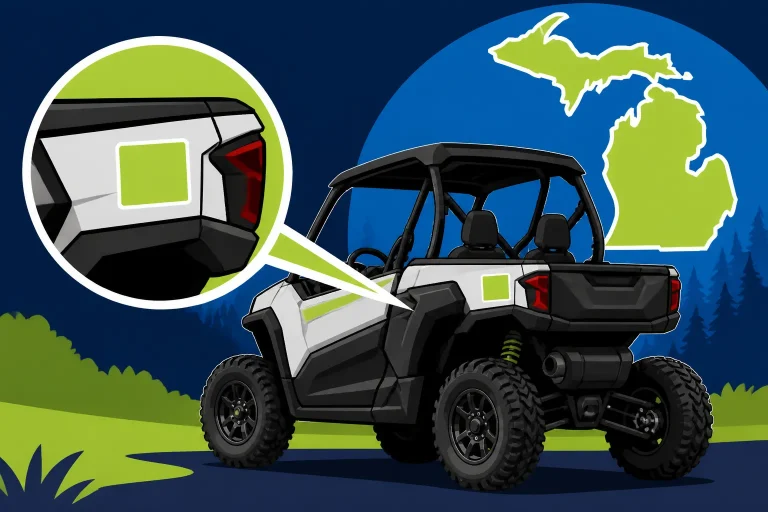
Do this before arriving at a trailhead. If the pass is issued as a decal, follow the placement instructions and make sure it is visible and attached to the correct machine. If the state provides a temporary document or other proof while a decal is being delivered, follow the stated conditions for using it. Do not assume a phone screenshot, Michigan sticker, or purchase confirmation is acceptable unless Wisconsin’s instructions say it is.
Check the rules for each machine you plan to bring. A two-up ATV, a side-by-side, and a wider UTV can face different route limitations. Wisconsin routes and trails may have different vehicle-width limits, and a UTV that fits one route may be prohibited on another. Do not rely on a general description such as “ATV trail” to mean every ATV and UTV is allowed.
The machine itself should be in appropriate condition for the trip. Before departure, inspect brakes, tires, steering, lights, and any required safety equipment. Carry any operator or ownership documents that apply to your circumstances, but store original title documents securely rather than leaving them exposed on the vehicle. For Wisconsin-specific requirements, use the Wisconsin DNR’s current rules and the local trail information for the area you are visiting.
If you are also riding in Michigan before or after the Wisconsin portion of the trip, keep the two sets of requirements separate. Michigan may require both an ORV license and a trail permit for particular riding areas, while Wisconsin’s nonresident pass addresses Wisconsin access. The distinctions are covered in Michigan ORV License and Trail Permit Explained and Do You Need Both a License and a Trail Permit in Michigan?.
Plan the route, not just the border crossing
A Wisconsin pass does not mean you can ride every public road, trail, or forest road in the state. Access depends on the location and the route’s designation. A trail may be open to certain machine classes but not others; a road may be open only under local rules; and a connector may have restrictions that are easy to miss if you follow a generic map.
Use current maps and posted signs for the specific county or riding area. Check whether the route allows your machine’s width and type, whether it is open for the season, and whether there are local restrictions or temporary closures. A route appearing on an older map or a third-party app is not proof that it is currently open. Michigan riders can use Michigan ORV Trail Maps and What the Signs Mean for a helpful reminder that route markings and permitted vehicle classes matter; in Wisconsin, use the relevant Wisconsin and local information.
Road access deserves particular care. A trail pass is not a blanket authorization to ride on public roads. Local governments control whether some roads are open to ATV or UTV use, and roadway rules can differ from trail rules. Check the exact route and any local ordinance before riding between a lodging area, fuel stop, trailhead, or trail network. Do not assume that a short road connection is legal just because the adjoining trail is open.
Also check for closures and seasonal conditions shortly before leaving. Heavy rain, maintenance, weather, or land-management decisions can affect access. Ask the local trail authority or consult current official notices when a route is important to your plans. If a route is closed, do not bypass a barrier or follow another machine off the marked trail; that can create safety and access problems for everyone.
If a Michigan permit holder is traveling with riders from another state, make sure each machine and each operator is covered by the appropriate rules. Permits are commonly tied to the machine or its use, not to a group leader’s paperwork. A friend’s pass does not automatically cover your ATV. Likewise, a pass on a UTV does not necessarily cover another machine being transported in the same trailer.
A practical pre-trip checklist
Work through these steps before loading your ATV or UTV:
- Identify your machine’s status. Note whether it is registered in Michigan and whether its paperwork is straightforward. If it is newly purchased, homemade, or has unusual ownership documents, ask Wisconsin DNR what applies before you travel.
- Confirm the Wisconsin pass requirement. Check the current nonresident rules for an out-of-state machine, including how to buy the pass and how to display or carry proof.
- Match the machine to the route. Verify the route’s permitted vehicle type and width. Do not assume a UTV is allowed on every ATV-marked route.
- Check operator requirements. Review Wisconsin’s current age, supervision, and safety-certificate rules for every rider. A Michigan certificate or training card should not be assumed to satisfy Wisconsin’s rules without confirmation. For Michigan youth rules, see Michigan ORV Age Rules for Young Riders.
- Verify road connections separately. Look up local access rules for any public-road segments. A legal trail does not make every road leading to it legal for ORV use.
- Check closures and conditions. Review official trail notices close to departure and again if weather or conditions change.
- Pack useful documents and safety gear. Bring the proof Wisconsin requires, keep ownership paperwork protected, and carry the safety equipment required for the machine and route.
- Keep state requirements distinct. If the trip includes riding in both states, confirm Michigan requirements for Michigan riding and Wisconsin requirements for Wisconsin riding. Neither state’s permit should be treated as a substitute for the other’s.
A quick call or check of the official Wisconsin DNR guidance is worthwhile if you are unsure whether your registration type qualifies, which pass applies, or whether a particular route is open to your machine. It is much easier to resolve those questions before reaching a trail entrance than after unloading.
The simplest planning rule is: bring the correct Wisconsin pass for your out-of-state machine, confirm that the route allows your ATV or UTV, and check local road access separately. Treat Michigan permits as Michigan paperwork, not as a cross-border pass.
Disclaimer
This article is for general informational purposes only and does not constitute professional advice. Laws, prices and regulations vary by location and change over time. Consult a qualified professional for guidance on your specific situation.