Wisconsin Safety Certificate Accepted in Michigan
A Wisconsin safety certificate can help a young rider meet Michigan’s ORV safety-training requirement, but it does not make every ride legal by itself. Michigan’s age limits, supervision rules, permits and trail requirements still apply. Here’s how to confirm the certificate counts, what to carry, and which separate Michigan rules to check before riding.
Is a Wisconsin Safety Certificate Accepted in Michigan?
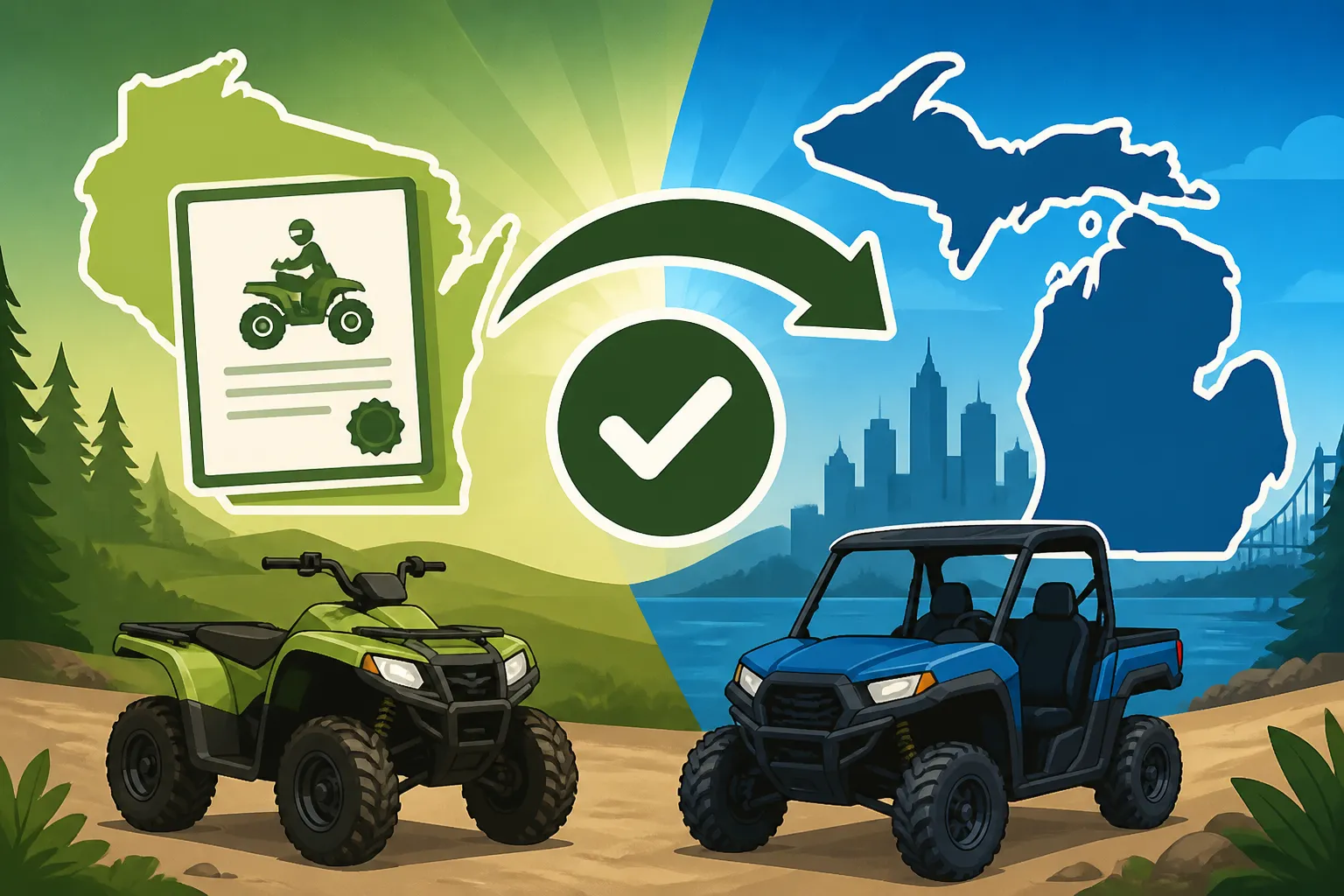
Generally, yes. Michigan accepts a valid out-of-state ORV safety certificate as proof of safety training, including a certificate issued through Wisconsin’s ATV safety education program. This matters most for riders who need a certificate under Michigan law, particularly younger operators riding on public land.
The certificate is evidence that the rider completed qualifying safety education. It is not a Michigan ORV license, trail permit, registration document or general permission to ride. A Wisconsin certificate does not waive Michigan’s operating rules, even when the training requirement is satisfied.
Before traveling, make sure the document is an official safety certificate rather than only a course registration, payment receipt or note saying a class was completed. If a Wisconsin course provider issued a card or digital credential, confirm it clearly identifies the rider and the completed ATV or ORV safety course. Keep the certificate accessible while riding; a paper copy or an official digital version can make it easier to show proof if asked.
Michigan’s safety-certificate requirement is only one part of a rider’s eligibility. Age limits and supervision rules can affect where and how a young person may operate, and those rules are based on Michigan law—not the rules in Wisconsin. A certificate does not override an age restriction or allow a rider to operate a machine they are otherwise too young to use. For a broader explanation, see Michigan ORV Safety Certificate Requirements and Michigan ORV Safety Certificate for Riders Under 16.
If there is doubt about whether a specific Wisconsin course or credential qualifies, verify it with the Michigan DNR before the trip. This is especially sensible if the document is old, incomplete, issued by a private provider, or describes a course as recreational training rather than an official safety certification.
What the Certificate Does and Does Not Cover
The most common misunderstanding is treating a safety certificate as an all-purpose riding permit. It is not. Think of it as proof of training that may satisfy one requirement; then check the other rules separately.
| Item | What the Wisconsin certificate may do | What it does not do |
|---|---|---|
| Michigan safety-training requirement | Provide proof of qualifying out-of-state training | Guarantee that every rider is legally eligible by age |
| Michigan ORV license | Nothing by itself | Replace a Michigan ORV license where one is required |
| Michigan trail permit | Nothing by itself | Provide access to trails that require the applicable trail permit |
| Supervision | Nothing by itself | Replace Michigan’s supervision requirements for young riders |
| Road riding | Nothing by itself | Make an ORV legal on a road or remove road-specific restrictions |
| Machine or passenger rules | Nothing by itself | Change limits based on the machine, its design or its passenger capacity |
The distinction between training and permits is important. Michigan’s ORV license and trail permit are separate from a safety certificate. Which permit is needed depends on where the machine will be operated and whether the route or riding area requires it. A Wisconsin safety card does not serve as either Michigan permit. Review Wisconsin Riders Need a Michigan Permit and Do You Need Both a License and a Trail Permit in Michigan? before setting out.
A certificate also does not create an exception for private property, public land, roads or a particular type of machine. Different locations can have different access and operating rules. Riding on a permitted trail, for example, does not automatically mean the rider may continue onto a nearby road. The route itself must be open to the machine, and the rider must meet the requirements for that location.
Likewise, a course certificate does not settle every question about a rider’s age. Michigan has age-specific rules, and the permitted activity may depend on the rider’s age, machine and location. Check Michigan ORV Age Rules at 10, 12 and 16 for the details that apply to a young rider. If a rider is close to an age threshold, do not assume that the age rules from Wisconsin carry over into Michigan.
How to Check and Carry a Wisconsin Certificate
A little preparation can prevent confusion at a trailhead or during a trip. Use these steps before leaving Wisconsin.
-
Confirm that the document is the safety certificate. Look for the rider’s name and a clear indication that the ATV or ORV safety course was completed. A class receipt or a course provider’s informal email may not be enough to establish certification.
-
Check that the certificate belongs to the rider. A parent’s or sibling’s certificate cannot be used as proof for another operator. If the name on the card differs from the rider’s current name, bring supporting documentation or ask the issuing program how to confirm the credential.
-
Keep proof available. Carry the original card, if one was issued, or an official digital certificate that can be opened without relying on a weak trail-side connection. A backup copy can help, but it is best not to depend on a photograph if the official credential is available.
-
Check Michigan’s age and supervision rules separately. Training does not change the age at which a rider may use a machine or the supervision conditions that apply. Make sure the rider, supervising adult and machine meet Michigan’s rules for the planned location.
-
Check permits and route access. Confirm that the machine has the Michigan ORV license and trail permit required for the places you plan to ride. Also verify that each trail, route or riding area is open to that type of ORV.
-
Ask about a questionable credential before the trip. If the certificate is damaged, incomplete, difficult to read or issued by a program you cannot identify, contact the appropriate Michigan or Wisconsin safety-education office. Resolving an uncertainty at home is easier than trying to do it on the trail.
A certificate usually proves training; it does not prove that all other trip requirements have been met. Keep the paperwork organized so the rider or supervising adult can produce it promptly, rather than leaving it buried in a vehicle or stored in an account that cannot be accessed offline.
For families whose child completed a course in Wisconsin, it can be useful to keep a copy of the certificate with other machine documents. However, do not treat a copy of the certificate as a substitute for a required permit sticker or other proof. The documents serve different purposes. Safety Certificate Reciprocity for Michigan Riders explains the broader issue of out-of-state training credentials.
Before a Wisconsin Rider Heads to Michigan
Plan around Michigan’s rules, not the rules the rider is used to at home. A Wisconsin certificate may count toward Michigan’s safety-training requirement, but local operating requirements still control once the rider is in Michigan.
Check the intended route, not just the destination. A weekend plan might include public trails, connecting roads, state land or a private riding area. Each place may have different access rules. Confirm that the route is open to the type of machine being used, and verify permit requirements for each riding location. If your group expects to cross or ride on public roads, check the road rules separately; an ORV safety certificate does not authorize road use.
For a young rider, check four things together:
- The rider’s age and whether that age is eligible for the planned activity.
- Whether a parent, guardian or other qualified adult must supervise.
- Whether the machine is permitted for that rider and location.
- Whether the necessary Michigan ORV license and trail permit are in place.
Do not let one completed item create a false sense that the rest are covered. For example, a rider may have a valid safety certificate but still need supervision, be too young for a particular machine or lack a required permit. Likewise, an adult’s presence does not replace a certificate if one is required.
If the rider’s certificate is not readily verifiable, or the planned use involves a special type of land or route, ask the relevant authority before riding. The goal is to confirm the credential and route in advance, not to rely on a guess after reaching the trail. For more on out-of-state permit questions, see Michigan ORV Permit Reciprocity With Other States.
In short, a valid Wisconsin ATV or ORV safety certificate is generally accepted in Michigan as proof of safety training. Treat it as one document in a broader checklist: Michigan age and supervision rules, machine restrictions, route access and any required Michigan permits remain separate obligations.
Disclaimer
This article is for general informational purposes only and does not constitute professional advice. Laws, prices and regulations vary by location and change over time. Consult a qualified professional for guidance on your specific situation.