Riding an ORV on the Road After Dark
There's nothing quite like the thrill of a Michigan ORV adventure, whether you're tackling muddy trails or cruising down a quiet two-track. But when the sun starts to dip below the horizon, many riders find themselves wondering: Can I still use public roads to get back to camp or connect to another trail after dark? It's a common dilemma, and the rules around night riding on Michigan's county roads and designated routes can feel as murky as a backwoods bog. This comprehensive guide is here to shine a light on Michigan's regulations for operating your Off-Road Vehicle (ORV) on public roads once night falls, helping you navigate the darkness safely and legally.
The Core Rules for Night Riding on Michigan Roads
When the last sliver of daylight fades, the rules for operating your ORV on Michigan roads don't just disappear. In fact, they become even more critical, focusing heavily on visibility to ensure the safety of everyone sharing the road. It’s not enough to simply have lights; you need the right lights, and they need to be working correctly. This isn't just about avoiding a ticket; it's about making sure other drivers can see you, especially when you're a smaller, less conspicuous vehicle like an ATV or UTV.
General Lighting Requirements for ORVs on Roads
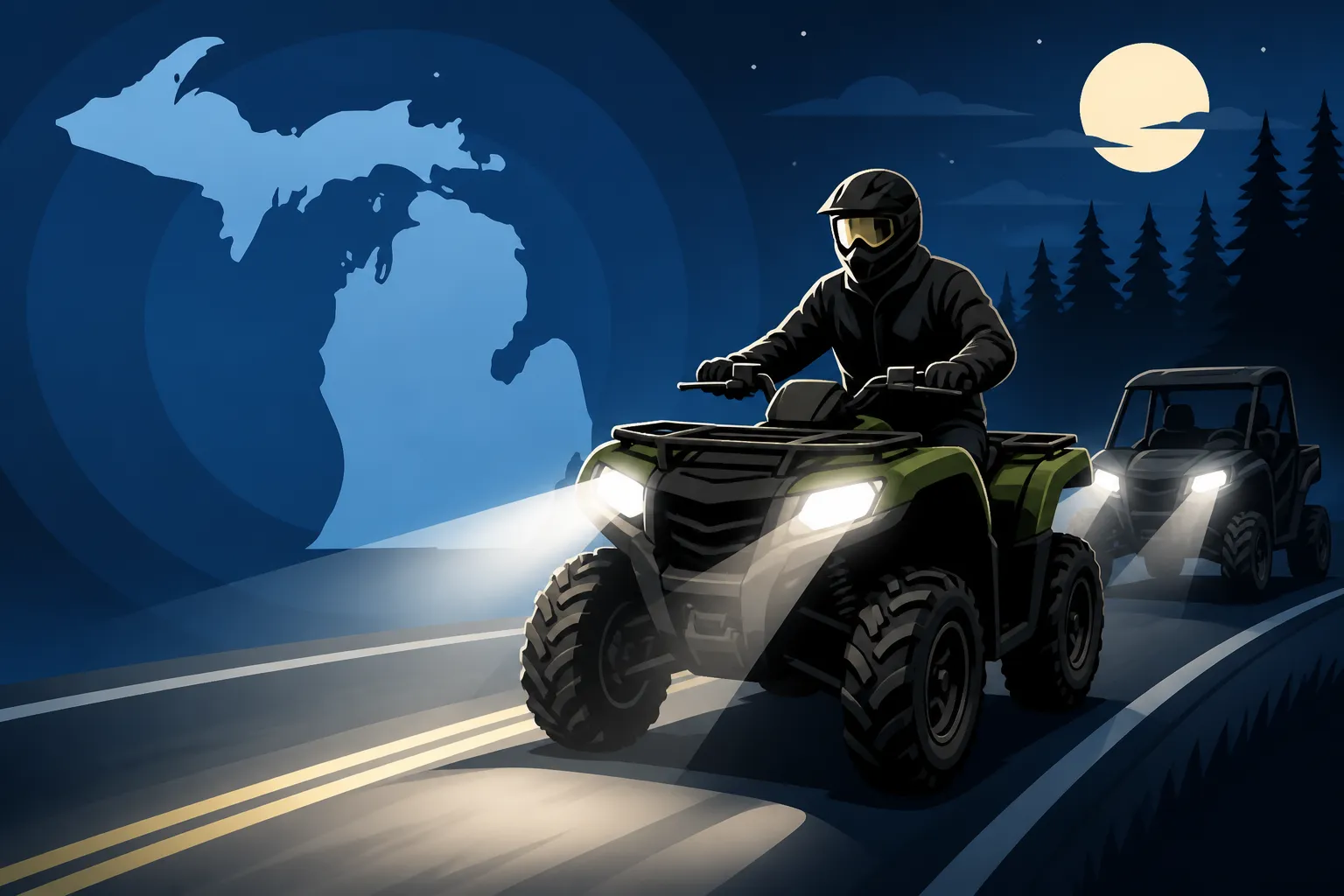
Michigan law is pretty clear: if you're going to operate any vehicle on a public road after dark, it needs to be properly lit. For ORVs, this means having functional headlights and taillights. The goal is two-fold: for you to see where you're going, and, more importantly, for others to see you. Think about rural roads at night – they can be pitch black, and a small ORV without adequate lighting can easily become invisible.
Your ORV must be equipped with at least one headlight that emits a white light visible from a distance of 200 feet, and at least one taillight that emits a red light visible from a distance of 200 feet. This isn't just a suggestion; it's a legal requirement designed to prevent accidents. Imagine you're riding your UTV back to your cabin after a long day on the trails. You might be familiar with the route, but if a car comes around a bend and doesn't see your taillight until the last second, you're looking at a dangerous situation. It's not just about what's ahead of you; it's about what's behind and to the sides as well. You also want to make sure your lights are clean and unobstructed. Mud splatter from a day on the trails can drastically reduce the effectiveness of your lights, turning a bright beam into a dull glow. A quick wipe down before heading out on the road after dark is always a good idea.
Specifics for Headlights, Taillights, and Brake Lights
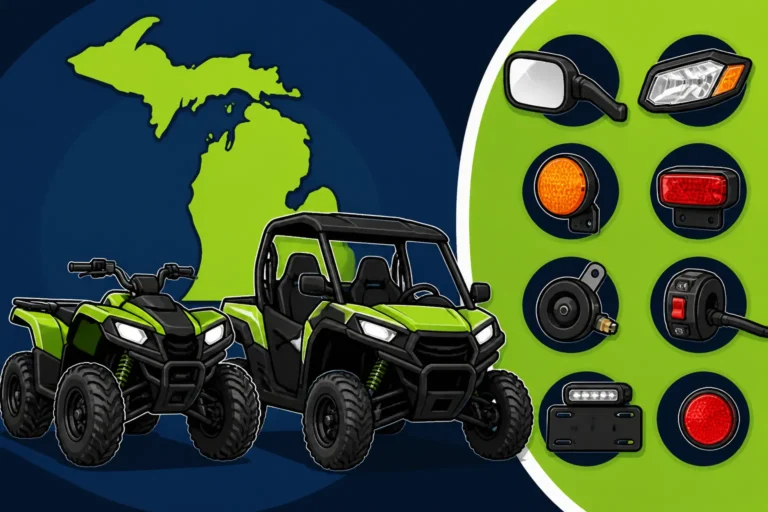
Let's dig a little deeper into the specific types of lighting you need. Your headlight isn't just for showing you the way; it's a beacon. Michigan law specifies a white light, and while most factory ORV headlights meet this, it's worth checking their brightness and beam pattern. You want to illuminate the road ahead sufficiently to spot obstacles, but not so brightly that you blind oncoming traffic. Aftermarket options are plentiful if your stock lights feel a bit dim. Many riders choose to upgrade to LED headlights for their brightness and efficiency, and brands like SuperATV offer a variety of lighting solutions that can significantly improve your nighttime visibility and confidence on the road.
When it comes to the rear, the red taillight is your primary warning to vehicles behind you. Again, a 200-foot visibility standard applies. But what about brake lights? While not always a primary requirement for all ORV operation off-road, if you're going to be on a public road, functional brake lights are absolutely essential. When you slow down or stop, those brake lights need to illuminate clearly to signal your intentions to anyone following. This prevents rear-end collisions, which can be particularly nasty for ORV riders. Think about a sudden stop on a dusty gravel road after dark – if your brake lights don't pop brightly, the driver behind you might not react in time. It’s also important to make sure all your lights are properly aimed. A headlight pointed too high will blind others, while one pointed too low won't give you adequate visibility. Regularly inspect your wiring too, as loose connections can cause intermittent light failures, which is the last thing you want after dark.
Reflective Elements and Visibility Gear
Beyond active lighting, passive visibility plays a huge role in night riding safety. Reflective materials can be lifesavers. While not explicitly mandated for every part of your ORV on Michigan roads, adding reflective tape to the sides, front, and rear of your machine can make a significant difference. It catches the headlights of other vehicles, making your ORV more discernible even if your active lights are slightly obscured or if a driver is distracted. This is particularly useful for the sides of your machine, which might not be directly illuminated by your own lights.
Consider also your riding gear. Wearing reflective elements on your helmet, jacket, or even adding a reflective vest can greatly enhance your personal visibility. Remember, you're often riding a smaller, less substantial vehicle than a car or truck, and anything you can do to stand out against the dark backdrop of a Michigan night is a win for safety. This attention to detail extends to your passengers as well. If you have riders with you, ensure they are also wearing appropriate gear that maximizes their visibility. The more reflective surfaces you have, the larger and more noticeable your ORV and its occupants will appear to other drivers. This combination of active lighting and passive reflectivity creates a much safer environment for everyone.
When is "After Dark" According to Michigan Law?
The concept of "after dark" might seem straightforward, but legally, it has a specific definition that impacts when your ORV's lights must be on when you're on public roads. It's not just about when you personally feel it's too dim to see. Understanding the legal interpretation is crucial for compliance and avoiding unnecessary fines.
Understanding Sunset-to-Sunrise Regulations
In Michigan, the law generally defines "night" or "after dark" as the period from one-half hour after sunset to one-half hour before sunrise. This isn't unique to ORVs; it's a standard for all vehicles operating on public roadways. This means even if there's still a faint glow in the sky right after sunset, or a glimmer of dawn before sunrise, you are legally required to have your lights on during these transitional periods if you are on a road. This buffer period is designed to account for diminishing natural light and ensure maximum visibility during those trickiest times of day.
It's a common mistake to wait until it's completely black outside before flipping on your lights. However, during dusk and dawn, the light conditions can be deceptive. Your eyes might adjust, making you feel like you can see fine, but other drivers, especially those coming from brighter areas or facing the sun, might struggle to see your ORV. This is why the law builds in that extra half-hour. Always err on the side of caution. It's better to have your lights on a little early than a minute too late, especially if you're transitioning from a well-lit area to a darker stretch of road, or vice-versa. Keeping track of sunset and sunrise times, easily accessible on your phone or local weather reports, can help you plan your rides accordingly.
The Importance of Low-Light Conditions
Beyond the hard legal definition of one-half hour after sunset, Michigan law also requires lights to be used at any other time when there is "not sufficient light to render clearly discernible persons and vehicles on the highway at a distance of 500 feet ahead." This is a crucial detail, especially for ORV riders in Michigan. It means that even during daylight hours, if heavy fog rolls in, a torrential downpour obscures visibility, or you find yourself under a thick tree canopy on a gloomy day, your lights need to be on.
This rule emphasizes the purpose of vehicle lighting: to make your vehicle visible. Imagine a late afternoon ride in the Upper Peninsula, and a sudden, heavy thunderstorm blows in. The sky darkens dramatically, and visibility drops to mere feet. Even though it might technically be before the "half-hour after sunset" mark, the prevailing low-light conditions demand your lights be activated. This is a common-sense safety measure that applies directly to the varying conditions Michigan riders encounter. Don't rely solely on the clock; rely on your judgment regarding visibility. If you're questioning whether your lights should be on, they probably should be. Being proactive about visibility can prevent dangerous encounters with other road users who might not be expecting an ORV.
Adjusting for Weather and Visibility
Michigan weather is notoriously unpredictable, and these rapid changes can significantly impact visibility for ORV riders. Fog, heavy rain, snow, or even dense smoke from a distant wildfire can turn a bright day into a low-visibility challenge. In such conditions, your ORV's lighting becomes absolutely paramount, regardless of the time on the clock. It's not just about being seen, but also about seeing the road and any potential hazards.
For example, riding through a dense fog bank requires not only your headlights and taillights but also a reduction in speed and heightened awareness. The moisture in the air can diffuse light, making it harder for your lights to cut through the haze. This is where high-quality, properly aimed lights, perhaps even fog lights designed for your ORV (like those offered by SuperATV), become invaluable. Similarly, a heavy snowfall at dusk can create whiteout conditions. Your lights must be strong enough to illuminate the falling snow and the road surface, and your reflective gear will help you stand out. Always assess the conditions around you. If you struggle to see clearly, or if you feel other drivers might struggle to see you, turn on your lights. This proactive approach to safety is far better than waiting until an incident occurs to realize your visibility was compromised. Always keep an eye on weather forecasts, especially when planning longer rides that might extend into the evening or take you through varied terrain.
Beyond Lights: Other Gear and Safety Considerations
While proper lighting is non-negotiable for night riding on Michigan roads, it’s only one piece of the safety puzzle. There are other crucial gear requirements, operational considerations, and mental adjustments you need to make to ensure a safe and enjoyable experience when the sun goes down. Night riding introduces a different set of challenges, and being prepared for them can make all the difference.
Helmets, Eye Protection, and Other Required Safety Gear
First and foremost, let's talk about personal protective equipment (PPE). The Michigan helmet law for ATV riders is clear: if you are under 16, you must wear a U.S. DOT-approved helmet. However, for anyone operating an ORV on a road after dark, a helmet is a smart choice regardless of age. While Michigan generally has exemptions for riders over 16 on specific types of street-legal ORVs, the increased risks of nighttime riding make wearing a helmet a non-negotiable safety measure. The same goes for eye protection. [Michigan Eye Protection Requirement Without a Windshield] states that if your ORV doesn't have a windshield, you must wear eye protection. At night, this is even more critical. Glare from oncoming headlights, dust, bugs, and other debris become significantly more hazardous when your vision is already compromised by darkness. Clear goggles or a helmet visor are essential.
Beyond helmets and eye protection, consider other safety gear. Sturdy boots, gloves, and protective clothing can mitigate injuries in the event of an accident. While not always legally mandated for road riding, these items offer crucial protection. Furthermore, ensure your ORV is equipped with mirrors. [Mirrors Required on a Street-Legal Side-by-Side] helps you be aware of vehicles approaching from behind, which is especially important on dark roads where sound might be muffled by your engine or the environment. A horn or audible warning device is also a must for alerting other road users to your presence. All these elements combined create a safer environment, allowing you to react more effectively to unexpected situations in low light.
Speed Limits and Road-Specific Rules for Night Riding
Just because you can ride on certain Michigan roads after dark doesn't mean you should push your speed. In fact, reducing your speed is one of the most effective safety measures for night riding. [Michigan's 25 mph Limit on County Roads] is a common maximum for ORVs, but even that might be too fast depending on the specific conditions. Your reaction time is naturally slower in the dark, and your headlights only illuminate a finite distance ahead. If you're going too fast, you might "outrun" your headlights, meaning you won't have enough time to react to an obstacle that appears in your beam.
Road-specific rules also become more critical. Be extra vigilant for road signs, curves, and intersections, which can be harder to spot at night. Pay attention to [Michigan Road Shoulder vs Maintained Portion] definitions, as ORVs are often restricted to the far right of the maintained portion or the shoulder. Swerving quickly to avoid an unseen pothole or animal could put you in the path of oncoming traffic. Always assume there are unexpected hazards, from deer to debris, and adjust your speed accordingly. Furthermore, maintain a safe following distance from any vehicles ahead, allowing you ample time to react to their brake lights. Remember, the goal isn't to get there fastest, but to get there safely.
Enhanced Awareness and Defensive Driving at Night
Night riding demands a heightened state of awareness and a commitment to defensive driving. Your senses are already working harder in the dark, so you need to compensate by being extra cautious. This means actively scanning the road ahead, to the sides, and behind you. Look for glints of light that might indicate an animal's eyes, or the faint glow of a distant homestead. Use your mirrors frequently, especially before making any turns or lane adjustments (even if just moving to the shoulder).
Consider the behavior of other drivers. They might not be expecting an ORV on the road, especially after dark. Always assume they haven't seen you, even if your lights are blazing. Make eye contact if possible, or give a slight horn tap if you feel you're going unnoticed. Be mindful of dust kicked up by your ORV, which can obscure visibility for those behind you. If you're riding in a group, maintain appropriate spacing to avoid collisions and allow each rider sufficient visibility. For longer night rides, consider planning your route during the day. Knowing the twists, turns, and potential hazards of a road beforehand can significantly reduce stress and increase safety when darkness falls. Avoid distractions, stay sober, and be fully present in your riding experience. Your focus is your best defense against the inherent challenges of night riding.
Permits, Ordinances, and Road Access at Night
Navigating Michigan's ORV road system is complex enough during the day, but adding darkness into the mix layers on additional considerations. It’s not just about your machine and your gear; it’s about understanding the legal framework that dictates where and when you can even be on certain roads with an ORV after dark. Local ordinances, state permits, and the distinction between street-legal and off-road vehicles all play a role.
Local Ordinances and Night Riding Restrictions
Michigan's approach to ORV road access is largely decentralized, meaning that while the state sets baseline rules, individual counties and townships have significant authority to open or close roads, and sometimes to impose additional restrictions. This means that [How to Find Your Michigan County's ORV Ordinance] is absolutely vital, especially when planning a night ride. Just because a county road is open to ORVs during the day doesn't automatically mean it's open at night.
Some local ordinances specifically prohibit ORV use on public roads after certain hours, or they might have stricter lighting requirements than the state minimum. For example, a township might open its roads to ORVs but ban their use between 10 PM and 6 AM to reduce noise complaints. Or, a county might only allow ORV road access from dawn to dusk. These restrictions are often posted at trailheads or on county websites. Getting caught violating a local night riding ban can result in fines and other penalties, so always do your homework. A quick call to the local sheriff's department or county clerk's office before your trip can save you a lot of trouble. This is particularly important if you're riding in an unfamiliar area.
ORV Trail Permits and Road Access
Beyond local ordinances, your Michigan ORV License and Trail Permit are fundamental to legal road access, day or night. [Michigan ORV License and Trail Permit Explained] covers the state-level requirements. If you're using designated ORV routes that happen to be shared with public roads, or if you're traveling on a county road opened by local ordinance, you absolutely need these permits displayed on your machine. The permit year runs from April 1st to March 31st, so make sure yours is current.
The permits fund trail maintenance and enforcement, and they signal to law enforcement that your machine is authorized for use on public ORV routes. While the permits themselves don't change the lighting rules for night riding, they are a prerequisite for using any public road legally in Michigan with an ORV, regardless of the time of day. [Michigan ORV Paperwork During a DNR Stop] emphasizes the importance of having these documents readily available. Conservation officers and local law enforcement will be checking for them, especially during twilight and nighttime hours when ORV use might be less expected by the general public. Don't risk a fine for something so easily preventable; purchase and display your permits.
Special Considerations for Street-Legal UTVs
For those who have gone through the process of making their UTV "street legal" in Michigan, the rules for night riding are somewhat different, and generally more aligned with traditional automobiles. [How to Make a Side-by-Side Street Legal in Michigan] outlines the extensive modifications and inspections required. Once a UTV is titled as an "assembled vehicle" or otherwise meets street-legal criteria, it's treated more like a car or truck in terms of road operations.
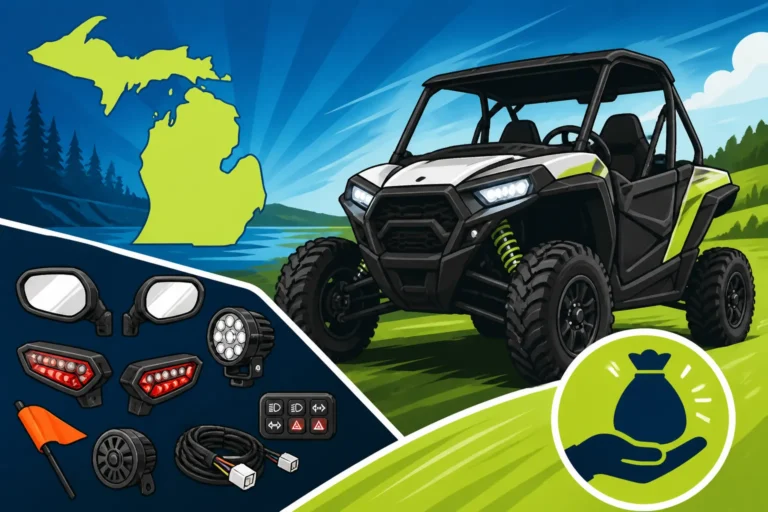
This means it must adhere to the full suite of motor vehicle lighting requirements, including working turn signals, hazard lights, and proper headlamp aiming, as described in [Safety Glass, Mirrors and Horns: Michigan's Street-Legal List]. These vehicles are expected to operate safely and visibly in all conditions, including after dark. While the baseline ORV rules apply to standard off-road vehicles on designated routes, a street-legal UTV on a public road, whether county or state, is held to a higher standard. You'll need appropriate [Insurance a Michigan Street-Legal UTV Needs] which typically includes no-fault coverage, further distinguishing it from a purely off-road machine. These modifications and insurance requirements exist precisely because these vehicles are intended for more extensive and varied road use, including after sunset.
| Feature | Standard ORV (Road-Legal) | Street-Legal UTV (Assembled Vehicle) |
|---|---|---|
| Headlights | 1 white, 200 ft visibility | 2 white, low/high beam, specific aiming standards |
| Taillights | 1 red, 200 ft visibility | 2 red, 200 ft visibility |
| Brake Lights | Functional (highly recommended/often required) | Mandatory, dedicated brake lights |
| Turn Signals | Not required | Mandatory front and rear |
| Hazard Lights | Not required | Mandatory |
| Side Markers | Not required | Required |
| Reflectors | Recommended | Required |
| Windshield | Optional (eye protection needed if no shield) | Required (safety glass) |
| Mirrors | Rearview (highly recommended/often required) | Left & Right Side Mirrors + Rearview |
| Horn | Recommended | Mandatory |
| Speedometer | Not required | Mandatory |
| Insurance | ORV-specific (liability often optional) | Michigan No-Fault (mandatory) |
| Road Access | Designated ORV routes & county roads by ordinance | Any public road (like a car) |
Common Mistakes and How to Avoid Them
Even with the best intentions, it's easy to make mistakes when navigating the nuances of ORV road riding after dark in Michigan. These errors can range from minor oversights to significant safety hazards, often resulting in fines or, worse, accidents. Being aware of the most common pitfalls is the first step toward avoiding them and ensuring a smooth, safe night ride.
Inadequate Lighting and Visibility Penalties
One of the most frequent mistakes is simply having inadequate lighting. This isn't just about having a headlight and a taillight, but ensuring they meet the visibility standards and are in good working order. A dim headlight, a taillight obscured by mud, or non-functional brake lights are all forms of "inadequate lighting." Many riders forget that factory lights might suffice for trail riding, but they may not be bright enough or broad enough in their beam for safe road use.
Penalties for operating an ORV with insufficient lighting on a public road after dark can include significant fines. Law enforcement officers are vigilant about this, as it's a primary safety concern. Moreover, if you're involved in an accident and your lighting is found to be inadequate, it could complicate insurance claims and potentially increase your liability. To avoid this, regularly inspect all your lights before any night ride. Check for burned-out bulbs, cracked lenses, or loose wiring. Consider upgrading your stock lighting with brighter LED options or auxiliary lights from reputable brands. [Michigan ORV Lighting Rules During Daylight] offers a good baseline, but remember that night conditions demand even more attention to detail. Ensure your lights are clean and properly aimed, and test your brake lights by having a friend observe them while you press the pedal.
Ignoring Local Night Riding Bans
As we discussed, Michigan counties and townships have the authority to impose their own rules regarding ORV road access, including restricting or prohibiting night riding. A common mistake is assuming that if a road is open during the day, it's open all the time. Many municipalities institute curfews for ORV use on their roads, often to address noise concerns from local residents. These bans might be posted on local government websites, at trailheads, or through local signage that can be hard to spot in the dark.
Ignoring these local bans can lead to tickets and fines, which are often more about deterring nuisance behavior than generating revenue. More importantly, it can create a negative perception of ORV riders within the community, potentially leading to more restrictive ordinances in the future. Always make it a point to check [Michigan County ORV Ordinances Explained] for the specific area you plan to ride in. A quick search online or a call to the local sheriff's department can save you from an unpleasant encounter. If you're unsure, it's always safer to stick to designated ORV trails or routes that explicitly permit nighttime use, or simply plan your road portions of the ride to be completed before dark. Respecting local rules helps ensure continued access for all riders.
Underestimating Nighttime Driving Challenges
Perhaps the most dangerous mistake is underestimating how different night riding truly is compared to daylight riding. Reduced visibility affects not just what you can see, but also your depth perception, peripheral vision, and ability to judge distances and speeds of other vehicles. Animals are far more active at night, and deer, coyotes, or even smaller critters can dart out in front of you with little warning. Road hazards like potholes, fallen branches, or uneven gravel are much harder to spot until you're right on top of them.
Fatigue can also set in more quickly when riding in the dark, as your eyes and brain are working harder to process information. Glare from oncoming headlights can temporarily blind you, and dust kicked up by your own or other vehicles becomes a dense, disorienting cloud in your headlights. To combat these challenges, prepare thoroughly. Reduce your speed significantly. [Fines for Speeding on an ORV] can be steep, but the risk of an accident is a far greater concern. Scan the road constantly, looking far ahead and to the sides. Consider a reflective safety vest for yourself and any passengers. If you feel tired or disoriented, pull over to a safe, well-lit area and take a break. Bring a [Michigan ATV Bill of Sale: What to Put in It] along with your other documents. Having an emergency kit, including a flashlight, basic tools, and a first-aid kit, is also highly recommended. Treat night riding on roads with the respect it deserves, and you'll significantly increase your chances of a safe and enjoyable journey.
Disclaimer
This article is for general informational purposes only and does not constitute professional advice. Laws, prices and regulations vary by location and change over time. Consult a qualified professional for guidance on your specific situation.