Michigan Frozen Lake Riding Spots
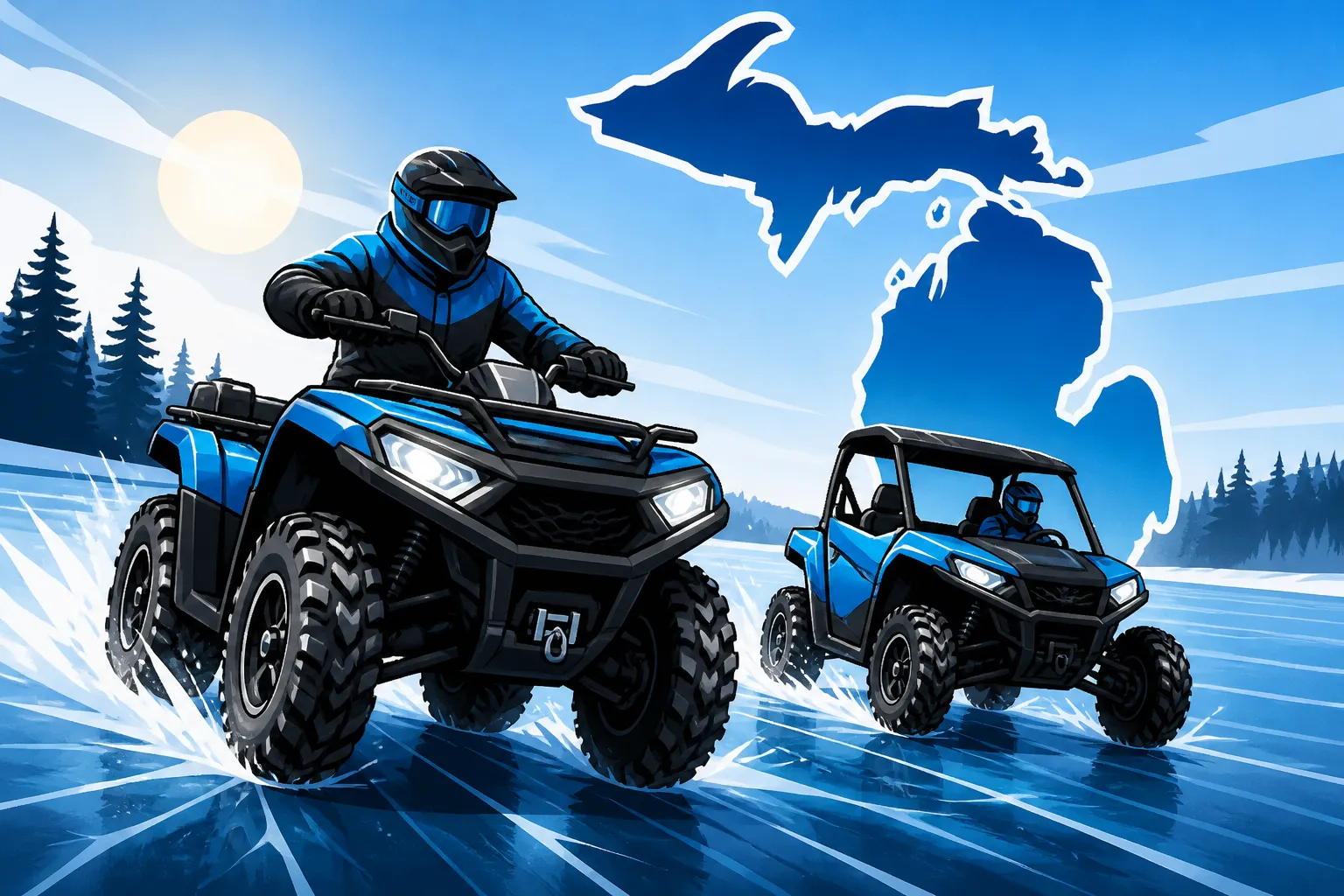
Michigan’s lakes can look like wide-open riding country in winter, but a frozen surface is not automatically safe or open to ATVs and UTVs. This guide explains how to research possible riding areas, confirm access and permit rules, assess ice hazards, and plan a ride without mistaking a convenient launch or map line for permission.
Where to research Michigan frozen lake riding
Before choosing a lake, separate three questions: Is the ice safe enough for your machine? Is ORV use allowed there? Can you legally and safely reach the ice from your starting point? A “yes” to one does not answer the other two.
Lakes to investigate before you go
Several Michigan lakes may come up when riders search for winter access, including Houghton Lake, Higgins Lake, Burt Lake, Mullett Lake, Torch Lake, and Lake Gogebic. Treat these as places to research, not as a list of lakes where riding is automatically authorized. Conditions and access can vary by shoreline, township, launch, landowner, and season.
Houghton Lake, in Roscommon County, is a large inland lake with communities and public access points around its shoreline. That size can make it tempting to imagine a long, open route across the ice. In practice, shoreline access, local restrictions, ice conditions, and other winter users all matter. A public boat launch, for example, does not by itself establish permission to ride an ORV onto the lake.
Higgins Lake, Burt Lake, and Mullett Lake are also familiar northern Michigan destinations. They have shoreline communities, public access areas, and seasonal recreation, but access rules may differ from one location to another. On a lake with a busy launch or a narrow channel, the safest choice may be to avoid riding altogether, even if another part of the water appears open.
Farther west, Lake Gogebic is a large Upper Peninsula lake worth researching for winter recreation access. Its size does not make its ice uniform: snow cover, wind, currents, inlets, and underwater features can create changing conditions. Torch Lake is another well-known option to investigate, but its depth and shoreline setting are reminders that appearance alone tells you little about ice strength. Confirm local rules and conditions for the specific access point and route you have in mind.
Compare locations by access and uncertainty
A useful first step is to compare candidate lakes by practical questions rather than by size or popularity. The table below is a planning aid, not an access map or a statement that ORV riding is permitted at any listed location.
| Lake to research | What makes it worth checking | Questions to answer before riding |
|---|---|---|
| Houghton Lake | Large lake with shoreline communities and public access areas | Which access point allows the activity, and are there local restrictions? |
| Higgins Lake | Popular northern Michigan recreation destination | Is ORV use allowed at the chosen location, and what are the current ice conditions? |
| Burt Lake | Connected to a broader inland-water recreation area | Are there channels, currents, or shoreline restrictions along the proposed route? |
| Mullett Lake | Large inland lake with multiple shoreline communities | Is the route permitted, and can you avoid channels and other hazards? |
| Torch Lake | Well-known lake with varied shoreline and depth | What do local authorities say about access and ice safety at your specific entry point? |
| Lake Gogebic | Upper Peninsula destination with winter recreation interest | Which land manager or local authority can confirm access and current conditions? |
For each lake, identify who manages the access point and who can answer questions about ORV use. Depending on the location, that could mean checking with a township, county, state land manager, local law enforcement agency, or the landowner. Ask specifically whether ORVs may be operated on the frozen water and whether there are restrictions on launching, parking, hours, or routes.
If you use onX Offroad to explore an area, use it as a planning aid rather than proof of permission. A displayed road, trail, or access point does not necessarily show whether riding on the ice is allowed, whether the route is open in winter, or whether the shoreline is private. Cross-check the route with the relevant land manager before unloading.
Understand how lake access differs from trail access
A route that leads to a lake is not the same thing as authorization to ride on the lake. A trail may end at a boat launch, for instance, while the launch area has its own rules or the frozen water is subject to a local restriction. Likewise, an access point that is open to people on foot may not be intended for motorized use.
Keep the difference between an ORV license and a trail permit in mind. A license, trail permit, or recreation pass may apply differently depending on where and how you ride. Do not assume that a permit for designated trails automatically grants access to a frozen lake, or that a lake ride is exempt from other requirements. Review [Michigan ORV License and Trail Permit Explained] and [Michigan ORV Permit for Frozen Lakes] when sorting out which rules may apply.
How to confirm access and plan your route
A lake ride requires more homework than simply finding a spot where someone has driven onto the ice. Start with an exact launch point, check who controls it, and ask about both the access area and the frozen water. If the answer is unclear, choose another plan rather than treating uncertainty as permission.
Check the specific rules, not just general lake advice
Local rules can make a major difference. A county or township may restrict ORV use on certain roads, in a village, near a launch, or on a particular area of public land. Private property can create another boundary: a path across a private lot or shoreline is not yours to use just because it is the shortest route to the water.
Before leaving home, write down the name of the access point, the shoreline area you intend to use, and the route you plan to ride. Contact the relevant authority with those details. Ask whether motorized ORVs are allowed on the frozen surface, whether the access point is open to ORVs, and whether any seasonal or local restrictions apply. A general answer such as “people ride out there” is not as useful as a direct confirmation for your planned location.
Map apps can help you understand roads, trails, public land boundaries, and nearby services. onX Offroad may help you build a rough route or identify features to investigate, but map information cannot confirm changing local ordinances, a temporary closure, or a landowner’s permission. Compare what you see in the app with official notices and direct answers from the land manager.
It can also help to save an offline map before you leave. Cell reception can be unreliable around some rural shorelines and in parts of the Upper Peninsula. Use the map to orient yourself, not as a reason to ride beyond a signed boundary or onto a route you have not confirmed.
Sort out permits, riders, and machine requirements
Check permit rules for the specific type of riding you plan to do. Requirements may differ between designated trails, public land, private property, and frozen public water. [Michigan ORV Permit Exemptions on Private Land] can help explain why riding on someone’s property is not the same as riding on public land, while [Michigan ORV Safety Certificate Requirements] is useful when a young rider will be part of the group.
If a rider under 16 is coming, confirm age, supervision, and safety-certificate requirements before the trip. Make sure the machine is appropriate for the rider and that the rider can reach and operate the controls safely while wearing winter gear. Bulky gloves, thick boots, and layered clothing can change how a young rider handles a machine.
Check that your machine is in good working order before winter travel. Look over tires, brakes, throttle return, lights, battery, and fuel level. Cold weather can make a weak battery or a sticking control much more noticeable. Carry a communication device that works in the area, and tell someone who is not riding with you where you plan to go and when you expect to return.
If you are using onX Offroad or another map app, download the information you need before departing and mark the access point and planned turnaround location. Avoid planning a route that depends on crossing a channel, traveling over unknown water, or using a road shoulder that may not allow ORVs. The simplest route is often the safer one.
Build a conservative plan with a clear turnaround point
Set a route that stays well away from channels, inlets, outlets, bridges, culverts, and areas where water may move beneath the ice. These features can weaken ice even when nearby areas appear solid. Also watch for pressure cracks, heaves, slush, open water, thin snow bridges, and dark or wet-looking patches.
Choose a short first outing rather than planning to cross a large lake. A nearby turnaround point makes it easier to return if visibility worsens, the ice surface changes, another user approaches, or you feel uncertain. Agree in advance that any rider can call off the trip without being pressured to continue.
Let someone on shore know your planned access point, approximate route, group size, and return time. If your group changes its plan, update that person. A route shared only within the riding group may not help anyone locate you if you do not return as expected.
Ice safety for ATV and UTV riders
Ice conditions are local and can change quickly. No simple measurement or online report can guarantee that an entire lake will support a machine. A safe plan is based on current, location-specific information and a willingness to turn around—not on the fact that other riders have been out recently.
Do not judge ice by appearance or by someone else’s tracks
Snow can hide cracks, open water, slush, and changes in surface conditions. A set of tracks crossing the lake shows only that another person traveled there at a particular time; it does not establish that the route is safe now or that your heavier machine can follow it safely. Ice can vary across short distances because of currents, springs, vegetation, changing depths, and wind.
Ask a knowledgeable local authority or qualified ice-safety professional about current conditions near the exact area you are considering. General reports from another bay or another side of the lake may not apply. If there is no reliable current information, do not treat that absence as reassurance.
Avoid riding near moving water and other known weak areas. Inlets, outlets, narrows, channels, and places where streams enter or leave a lake deserve special caution. Do not follow a route across a channel just because it looks frozen from the shoreline. If an intended route approaches one, turn around or choose a different outing.
If the ice surface is changing, visibility is poor, or you cannot confidently identify hazards, stay off the lake. A scenic ride is not worth a rescue or a cold-water emergency.
Prepare for a breakdown or cold-water emergency
Travel with another machine when possible and keep the group together. Carry a charged phone in a warm, accessible place, but do not assume it will have service. A communication device suitable for the area, a first-aid kit, warm dry layers, a headlamp, and basic recovery equipment can make a difficult situation more manageable. Tell someone on shore when to contact local help if you have not checked in.
Wear appropriate cold-weather protective gear and keep clothing secured away from wheels, belts, and other moving parts. A helmet and eye protection are important even at low speeds. Riders should know how to stop and dismount safely, and passengers should have properly fitted protective equipment and a seat designed for them.
Do not improvise a rescue by driving another machine toward a person who has fallen through. Call emergency services and follow instructions from trained responders. A person entering cold water can become impaired quickly, and an unplanned rescue attempt can put additional people in danger. Keep a safe distance from the edge of a break and use appropriate rescue equipment only if you are trained and can do so without creating another casualty.
Plan to end the ride before daylight fades or weather makes navigation difficult. Wind can reduce visibility across an open lake, and wet clothing can become dangerous in cold conditions. Leave enough time to return to shore without rushing.
Ride with other winter users in mind
Frozen lakes can be shared by anglers, snowmobilers, people on foot, and other recreational users. Ride slowly near access areas and people, keep a predictable line, and leave plenty of room around fishing shelters, parked vehicles, and groups. Avoid sudden turns or unnecessary noise near homes and shorelines.
Do not assume every marked path is an ORV route. A snowmobile track, walking path, or route to an ice-fishing spot may not be intended for ATVs or UTVs. Follow posted signs, give way where appropriate, and keep machines off areas that are closed or designated for another use.
A map can help you plan around roads and trails, but onX Offroad cannot show every temporary restriction or every person on the ice. Use it alongside local instructions, visible signs, and good judgment. If a route seems to lead through a crowd or toward an uncertain boundary, turn back and find another way.
A practical checklist before riding a frozen lake
A short checklist makes it easier to catch missing details before the trailer is loaded. It is especially helpful when the group is excited, the weather window is limited, or someone is visiting from out of town.
Before you leave home
Confirm the exact lake access point and ask the relevant authority whether ORV use is allowed there and on the frozen water. Check for closures, local restrictions, and any permit requirements that apply to your route. Review [Michigan ORV Trail Maps and What the Signs Mean] for map and sign basics, but remember that a trail map alone does not establish lake access.
Check current local ice information for the specific area you plan to ride. Look at the weather forecast, including wind and visibility, and set a conservative turnaround time. If the ice information is old, vague, or unavailable, postpone the lake ride rather than relying on guesswork.
Prepare the machine, protective gear, communication equipment, warm spare clothing, and emergency supplies. Make sure everyone in the group knows the route and understands that turning around is part of the plan, not a failure.
At the access point
Read every posted sign and check that the shoreline route is open to your machine. Look for barriers, fresh closures, or signs that the area is being used by other winter recreationists. If access is uncertain, do not unload until you have clarified it.
Pause before entering the ice and review the route together. Identify hazards to avoid and a clear return point. Keep the group close enough to communicate and move at a speed that allows riders to respond to changing conditions.
If the surface, weather, or traffic differs from what you expected, revise the plan or leave. A frozen lake is not a controlled riding area, and a route that looked reasonable from home may not make sense once you see the actual conditions.
After the ride
Tell your shore contact that you have returned, and check the machine for damage, packed snow, or ice around moving parts. Make a note of any access issues, signs, or hazards you encountered so you can make a better decision next time. Do not turn a successful outing into a blanket recommendation for other riders; conditions can be different on the next day or at the next access point.
If your group is considering a designated trail ride instead, review [Where to Ride an ATV in Michigan] and [Michigan ORV Trail Closures and Seasonal Dates]. Those resources address a different kind of riding area, but they can help you compare a marked route with the uncertainties of lake ice.
Disclaimer
This article is for general informational purposes only and does not constitute professional advice. Laws, prices and regulations vary by location and change over time. Consult a qualified professional for guidance on your specific situation.