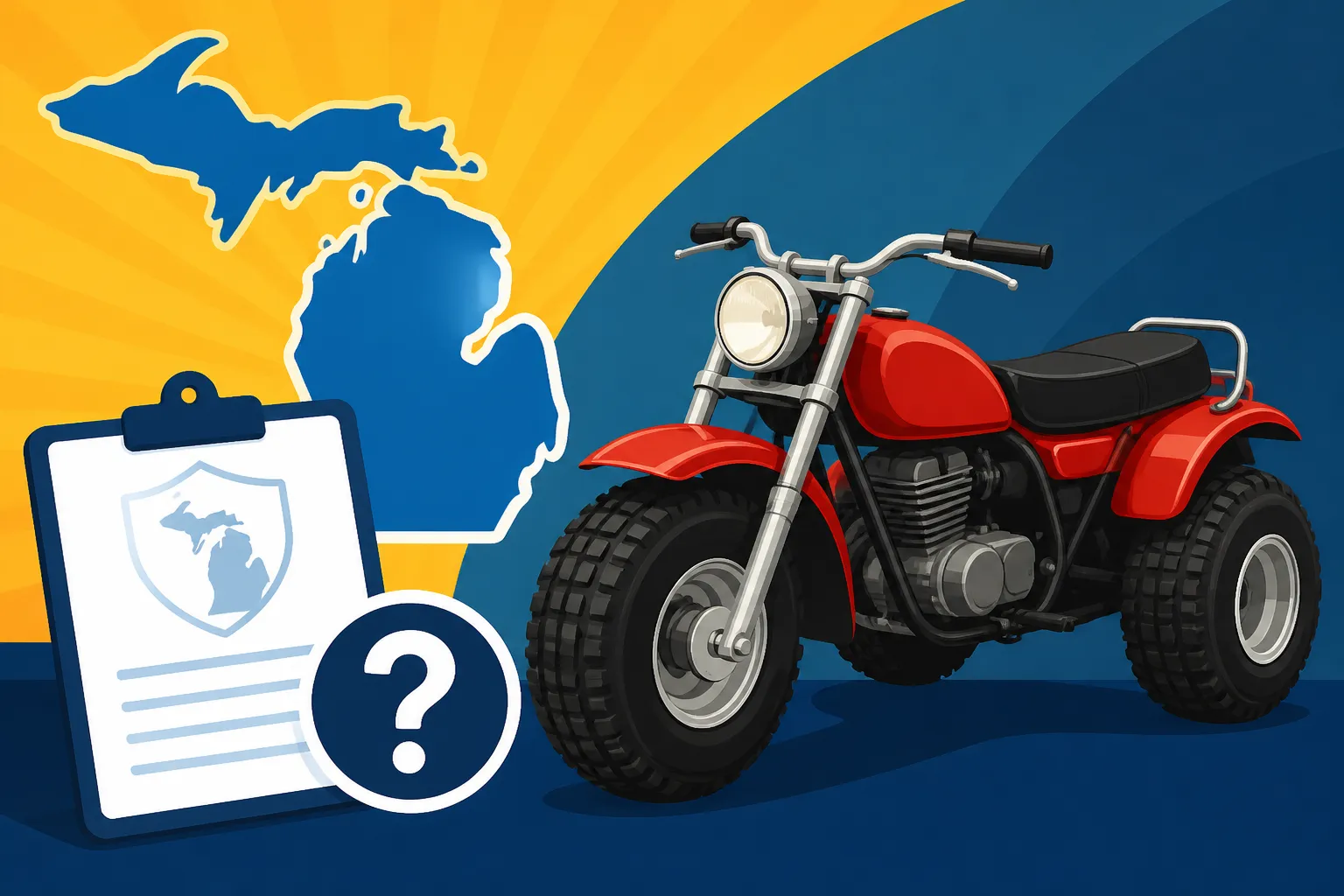
Do Vintage Three-Wheelers Need a Michigan Title?
Oh, the classic three-wheeler! There's something undeniably nostalgic about those machines, isn't there? But whether you've just inherited one from grandpa, found a gem at an estate sale, or you're dusting off an old friend from the back of the barn, you might be scratching your head about Michigan's titling rules. It feels like every time you turn around, there's a new regulation, and when you add the "vintage" and "three-wheeler" labels to the mix, it can get downright confusing. This guide is here to clear up that fog, walking you through whether your beloved vintage three-wheeler needs a Michigan title and what steps you'll need to take to make it street-legal, or at least trail-legal.
Understanding Michigan's ORV Titling Requirements
First things first, let's get a handle on what Michigan considers an Off-Road Vehicle (ORV) and why titling is generally a thing. It's easy to assume that because your three-wheeler is old, it might fall outside the modern rules, but that's not always the case.
What Defines an Off-Road Vehicle ORV in Michigan?
Michigan's definition of an ORV is pretty broad, covering just about any motorized vehicle designed for off-road use. This includes things like ATVs, UTVs, dirt bikes, and yes, those classic three-wheeled all-terrain vehicles. The key is that it's "capable of traveling over or through all natural terrain," which means if it's got an engine and isn't primarily designed for on-road travel (like your car or truck), it likely falls under the ORV umbrella.
This definition doesn't really care about the number of wheels, the year it was made, or how much dust it's collected. If it's a machine that can take you off the beaten path, Michigan generally considers it an ORV. So, your cherished Honda ATC, Yamaha Tri-Moto, or Kawasaki Tecate, even if it's from the 80s, is absolutely an ORV in the eyes of the law. This is the foundation upon which all other titling rules are built.
The General Rule: Why Most ORVs Need a Title
For most ORVs sold and operated in Michigan today, a title is required. Think of the title as the official birth certificate and ownership document for your machine. It proves who legally owns the vehicle and records important information like the Vehicle Identification Number (VIN). When you buy a new ORV from a dealer, they handle the initial titling process for you, often submitting the paperwork directly to the Secretary of State. For private sales, it's on the buyer to transfer the title into their name.
The main reason for this requirement is accountability and traceability. A title helps prevent theft, ensures proper sales tax collection, and makes it clear who is responsible for the machine. It's how the state keeps tabs on ORV ownership, which is crucial for managing public lands, enforcing safety regulations, and even recovering stolen vehicles. Without a title, proving ownership can be a nightmare, and operating the machine on public trails becomes legally questionable. [Michigan Gives You 15 Days to Title an ORV] after a purchase, underscoring the state's expectation for timely titling.
The Specifics of "Vintage" and "Three-Wheeler"
Now, let's zero in on the unique aspects of your vintage three-wheeler. This is where the waters can get a little murky, but we'll try to clear them up. The age of the machine and its specific configuration sometimes lead to questions about exemptions or different processes.
What Qualifies as a Vintage Machine in Michigan?
Michigan doesn't have a specific "vintage" or "classic" classification for ORVs in the same way it does for classic cars. So, while you might lovingly refer to your 1985 ATC 250R as vintage, the state doesn't necessarily grant it special titling privileges based solely on its age. It's still treated as an ORV, albeit an older one.
However, the year of manufacture does play a critical role, but not because it's "vintage." Instead, it relates to when Michigan first started requiring ORV titles. For machines manufactured before a certain date – generally, around 1990-1991, though often simplified to "prior to 1995" in conversation about older vehicles – the titling requirements were different or non-existent. This is a common point of confusion, and we'll dive deeper into the implications of that specific cutoff later on. It's less about the aesthetic of "vintage" and more about the historical timeline of Michigan's titling laws.
Are Three-Wheelers Treated Differently?
Historically, three-wheelers faced a lot of scrutiny due to their unique handling characteristics and a higher rate of accidents compared to four-wheel ATVs. Because of safety concerns, manufacturers voluntarily stopped producing three-wheelers for sale in the U.S. consumer market in the late 1980s. This created a bit of a legacy issue. While new three-wheelers aren't sold, existing ones are still out there, and they're still considered ORVs.
Michigan's titling laws generally don't distinguish between three-wheelers and four-wheelers when it comes to the basic requirement for a title. If it's an ORV, it typically needs a title. However, where three-wheelers do see different treatment is often in age restrictions for riders. For example, [Three-Wheel ATVs and Riders Under 16] face specific limitations, often prohibiting riders under 16 from operating them on public lands. This is a safety regulation, not a titling exemption, but it highlights that three-wheelers are indeed viewed with a slightly different lens due to their design.
Scenarios Where a Title Might Be Exempt or Different
While the general rule is that ORVs need titles, there are a few specific situations where your vintage three-wheeler might have a different path, especially given its age. These are important to understand before you head to the Secretary of State.
Machines Exclusively Used on Private Property
This is perhaps the most common misconception. Many people believe that if they only ride their ORV on their own private land, it doesn't need a title. While it's true that some permits might be exempt on private land, the title itself is fundamentally a proof of ownership document. Michigan law generally requires all ORVs to be titled, regardless of where they are operated.
The title isn't just about public trail access; it's about establishing legal ownership. If your vintage three-wheeler is stolen from your private property, a title is your strongest piece of evidence to prove it's yours and aid in its recovery. It also simplifies things immensely if you ever decide to sell it. So, even if your three-wheeler's only job is to putter around your family farm or cottage property, getting it titled is still the recommended and legally sound approach. [Michigan ORV Title for a Machine Used Only on Private Land] delves into this further, clarifying that while permits may differ, titling usually doesn't.
Machines Older Than a Certain Year Pre-1995 ORVs
This is the big one for vintage three-wheelers! Michigan began its comprehensive ORV titling requirements in the early 1990s. Specifically, if your three-wheeler was manufactured prior to January 1, 1991, it was not legally required to have a Michigan ORV title at that time. This means many vintage three-wheelers from the 70s and 80s simply never received a Michigan title in the first place because the law didn't exist for them.
So, if you own a machine from before 1991, does it need a title now? Yes, if you intend to operate it on public land, apply for an ORV trail permit, or transfer ownership easily. While it might not have been issued a title initially, if you want to integrate it into the modern ORV system, you'll need to go through a titling process. The Secretary of State often uses a "manufactured prior to 1995" guideline for vehicles that likely don't have existing titles. For these machines, you'll need to establish proof of ownership through a bill of sale or other documentation, and then apply for an original Michigan ORV title. It's not an exemption from titling, but rather a special path for titling an older machine that historically wouldn't have had one. [Michigan ORV Title for a Machine Older Than 1995] provides more specific details on this exact scenario.
Farm Use Exemptions for Three-Wheelers
Michigan does offer some specific exemptions for ORVs used exclusively for farm operations. These exemptions generally relate to registration and trail permits, but the titling requirement can also be affected. If your vintage three-wheeler is solely used for agricultural purposes on private land owned or leased by the farmer, it might be exempt from the general ORV titling requirement.
However, this exemption is quite strict. The machine must be used for tasks like planting, harvesting, tilling, or hauling agricultural products. It cannot be used for recreation, even if it's on farm property. If you ever take it out for a recreational ride on trails, or even on public roads (where permitted), that exemption generally goes out the window. If you're relying on this exemption, be absolutely sure your use case fits the narrow definition. If there's any recreational use, you'll want to title it. [ORV Title Exemptions for Farm Machines in Michigan] offers a deeper dive into what qualifies.
What to Do If Your Vintage Three-Wheeler Lacks a Title
It's a common situation with older machines: you acquire a vintage three-wheeler, and there's no title to be found. Maybe the previous owner lost it, or perhaps the machine was so old it never had one to begin with. Don't despair; Michigan has processes in place to help you establish legal ownership.
Proving Ownership Without a Title
When a title is missing, your primary goal is to gather as much evidence as possible to prove that the three-wheeler is rightfully yours. The most crucial document is a detailed bill of sale. Even if it's a simple handwritten note, it needs to clearly identify the machine (make, model, VIN), the seller's and buyer's information, the date of sale, and the purchase price. Both parties should sign it. A template from a service like LawDepot can provide a good starting point for ensuring all necessary details are included, even for a private sale.
Other supporting documents can include:
- Previous registrations: Even if it wasn't a Michigan ORV registration, an old registration from another state or an older vehicle type can show a chain of ownership.
- Insurance documents: Proof that you've insured the vehicle in your name.
- Receipts for parts or repairs: If you've put money into restoring it, those receipts can show an investment consistent with ownership.
- Photos: Sometimes, photos of you with the machine over time can help establish a history.
- Affidavits: Sworn statements from previous owners or witnesses to the sale can be helpful.
The more evidence you can present, the stronger your case will be at the Secretary of State. The core idea is to establish a clear, uninterrupted chain of possession leading to you. For a deeper look, check out [Proof of Ownership When a Michigan ORV Has No Title]. And remember, a well-drafted bill of sale is your first line of defense; consider using a reputable template for this, like those found on LawDepot.
The Bonded Title Process
If you have a vintage three-wheeler but lack a clear chain of ownership or the previous title is lost and the seller is unreachable, a bonded title might be your best option. This is a bit more involved but provides a legal path to getting a title. Essentially, you purchase a surety bond (a form of insurance) for a certain value of the machine. This bond protects the state and any potential previous owner who might later come forward with a legitimate claim to the vehicle.
The process typically involves:
- Valuation: Getting your three-wheeler appraised to determine its fair market value.
- Application: Filling out specific forms from the Secretary of State, detailing why you need a bonded title and presenting all your ownership evidence.
- Bond Purchase: Obtaining a surety bond from an insurance company. The cost of the bond is usually a small percentage of the vehicle's value.
- Inspection: The Secretary of State might require a VIN inspection to ensure the machine isn't stolen and the VIN matches your documentation.
Once the bond is in place and your application is approved, the Secretary of State will issue you a title with a "bonded" notation. After a certain period (usually three years), if no one makes a claim against the bond, the "bonded" status is typically removed. It's a fantastic solution for those legitimate ownership gaps. Find out more at [Bonded Title for an ATV in Michigan].
Getting a Court Order for a Title
For the most challenging cases, where all other avenues fail, obtaining a court order for a title is a possibility. This is usually a last resort, as it involves legal proceedings and can be more time-consuming and expensive. You would essentially petition a court to declare you the legal owner of the three-wheeler, based on the evidence you present.
A judge, after reviewing your case and ensuring all due diligence has been done to locate previous owners or titles, can issue an order compelling the Secretary of State to issue a new title in your name. This is a robust solution but one that requires legal counsel and patience. While it’s not ideal for every scenario, it exists as a formal path when the ownership puzzle is particularly complex. For those considering this route, [Getting a Court Order to Title an ORV] offers additional insights.
Why Titling Your Vintage Three-Wheeler Matters
Even if you're not planning to sell your vintage three-wheeler anytime soon, getting it properly titled in Michigan is incredibly important. It's about more than just bureaucracy; it protects you and your investment.
Legal Operation on Public Lands
This is often the most immediate concern for riders. If you want to take your vintage three-wheeler onto any of Michigan's vast network of ORV trails, routes, or areas, it must be titled and have the necessary ORV license and trail permit. Conservation officers routinely check for proper documentation, and operating an untitled ORV on public land can result in fines and even impoundment.
Even if your three-wheeler is so old it didn't initially require a title, if you're using it on state or county land that permits ORVs, you'll need to go through the process to get that title. It's not just about having the machine; it's about having the proper paperwork to prove your right to ride it where you want to. Don't let an oversight here spoil a great day on the trails.
Protecting Your Investment and Future Sales
A title is the ultimate proof of ownership. Without it, your vintage three-wheeler, no matter how meticulously restored or how rare, is significantly devalued and harder to sell. Imagine trying to sell a vintage car without a title – it's a huge red flag for any potential buyer. The same applies to ORVs. Buyers want assurance that they're purchasing a legitimate machine and that they'll be able to title it in their own name.
If you ever decide to part ways with your three-wheeler, a clean title makes the transaction smooth and hassle-free. It protects you from accusations of selling stolen property and ensures the buyer can legally take ownership. Without a title, you're looking at a much smaller market of buyers, likely for parts only, or those willing to take on the risk and hassle of a bonded title themselves. [Selling an ATV in Michigan Without a Title: What Goes Wrong] explains the pitfalls in detail.
Insurance and Recovery
While ORV insurance isn't always mandatory in Michigan (unless you're operating on public roads or as part of a street-legal conversion), having a title can be crucial if you choose to insure your vintage three-wheeler. Insurance companies rely on titles to verify ownership and the machine's identity (via the VIN) before issuing a policy. Without a title, getting comprehensive or collision coverage might be difficult or impossible.
More importantly, if your three-wheeler is ever stolen, a title is indispensable for its recovery. Law enforcement agencies use VINs and title records to track ownership. Without a title, proving to the police or an insurance company that the recovered machine is actually yours becomes a significant challenge. A clear title streamlines the process of reporting the theft and, hopefully, getting your cherished machine back. For more on this, consider [Stolen ATV Recovery and the Title Trail].
Steps to Title a Vintage Three-Wheeler in Michigan
Alright, you're convinced that titling your vintage three-wheeler is the way to go. What's the actual process at the Michigan Secretary of State? It's fairly straightforward once you have your ducks in a row.
Gathering Necessary Documentation
Before you even think about heading to a Secretary of State branch, gather every single piece of paper related to your three-wheeler. This typically includes:
- Proof of Ownership: This is critical. If you have an existing title (even if it's from out-of-state), that's best. If not, a well-executed bill of sale from the person you bought it from, along with any previous bills of sale you can trace, is essential. Remember, a robust bill of sale, perhaps using a template from a service like LawDepot, can make a huge difference here.
- Michigan ORV Title Application (Form TR-11L): You can usually download this form online or pick one up at the Secretary of State. You'll fill out all the details about yourself and the three-wheeler, including the VIN.
- Identification: Your valid Michigan driver's license or state ID.
- Payment for Fees: There will be a title fee, and potentially sales tax (or use tax, if you bought it from a private party and haven't paid tax yet). While specific figures can't be given here, be prepared for these costs. Check the Secretary of State website for current rates.
- VIN Verification (if required): For older machines or those without a clear title history, a VIN inspection might be necessary. This often involves a law enforcement officer or a Secretary of State employee visually verifying the VIN on the machine matches your paperwork.
Make sure all your documents are complete and accurate. Any discrepancies can cause delays. For a comprehensive list, refer to [Documents to Bring to a Secretary of State ORV Appointment].
The Secretary of State Visit
Once you have all your documents ready, it's time to visit a Michigan Secretary of State branch.
- Appointment: It's highly recommended to schedule an appointment online beforehand. Walk-in availability can be limited, and waiting times can be long, especially for more complex transactions like titling an older ORV without a clean paper trail. [Michigan Secretary of State Appointments for ORV Title Work] can guide you on how to set this up.
- Present Your Documents: When your number is called (or at your appointment time), present all your gathered documentation to the clerk. Be prepared to explain the history of the three-wheeler, especially if it's an older model without a previous Michigan title.
- VIN Verification: If a VIN inspection is required, the clerk will guide you on how to get this done. Sometimes, they can do it on-site if the machine is present, or they might instruct you to get it verified by law enforcement.
- Pay Fees: Pay the required title fee and any applicable sales or use tax.
- Temporary Documentation: The clerk will process your application. You might receive a temporary operating permit or receipt right away, allowing you to operate your three-wheeler while you wait for the physical title.
Be patient and polite. Titling older or unique vehicles can sometimes require a bit more legwork from the clerk, so having all your information organized will help everyone.
What to Expect Post-Application
After your visit, the waiting game begins. The Secretary of State will process your application.
- Title Mailing: Your official Michigan ORV title will typically be mailed to your address. The timeframe can vary, but generally, it arrives within a few weeks. [How Long a Michigan ORV Title Takes to Arrive] gives a more specific idea of current expectations.
- ORV License/Permit: Once you have your title, you can then purchase your Michigan ORV license and trail permit. These are required annually for operation on public lands and come as stickers that attach to your three-wheeler.
- Future Transactions: With a title in hand, any future sale or transfer of ownership will be much simpler. You'll simply sign over the title to the new owner, just like with any other titled vehicle.
By going through this process, you ensure your vintage three-wheeler is fully legitimate in Michigan, allowing you to enjoy it without worry and protecting your investment for years to come.
Titling Scenarios for Vintage Three-Wheelers in Michigan
Here's a quick overview of different situations you might encounter and the likely path to getting a title for your vintage three-wheeler.
| Scenario | Likely Previous Title Status | Required Action | Key Documents |
|---|---|---|---|
| Machine manufactured AFTER Jan 1, 1991 | Should have a Michigan ORV title | Transfer existing title (if available) or apply for bonded title/court order. | Signed title from seller, Bill of Sale, TR-11L application. |
| Machine manufactured BEFORE Jan 1, 1991 | May never have had a Michigan ORV title | Apply for an original title, proving ownership through other documentation. | Strong Bill of Sale (from LawDepot), affidavits, TR-11L application. |
| Used only on Private Property | Regardless of age, title is recommended | Follow appropriate path (transfer existing, apply original, or bonded) for age. | Proof of ownership, TR-11L application. |
| Farm Use Exemption (strict criteria) | May be exempt from titling | Verify specific farm-use requirements with Secretary of State. | Proof of exclusive farm use. |
| Lost Title, Previous Owner Unreachable | Had a title at some point | Pursue a bonded title. | Bill of Sale, valuation, surety bond, TR-11L application. |
| No Proof of Ownership (found/abandoned) | Unknown | Seek a court order to establish ownership. | Evidence of possession, legal counsel, TR-11L application. |
Disclaimer
This article is for general informational purposes only and does not constitute professional advice. Laws, prices and regulations vary by location and change over time. Consult a qualified professional for guidance on your specific situation.