Michigan ORV Safety Certificate for Riders Under 16
Michigan’s ORV safety rules can be confusing when a young rider has a certificate but still needs supervision, permits, or different permissions for road use. The key distinction is that a certificate is only one part of the rules for riding on public land. Here’s how Michigan’s age limits, supervision requirements, and related safety obligations fit together.
When a rider under 16 needs an ORV safety certificate
In Michigan, anyone under 16 must complete an approved ORV safety course and carry a valid safety certificate to operate an ORV on public lands, according to the Department of Natural Resources. That requirement applies whether the machine is an ATV or a UTV. Having the certificate does not, by itself, allow a young rider to operate without an adult.
The certificate confirms that a young rider has completed the required safety training. It is not the same as an ORV license or trail permit, and it does not replace the supervision requirement. Under Michigan’s rules, operators under 16 must be under the direct visual supervision of an adult while operating on public lands, according to the Department of Natural Resources.
It helps to think of the certificate as a qualification, not a general permission slip. A rider may have completed a course and still be too young to operate a particular type of machine or ride without an adult watching. The location also matters: rules for public lands do not automatically apply in the same way on private property, where permission from the landowner and other requirements may still matter.
What “carry the certificate” means in practice
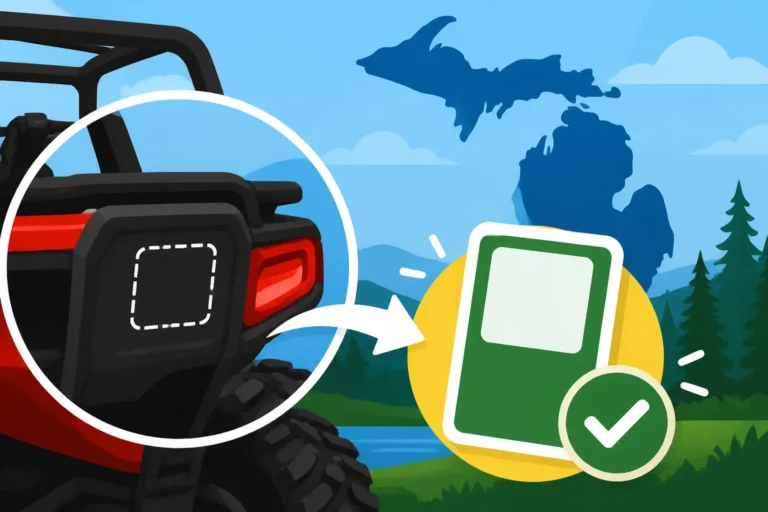
A young rider should have the certificate available during a ride, rather than assuming that an adult can provide it later if asked. Keep it in a secure, accessible place that will not be damaged by weather or fall out during riding. A protected document sleeve or a safe storage spot in the vehicle can help, as long as the rider can produce the certificate when needed.
Before heading out, check that the rider has the certificate and that the name and details are legible. If a certificate is lost, damaged, or difficult to access, resolve that before relying on it for a public-land ride. For questions about course eligibility and certificate requirements, see Michigan ORV Safety Certificate Minimum Age and [Michigan ORV Safety Certificate Course Cost].
A certificate from another state or a province of Canada may be accepted in some circumstances, but do not assume every course card qualifies. Michigan law requires non-resident operators aged 12 to 15 to present a certificate issued under Michigan Part 811 or a comparable certificate issued under another state’s or a Canadian province’s authority, according to the Michigan Legislature. Riders visiting from outside Michigan can review Safety Certificate Reciprocity for Michigan Riders and Non-Resident ORV Permits in Michigan before traveling.
A certificate does not remove the supervision requirement
The supervising adult needs to be able to see the young rider directly. Being somewhere on the same trail system, in the same group, or reachable by phone is not necessarily the same as direct visual supervision. The practical point is that the adult must be in a position to observe the rider and respond if a problem develops.
Plan the ride so the adult can keep the young rider in view, including when terrain bends, vegetation blocks sightlines, or the group separates. Do not send the young rider ahead around a blind corner and assume the supervision condition is still satisfied. For more detail on how to apply this requirement during a ride, see What Direct Visual Supervision Actually Means.
Age limits, machine type, and public-road riding
The rules depend on the rider’s age, the machine, and where the machine is operated. A young rider’s certificate is important, but age limits can still prohibit riding a particular ATV on public lands.
Children under 10 may not operate a four-wheel ATV on public lands in Michigan, according to the Department of Natural Resources. This restriction is separate from the certificate requirement. Completing a course does not override the age restriction, so a child in this age group cannot ride a four-wheel ATV on public lands simply because they hold a certificate and an adult is present.
For riders from 10 to under 16, an approved safety certificate and direct visual supervision by an adult are required for ORV operation on public lands, according to the Department of Natural Resources. Operators must be at least 16 to operate an ATV unsupervised on public lands, also according to the Department. The rider’s age is therefore a key check before choosing a machine or planning a route. See Michigan ORV Age Rules at 10, 12 and 16 for a closer look at the age categories.
Check what kind of vehicle the young rider will use
People often use “ATV,” “UTV,” and “ORV” interchangeably, but Michigan law defines vehicle types using width. The Michigan Department of Natural Resources designates three ORV trail types by width: motorcycle-only trails maintained at a 24-inch width, trails maintained at a 50-inch width, and ORV routes maintained at a minimum 72-inch width.
These definitions can matter when deciding which rules apply and whether a route is open to a particular machine. Do not rely only on the vehicle’s marketing name or the rider’s familiarity with it. Check the machine’s width, the route’s vehicle restrictions, and any applicable age and supervision rules before setting out.
If an adult is supervising a young rider in a group, make sure the group’s machines and route are suitable for the rider. A larger UTV can have different passenger and restraint considerations than an ATV, while a narrow trail may not be open to every vehicle width. The supervising adult should know which machine the child is using and whether it is designed for the way it will be ridden.
Public-road use has an additional set of rules
A public road designated for ORV use is not the same as an ORV trail, and the rules for young riders can differ. A driver’s license is not required for adults operating an ATV on a public road designated for ORV use, according to the Michigan Legislature. For a person under 18, the Legislature requires either a valid driver’s license or direct supervision by a parent or guardian while the young operator holds an ORV safety certificate.
That road-use rule is separate from the general public-land supervision requirement. A parent or guardian should check that the road is actually designated for ORV use and that the rider meets the applicable age, certificate, and supervision conditions. A certificate should not be treated as permission to ride on any road. Local access rules and the route designation still matter.
For additional detail about young riders on public roads, see Michigan ORV Road Rules for Riders Under 16. For wider questions about which roads allow ORVs, confirm the route rules before riding rather than assuming an open trail means an adjacent road is open too.
Certificate, ORV license, and trail permit are separate requirements
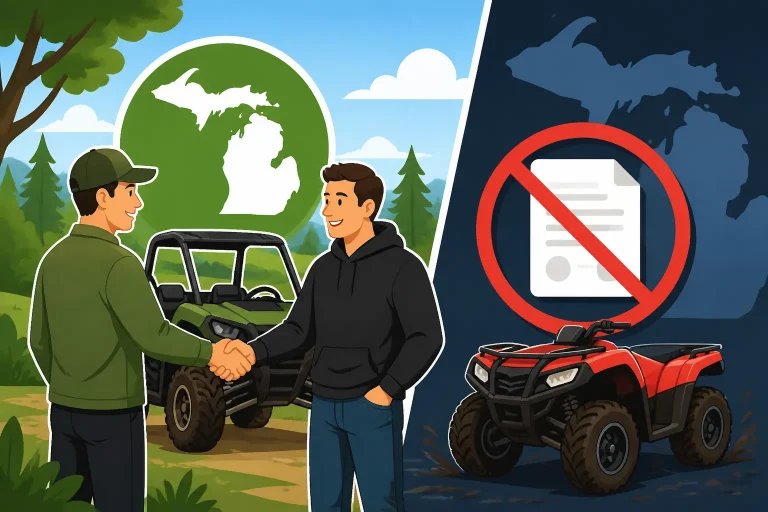
A common source of confusion is assuming that a certificate and an ORV permit do the same job. They do not. The certificate is the rider’s safety-course credential. The ORV license and trail permit are separate requirements tied to where a machine is operated.
According to the Michigan Department of Natural Resources, the annual ORV license costs $26.25. Riding on state-designated ORV trails requires an additional $10.00 trail permit, for a combined total of $36.25. Those figures are as of October 2026. A trail permit is required along with the base ORV license for those trails; it is not a substitute for a young rider’s safety certificate or adult supervision.
The Department of Natural Resources says annual ORV licenses and trail permits expire on March 31 of the following year, regardless of when they were purchased. That means a permit bought later in the season does not create a new twelve-month period. Check the machine’s permit status and intended route before riding, particularly if a family is using a vehicle that was purchased or permitted by someone else.
Michigan also treats some riding locations differently. For example, an ORV license is required to ride on the frozen surface of public waters, but a trail permit is not required for that specific use, according to the Department of Natural Resources. That exception concerns the trail permit, not the youth certificate and supervision rules that apply to operating on public lands.
The permit rules can have exceptions depending on location and use, so it is worth checking them independently from youth safety requirements. See Michigan ORV License and Trail Permit Explained for the distinction between the base license and trail permit, and Michigan ORV Permit Exemptions on Private Land for questions about private property.
Confirm all requirements before the ride
Before loading a machine, match the planned ride to the right requirements:
- Rider: Does the young operator meet the age rule for the machine and location?
- Certificate: Has the rider completed an approved course, and can they carry their certificate?
- Supervision: Can an adult maintain direct visual supervision for the entire ride?
- Machine: Is the vehicle permitted on the route, and is it designed to carry its occupants?
- Permits: Does the location require an ORV license, a trail permit, or both?
- Route: Is the route open to the machine and the intended type of riding?
For trails, make sure the rider is not being asked to go beyond the group’s sightline or ability to supervise. For a public road designated for ORV use, check the road-specific conditions as well. Treat each requirement as its own check; satisfying one does not automatically satisfy the others.
Safety checks that support a compliant ride
A course certificate is only one part of safe riding. The adult supervising a young rider should also check the machine, required protective equipment, and route conditions. These details matter for children and adults alike, but a younger rider may need closer help preparing and checking equipment.
Helmet and eye protection
Michigan generally requires ORV operators and passengers to wear a Department of Transportation-approved crash helmet and protective eyewear, according to the Michigan Legislature. Exceptions apply under certain conditions, including some private-property riding with permission and riding in a UTV equipped with an approved roof and properly fastened safety belts.
For a young rider, do not assume that a UTV’s roof alone makes a helmet unnecessary. The exception described by the Michigan Legislature includes both an approved roof and properly fastened safety belts. When it is unclear whether an exception applies, follow the helmet and eye-protection requirements rather than relying on a guess.
A properly fitting helmet and goggles should be checked before each outing. If you buy gear through Amazon or another retailer, verify that the helmet meets the required DOT approval and fits the rider correctly; a listing title or product photo alone is not proof of approval. Protective eyewear should stay in place and provide a clear view without interfering with the helmet.
Passengers, belts, and machine design
Michigan prohibits carrying a passenger on an ORV unless the vehicle’s manufacturing standards or design explicitly provide for transporting passengers, according to the Michigan Legislature. Do not add a passenger to a single-rider ATV just because the rider is small or the trip is short. The machine must be designed to carry the passenger.
For UTV occupants seeking the helmet exception, Michigan requires properly adjusted and fastened safety belts along with a roof that meets crash-helmet standards, according to the Michigan Legislature. The Department of Natural Resources also says each occupant must wear a seat belt in the Silver Lake ORV Area. A passenger who is too small for a belt to fit properly should not be carried as though the belt requirement has been met.
Before riding, confirm that every occupant has an appropriate seat and restraint, and that everyone knows how to use it. Adults should explain that belts stay fastened while the vehicle is moving, not merely when approaching a checkpoint or entering a managed area.
Mechanical and environmental conditions
Michigan law requires ORVs on public lands to have a United States Forest Service-approved spark arrester and a muffler in good working order and constant operation, according to the Michigan Legislature. Riders should check that these parts are present and functioning before a ride, especially after repairs or modifications.
Headlights and taillights must be lighted when operating an ORV from a half-hour after sunset to a half-hour before sunrise, according to the Michigan Legislature. Do not plan a young rider’s trip around daylight alone if the group could be delayed into darkness. A late return can turn an otherwise suitable ride into a lighting and visibility problem.
The Michigan Department of Natural Resources may close state trails and facilities because of weather events or wet conditions. Check current closures before leaving and be prepared to change plans. A route that is usually available may be closed to protect trail conditions or for safety reasons. Avoid riding around barriers or treating a closure notice as optional.
Preparing a young rider before leaving home
Good preparation makes the legal requirements easier to follow in the moment. It also helps the supervising adult choose a ride that fits the young operator’s ability, rather than relying on the child to keep up with a group moving at an adult pace.
Start by confirming the rider’s age against the machine and location rules. If the ride is on public lands, make sure the rider has completed the approved course, has the certificate with them, and will remain under direct visual supervision. Remember that children under 10 cannot operate four-wheel ATVs on public lands, according to the Department of Natural Resources. When the ride involves a public road designated for ORV use, check the separate conditions for riders under 18 with the Michigan Legislature.
Next, inspect the machine and protective equipment together. The young rider should know how to put on and fasten a helmet, use eye protection, stay seated as intended, and wear a seat belt if the machine has one. The adult should verify that the vehicle is built for its passengers, its lights and safety equipment work, and its spark arrester and muffler are in good working order.
Then select a route where supervision is realistic. Direct visual supervision is harder to maintain when riders spread out, when terrain blocks sightlines, or when the route has several branches. Choose a pace and route that allow the adult to stay close enough to observe the young rider without creating pressure to take risks. Explain in advance where the group will stop and what to do if the child loses sight of the adult.
Finally, check the route and permit requirements. Confirm whether the ride is on a state-designated trail, a different public-land route, a public road designated for ORV use, frozen public water, or private land. The relevant permits and riding restrictions may differ. Check for closures and route limitations, and make sure the planned ride does not depend on a permit exception that may not apply.
If a young rider is visiting Michigan, check the certificate’s issuing authority and whether it is comparable under Michigan law. Michigan recognizes qualifying certificates from another state or a Canadian province for non-resident operators aged 12 to 15, according to the Michigan Legislature. Do not rely on a generic participation card or course receipt unless it meets the applicable requirement.
The supervising adult should be ready to change the plan if the child is tired, the route becomes difficult, weather worsens, or the group can no longer maintain direct visual supervision. A valid certificate does not make a difficult route appropriate, and a permit does not guarantee a trail is open. The safest plan is one that gives the young rider room to follow the rules without being rushed.
Frequently Asked Questions
Does an ORV safety certificate let a rider under 16 ride alone?
No. The Department of Natural Resources requires anyone under 16 operating an ORV on public lands to have a valid certificate and be under direct visual supervision of an adult. The certificate does not remove the supervision requirement.
Can a child under 10 ride a four-wheel ATV on Michigan public lands with an adult?
No. The Department of Natural Resources prohibits children under 10 from operating four-wheel ATVs on public lands. Adult supervision and a certificate do not override that restriction.
Does the safety certificate replace the ORV license or trail permit?
No. The certificate is a rider safety credential. The Michigan Department of Natural Resources lists the ORV license and, for state-designated ORV trails, the additional trail permit as separate requirements.
Can an out-of-state certificate count in Michigan?
It may. The Michigan Legislature says non-resident operators aged 12 to 15 must present a Michigan Part 811 certificate or a comparable certificate issued under another state’s or a Canadian province’s authority. Check that the particular certificate qualifies before riding.
Sources
- Michigan Department of Natural Resources — ORV FAQs – State of Michigan (checked October 28, 2026)
- Michigan Department of Natural Resources — Purchase permit, learn requirements – State of Michigan (checked October 28, 2026)
- Michigan Legislature — MCL – Section 324.81131 (checked October 28, 2026)
Disclaimer
This article is for general informational purposes only and does not constitute professional advice. Laws, prices and regulations vary by location and change over time. Consult a qualified professional for guidance on your specific situation.