Crossing Railroad Tracks on an ORV
It’s a feeling many Michigan ORV riders know all too well: you’re out on a fantastic trail, enjoying the wind in your face and the rumble of your machine, when suddenly, a set of railroad tracks looms ahead. Your heart might do a little flutter as you wonder if this is a legal crossing, if it's safe, and what exactly Michigan law says about maneuvering your ATV or UTV over those steel rails. This guide is here to untangle the confusion and help you understand the critical rules and safety practices for crossing railroad tracks on your ORV in our beautiful state.
The Serious Risks of Crossing Railroad Tracks on an ORV
Let's be brutally honest from the start: railroad tracks are not part of the standard ORV playground. While many designated ORV trails and routes in Michigan do legally cross railroad lines, these are specific, marked intersections. Any other crossing is not only illegal but incredibly dangerous. We’re talking about massive, fast-moving trains that cannot swerve or stop quickly, and a unique track geometry that can easily spell disaster for an ORV.
Unseen Dangers and Momentum
It's easy to underestimate the sheer force and speed of a train. When you're out on the trails, your mind is often focused on the terrain directly in front of you – the mud, the rocks, the trees. But a train can appear seemingly out of nowhere, often moving much faster than you anticipate. Even if you see or hear a train coming, the reality is that it takes a train a significant distance – sometimes over a mile – to come to a complete stop, even in an emergency. Your quick reflexes on an ATV or UTV simply aren't enough to counteract that kind of momentum. Many tragic incidents happen because riders believe they can "beat" the train, or misjudge the time they have.
Beyond the train itself, the tracks present their own set of hazards. The steel rails are incredibly slippery, especially when wet or icy. Crossing them at the wrong angle can cause your tires to lose traction instantly, leading to a slide or even a rollover. The gaps between the rails, known as the flangeway, can also snag tires, especially smaller ATV tires, or even frames if your ground clearance isn't sufficient. Imagine getting a tire wedged or high-centered on the tracks – you're suddenly a sitting duck, with very little time to react if a train approaches. It’s a terrifying scenario that’s far too real for some riders.
Derailment Risks and Mechanical Damage
Beyond the immediate danger to life, illegal or improper railroad crossings can also cause significant damage to your off-road vehicle. The abrupt change in elevation, the hard steel of the tracks, and the unevenness of the ballast (the crushed rock bed) can wreak havoc on your suspension, tires, and even your frame. It's not uncommon for riders to bend rims, blow out tires, or damage critical suspension components like A-arms or shock mounts if they hit the tracks incorrectly. And if you're tackling particularly rough terrain, including potentially unmarked or neglected crossings, having robust parts can make a difference. Many riders opt for aftermarket upgrades from brands like SuperATV to enhance the durability of their machines, but even the toughest components won't save you from a direct hit with a train or a severe mechanical failure that leaves you stranded.
Even if you avoid a catastrophic accident, getting stuck or damaging your machine on active railroad property can lead to hefty fines, vehicle impoundment, and an incredibly difficult recovery process. Law enforcement and railroad companies take trespassing on their property very seriously, and the cost of retrieving a damaged ORV from a remote section of tracks can be astronomical, not to mention the potential legal penalties. It's a situation you absolutely want to avoid at all costs.
Michigan Laws on ORV Railroad Crossings
Michigan law is very clear about where and how ORVs can interact with railroad tracks. The overarching principle is that you can only cross where it is explicitly allowed and marked. This isn't just a suggestion; it's a legal requirement designed for your safety and the safety of others. Ignoring these rules can lead to serious consequences, not just for you, but potentially for everyone involved in an accident.
Designated Crossings vs. Trespassing
In Michigan, ORVs are generally permitted to cross railroad tracks only at established, clearly marked crossings that are part of a designated ORV trail, route, or street-legal road. These crossings are typically maintained by the railroad company or the state and are designed to accommodate vehicular traffic safely. They'll often have warning signs, crossbucks, and sometimes even active signals (lights and gates) to indicate the presence of a train. These are the places where you can, with extreme caution, proceed.
However, many riders, sometimes out of ignorance or a desire to explore, encounter unmarked tracks. Perhaps it's a forgotten spur line in the woods, or a track that appears to simply cut across public land. Let me be unequivocally clear: crossing railroad tracks anywhere other than a designated, marked crossing is considered trespassing. This is a serious offense, carrying fines and potentially leading to your ORV being impounded. Railroad property, including the tracks and the land immediately adjacent to them, is private property. It's not public access, even if it looks like an abandoned or rarely used line. Just because a trail might lead to tracks doesn't mean it's a legal crossing. Always look for clear signage indicating an authorized crossing. If there's no sign, no official crossing structure, assume it's illegal. You can find more information about what to expect during a stop in [Michigan ORV Paperwork During a DNR Stop].
Penalties for Illegal Crossings
The penalties for illegally crossing railroad tracks on an ORV in Michigan are no joke. You're looking at fines that can quickly add up, and in some cases, your machine could be seized. A first offense might result in a significant monetary penalty, but repeated offenses or incidents where you cause damage or endanger others can lead to more severe charges. These aren't just minor traffic tickets; they can become serious legal headaches.
Beyond the immediate financial hit, there are other repercussions. An illegal crossing ticket might impact your driving record, and if an accident occurs, you could be held liable for damages, not only to your own vehicle but potentially to railroad property or for any delays caused to train operations. Imagine getting hit with a bill for disrupting an entire freight line! It's a risk that far outweighs any perceived convenience of taking a shortcut across unauthorized tracks. Make sure you understand how to navigate official encounters by knowing [Michigan ORV Paperwork During a DNR Stop].
Safe Crossing Practices for ORV Riders
Even at a designated, legal crossing, safety is paramount. You can never be too careful when dealing with railroad tracks. These aren't just another bump in the trail; they demand your full attention and respect. Developing safe habits now will protect you, your passengers, and your machine for years to come.
Stop, Look, Listen, and Live
This classic adage is more critical than ever when approaching a railroad crossing on an ORV. Always, always come to a complete stop before the tracks. Don't just slow down; stop. This gives you time to thoroughly scan both directions for trains. Take off your helmet if it impedes your hearing, turn down any music, and listen intently for the sound of an approaching train, including its horn. Remember, ORVs can be noisy, so your machine might mask the sound of an oncoming train. If there's a designated stop line, stop behind it. If not, stop far enough back from the tracks to give yourself a safe buffer zone.
Once you’ve stopped, look in both directions down the tracks. Don't assume that because you can't hear anything, nothing is coming. Wind direction, track curves, and even the type of train can affect how far and how clearly you can hear it. Look for flashing lights or lowered gates, which indicate an active train. Only when you are absolutely certain that no train is approaching from either direction should you even consider proceeding. This disciplined approach is the most effective way to avoid becoming another statistic. You should also be aware of [Michigan ORV Accident Reporting Requirements] if the unthinkable were to happen.
Choosing the Right Angle and Speed
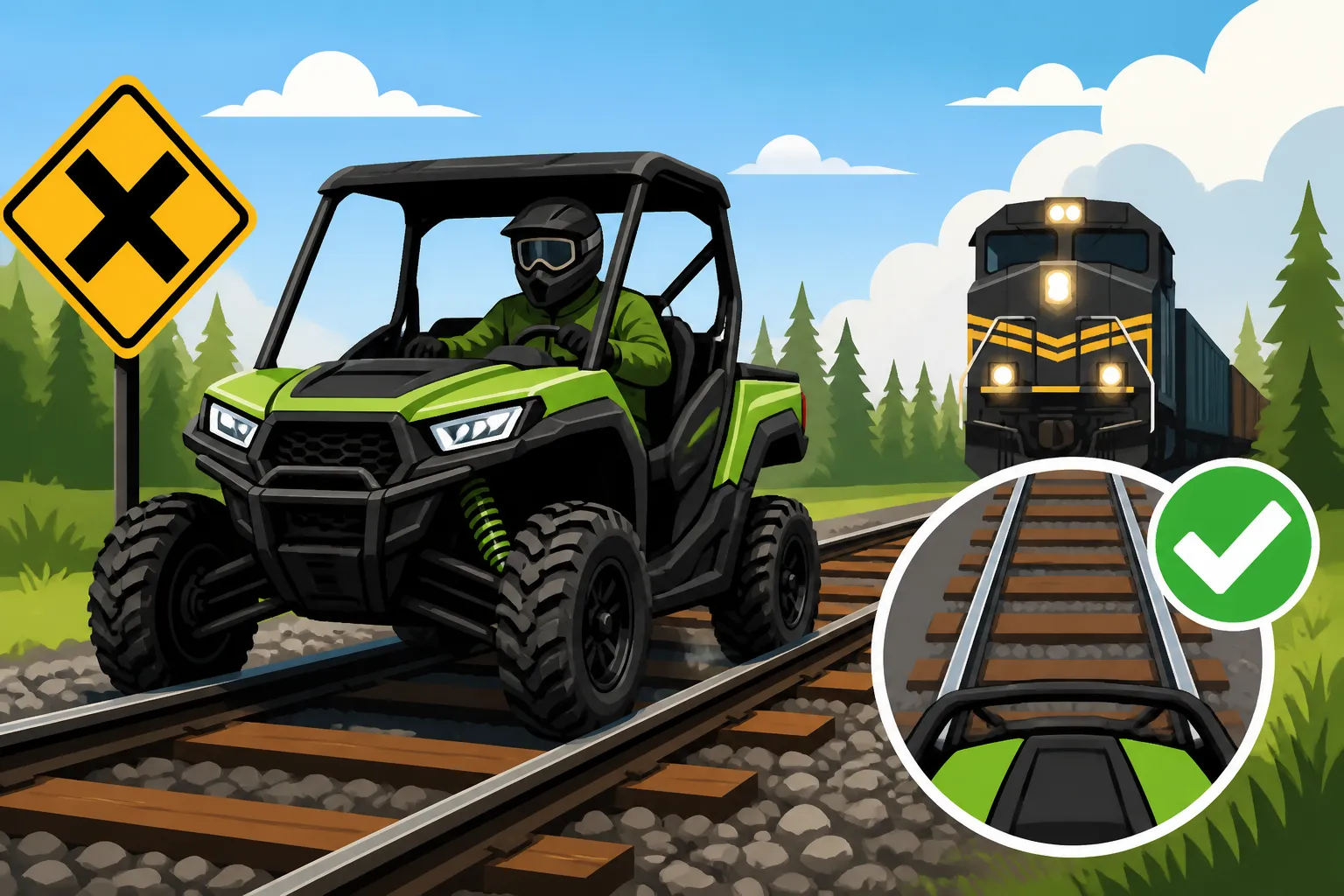
When you finally deem it safe to cross, the angle and speed at which you traverse the tracks are crucial. You want to cross railroad tracks as close to a 90-degree angle as possible. This minimizes the chance of your tires getting caught in the flangeway (the gap next to the rail) and reduces the risk of sliding on the smooth steel. Trying to cross at a sharp diagonal increases the risk of a tire getting wedged or your ORV losing traction and skidding sideways.
Approach the tracks slowly and deliberately. Once you begin to cross, maintain a steady, low speed, just enough to carry you smoothly over the rails without losing momentum. Avoid sudden acceleration or braking on the tracks themselves, as this can lead to a loss of control. If your ORV has multiple drive modes, engaging four-wheel drive (if applicable) can provide extra traction and stability, especially if the crossing is wet, muddy, or gravelly. Aftermarket parts like those offered by SuperATV, such as heavy-duty axles or enhanced suspension components, can provide better control and durability, but they are no substitute for proper technique and caution. Always be prepared for an uneven surface, as legal crossings can still be rough. For more on safe riding, consider pursuing a [Michigan ORV Safety Certificate Requirements].
Here's a quick guide to safe crossing:
| Action | Safe Practice | Unsafe Practice |
|---|---|---|
| Approach | Reduce speed, prepare to stop. | Maintain speed, assume no train is coming. |
| Before Tracks | Come to a complete stop, at a safe distance. | Roll through slowly, or stop too close. |
| Observation | Look both ways (left, right, left again), listen carefully for trains. | Quick glance, rely solely on hearing. |
| Train Detection | Wait for all trains to pass, and for gates/lights to clear. | Try to beat a train, proceed immediately after one passes (second train risk). |
| Crossing Angle | Cross at a 90-degree angle to the tracks. | Cross diagonally or at a shallow angle. |
| Speed during Crossing | Maintain a slow, steady, controlled speed. Engage 4WD if available. | Accelerate quickly, brake suddenly, or attempt to jump tracks. |
| Obstacles | Be aware of high center risks, loose gravel, or slippery conditions. | Ignore track conditions, assume smooth passage. |
| Exiting Tracks | Continue straight until clear of all tracks. | Turn sharply immediately after crossing. |
What to Do If You Encounter an Illegal Crossing or Get Stuck
Despite your best efforts to stick to legal routes, you might occasionally find yourself in a situation where you realize you've accidentally approached an unmarked track, or worse, gotten stuck. Knowing what to do in these high-stress moments can make a difference between a close call and a serious incident.
Reversing Course Safely
If you're on a trail and come across railroad tracks that you suspect are not a legal crossing – meaning no official signs, no maintained crossing structure – your immediate action should be to stop well before the tracks and turn around. Do not attempt to cross. Period. It might be frustrating to backtrack, especially if you feel like you're losing time or got turned around, but it is infinitely safer and smarter than risking a ticket, vehicle damage, or your life. Look for alternative routes, consult your [Michigan ORV Trail Maps and What the Signs Mean], or use a GPS app to find a legal way around. Sometimes, adventure means admitting you took a wrong turn and correcting it.
Never try to ride along the tracks, even for a short distance, to find a better crossing. This is also illegal trespassing and incredibly dangerous. Railroad ballast is unstable, and the space next to the tracks is often narrow with unpredictable obstacles. Remember, every inch of railroad property is considered a high-risk zone.
If Your ORV Gets Stuck on the Tracks
This is a rider's worst nightmare: your ORV gets high-centered, a tire gets wedged, or you simply lose traction and stall out on the tracks. If this happens, your absolute priority is getting yourself and any passengers to safety immediately. If you hear or see a train, evacuate the area around the tracks as fast as possible, moving in the direction the train is coming from, but away from the tracks themselves. This way, if debris flies from the impact, you're not in its path.
Once you are in a safe location, then you can attempt to call for help. Dial 911 immediately and provide your exact location. Most railroad crossings have a blue and white sign with an emergency number and a DOT crossing ID number – provide this information to the dispatcher. This helps emergency services and the railroad company locate you quickly and can initiate efforts to stop or slow approaching trains. Do not try to heroically free your ORV if there is any chance of a train approaching. Your life is not worth a machine, no matter how much you love it or how many [Street-Legal UTV Kit Prices] you invested. If you're going into remote areas, make sure you know [Cell Service on Michigan ORV Trails] and have a backup communication plan.
Conclusion
Navigating Michigan's beautiful landscapes on your ORV is an incredible experience, but it comes with the responsibility of understanding and respecting the rules of the trail, especially when it comes to railroad crossings. Always prioritize safety above convenience, stick to designated crossings, and know how to react in an emergency. By doing so, you'll ensure your adventures remain thrilling, safe, and within the bounds of Michigan law.
Disclaimer
This article is for general informational purposes only and does not constitute professional advice. Laws, prices and regulations vary by location and change over time. Consult a qualified professional for guidance on your specific situation.