Plowing a Sidewalk With a UTV
Winter in Michigan brings its own unique set of challenges, and few are as persistent as keeping sidewalks clear of snow and ice. While the idea of strapping a plow to your trusty UTV and making quick work of those snowy paths might seem like a dream come true, there's often a tangled web of rules, practicalities, and safety concerns that homeowners and business owners need to navigate. This guide aims to unravel that complexity, giving you a clear picture of what's involved in using your UTV to plow Michigan sidewalks.
The Legal Landscape of Plowing Sidewalks in Michigan with a UTV
When those first heavy snowfalls hit, the thought of clearing your sidewalks often leads to eyeing your UTV as the perfect solution. It's powerful, it's rugged, and it's right there. However, the legalities surrounding using an Off-Road Vehicle (ORV) like a UTV to clear snow, especially on public sidewalks, are far from straightforward. It's not as simple as just firing it up and getting to work; there are specific rules and responsibilities that Michigan residents need to understand.
Private Property vs. Public Sidewalks: Where's the Line?
Let's start with the most fundamental distinction: where you're actually plowing. If you're talking about a sidewalk or pathway entirely within your own private property, such as a long driveway or a path to your backyard shed, you're generally in the clear. Your UTV is your property, and your land is your domain. However, the moment you consider touching a sidewalk that runs along a public road, or one that's part of a condominium complex or business park, you step into a very different legal arena.
Most cities and townships in Michigan have ordinances that place the responsibility for clearing snow from public sidewalks in front of private residences or businesses directly on the property owner. While the responsibility is yours, the method you can use is often regulated. These public sidewalks are part of a municipal right-of-way, meaning they are for pedestrian traffic, not typically for motorized vehicles like UTVs, even if you’re doing a public service.
Road Legality and ORV Status for Sidewalk Access
Even if an ordinance permits some form of mechanized snow removal on a sidewalk, a significant hurdle for UTV owners is simply getting the machine to the sidewalk. UTVs are primarily designed as off-road vehicles. While Michigan has made strides in allowing ORVs on certain county roads, especially in northern regions, this doesn't automatically grant them free rein everywhere, particularly not on or immediately adjacent to public sidewalks within urban or suburban areas.
To even operate on a public road to get from your driveway to a public sidewalk section, your UTV would likely need to be deemed street legal. This often involves a rigorous conversion process and specific equipment, as outlined in guides like [How to Make a Side-by-Side Street Legal in Michigan]. Without proper street-legal conversion and registration, operating an ORV on a public road to access a sidewalk could result in fines or other penalties. Even if your UTV is street legal, the permission to drive on a road does not automatically extend to driving on a sidewalk itself. Crossing streets with your UTV, even if street legal, also falls under specific traffic laws, similar to [Crossing a State Highway on an ORV in Michigan]. You have to consider if local authorities permit ORVs for snow removal at all on any part of the public right-of-way.
Local Ordinances and Homeowner Association Rules
This is where things can get incredibly granular and confusing. Michigan is a "home rule" state, which means local municipalities have significant authority to enact their own ordinances, as long as they don't conflict with state law. What's perfectly acceptable in one township might be strictly prohibited in the next. Many cities have specific rules about what equipment can be used on sidewalks, prioritizing pedestrian safety and infrastructure protection. They often have provisions for snow blowers or smaller, lighter machines, but a UTV, with its weight and width, might be explicitly or implicitly excluded.
The best course of action is always to contact your local city clerk or township office directly and inquire about their specific snow removal ordinances. Don't rely on assumptions. Furthermore, if you live in a planned community, a condominium, or a development governed by a Homeowner's Association (HOA), you likely have another layer of rules to contend with. HOAs often have covenants that dictate acceptable vehicle types, noise levels, and even types of activities permitted on common grounds or private roads within their jurisdiction. Even if the city allows it, your HOA might not, leading to potential fines from them, regardless of municipal law.
Practical Considerations for UTV Sidewalk Plowing
Beyond the legal labyrinth, there are some very real, everyday challenges you'll face if you decide to use your UTV to clear Michigan's sidewalks. It’s not just about fitting the plow and pushing snow; it’s about understanding the physics of your machine, the integrity of the sidewalk, and the nuances of snow management in tight spaces. Ignoring these practicalities can lead to frustration, damage, or even a breakdown.
UTV Size, Weight, and Sidewalk Integrity
One of the biggest practical concerns is the sheer size and weight of most UTVs. While they are incredibly capable machines for off-road trails and property work, sidewalks are typically not engineered to withstand the repeated passage of several hundred, or even over a thousand, pounds of vehicle weight plus a plow and operator. Unlike a paved road, a sidewalk is a relatively thin slab of concrete, often laid over a simple gravel or sand base, and sometimes compromised by tree roots growing beneath it.
Repeatedly driving a heavy UTV on a sidewalk can lead to cracking, crumbling, or outright breakage of the concrete. This is particularly true for older sidewalks, those with existing hairline fractures, or areas where the sub-base might be uneven or water-saturated. The cost of repairing damaged sections of a sidewalk, especially if it's public property you're responsible for, can quickly outweigh any time savings from using the UTV. Smaller, lighter UTVs might pose less risk than larger, more powerful side-by-sides, but the risk remains significant for any motorized vehicle not specifically designed for pedestrian pathways. The type of tires you have, such as aggressive trail tires, can also exert more concentrated pressure than wider, softer-compound street tires, further contributing to potential damage.
Attachment Compatibility and Plow Types
Equipping your UTV for plowing involves more than just buying a blade. You need a robust plow system that’s compatible with your specific UTV model and designed for the job. There are various types of plows available, from straight blades that simply push snow forward to V-plows that can angle to direct snow to either side, and even specialized back drags for pulling snow away from garage doors.
Companies like SuperATV offer a wide range of UTV plow systems and accessories, from the plow blades themselves to the mounting hardware and lift mechanisms. It's crucial to select a plow that's not only the right width for the sidewalks you intend to clear but also built with durable materials and a strong mounting frame. Many UTVs can accommodate front-mounted plows, which typically attach to a frame system under the UTV. The lift mechanism can be manual, often via a winch (which itself needs to be robust), or a hydraulic system for easier, more precise control. Without a properly matched and securely mounted plow, you risk inefficient plowing, damage to your UTV, or even losing the blade mid-job.
Maneuverability and Snow Displacement
Picture this: a typical sidewalk is about three to four feet wide. Most UTVs, even compact models, are significantly wider than that, usually between 50 and 64 inches. Add a plow blade that's wider than the UTV itself, and you suddenly have a very unwieldy machine trying to navigate a narrow, often obstacle-ridden path. You'll find yourself constantly making multi-point turns, backing up, and trying to avoid mailboxes, fire hydrants, street signs, and utility boxes.
Then there's the question of where the snow goes. With a narrow sidewalk, you often have very little room to push snow to the side without piling it onto someone's lawn, burying shrubs, or, worse, pushing it back into the street where it can become a hazard for traffic. This is especially problematic if your municipality has rules about not depositing snow on public roads. The limited visibility from inside a UTV cab, especially with a plow blocking some of your view, further complicates precise maneuvering and awareness of your surroundings. Plowing sidewalks effectively requires a different kind of precision and gentleness than clearing a wide-open parking lot or driveway.
Safety and Responsibility While Plowing
When you’re operating any heavy machinery, especially in cold, snowy conditions and potentially near public areas, safety has to be your absolute top priority. Plowing sidewalks with a UTV introduces unique risks that go beyond typical recreational riding or even clearing your own driveway. Understanding these risks and taking proactive steps to mitigate them isn't just about protecting yourself; it's about safeguarding others and fulfilling your responsibilities as an operator.
Visibility and Awareness
Michigan winters often mean reduced visibility due to falling snow, fog, or simply the shorter daylight hours. Operating a UTV with a plow in these conditions amplifies the danger. A UTV, even with its lights on, can be surprisingly quiet compared to a full-size truck plow, meaning pedestrians might not hear you coming. This is particularly hazardous on sidewalks where people, including children walking to school or residents taking their dogs for a walk, might not expect a motorized vehicle.
It's absolutely critical to equip your UTV with ample lighting, including amber warning lights, to maximize your visibility to others. Consider wearing high-visibility clothing yourself, especially if you're operating at dawn, dusk, or night. Always proceed at a very slow, controlled speed, scanning constantly for people, pets, and hidden obstacles like ice patches or uneven sidewalk sections. Remember, even a minor collision with a pedestrian, or an incident where you damage property due to poor visibility, can have serious consequences. For more on navigating road rules generally, you might look at [Michigan's 25 mph Limit on County Roads].
Insurance and Liability
This is arguably one of the most critical, yet often overlooked, aspects of plowing sidewalks with a UTV. If you cause damage to public property (like cracking a sidewalk) or private property (like a neighbor's fence), or God forbid, injure someone, who is liable? Your standard ORV insurance policy, which covers your machine for recreational riding, may not cover commercial snow removal, or even personal snow removal if it's on public property. Policies often have exclusions for certain types of activities or operating locations.
It's imperative to review your UTV insurance policy carefully and, if necessary, speak directly with your insurance agent. Ask specific questions about coverage for plowing on public sidewalks, property damage, and personal liability. Your homeowner's insurance might offer some limited personal liability coverage, but it's unlikely to extend to incidents involving a UTV, especially one being used in a quasi-commercial capacity or on public land. If you're doing any plowing for others, even informally for a neighbor, you may need specific commercial liability insurance. Neglecting this could leave you financially devastated in the event of a serious incident. Be sure to understand your policy; it's just as important as knowing [Michigan ORV Insurance and When You Actually Need It] for recreational rides.
Best Practices and Alternatives
Given the legal and practical challenges, sometimes the "best practice" is to reconsider using a UTV for public sidewalks entirely. If local ordinances permit it and you're confident in your machine and skills, always prioritize safety: operate slowly, use maximum visibility aids, and be prepared to stop instantly. If you are permitted, try to limit UTV use to main, wider pathways where there's less risk of damage or encountering pedestrians in tight spots.
However, for most narrow, residential sidewalks, a walk-behind snowblower or even good old-fashioned shoveling might be the safest and most legally sound alternative. These methods reduce the risk of infrastructure damage and greatly minimize liability exposure. For longer, wider paths that are clearly private property, a UTV with a plow can be an efficient tool. Always remember to check [Michigan ORV Rules Inside City Limits] before venturing beyond your private property with your machine.
Equipping Your UTV for Snow Removal
So, you've done your homework, checked the local ordinances, and determined that using your UTV to plow your specific sidewalks or designated private pathways is permissible and practical. Now comes the fun part: outfitting your machine for battle against Michigan's formidable winter snows. A well-equipped UTV isn't just about power; it's about smart accessories, proper maintenance, and knowing your limits.
Essential UTV Snow Plow Accessories
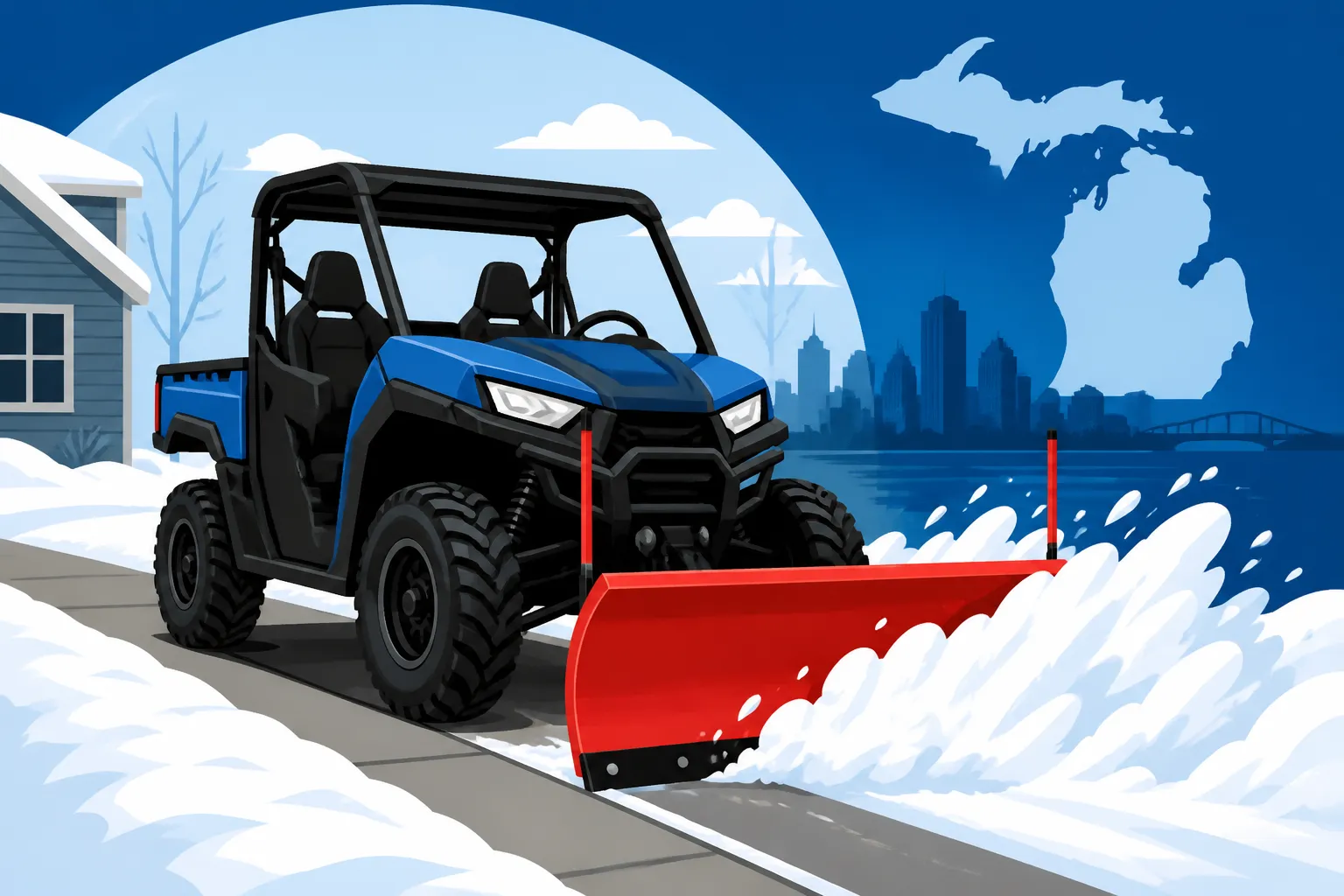
Transforming your UTV into a snow-clearing machine requires more than just bolting on a blade. A full plow system typically includes a heavy-duty plow frame or mount that connects to your UTV's chassis, a sturdy plow blade (often made of steel or poly), and a lift mechanism. For lifting, many UTV plows utilize an electric winch, which is often already installed on many UTVs for recovery purposes. If you don't have one, investing in a reliable winch with adequate pulling power is crucial. Hydraulic lift systems offer even smoother, more precise control but are generally more expensive and complex to install.
Beyond the core plow system, several accessories can make your winter work more efficient and comfortable. Plow shoes or skids, usually made of steel or heavy-duty plastic, attach to the bottom corners of your plow blade. They lift the blade slightly off the ground, protecting the sidewalk surface from direct contact with the metal blade and preventing excessive wear on the blade itself. Snow deflectors, often rubber or poly strips mounted to the top edge of the blade, prevent snow from flying over the top of the plow and onto your windshield. For operator comfort in Michigan's brutal cold, consider a full cab enclosure, a windshield wiper kit, and even a UTV heater. Companies like SuperATV also offer durable windshields and heating solutions that can transform your open-air UTV into a more bearable workspace during a blizzard. Aggressive tires or tire chains are also vital for maintaining traction on slippery, icy surfaces.
Maintenance and Winterization
Plowing snow is tough on any vehicle, and your UTV is no exception. Proper maintenance before, during, and after the winter season is essential to ensure reliability and longevity. Before the first snowfall, perform a thorough inspection: check all fluid levels (oil, coolant, brake fluid), test your battery (cold weather is brutal on batteries), and inspect belts and hoses for wear. Lubricate all moving parts of your plow system, especially pivot points and pins, to prevent rust and ensure smooth operation.
After each plowing session, especially if you’ve been using road salt, thoroughly rinse your UTV and plow to remove corrosive salt and grime. Pay special attention to the underside of the vehicle, the plow frame, and any exposed metal components. A quick spray with a silicone lubricant on pivot points can also help. At the end of the winter season, remove the plow system, clean it thoroughly, and store it in a dry place to prevent rust. Consider applying a rust preventative to any exposed metal. Neglecting these steps can lead to premature wear, rust, and costly repairs down the line. Remember, preventative care is always cheaper than reactive repairs.
Operator Skill and Training
Even with the best equipment, the operator makes all the difference. Plowing with a UTV, especially on narrow sidewalks, is a skill that requires practice and patience. The weight of the plow changes the center of gravity and handling characteristics of your UTV, affecting braking and steering. Practice in an open, snow-covered area (like a large, empty parking lot) before tackling tight sidewalks or public areas. Learn how your machine responds with the added weight and how the plow interacts with different snow depths and textures.
Understand the limits of your machine. Don't try to push through snow that's too deep or too heavy, as this can strain your UTV's drivetrain, damage the plow, or even get you stuck. Learn to make multiple passes if necessary, taking smaller bites of snow. Always prioritize smooth, controlled movements over brute force or speed. Being a skilled operator not only makes the job easier and more efficient but also significantly reduces the risk of damage to property or injury to yourself and others.
| Feature | UTV with Plow | Walk-Behind Snowblower |
|---|---|---|
| Plowing Capacity | High volume, faster over longer stretches | Lower volume, slower, but very precise |
| Maneuverability | Restricted on narrow sidewalks, turns wide | Excellent in tight spaces, around obstacles |
| Surface Impact | Risk of damage to sidewalks due to weight | Minimal impact, safe for most surfaces |
| Operator Comfort | Enclosed cab options, heated accessories | Exposed to elements, physically demanding |
| Cost (Initial) | Higher (UTV + plow system) | Lower |
| Legal Restrictions | Significant on public sidewalks | Generally none for personal use |
| Versatility | Multi-use machine (trails, work, plow) | Single-purpose (snow removal) |
Disclaimer
This article is for general informational purposes only and does not constitute professional advice. Laws, prices and regulations vary by location and change over time. Consult a qualified professional for guidance on your specific situation.