Michigan Golf Cart Age Requirement on Streets
The confusion around golf cart use on Michigan streets is a real head-scratcher for many folks, especially when it comes to who can actually get behind the wheel. It's not as simple as just rolling it out of the garage and onto the nearest paved road. This guide is going to clear up the age requirements for operating golf carts on Michigan streets, diving into the state laws and the all-important local ordinances that dictate where, when, and by whom these machines can be driven.
The Nuance of "Street Legal" for Golf Carts in Michigan
Let's get one thing straight right off the bat: there isn't a blanket state law in Michigan that makes all golf carts automatically street legal on every road. This is often the biggest misconception and the source of a lot of frustration. Unlike an ORV that has state-level trail permits and specific road crossing rules, golf carts operate under a more patchwork system, primarily governed by local ordinances.
State Law vs. Local Ordinances: The Patchwork Problem
Michigan state law itself doesn't explicitly prohibit golf carts from being operated on public roads. However, it also doesn't explicitly permit them unless they meet specific criteria to be classified as a Low-Speed Vehicle (LSV). This creates a legal gray area where the power falls to cities, townships, and villages to decide if, and under what conditions, golf carts can be driven on their local streets.
Think of it like this: your golf cart might be perfectly fine for cruising around the campground or your private property, but once you hit a road maintained by a municipality, you're entering their jurisdiction. Many communities have taken the initiative to pass ordinances allowing golf carts on certain roads, often with specific speed limits (typically 25 mph or less), equipment requirements, and, yes, driver age restrictions. If your local municipality hasn't passed such an ordinance, then operating a golf cart on their streets is generally not permitted, regardless of who's driving it. This is why checking with your specific local government is the absolute first step before even thinking about street driving. You might find some useful insights in [Michigan Cities With Golf Cart Ordinances].
Defining a Golf Cart vs. a Low-Speed Vehicle (LSV)
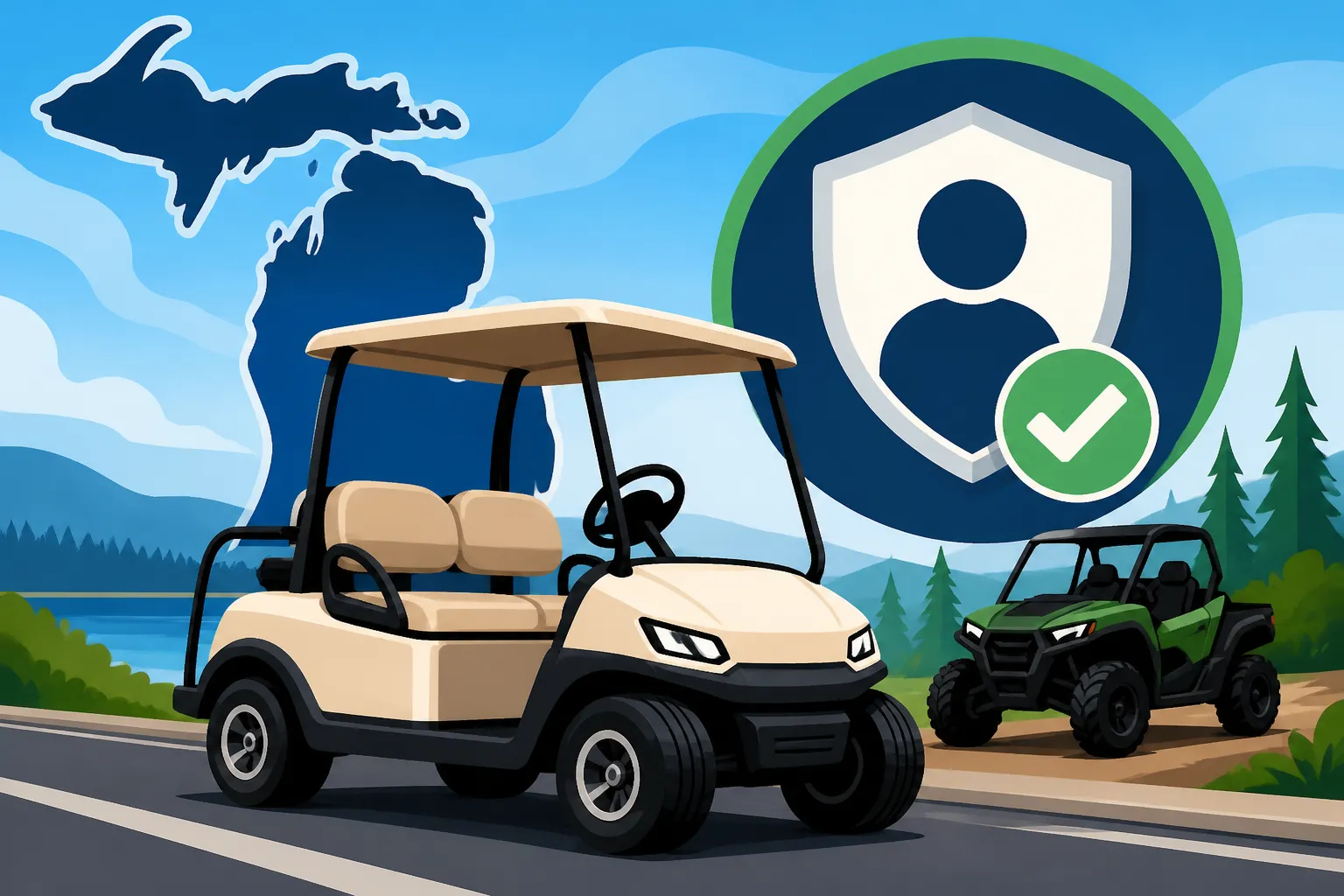
This distinction is absolutely critical when discussing age requirements. A standard golf cart, as you know it, is primarily designed for golf courses or private property. A Low-Speed Vehicle (LSV), on the other hand, is a vehicle that looks very much like a golf cart but has been manufactured or modified to meet specific federal safety standards and Michigan vehicle code requirements.
Here's a quick rundown of the main differences:
| Feature | Standard Golf Cart (Off-Road Use) | Low-Speed Vehicle (LSV) (Street Legal) |
|---|---|---|
| Speed | Typically up to 20 mph | Max 25 mph |
| Primary Use | Golf courses, private property, campgrounds | Public roads with speed limits up to 35 mph |
| Registration | None required | State title, registration, and license plate |
| Driver's License | Not explicitly required (on private land) | Required (valid driver's license) |
| Safety Equipment | Basic (lights, horn optional) | Headlights, taillights, brake lights, turn signals, mirrors, DOT-approved tires, windshield, seatbelts, VIN |
The key takeaway here is that if a golf cart is going to be driven on public streets, it almost certainly needs to meet the more stringent requirements of an LSV, or at the very least, comply with a local ordinance that mandates similar safety equipment. Many owners choose to add accessories from brands like SuperATV to bring their golf carts up to these standards, installing lights, turn signals, and mirrors. However, simply adding these features doesn't automatically make it an LSV; it must also be titled and registered with the Michigan Secretary of State. You can learn more about this in [Michigan Golf Cart and Low-Speed Vehicle Rules].
Age Requirements for Operating Golf Carts on Michigan Streets
Now, let's get to the heart of the matter: who can actually drive these things on public roads? The short answer, in most cases, is that if it's on a public street, the driver needs to be at least 16 years old and hold a valid Michigan driver's license.
A Valid Driver's License as the Key Requirement
For any vehicle operating on a public road in Michigan, whether it's a car, a motorcycle, or a Low-Speed Vehicle, the operator is required to possess a valid driver's license. This is not just a suggestion; it's a fundamental aspect of road safety and legal operation. Since a Michigan driver's license typically isn't issued until a person is 16 years old (after completing graduated licensing requirements), this effectively sets the minimum age for driving an LSV—or any golf cart allowed on public streets—at 16.
This means that even if your local township has a fantastic ordinance allowing golf carts on its streets, it's almost certainly going to include a clause requiring the operator to be a licensed driver. Allowing an unlicensed person, particularly a minor, to drive on public roads opens up a host of legal liabilities and safety concerns. It's a bit like asking if a 12-year-old can drive your car to the corner store just because the store is close by; the answer is a resounding no, because they don't have a license.
Exceptions and Local Variances: A Rare Breed
While the general rule is 16 with a driver's license, some people hold out hope for exceptions. It's important to understand that truly distinct exceptions for underage golf cart operation on public streets are exceedingly rare, if they exist at all.
- Private Property vs. Public Roads: The biggest "exception" is often confused with private property. On your own land, or within a private community that has its own rules (like a private campground or gated residential area), the age requirements are set by the property owner or association, not state or local traffic laws. Here, a 12-year-old might be allowed to drive a golf cart with parental supervision. But the moment those wheels touch a public right-of-way, even an unpaved one, you're under different rules.
- Highly Specific Local Ordinances: Theoretically, a local ordinance could be drafted that allows someone under 16 to operate a golf cart on specific, very low-speed, low-traffic local roads. However, such ordinances would face immense scrutiny regarding safety and liability and are not common. Most municipalities that allow golf carts on streets typically default to requiring a licensed driver to mitigate these risks. If you're hoping for such an exception, you absolutely must verify it directly with your specific city, township, or village clerk and expect it to be an uphill battle.
Always assume that if it's a public road, a licensed driver (16+) is needed. Don't rely on assumptions or anecdotal evidence from other states or private communities.
Passenger Age and Supervision
When it comes to passengers, the rules are usually less strict regarding age, but common sense and local ordinances still apply. If a golf cart is permitted on public roads and being operated by a licensed driver, then generally, passengers are allowed as long as there are enough designated seating positions and all safety equipment (like seatbelts, if required for an LSV) is being used correctly.
For young children, parental supervision is always recommended. Even if a local ordinance doesn't specify a minimum passenger age, ensuring children are mature enough to remain seated and follow instructions is paramount for safety. You wouldn't let a toddler roam free in a moving car, and the same principle applies to golf carts.
What Happens When a Golf Cart Becomes a Low-Speed Vehicle (LSV)?
If you're serious about driving your golf cart on Michigan streets, understanding the LSV classification is key. This is where your golf cart transitions from a recreational machine to a street-legal vehicle, bringing with it specific requirements and, crucially, age restrictions.
LSV Equipment Requirements
For a golf cart to be legally considered an LSV in Michigan, it must meet a specific checklist of equipment requirements. These aren't just suggestions; they are mandates that bring the vehicle up to a standard acceptable for road use. Many golf cart owners turn to aftermarket parts providers, like SuperATV, to acquire the necessary components for this conversion.
Here's what an LSV needs:
- Headlights: Must emit white light visible from 500 feet.
- Taillights: Must emit red light visible from 500 feet.
- Stop Lights (Brake Lights): Must be activated by the brake pedal.
- Turn Signals: Both front and rear.
- Reflex Reflectors: Rear and side reflectors.
- Exterior Mirrors: At least one rearview mirror, and often two (one on each side).
- Windshield: Made of safety glazing.
- Seatbelts: For all designated seating positions.
- Vehicle Identification Number (VIN): Must have a VIN issued by the manufacturer or the state if it's a homemade/rebuilt LSV.
- DOT-Approved Tires: Tires rated for street use.
- Horn: An audible warning device.
Without all of these elements, and meeting their specific standards, your golf cart will not qualify as an LSV, regardless of any modifications you've made. This means it won't be eligible for the titling and registration that allows it on public roads. This process is detailed further in [Registering a Low-Speed Vehicle in Michigan].
Licensing and Registration for LSVs
Once your golf cart meets the LSV equipment requirements, the next step is to get it titled and registered with the Michigan Secretary of State. This is where the age requirement really solidifies.
- Titling and Registration: An LSV, just like a car or motorcycle, needs a Michigan title and annual registration. This process involves proving ownership, providing the VIN, and ensuring all documentation is in order. You'll receive a license plate that must be displayed on the rear of the vehicle.
- Driver's License Requirement: Because an LSV is a registered motor vehicle operating on public roads, the operator must possess a valid Michigan driver's license. There are no special LSV-only licenses, and the standard age requirements for obtaining a driver's license apply. This means the operator must be at least 16 years old and have completed all the steps of Michigan's graduated licensing program. This is a non-negotiable point for LSVs. You won't be able to register it for street use if you don't acknowledge this, and law enforcement will expect it.
This classification means that for all intents and purposes, from a licensing standpoint, driving an LSV is treated much like driving any other motor vehicle on the road. This also extends to other responsibilities like insurance; you'll want to check [Golf Cart Insurance on Public Roads] for more details.
The Practicalities and Risks of Underage Operation
Ignoring the age requirements for golf carts on Michigan streets carries significant risks, not just legally but also in terms of safety and financial liability. It's truly not worth taking the chance.
Enforcement and Penalties
Michigan law enforcement, including local police and sheriff's deputies, are empowered to enforce traffic laws. If an underage or unlicensed individual is found operating a golf cart on public streets where it's either prohibited or requires a licensed driver, the consequences can be swift and costly.
- Tickets and Fines: The operator could receive a citation for operating an unregistered vehicle, operating without a license, or violating a local ordinance. Fines can range from minor to substantial.
- Vehicle Impoundment: In more serious cases, or if repeated violations occur, the golf cart could be impounded, leading to towing and storage fees on top of any fines.
- Parental Responsibility: If the operator is a minor, the parents or guardians could also face legal repercussions, as they are often held responsible for allowing an unlicensed minor to operate a vehicle on public roads.
These aren't just minor inconveniences; they can be serious legal entanglements that no one wants to deal with.
Insurance Implications
This is a huge one that many people overlook. Your homeowner's insurance policy might offer some limited coverage for a golf cart used on your private property, but it's highly unlikely to cover incidents that occur on public roads, especially if the vehicle is being operated illegally (e.g., without proper registration or by an unlicensed driver).
If an accident occurs with an underage driver on a public street:
- Voided Coverage: Your insurance provider could deny any claims, arguing that the vehicle was being operated in violation of state or local laws and therefore fell outside the terms of your policy.
- Personal Liability: This leaves you personally liable for damages, injuries, and medical costs, which can quickly amount to hundreds of thousands of dollars. Imagine hitting another vehicle or, worse, injuring a pedestrian. The financial ramifications could be devastating.
- No-Fault Implications: If your golf cart is classified as an LSV, it falls under Michigan's no-fault insurance laws. However, if it's being operated by an unlicensed driver, that could complicate or invalidate your no-fault coverage.
It's a gamble you simply cannot afford to take. Always ensure proper insurance coverage and adherence to all legal requirements, especially driver licensing, to protect yourself and others.
Safety Concerns
Beyond the legal and financial risks, there are very real safety concerns that drive these age requirements. Golf carts, even when modified with accessories from SuperATV, are not cars. They have a lower center of gravity, slower speeds, and often lack the robust safety features of a traditional automobile.
- Limited Protection: In a collision with a full-sized vehicle, golf cart occupants have minimal protection.
- Visibility: Their smaller size can make them less visible to other drivers, especially in traffic.
- Driver Inexperience: Inexperienced or underage drivers may lack the judgment, reaction time, and understanding of traffic laws necessary to safely navigate public roads. They might struggle with judging distances, reacting to unexpected hazards, or even properly signaling turns.
Prioritizing safety means ensuring that anyone operating a golf cart on public streets is mature, licensed, and fully aware of the responsibilities that come with driving. For specific rules about who can drive what and where, you might also find [Michigan Driver's License Rules for ORV Road Riding] helpful, as the principles often overlap.
In Michigan, if you're planning to take your golf cart onto public streets, the overwhelming likelihood is that the operator will need to be at least 16 years old and hold a valid driver's license. Always check local ordinances, clarify the LSV distinction, and prioritize safety and legal compliance above all else.
Disclaimer
This article is for general informational purposes only and does not constitute professional advice. Laws, prices and regulations vary by location and change over time. Consult a qualified professional for guidance on your specific situation.